
Minor GTA 6 gameplay spoilers follow.
Grand Theft Auto has always invited players to test the limits of a city simulation. Take a car, start a fight, fire a weapon in a crowded street: the usual expectation is that nearby pedestrians will react, flee, call attention to the chaos, or occasionally fight back. Recent GTA 6 clips circulating online suggest that in Leonida, that last possibility can become the entire event.
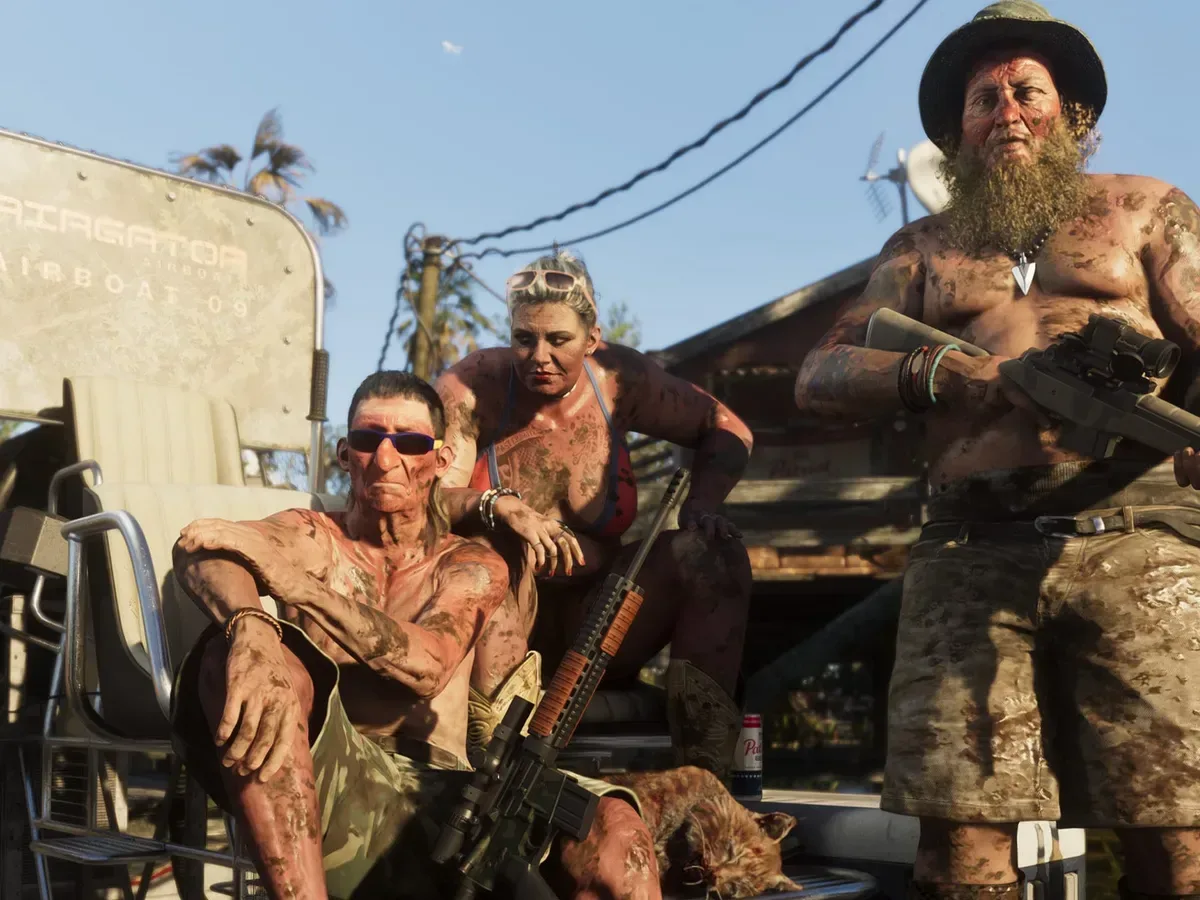
Players have shared encounters in which apparently ordinary non-player characters, or NPCs, refuse to surrender a vehicle, withstand a surprising amount of damage, give chase after being shot, or react in ways that turn a routine crime into a small improvised disaster. The clips are funny because they subvert the player’s usual power fantasy. They are also interesting because their unpredictability is what makes an open-world setting feel less like a theme park full of disposable extras.
The sensible lesson is not especially complicated: if an NPC is acting unusually determined, it may be wiser to find another car.
A carjacking that escalated immediately
One widely shared video shows Lucia trying to take a vehicle from its driver. Rather than passively being pulled from the seat, the driver squares up for a fight. The encounter reportedly includes the NPC absorbing repeated punches, retaliating against Lucia, using a powder, and continuing to resist even after a headshot.
That sequence is deliberately outrageous in the way only emergent open-world chaos can be. A carjacking is normally a quick transaction in games: remove driver, enter vehicle, leave before the consequences arrive. Here, the vehicle owner becomes the consequence. The comedy comes from the abrupt reversal of roles. Lucia initiates the confrontation, but the NPC’s tenacity turns her from aggressor into someone who may need an exit plan.
It is worth separating what a striking clip shows from what it proves about the wider game. A single unusually durable character does not establish that every Leonida resident has the same toughness or behavior. It does, however, demonstrate why individual encounters can be memorable when pedestrians are not all restricted to one predictable response. The player cannot reliably judge a character’s reaction merely by looking at them or by assuming the standard rules will apply.
Jason finds the wrong driver on the wrong day
Another video centers on Jason attempting a similar hijacking. The occupant first appears to have a dramatic meltdown inside the vehicle, headbutting the steering wheel and triggering the horn with each impact. After getting out, she threatens Jason, and then attempts to pull him back out after he enters the car and drives away.
Related coverage includes GTA 6 Players Find NPCs Who Refuse to Go Down Without a Fight.
Whether the scene is best read as hostile behavior, an exaggerated panic response, or simply the game’s simulation colliding with a bizarre animation sequence, the practical implication is the same: an NPC may remain engaged after the player has taken the driver’s seat. Getting into a vehicle is not necessarily the clean break that a player expects.
That distinction matters in an open-world crime game. A hijacking is not just a button prompt; it is an interaction with a character, a vehicle and the surrounding world state. If the former driver remains aggressive, the player’s escape can become more difficult before police attention, traffic or other hazards even enter the picture. In the clip, the attempted theft does not end when Jason claims the car. It simply shifts into a new phase.
When damage does not end the encounter
The most unsettling footage involves an NPC targeted from a tower with a sniper rifle. The player fires into the character’s chest. Instead of collapsing, the target starts moving toward the tower. Further shots appear to land; the character is reportedly struck by a vehicle as well. Yet the pursuit continues, with the NPC eventually running while still carrying drinks.
A separate clip shows another NPC notice that a sniper is aiming, make a throat-cutting gesture, endure gunfire and sprint toward the player. The pursuit ends with the character apparently teleporting behind the player before attacking.
These moments should be treated carefully. Shared gameplay videos are snapshots, not technical documentation. They cannot by themselves explain whether the characters’ endurance is an intentional attribute, a temporary state, an animation or targeting oddity, or a bug. The reported teleport is particularly difficult to interpret without a broader view of the scene and game systems.
Still, the clips illustrate an important design effect. A pursuit state is the period in which an NPC remains focused on and moves toward a player following a confrontation. When that state persists longer than expected, the player’s assumptions change. Range, weapon choice and a clear line of sight may no longer feel like guarantees of safety. The encounter becomes less about executing an action and more about deciding whether to keep escalating it.
That uncertainty is powerful even when it is funny. The player on the tower begins in a position of obvious advantage. Watching the target keep advancing converts a controlled test of aim into a threat. The joke is that the ordinary pedestrian has suddenly been recast as something much closer to a slasher-movie pursuer—still clutching refreshments.
The getaway car has a passenger
People are not the only potential complication. In another clip, a player steals a vehicle and believes the escape is secure, only to hear movement from the back seat. The owner’s cat is still inside the car and attacks, startling the player and using claws and teeth.
This is a small anecdote, but it gets at why incidental details can matter so much in a game built around vehicles. The car is typically treated as an object: transportation, cover, a getaway tool, or something to replace when it is damaged. An animal left inside changes that framing. Suddenly the vehicle has a tiny, immediate connection to the person it was taken from, and it carries a cost the player did not account for.
There is no basis in these clips to assume every stolen car can contain an angry cat. The useful takeaway is narrower. GTA 6 appears capable of producing situations where a player’s action has an unexpected wrinkle after the apparent objective has been completed. Those moments are ideal material for short clips because they need little setup: steal car, hear noise, regret car theft.
Why unpredictable NPCs matter
NPC stands for non-player character, a character controlled by the game rather than another human player. In a large city game, NPC behavior carries a significant share of the illusion that the world is active. Pedestrians do not need to be individually complex to contribute to that illusion. They need to react in ways that make sense often enough—and surprise the player occasionally enough—that streets do not feel like sets populated by interchangeable mannequins.
The clips from Leonida point toward a useful form of unpredictability: not randomness for its own sake, but behavior that complicates an otherwise familiar player action. A driver who gets angry, a wounded target who retaliates, or an animal remaining in a stolen vehicle all disrupt an efficient routine. The player must pay attention instead of operating entirely on habit.
There is a balance to strike. If every NPC could shrug off extreme damage or instantly reappear behind the player, the novelty would wear thin and the systems could feel inconsistent in a frustrating way. If these are comparatively rare occurrences, however, they can create precisely the stories players want to tell: the stranger who would not surrender a car, the impossible runner who would not stop coming, the pet that ruined a getaway.
That is also why footage of eccentric NPC reactions travels so quickly. Mission outcomes are often shared by many players. A spontaneous confrontation with a singularly furious driver is personal, chaotic and easy to understand even without narrative context.
What players can take from the clips
None of this calls for a universal strategy beyond situational awareness. The available footage does support a few modest practical principles:
- Do not assume a driver will give up quietly. A vehicle theft can become a fight before the player gets moving.
- Watch for continued aggression after entering a car. An NPC may still try to intervene rather than returning to a neutral routine.
- Leave room for the strange. A seemingly completed escape may still contain an unforeseen problem, including a feline one.
- Interpret exceptional clips as exceptional. Viral moments show what can happen, not necessarily what will happen in every encounter.
- Capture settings matter when chaos is shareable. Players on Xbox who would prefer not to have gameplay clips shared automatically can consult this guide on turning off GTA 6 auto uploads.
The broader appeal is not that GTA 6 NPCs are merely difficult. It is that their reactions, at least in these reported examples, can derail a player’s plan in a way that feels distinct from a scripted mission failure. Leonida’s most intimidating residents may not announce themselves with a marker or a warning. Sometimes they are simply the person sitting in the car you decided to steal.