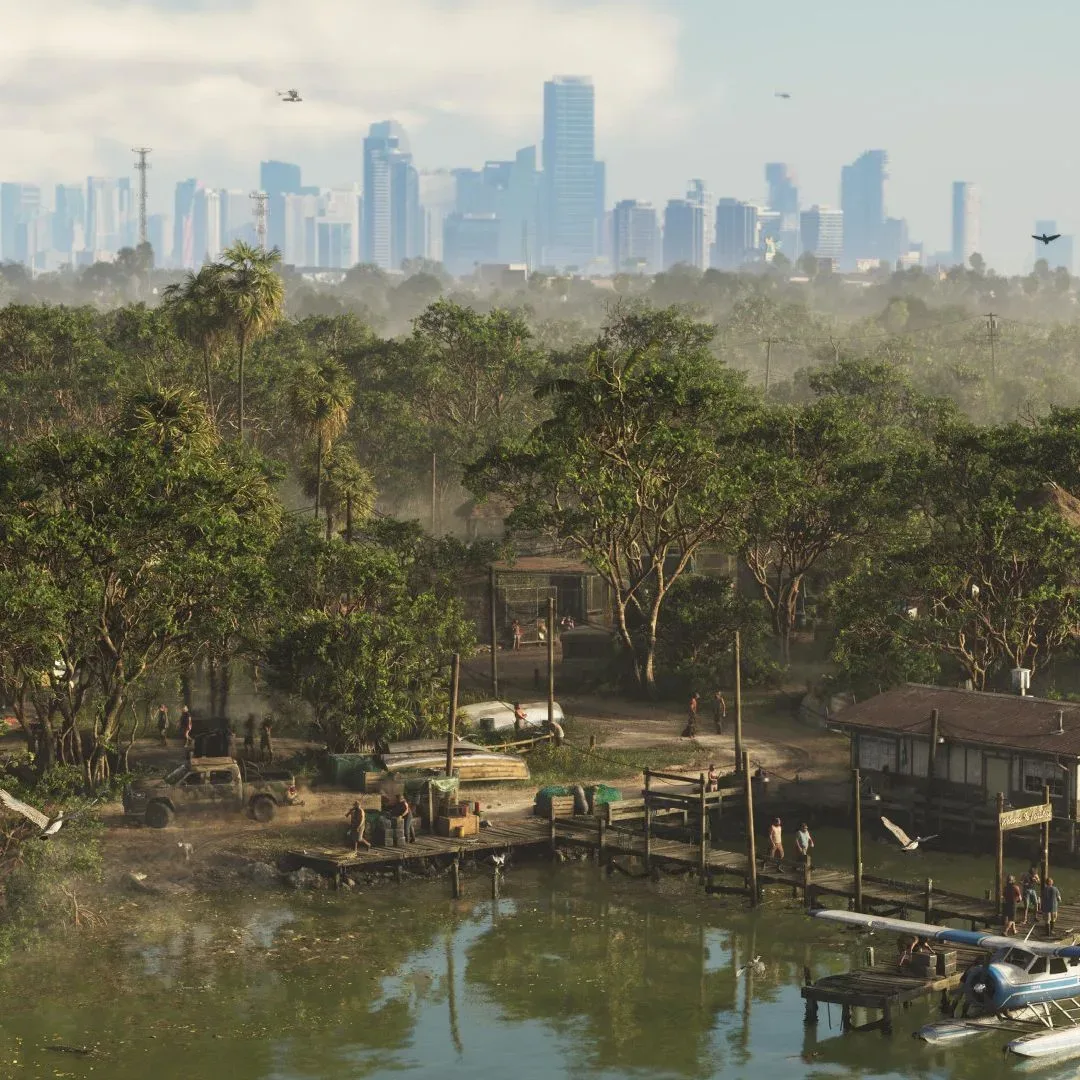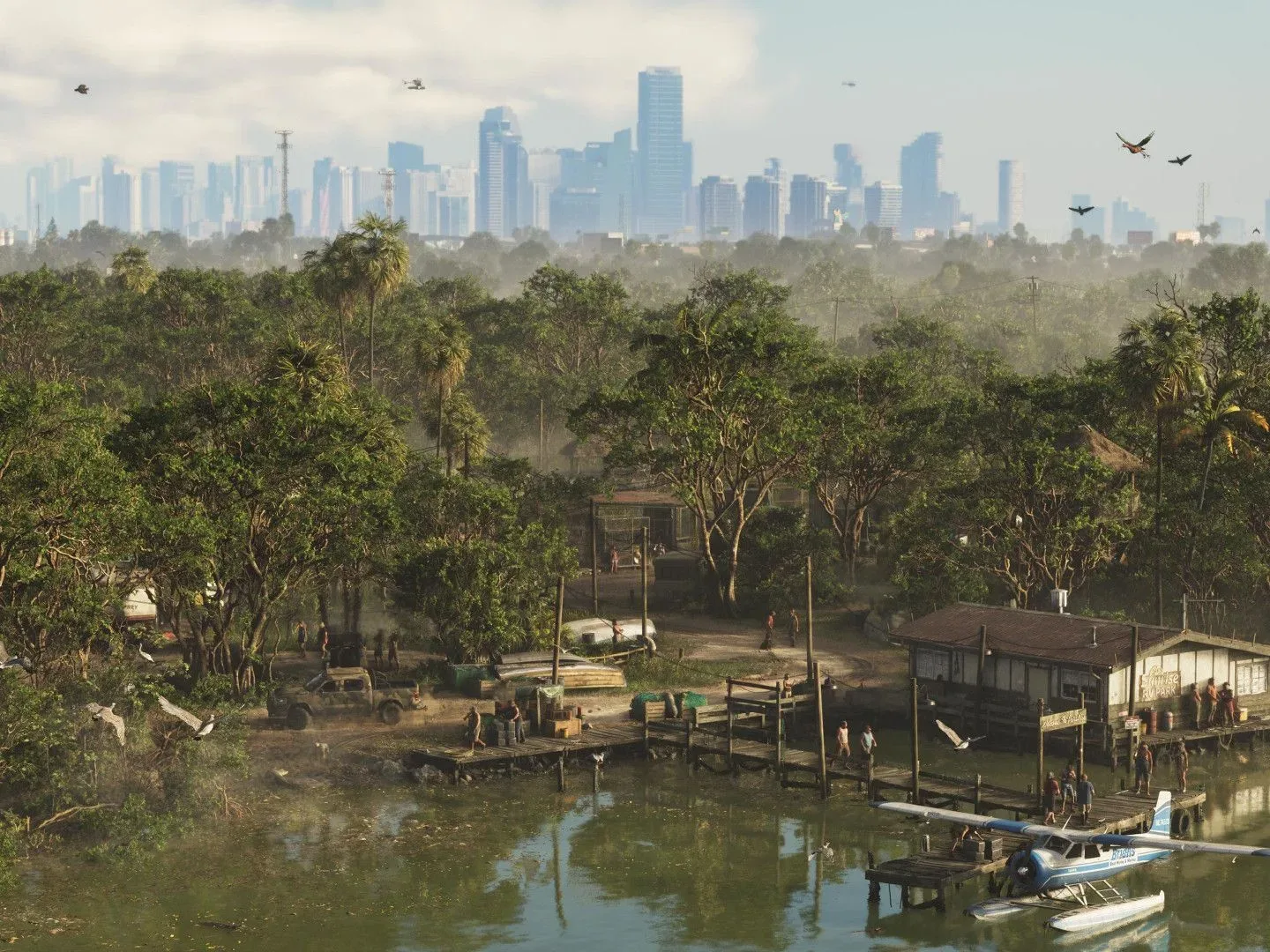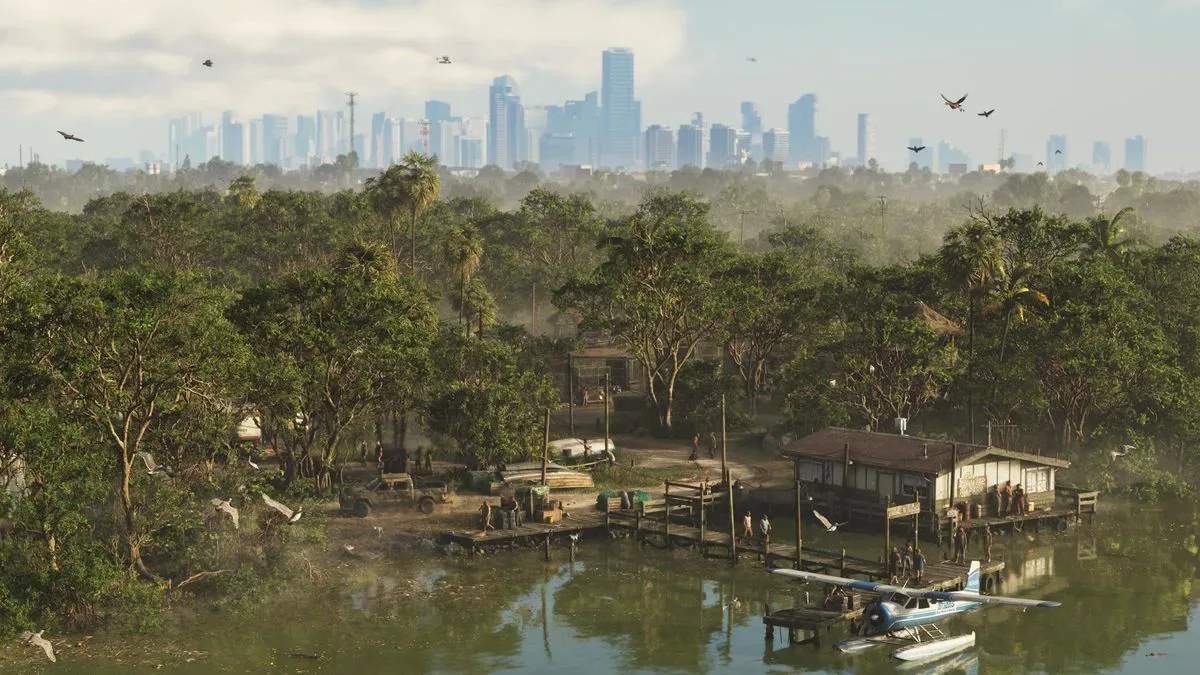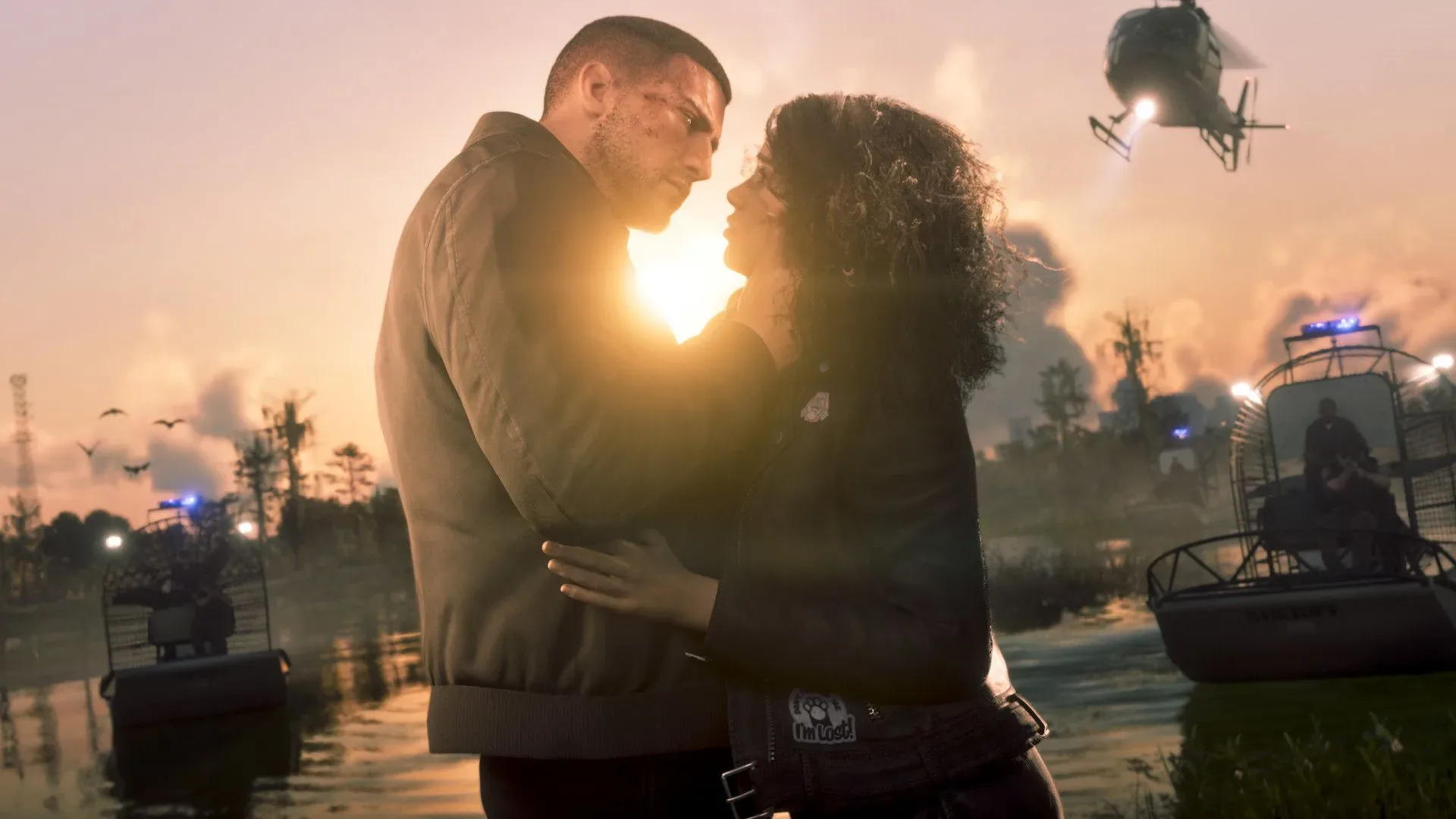
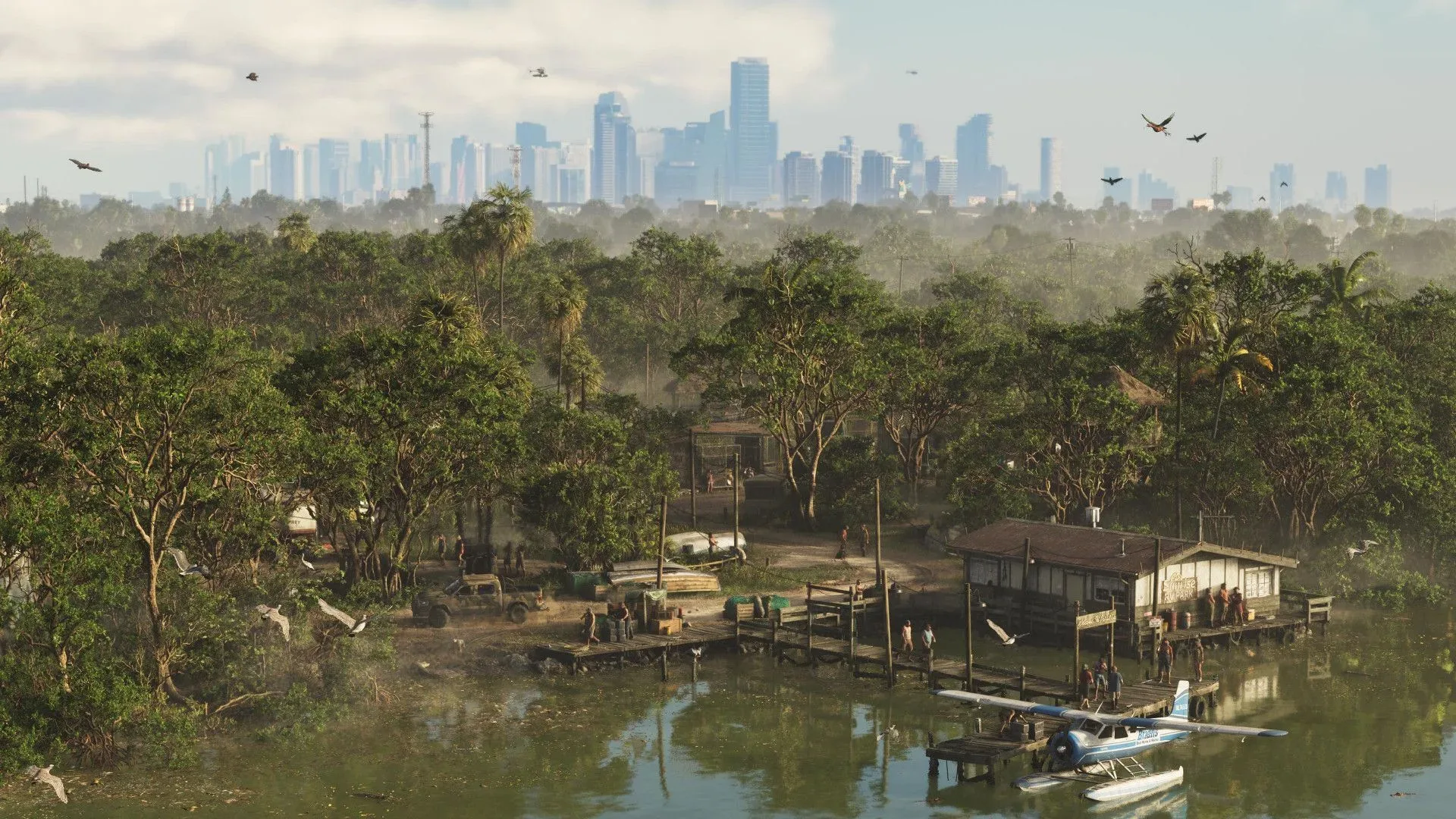
Grand Theft Auto 6 is being positioned around an unusually direct design challenge: can players resist treating an enormous open world like a spreadsheet with better lighting?
In development notes supplied to press, Rockstar vice president of design Stephen Donkin said the studio hopes players exploring the state of Leonida will eventually “stop thinking in tasks, completion percentages, online guides” and instead allow the game to reveal itself naturally. It is a simple request on paper. In practice, it pushes against years of habits built by open-world games, achievement lists, map markers, collectible trackers and the perfectly reasonable fear of missing something permanently useful.
Donkin’s comments do not confirm a particular GTA 6 feature, progression system, reward structure or approach to completion. They do, however, state a creative intention: Leonida is meant to reward unhurried attention and player-led discovery rather than a rigid route through an exhaustive to-do list.
Leonida is intended to unfold, not merely be cleared
“There is so much to do in Leonida,” Donkin said, adding that there is also much to discover. The distinction matters. Doing something in an open-world game can mean accepting a formal mission, checking off an activity or collecting an item. Discovering something suggests the player has encountered it through movement, observation, curiosity or an unexpected chain of events.
Donkin described an experience that can feel “almost infinite at a macro level,” while keeping individual encounters “hand-crafted and with a human behind it.” That is an ambitious balance. At a macro level means the broad, overall impression of a game world: its apparent scale, number of possible directions and density of things that may happen. A hand-crafted encounter, by contrast, is one designed with specific detail and purpose rather than feeling interchangeable or automatically assembled.
The ideal, then, is not simply a bigger map packed with more icons. It is a world in which the size supports possibility, but local moments retain personality. A player might not see every encounter, or see them in the same order as another player, yet each one should feel authored rather than disposable.
That kind of structure can make a large world feel less like a department store aisle of activities. It also depends on confidence from both sides. The developer has to make wandering worthwhile. The player has to tolerate uncertainty, including the possibility that a detour will not immediately produce a weapon upgrade, a percentage point or a notification declaring that exploration was officially productive.
What “follow your nose” means in game-design terms
Donkin encouraged players to “follow their nose” and play at the pace the game asks of them. That phrase is less a command to ignore missions than a description of self-directed play: choosing a direction because a location, character, sightline or situation seems interesting, rather than because a menu has ranked it as the next optimal step.
Related coverage includes GTA 6 Design Lead Wants Players to Leave Checklists Behind in Leonida.
Self-directed play differs from an entirely unguided game. A world can still have a story, objectives and designed encounters while giving players room to decide when and how intensely to pursue them. The important question is whether the game makes its surrounding spaces feel valuable beyond their utility as corridors to the next objective.
For GTA 6, Donkin’s wording indicates that immersion is the intended payoff. Immersion is often used loosely, but here it means accepting the fictional world’s rhythms long enough for the player’s attention to be led by its places and situations, not just its interface. A map can be useful without becoming the main character. A mission can be compelling without making every unscheduled minute feel like wasted time.
The tension is obvious: many players enjoy structured tracking, and guides can be especially helpful for accessibility, limited free time, difficult challenges or a desire to finish a game thoroughly. Donkin did not say guides or completion-minded play are forbidden. His comment is better understood as a stated aspiration for a first pass through Leonida: let the world create some surprises before turning it into a solved set of instructions.
Why the checklist instinct is so hard to switch off
Completion percentages are satisfying because they turn a vague, sprawling game into a legible goal. They answer a question that a huge open world otherwise leaves dangling: what remains? Icons, lists and collectible totals offer certainty. They can also help players decide what to do after a long break, or provide a clean endpoint after the main story.
But completion systems can reshape player behavior. Once the interface identifies every activity as a unit in a total, a dramatic landscape may become a route between markers. Optional content may be judged only by how efficiently it advances the number. Players can feel pressure to optimize even when there is no actual deadline.
That does not make completionism a bad way to play. It is a legitimate form of enjoyment, particularly for people who like mastering a game’s full design. The concern behind Donkin’s comments is narrower: if every corner of Leonida is approached primarily as an obligation, some of the world’s intended texture could be missed.
Grand Theft Auto has its own history with this friction. Earlier entries asked players to take on collectibles and minigames to reach full completion, while smaller games such as Vice City Stories and Liberty City Stories included hunts for red balloons and stray pigeons. Those pursuits can give an open world long-term goals, but they can become laborious near the finish line when a player is searching for one remaining item rather than engaging with the world on its own terms.
Donkin’s statement suggests that GTA 6 wants to avoid letting that final-mile mentality define its broader identity. It is not proof that the game contains no collectibles, no completion measures or no structured activities. Nothing in the comments supports that conclusion. It is evidence that Rockstar wants the experience of being in Leonida to take priority over the impulse to clear Leonida.
A different open-world promise
Open-world games often sell freedom in two competing forms. One is catalog freedom: an expansive menu of missions, activities and rewards, all visible and selectable. The other is situational freedom: the sense that interesting things can emerge from paying attention, experimenting or taking an unplanned route. Most games mix both. The balance determines whether a world feels like a curated itinerary or a place worth inhabiting.
Donkin’s emphasis lands firmly on the latter. He says players who “let go” and immerse themselves in Leonida can experience the version of the setting he has experienced. That is a notably personal description of a design objective. The goal is not merely for players to see all the content; it is for the world’s pace and accumulated encounters to create a particular feeling.
There is a practical implication for players who want to test that approach without treating it as a purity challenge:
- Use formal objectives when they sound appealing, not only because they are nearest or most efficient.
- Allow time for detours prompted by something seen in the world rather than something highlighted in a menu.
- Leave guides for moments when help improves enjoyment, rather than consulting them before every unknown is allowed to remain unknown.
- Do not mistake a missing percentage point for evidence that a session accomplished nothing.
These are not rules, and they will not suit every player. They are simply the behavior Donkin’s description appears to invite. For someone who has a short window to play, a route, guide or checklist can be the best way to make that time count. For someone able to move more slowly, withholding that optimization may preserve the surprise Rockstar says it is pursuing.
Hand-crafted encounters are the crucial claim
The most consequential part of Donkin’s comments may be his pairing of immense scale with individual encounters that feel handmade. Scale alone is no guarantee of discovery. A vast world can still feel thin if many activities resemble each other too closely, or if the player learns that every distraction resolves into the same reward loop.
Hand-crafted, in this context, means designed with discernible human intention: a distinct situation, a memorable setup, meaningful staging or details that make it feel unlike the last several stops. Donkin’s phrasing does not tell players how many such encounters GTA 6 will have or how they will be triggered. It does establish the standard Rockstar says it is aiming for.
That standard is also why online guides occupy such an awkward place in the conversation. Guides are useful records of game knowledge, but reading them in advance can turn an encounter into a destination. The player arrives already knowing what matters, where to stand and what result to expect. Discovery becomes execution.
Again, that is not an argument against guides. It is an argument for timing. A guide can rescue a stalled player, explain a confusing system or support a focused cleanup session. It is less compatible with the first-time curiosity Donkin is describing. Players looking for a specific GTA 6 task can still use resources such as this GTA 6 jet guide; Donkin’s point is that the game may be most effective when every outing does not begin with a destination already chosen.
What to watch for once players can explore Leonida
Donkin has set an expectation, not supplied a checklist of systems. The eventual question will be whether GTA 6 supports his vision through its actual design. Are players naturally drawn toward unscripted-looking points of interest? Do activities have enough variation to reward curiosity? Does the interface make room for noticing the world, or does it constantly redirect attention toward optimization? Can narrative urgency coexist with the invitation to take one’s time?
Those questions cannot be answered from development notes alone. Nor should a stated ambition be confused with proof that every player will experience Leonida in the same way. Open worlds are personal machines: one player sees a relaxing evening of exploration, another sees missed opportunities, and a third sees a remarkably efficient loop of errands.
Still, the direction is clear. Rockstar’s design leadership wants Leonida to be approached as more than a map to exhaust. The proposed reward is not merely higher completion, but the gradual sensation that the world has more character and possibility than any route planner can capture. For a series closely associated with large-scale urban sandboxes, that may be the most meaningful benchmark GTA 6 is chasing: not just a place players can finish, but a place they feel they have spent time in.