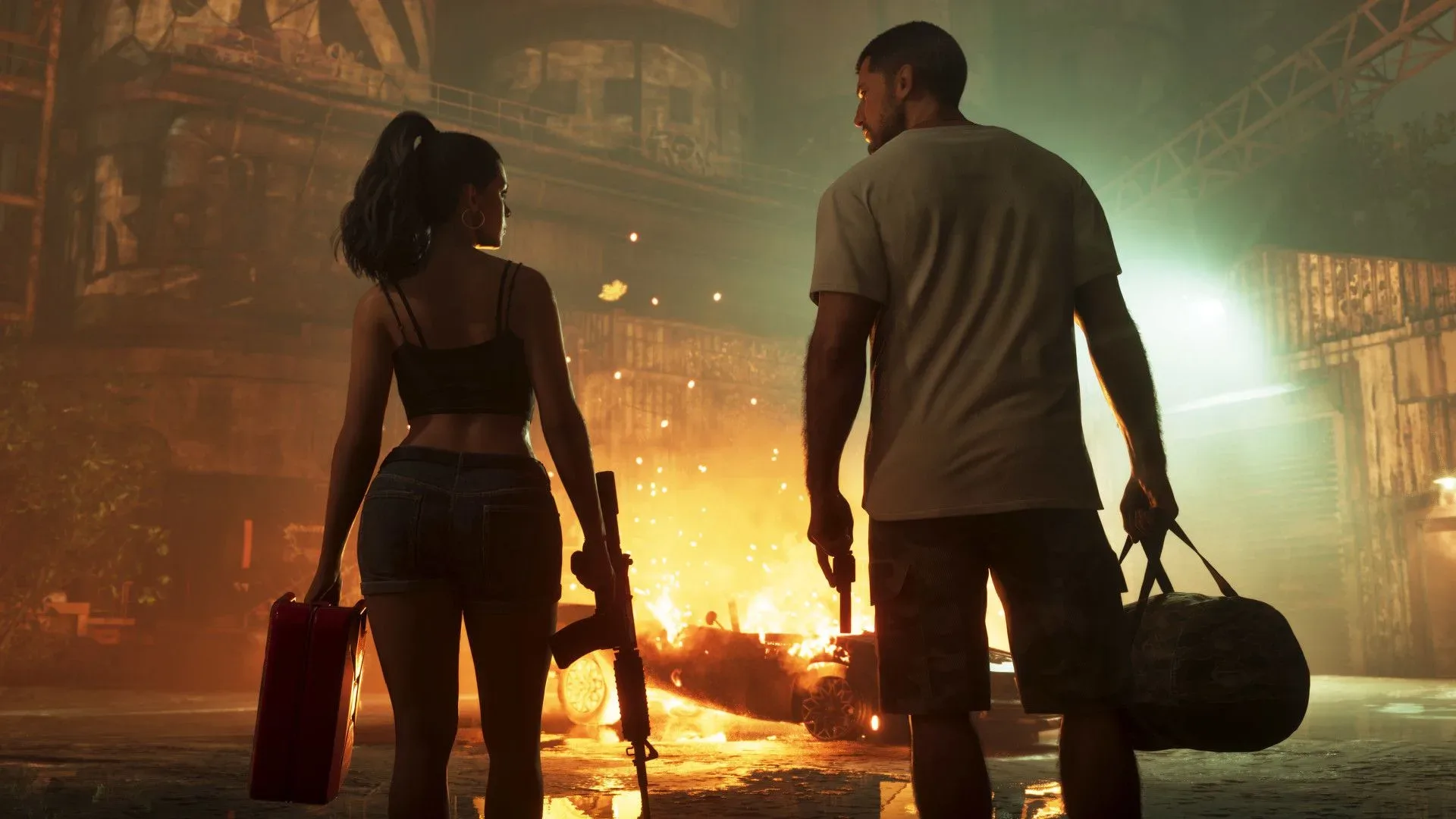
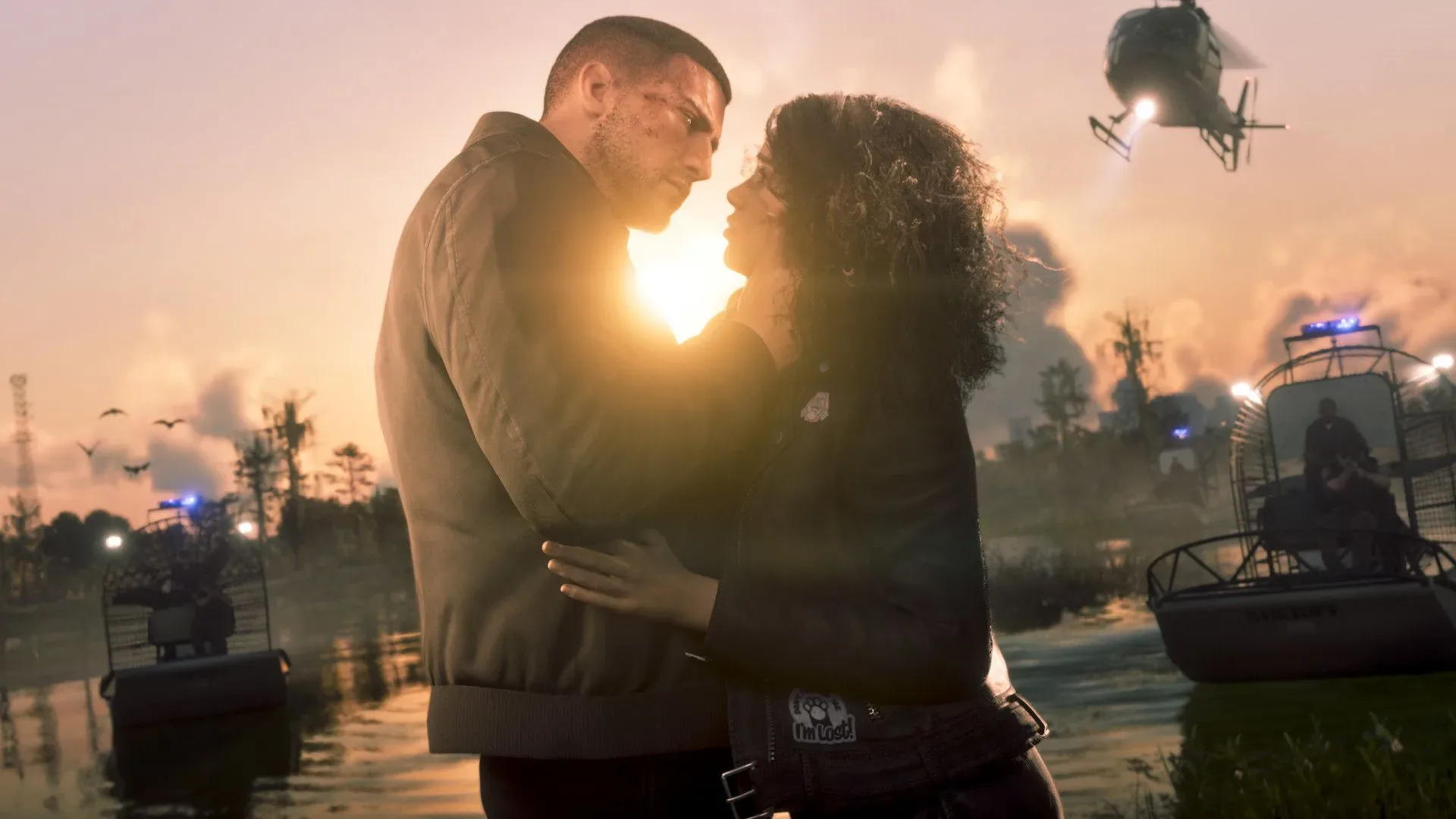
Grand Theft Auto 6’s enormous fictional state of Leonida is being positioned as more than a big map. Rockstar vice president of art and environment Adam Cochrane says its impact comes from a density of deliberately authored details: wind moving through trees and bunting, neglected gardens outside empty properties, residue beside dumpsters, and individual homes and businesses made to avoid a repeated, copy-and-paste feel.
Most notably, Cochrane describes that work as “curated, considered, and created by a human hand.” The comment arrives as the wider game business faces difficult questions around escalating production demands, visual fidelity, and the use of generative AI systems in creative workflows.
“The life is in the detail,” Cochrane says of the open world.
GTA 6 is due to arrive on November 19, 2026. Its protagonists are Jason and Lucia, but the stated ambition for Leonida appears to be a setting that continues to suggest stories beyond the player’s immediate goals. That distinction matters. A world can be technically huge and still feel like a collection of mission spaces. Rockstar’s art leadership is instead emphasizing environmental specificity: the idea that a player should form an impression of who occupies a building, who has left it behind, or what has happened in an overlooked corner, even when the game never stops to explain it.
Small environmental signals, large-world purpose
Cochrane’s examples are unusually mundane, and that is the point. Swaying foliage, a weathered yard, or mess gathered near a dumpster are not typically the details players seek out in trailers. They are environmental cues. In game-design terms, an environmental cue is visual information that helps a place communicate character, condition, ownership, history, or use without a line of dialogue.
An overgrown garden, for example, can imply absence or neglect. Personalized interiors and storefronts can make locations feel occupied by distinct people rather than assembled from a short list of interchangeable assets. “Assets” is a development term for the discrete pieces used to make a game world, such as a prop, texture, building component, sound, or character model. Reusing assets is a normal and necessary part of building a large game. The creative challenge is making reuse less obvious through placement, dressing, variation, and context.
That is the quality Cochrane is highlighting when he talks about each home and business feeling unique rather than repetitive. It is not simply a claim that Leonida contains lots of objects. It is a claim about selection and arrangement. A discarded item, plant growth, signage, furniture, or the state of a property can become part of an authored visual sentence.
Players may not consciously catalogue every one of those sentences. But the cumulative effect can matter more than any single prop. When a world consistently appears to have been observed and arranged rather than merely populated, moving through it can feel less like traversing a game board and more like visiting a place with its own internal texture.
Related coverage includes Rockstar Art Lead Says GTA 6's Leonida Was Built 'by a Human Hand'.
Exploration is not limited to tangible rewards
Rockstar’s art lead also points to “vignettes and storytelling” placed around the world for players to find. A vignette is a small, self-contained scene: a moment, arrangement, or bit of activity that communicates an idea without necessarily becoming a formal mission. In an open-world game, these scenes can encourage curiosity because they provide a reason to look beyond the next objective marker.
Cochrane says some areas offer in-game rewards, while others are rewarding because of the care evident in their creation. That makes an important distinction between mechanical reward and experiential reward. The first is something recognized by the game’s systems, such as an item or other benefit. The second is the player discovering a striking scene, a piece of implied history, or a detail that makes the wider setting more believable.
Neither category cancels out the other. Tangible rewards can direct players toward places they might otherwise miss, while non-mechanical discoveries can keep exploration from becoming a checklist. If every interesting location must pay out in a measurable way, the act of wandering can start to feel transactional. If nothing ever has practical value, some players may feel that the game is wasting their time. The stated approach suggests Leonida will use both forms of payoff.
That sense of player-directed discovery also fits the broader direction outlined for GTA 6’s mission design. Rockstar has previously discussed the greater difficulty of building GTA 6’s more open missions, a useful counterpart to the environmental-art comments. Open missions concern choice in how a player approaches an objective; authored environmental detail concerns what a player notices between objectives. Together, they point to a game that wants the surrounding world to support agency rather than simply frame it.
What “human hand” does and does not establish
Cochrane’s wording is a broad creative statement about Leonida’s construction. It should not be stretched into claims that have not been made. The remarks do not provide a complete production breakdown, identify every tool used in development, or set out a company-wide policy on AI. They do, however, clearly frame the world’s particularity as the result of human curation and human creative labor.
That framing has real significance in the current debate. Generative AI refers to systems that generate new output—such as text, images, audio, or other material—from patterns learned during training. Discussions of its use in games often focus on whether it can reduce the burden of producing larger and more detailed worlds. But a production shortcut and a convincing environment are not automatically the same thing.
The details Cochrane lists are connected by judgment: what should look neglected, where decoration belongs, which properties need distinguishing traits, and which small scenes are worth placing where players may or may not ever see them. Those decisions involve consistency, tone, pacing, visual storytelling, and restraint. A world can contain immense volume yet still feel anonymous if its details do not add up to a coherent sense of place.
In that respect, “human hand” is less a slogan about raw workload than a description of authorship. Curation means deciding what is included and excluded. Consideration means shaping elements toward a purpose. Creation means producing the result. Cochrane’s argument is that players can perceive that authorship once they step back from a single alleyway, building, or patch of roadside and recognize the same attentiveness across a vast landscape.
The fidelity trade-off remains part of the conversation
GTA 6’s scale and visual density also sit within a familiar technical tension: fidelity versus performance. Fidelity generally means the degree of visual and simulation detail a game aims to represent. Performance concerns how smoothly and consistently it runs, commonly discussed through frame rate, responsiveness, and stability.
Before release, there has been debate over whether a less demanding visual target might have enabled performance improvements. Cochrane’s comments explain why Rockstar views the environmental side of that trade-off as central rather than ornamental. The subtle animation, individualized dressing, and widespread storytelling details are intended to serve immersion—the feeling that the game space has convincing life beyond the player’s direct interaction with it.
That does not settle every player’s preference. Some will prioritize higher performance, while others will value the texture and specificity of the world. But it clarifies the design case for the detail Rockstar is pursuing: it is not merely decoration layered on top of missions, vehicles, and crime-story drama. It is part of the intended identity of Leonida.
For players, the practical implication is simple: GTA 6 may reward a slower pace at times. Looking into a side street, circling a block, or visiting a place without an explicit objective could reveal either a concrete in-game benefit or a small authored moment that gives the world more character. The game’s major activities will inevitably draw attention, but Cochrane’s description suggests that much of Leonida’s value is expected to live in the spaces between them.
A scale claim built on density, not map size alone
Open-world games are often reduced to square mileage or travel time, but those numbers cannot fully describe the experience of a setting. The more meaningful measure may be density of intention: how often a player encounters something that appears specifically placed, considered, or shaped for that location.
Cochrane’s comments make that the central promise for GTA 6. He says the striking realization comes when players recognize that the close-up details they have been finding are present across the broader landscape. It is a claim about consistency at scale, not merely the presence of a handful of showcase areas.
Whether that promise lands for every player will depend on how naturally those details hold together during ordinary play. Still, the creative philosophy is clear. Leonida is being presented as a world where environmental art is not background noise, and where the smallest signs of life, mess, absence, and individuality are meant to carry as much weight as the skyline.