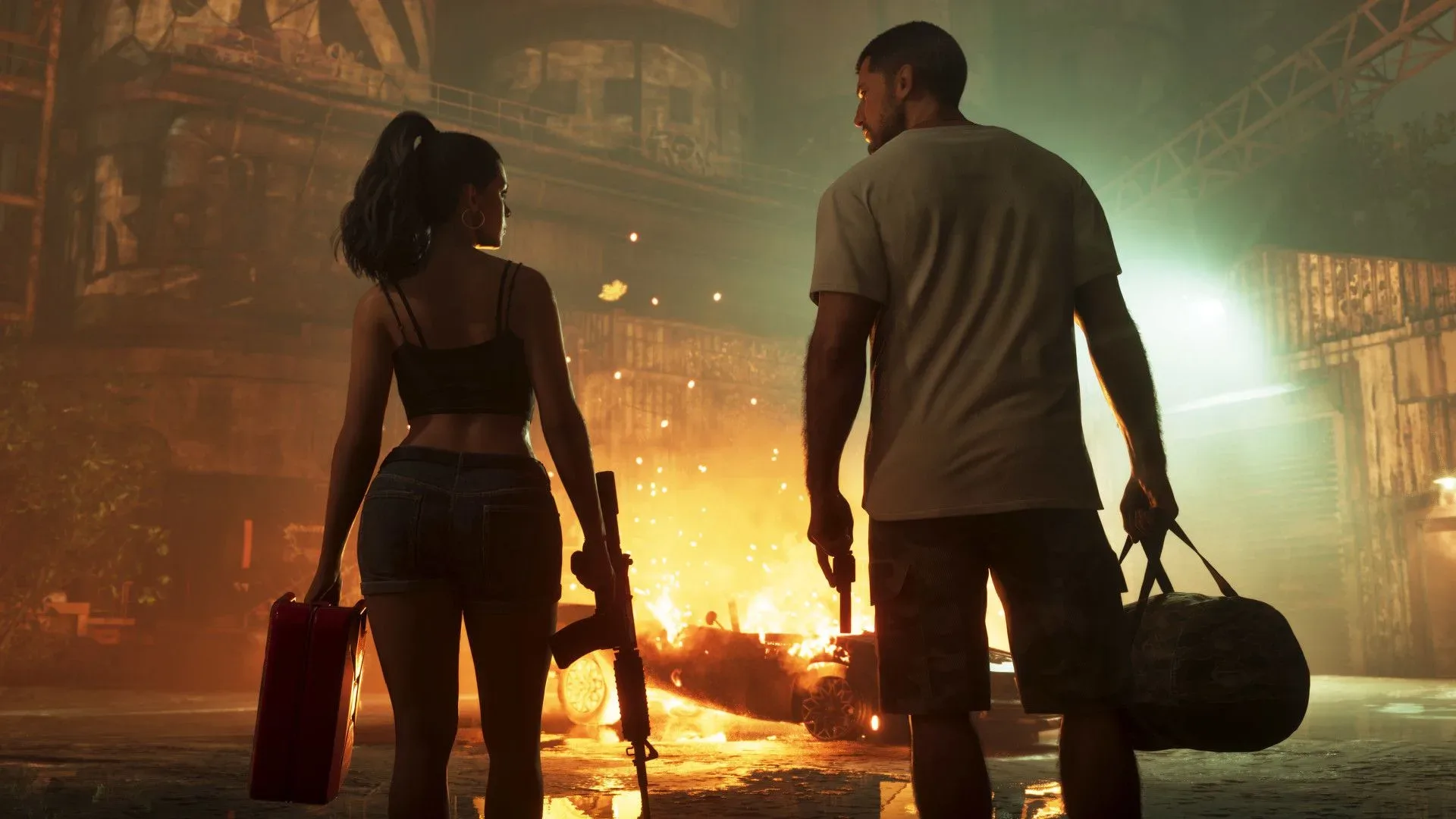
Grand Theft Auto VI is taking a more permissive approach to missions, with Rockstar Games leaders describing an effort to make the boundary between scripted objectives and open-world play less rigid. The stated goal was not simply to make missions bigger, but to let players use more of the game’s ordinary tools and systems while completing them.
David Hynd, Rockstar’s vice president of technology, said the studio pursued a more open-ended design philosophy across the project. That included reducing mission failures triggered when a player experiments, improvises or follows an approach that differs from the most obvious route.
“It’s a lot harder to keep Missions as open as possible (especially in a game as large as this), but the freedom and flexibility it allows the player was worth it,” Hynd said.
The remark identifies a familiar tension in open-world game design. A story mission needs to deliver particular events, characters, locations and dramatic pacing. An open world, meanwhile, gives players vehicles, pedestrians, police responses, weapons, navigation options and assorted emergent systems that are difficult to predict. Combining those two goals means the mission cannot only work when a player stands in one marked spot, uses one vehicle and follows one exact sequence.
What Rockstar means by more open missions
Open-ended mission design does not necessarily mean every objective has unlimited solutions or that the central campaign abandons structure. Rockstar’s core missions remain more directed than the game’s general free-roaming activities. The difference is in how strictly the game enforces the route to an objective.
A tightly scripted mission may effectively demand that a player stay close to a companion, enter a precise area, protect a particular vehicle, avoid leaving an invisible boundary or use a prescribed method. Departing from that expected sequence can bring up a Mission Failed screen even if the player is trying to solve the problem in a reasonable way.
In the approach outlined for GTA 6, the instruction may be closer to a broad outcome—complete a task or escape an area—while granting more latitude in the method. That leaves room for a player’s preferred style, whether it involves driving, evasion, confrontation, positioning or another mechanic available in the wider game. The important caveat is that flexibility is contextual: some story beats and objective conditions will still need limits in order to function.
Stephen Donkin, Rockstar’s vice president of design, said the team worked to blur the separation between being “on-mission” and “off-mission,” as well as the separation between different kinds of mission. That is a useful way to frame the change. Rather than treating missions as isolated sequences where the open world temporarily stops applying, the game is intended to bring more of the world’s normal behavior into authored content.
Related coverage includes GTA 6's Open Missions Required More Work, Rockstar Technology Lead Says.
Why fewer Mission Fails matter
A Mission Failed message is not inherently bad. Failure can clearly communicate that an objective has been lost, a protected character is no longer safe or a critical condition has been broken. It can establish stakes and make a challenge readable. The problem comes when failure feels less like the result of a bad decision and more like punishment for a plausible one.
For an open-world crime game, players naturally expect to test the systems around them. They may take an unfamiliar road, create an unintended distraction, bring a different vehicle, start trouble with law enforcement, or use the environment in a way the mission designer did not foreground. If the game repeatedly stops the action for those attempts, it teaches players that the apparent sandbox has been switched off whenever a mission begins.
Hynd said Rockstar wanted to encourage players to do what feels right for their own play style. Practically, that should make missions more welcoming to both players who follow directions carefully and those who want to push at the edges of an objective. It can also make repeat play more meaningful: alternate possibilities are often easier to notice once a player already understands the basic task.
That does not mean every experimental decision must succeed. A more flexible mission can still have consequences, and the world’s systems can still respond forcefully. The distinction is between allowing the game to react to an unusual choice and immediately declaring that choice invalid because it falls outside a narrow script.
The technical challenge behind flexibility
Hynd’s emphasis on difficulty is significant because open objectives create a combinatorial problem. Every additional player option can interact with vehicles, non-player characters, AI behavior, wanted responses, terrain, mission triggers and scripted scenes. The development team must make sure essential story states can still occur, or recover cleanly, after unexpected events.
“AI” in this context refers to the systems governing non-player character behavior: how characters move, react, pursue, flee, fight or carry out their role in an objective. “Regular mechanics” means the standard systems players encounter outside missions. Hynd said Rockstar used more of those regular mechanics, AI and systems within missions. In broad terms, that suggests a mission can lean more on the same simulation players use in free roam instead of replacing it with a narrowly controlled bespoke sequence.
This can make the world feel more consistent, but it raises the burden on design and technology teams. A mission must identify which outcomes are acceptable, keep crucial characters and events functioning, and handle a player who arrives from an unexpected direction or changes the situation before a scene is ready. It also needs to avoid creating confusion: freedom has limited value if the player cannot tell what the goal actually is.
The payoff is that success can feel authored without feeling over-managed. A player may still reach the story’s intended next beat, but the journey there can better reflect decisions made in the moment. For a game set in a large world such as Leonida, Rockstar’s stated ambition is for the mission layer to benefit from that scale rather than constantly fence it off.
Checkpoints are part of the equation
More freedom does not eliminate failure, so recovery remains important. GTA 6 includes improved checkpointing compared with Grand Theft Auto V and Red Dead Redemption 2, including a Retry Checkpoint option. That matters because a retry system determines how costly experimentation feels.
A checkpoint is a saved restart state inside a mission. Rather than forcing the player back to the very beginning after a failed segment, it allows them to resume closer to the point where the attempt went wrong. A Retry Checkpoint option specifically gives the player a way to restart from that most recent saved mission state.
Better checkpointing works naturally with open-ended design. When an unconventional plan collapses, the player can try again without losing a long stretch of setup. It reduces the friction of learning a mission’s boundaries and makes the game’s invitation to experiment more credible. Conversely, even a flexible objective can feel restrictive if a mistake requires repeating too much content.
There is an important practical limit: players should not assume that every action will preserve every mission state. The reporting on GTA 6 describes a direction toward fewer failure conditions and broader approaches, not a guarantee that all choices produce an equally supported path. The safest interpretation is that Rockstar has aimed to make objectives more resilient to reasonable improvisation.
What players should take from Rockstar’s comments
The key promise is a shift in mission philosophy rather than a checklist of individual features. Players can reasonably expect the game to be less eager to shut down an attempt simply because it deviates from a preferred script. The fuller value of that shift may become clearest on replays, when players deliberately test different routes and tactics.
- Objectives may prioritize results over a single prescribed route. Players may have more room to decide how to reach an outcome or leave a dangerous situation.
- Free-roam systems should have a larger role during missions. Rockstar says it has brought more regular mechanics and AI into mission content.
- Experimentation should carry less restart risk. The goal is to reduce unnecessary Mission Failed outcomes when someone tries something different.
- Failure recovery should be less disruptive. Improved checkpointing and Retry Checkpoint support quicker attempts after things go wrong.
That direction also fits the broader technical balancing act around GTA 6. The game’s ambition depends not only on the size of Leonida but on whether the systems running through it can remain responsive under varied circumstances. Rockstar has separately discussed hardware constraints in relation to performance, including the CPU limits cited in GTA 6’s PS5 Pro frame-rate discussion. Mission flexibility adds another demanding layer: the game needs to account for player agency while keeping a coherent story moving.
Rockstar’s comments do not turn GTA 6 into a wholly unscripted game, nor do they suggest that linear missions have disappeared. Instead, they point to a considered attempt to make authored missions feel less separate from the living, reactive world around them. If the balance holds, players may spend less time discovering arbitrary failure rules and more time discovering what their own approach can accomplish.