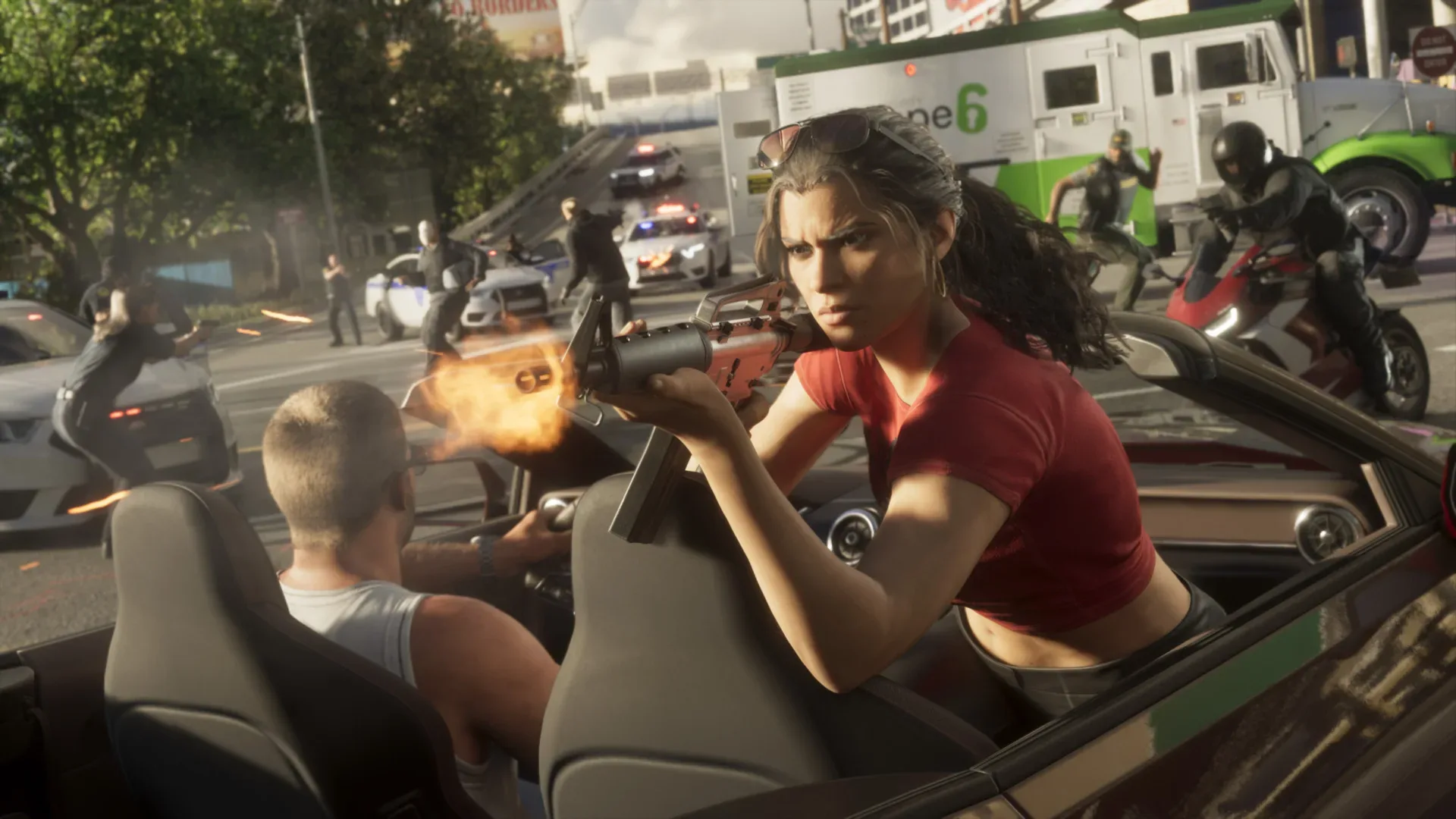

Grand Theft Auto 6 will target 30 frames per second on PS5, PS5 Pro, Xbox Series X and Xbox Series S, with no current-generation 60 FPS or 40 FPS mode planned. The key reason is not simply a preference for prettier reflections: Rockstar says the simulation underpinning its open world is beyond what the current consoles’ CPUs can sustain at higher frame rates.
That clarification matters particularly for PS5 Pro owners. The upgraded console can enhance GTA 6’s visual presentation, but it does not change the fundamental frame-rate target. In practical terms, the more powerful PlayStation hardware is being used to improve image quality and rendering features rather than to create a separate performance mode.
Why PS5 Pro does not change GTA 6’s 30 FPS target
Rockstar technology production director Marc Chambers described the baseline visual setup as using ray-traced reflections and global illumination. On PS5 Pro, the game adds ray-traced shadows and greater clarity through PlayStation Spectral Super Resolution, or PSSR. The console also has an upgraded graphics processor.
Those are meaningful graphical advantages, but they do not solve every performance constraint. Chambers said the PS5 Pro’s central processor is only slightly better than the base PS5’s, and that it is not powerful enough to run GTA 6’s “complex simulation” at higher frame rates.
“While the PS5 Pro’s central processor is slightly better than the PS5 base console, it is not powerful enough to run the game’s complex simulation at higher frame rates.”
That distinction between the graphics processor and the central processor is the center of the discussion. A GPU is principally responsible for drawing the image: geometry, lighting, effects, shadows, and many other visual tasks. A CPU has a different role, handling gameplay systems and the work needed to coordinate a dense, changing world. Neither component exists in isolation. A game’s performance is ultimately limited by whichever part of the hardware cannot complete its required work quickly enough.
For GTA 6, Rockstar’s explanation points to the CPU side as the decisive ceiling for higher frame rates. Improving visual output through PS5 Pro’s GPU capabilities and PSSR is therefore compatible with retaining a 30 FPS cap. It is not evidence that a 60 FPS mode is being held back merely to preserve a particular visual setting.
What 30, 40 and 60 FPS actually mean
FPS means frames per second: the number of complete images the game produces in one second. At 30 FPS, a new frame arrives roughly every 33 milliseconds. At 60 FPS, that budget drops to roughly 16.7 milliseconds. The higher target does not just ask the hardware to work a little harder. It asks the game to finish the required processing in about half the time for every frame.
Related coverage includes GTA 6 Is Targeting 30 FPS on Every Current Console, Including PS5 Pro.
A 40 FPS option, often discussed by players with 120Hz displays, would sit between those two targets. It still requires a consistently faster update rate than 30 FPS, giving the CPU less time to calculate the world state. Rockstar’s statement covers that prospect too: there is no indication that a 40 FPS current-console mode is planned.
Frame rate can affect the perceived smoothness of camera movement and the immediacy of control response. That is why performance modes have become an expected option for many console players. But a stable target also matters. A consistent 30 FPS presentation can feel more coherent than a mode that chases a higher number but repeatedly falls beneath it during the most demanding scenes.
Rockstar has not framed the choice as a simple visual-quality-versus-frame-rate toggle. Its explanation is that GTA 6’s simulation cannot reach the higher targets on these consoles. That makes calls to disable individual visual features understandable, but incomplete.
Ray tracing is part of the picture, not the whole answer
Ray tracing is a rendering technique used to model how light travels and interacts with surfaces. In GTA 6’s stated setup, ray-traced reflections can make reflective materials and surfaces respond more naturally to their surroundings. Global illumination concerns the way light bounces and contributes to a scene’s overall lighting. Ray-traced shadows, available as an enhancement on PS5 Pro, are another component of how objects are shaded and grounded in the world.
These features can be expensive to render, so it is reasonable to ask whether removing them would make 60 FPS possible. Yet Rockstar’s answer emphasizes the complex simulation rather than presenting ray tracing as the sole obstacle. The implication is that even a major reduction in rendering load would not automatically create sufficient CPU headroom for a stable higher-frame-rate mode.
This is an important limitation to keep in mind when comparing GTA 6 with games that offer quality and performance presets. Different games stress hardware in different ways. A title can be GPU-limited, CPU-limited, or constrained by a shifting combination of both depending on the scene. A toggle that works in one open-world game is not necessarily viable in another.
Rockstar’s description of the world helps illustrate the point. The game is said to feature heavy traffic, numerous NPCs within view, and dozens of aircraft in the sky at once. Each of those active elements potentially needs behavior, movement, collision awareness, animation, positioning and interaction with the wider game state. The company has not provided a technical breakdown of each system, so it would be speculative to assign an exact cost to any one of them. Still, the stated reason is clear: the simulation workload, not visual fidelity alone, prevents a higher target on today’s machines.
What PS5 Pro players are getting instead
The absence of 60 FPS does not mean the PS5 Pro version is identical to the base PS5 version. Rockstar says PS5 Pro adds ray-traced shadows and improved clarity through PSSR, alongside advantages from its stronger GPU.
PSSR is Sony’s upscaling technology. Upscaling generally means rendering from a lower-resolution image and using processing techniques to reconstruct a sharper final output. Its goal is to improve image quality while keeping the rendering cost lower than native rendering at the final display resolution. Rockstar is using that capacity to increase fidelity, not to double the simulation rate.
That reveals the studio’s priority for the enhanced console version: preserve the 30 FPS target while improving the picture within it. Players who value lighting detail, reflections, shadow treatment and image clarity may see the PS5 Pro upgrade as worthwhile. Players whose primary requirement is 60 FPS should not expect the machine to provide that option for GTA 6.
The same broad 30 FPS target applies across the rest of the current console lineup: standard PS5, Xbox Series X and Xbox Series S. The announcement therefore sets expectations before launch rather than leaving buyers to infer a performance mode from platform hierarchy alone. For more GTA 6 context, including the scale of its world, see the report on its north-to-south travel time.
Practical implications for players
The most useful takeaway is straightforward: choose a current console version of GTA 6 expecting a 30 FPS presentation, including on PS5 Pro. A 120Hz television does not change that stated target, and there is no announced future update that would add a 40 FPS or 60 FPS option on these platforms.
- PS5 Pro owners: expect visual enhancements, including ray-traced shadows and PSSR-supported clarity, rather than a higher frame-rate mode.
- PS5, Series X and Series S owners: expect the same 30 FPS target across the current-generation console family.
- Players considering a display upgrade: a 120Hz panel alone cannot make a 30 FPS-capped game run at 40 or 60 FPS; the game and hardware must support that mode.
- Players who only want 60 FPS: there is no current-console path confirmed for that preference. Any potential future version on other hardware remains unannounced.
It is also worth separating a firm present-tense statement from possible future scenarios. Rockstar has confirmed the plan for the present consoles. It has not announced a PC version, a later-console release, or frame-rate specifications for any such versions. Higher frame rates may be technically possible on future hardware, but that is an inference about technology rather than a promise attached to GTA 6 today.
A clear answer to the performance-mode debate
GTA 6’s 30 FPS target will remain a disappointment for players who consider 60 FPS essential, especially those who expected PS5 Pro to bridge the gap. But Rockstar has now provided a more specific explanation than a generic push for cinematic visuals. The studio is allocating PS5 Pro’s extra graphics capability to richer rendering and image clarity while identifying CPU simulation as the barrier to higher frame rates.
That does not make the preference debate disappear. Some players will reasonably favor smoother motion and quicker input response over advanced lighting. Others will prefer the more ambitious graphical presentation at a stable 30 FPS. What is settled is the current-console expectation: GTA 6 is not planning to offer either 60 FPS or 40 FPS, even on PS5 Pro.