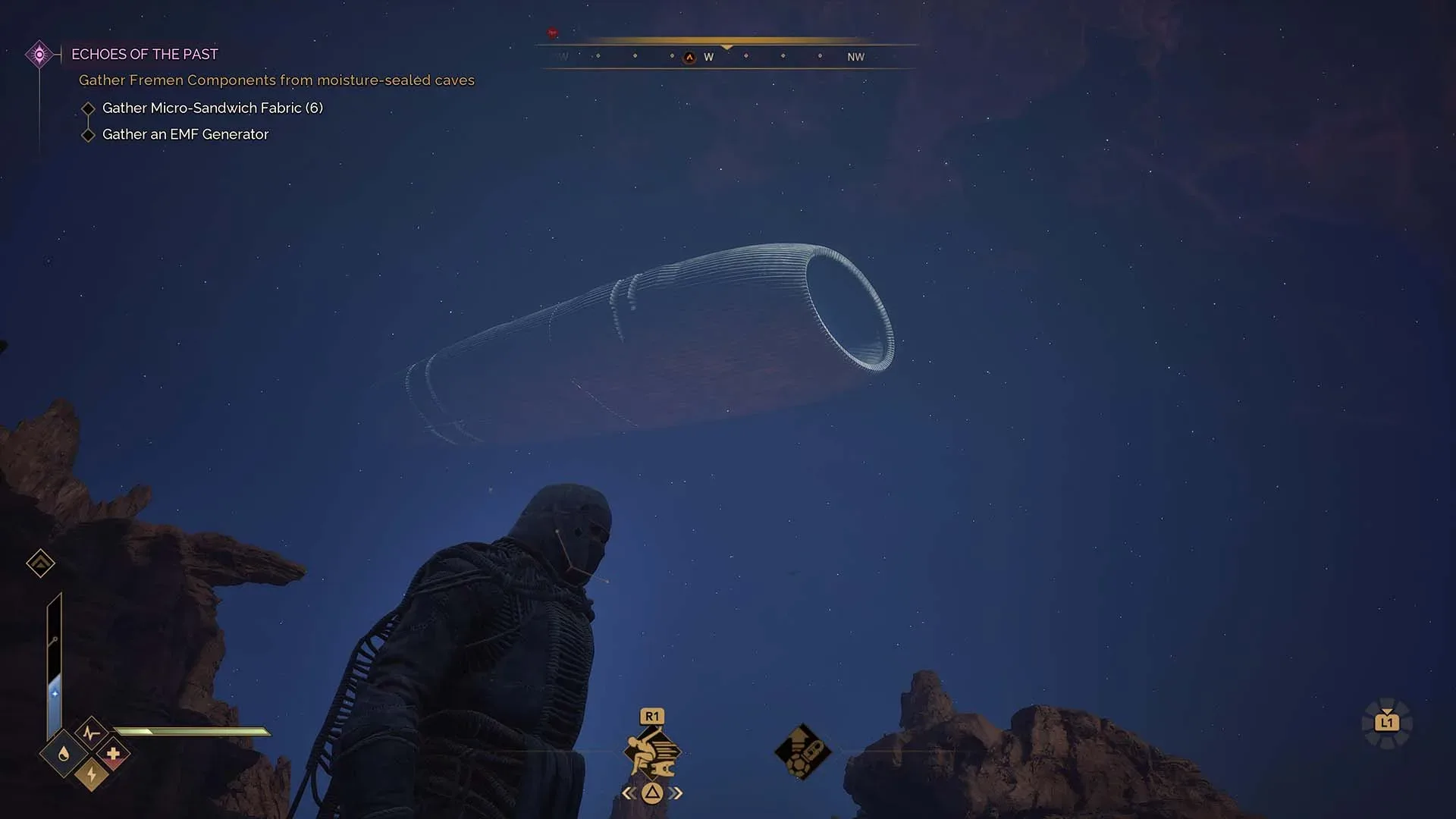
Dune: Awakening is preparing to make room for players who would rather face Arrakis with no guild calendar, no crowded server drama, and no stranger parking a suspiciously large vehicle outside their base. Funcom’s new single-player mode is due to arrive alongside the game’s console release later this month, offering a local way to experience its desert survival world alone.
That does not mean the game is being reshaped into a tightly directed, cinematic action-adventure in the mold of The Last of Us. Funcom chief creative officer Joel Bylos has drawn that line clearly: the mode is for people seeking a strong single-player survival game, not for those hoping that an MMO-survival structure will suddenly behave like a linear prestige-drama campaign with occasional crafting breaks.
It is a useful expectation check, especially for a game with Dune’s enormous cultural pull. Arrakis naturally invites visions of political intrigue, fate, family legacies, colossal worms, and dramatic stares across dunes. But Dune: Awakening is also a persistent open-world survival game built around systems. Players interested in the solo option should expect the fundamentals of that genre to remain central: surviving the hostile environment, gathering resources, managing the practical demands of life on Arrakis, and engaging with the game’s larger world through that framework.
A solo route through a multiplayer-shaped desert
Bylos’ position is not that solo players will receive a lesser or compromised adventure by default. Rather, he argues that people who want a quality survival experience they can play alone should find what they are looking for. The caveat is genre literacy. Go in expecting survival systems and an open-world structure, and the new mode is intended to fit. Go in demanding the rhythm and authored presentation of a completely different kind of game, and the sand may get into more than just the machinery.
For solo players looking for a great survival-game experience, Bylos says the mode should work well; the warning is aimed at anyone expecting a Last of Us-style experience.
That distinction matters because “single-player” can mean radically different things depending on the game. In one case, it means a tailored campaign built around a fixed sequence of encounters. In another, it means being able to inhabit a systems-heavy world without other human players sharing the space. Dune: Awakening’s upcoming option appears to belong firmly to the second category.
For some players, that may be exactly the point. Online survival games can be compelling while also demanding social coordination, network persistence, or tolerance for the unpredictability of other people. A local solo mode can create a more controlled route through the same setting. It can allow someone to progress at their own pace and engage with the world without treating every session as a diplomatic summit, a construction permit hearing, or an accidental neighborhood dispute conducted through emotes.
There is also a straightforward appeal in taking on Arrakis alone. Dune’s desert is not a setting that requires additional chaos to feel intimidating. The environment, the need for preparation, the prospect of scarce materials, and the risks attached to travel can supply plenty of pressure without a roaming squad turning the horizon into an unsolicited group project.
Related coverage includes Dune: Awakening's Solo Mode Is Built for Survival Fans, Not a Last of Us-Style Campaign.
Making “offline” is more complicated than flipping a switch
Funcom has characterized the technical work behind the solo mode as substantial. The original game’s design is rooted in a persistent, server-authoritative open world spanning multiple maps. Converting that kind of foundation into a smoother local experience is not simply a matter of adding a menu button labeled “Please Remove Everyone Else.” Systems that usually live on servers need to function on the player’s own machine, while the game still needs to behave coherently as a survival experience.
The studio has previously outlined several areas that required adaptation. Multiplayer-oriented features have to be translated for a single-player setting. Combat and resource-harvesting rates require balancing for a world where there may be no other players to cooperate with, compete against, or influence the broader economic flow. The player’s hardware must also take on processing work that would ordinarily be handled through the online infrastructure.
Those details give a clearer picture of why this feature has taken effort rather than appearing as a casual checkbox. Persistent games often build assumptions into almost every layer of their design: how the world updates, how resources are distributed, how threats operate, how progression is paced, and how maps connect. Pulling one player out of that ecosystem can expose a surprising number of dependencies.
Combat balance is an obvious example. A fight that is manageable when several players can share roles, damage, supplies, or attention may need a different approach for one person. Resource income creates a similar challenge. Rates designed around a multiplayer population could feel punishing in isolation, or too generous if left untouched after the surrounding competition disappears. The task is not merely to make the game run locally; it is to make the lone-player version feel like a purposeful survival game rather than an online world that misplaced its population.
Local performance is another practical piece of the equation. Anyone planning to play on a computer may also want to make sure the basics of their setup are behaving before entering the desert; this guide on Bluetooth security for phones, headsets, and controllers covers one small but relevant part of maintaining connected gaming gear. Funcom’s own explanation, meanwhile, emphasizes that the player’s machine will have to perform work normally associated with the game’s server-side structure.
The story is part of the pitch
Funcom sees Dune: Awakening’s narrative as a major reason a solo mode makes sense. Bylos has made an ambitious claim for the game’s storytelling, saying he believes it has the best story in the survival genre. That is a subjective assessment, not a promise that every player will agree, but it reveals how the studio views the adaptation’s strengths.
For a survival game, story can serve a particularly valuable role. Survival systems supply the moment-to-moment pressures: staying equipped, acquiring what is needed, navigating danger, and building the capability to continue. Narrative can give those actions a larger sense of direction, context, and motivation. In a setting as heavily defined by history, factions, ecology, and power as Dune, that connective tissue may be especially important.
The solo mode could therefore appeal to two overlapping groups. First are established survival players who prefer self-directed progression without a live multiplayer environment. Second are Dune fans who may be drawn by the chance to move through Funcom’s version of Frank Herbert’s universe on their own terms, provided they are comfortable with the game’s survival identity.
The overlap is meaningful, but it should not be overstated. A famous fictional world can bring players to the door; the underlying game design decides whether they want to stay. Funcom’s messaging is refreshingly direct on that point. The studio is not presenting the mode as an all-purpose answer for anyone who enjoys Dune in any form. It is presenting it as a version of Dune: Awakening aimed at solo survival play.
What prospective players should expect
Based on the details shared so far, the clearest way to approach the new mode is to focus on what it preserves rather than what it replaces. It preserves the game’s core survival format and its Arrakis setting. It is being adjusted to operate locally, with changes to multiplayer-facing systems, combat balance, harvesting balance, and machine-side workload. It is also positioned as a way to engage with a story Funcom considers a standout within the genre.
What it does not appear to promise is a wholesale genre conversion. There is no indication that Dune: Awakening’s solo offering is becoming a linear, cinematic, third-person action game structured around the kind of authored progression associated with The Last of Us. Players seeking that specific model should take Bylos’ warning seriously instead of assuming “single-player mode” means “a different game wearing the same stillsuit.”
- Good fit: players who want an open-world survival game they can play alone.
- Potential fit: Dune fans interested in story and setting who are willing to engage with gathering, survival, balance changes, and systemic progression.
- Probably not the target: players primarily seeking a linear, cinematic action-adventure campaign.
Funcom’s challenge is a large one, but the plan is also easy to understand. The studio is trying to give lone players a viable route across a game originally shaped around persistence and multiplayer infrastructure, without denying the genre that defines it. If that translation lands smoothly, solo players will be able to confront the dangers of Arrakis with only the desert, the systems, and their own planning to blame when things go sideways.