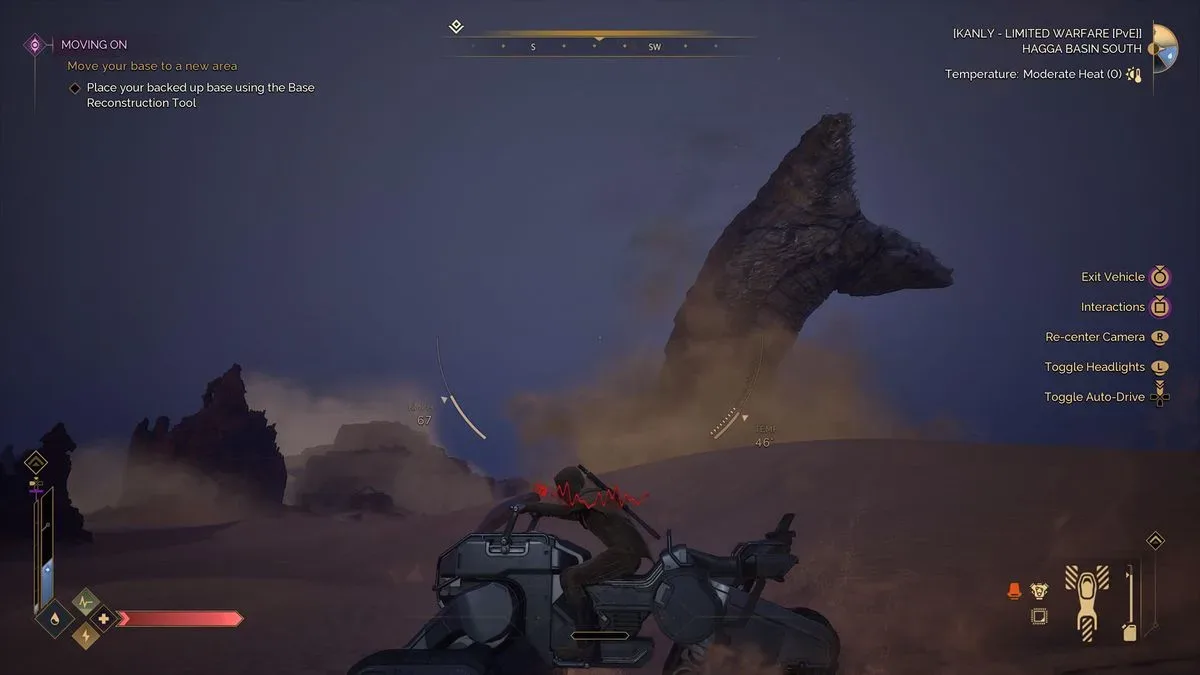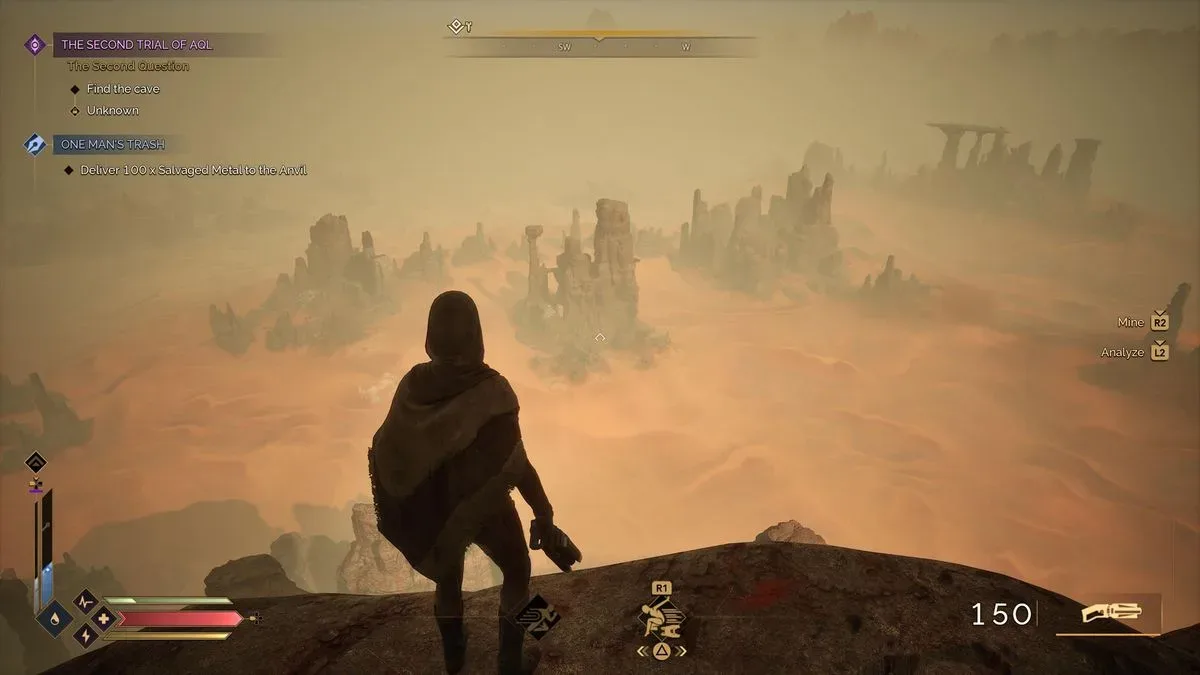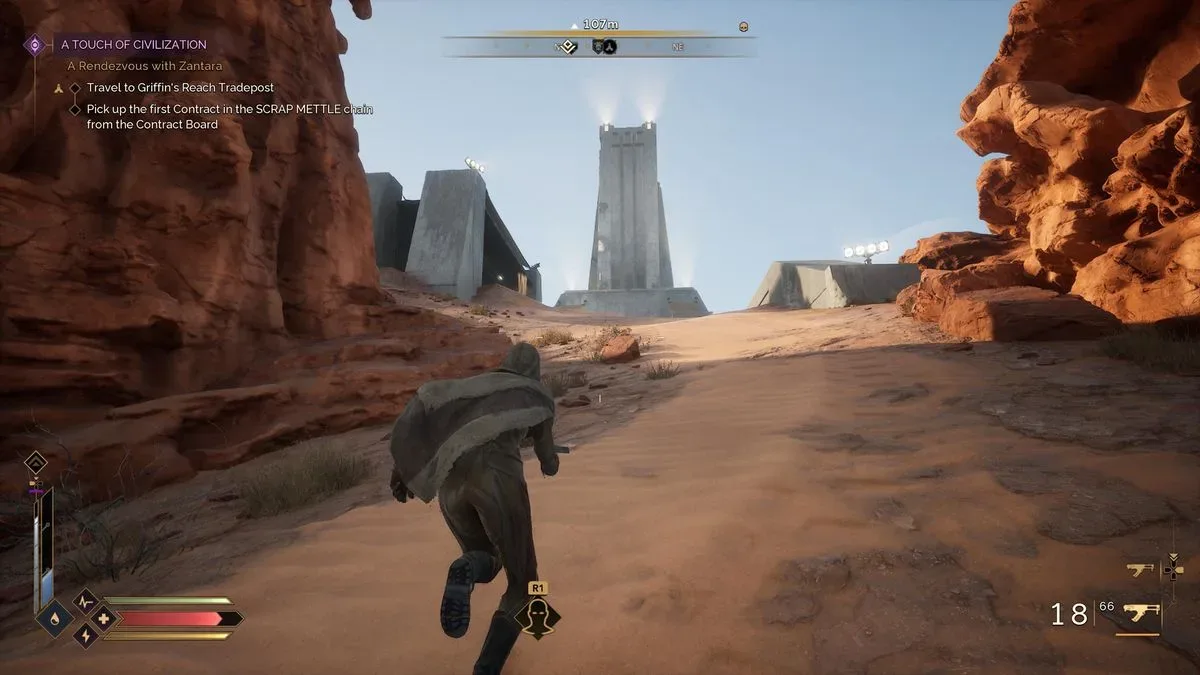
Dune: Awakening has reached PS5 and Xbox Series X alongside a substantial PC update, extending Funcom’s open-world Arrakis to console players. The basic verdict is both easy and frustratingly difficult: it is a spectacularly convincing place to visit, with several smart survival ideas, but too many of the systems meant to make desert life tense still feel undercooked.
Arrakis should be an almost perfect survival-game setting. It is hostile before an enemy ever appears. Sun exposure is a threat, water is essential, the open sand is dangerous, and the possibility of a Sandworm turns crossing the wrong patch of terrain into an urgent decision rather than a sightseeing detour. The game puts the player in that pressure cooker after their ship is destroyed, leaving them stranded on a planet where survival is supposed to demand planning, resources and caution.
That premise remains powerful. So does the game’s visual identity. On PS5, Dune: Awakening offers a 60fps performance option and a 30fps alternative that favors greater visual detail and reduced pop-in. Pop-in is the visibly late appearance of objects or scenery as a player moves through an open world; it can interrupt the illusion of a vast landscape, particularly in a game built around long journeys across exposed desert. The 30fps mode reduces that distraction, while the 60fps option makes movement and combat feel more responsive. The performance mode’s remaining pop-in is described as limited enough that it is likely the more appealing choice for players who prioritize control feel.
For a broader report on the console launch and the mixture of Arrakis beauty and mechanical friction, see this look at Dune: Awakening’s PS5 and Xbox Series X arrival.
Arrakis is the game’s strongest system
Funcom’s adaptation earns much of its goodwill through atmosphere. The world captures the severe, sun-blasted look associated with the recent Dune films and makes its setting more than a backdrop. Arrakis has a clear relationship with the player’s moment-to-moment needs: water supports the character as well as base operations, technology and powers, while traversing open sands can attract colossal worms. The result is a landscape that asks players to think about routes and preparation.
That environmental pressure is what separates survival games from ordinary open-world adventures. A survival loop is the repeated cycle of gathering resources, managing risks, improving tools or shelter, and then reaching farther into dangerous territory. In Dune: Awakening, water is positioned at the center of that loop. Players can gain limited hydration from dew found around flower patches, but the more forceful thematic mechanic is extracting water from defeated people.
It is a grimly fitting proposition for Dune’s unforgiving desert. The problem is not the idea. The problem is that the opponents guarding this resource often make it feel routine. Some enemies stay back and use firearms, but reportedly make limited use of cover or evasive behavior. Others charge directly with knives even when they are not protected by shields and are being shot at. When enemies reliably run into gunfire, the water obtained from them stops feeling like a hard-won lifeline and becomes another dependable farming route.
That distinction matters. Scarcity works best when the player has to adapt: take a risk, spend ammunition, avoid a camp, seek an alternative or accept a difficult trade-off. If nearby enemies are simple to defeat and respawn reliably, the water economy can lose the uncertainty that should make it frightening. Difficulty settings in the single-player mode may alter the challenge level, but they do not by themselves resolve behavior that feels unconvincing.
Combat has one very Dune-shaped bright spot
The game’s better encounters are those involving shielded foes. In Dune’s fiction, personal shields make ordinary gunfire ineffective, creating a rationale for dangerously close combat. Dune: Awakening uses that logic to create tense moments when a shielded enemy advances. A firearm is no longer the clean answer, and a knife fight becomes the necessary, risky alternative.
Melee is described as somewhat unwieldy, but that imperfection can suit its role. Close-range combat on an exposed desert world does not need to feel balletic to be effective; it can benefit from seeming desperate and messy. The trouble is consistency. When unshielded enemies use the same headlong approach despite being vulnerable to guns, the special tension of shielded encounters is weakened. The game has the ingredients for combat that reflects its setting, yet its ordinary enemy behavior too often works against them.
This is the key frustration running through the console version. Dune: Awakening contains many distinct activity types: survival management, shooting, stealth, climbing, flying, vehicle combat, building and a multiplayer framework, alongside a strictly single-player mode. Range can be a strength, but it raises the standard for every individual tool. A game with this many interconnected systems has to make basic interactions legible and reliable, because the player will repeat them constantly.
Movement improves over time, but the early friction is real
Traversal offers another case of a promising design with uneven execution. The climbing system permits players to scale surfaces while watching a stamina meter, recalling the broad freedom of games in which climbing is governed by endurance rather than a fixed set of ledges. Ascending cliffs is generally workable. Descending them is less dependable, with the character liable to push away from the rock face and fall.
Early in the game, that can be especially punishing because fall damage is a major concern. Later progression softens the issue. The skill tree includes a hookshot that can help with vertical movement, a dash useful for fleeing Sandworms, and eventual wearable equipment that negates fall damage. These unlocks demonstrate that the game has a rewarding power curve: players begin vulnerable and can gain tools that reshape how they travel and survive.
A power curve is the pace at which a game lets a character become more capable. A strong one makes early limitations meaningful without making players feel stuck in an awkward state for too long. Dune: Awakening appears to offer worthwhile upgrades, but the progression is described as slow and stingy. That makes the early stretch disproportionately important. If climbing, combat and menus feel rough before those tools arrive, some players may never reach the stage where the game opens up.
The game’s strongest ideas are often its most setting-specific ones: rationing water, moving carefully through the desert, building shelter, and treating Sandworms as a traversal problem rather than merely a boss-sized enemy.
Console controls expose the interface problem
The sharpest PS5-specific concern is the interface. Building a desert base should be a satisfying expression of survival progress: a place to process resources, create gear and turn a fragile foothold into a durable operation. On a DualSense controller, though, accessing the necessary building and crafting functions is described as laborious.
Complex PC-first games can work well on a controller, but they need careful interface translation. Console controls have fewer direct inputs than a keyboard, so designers often rely on radial wheels, shortcuts, grouped inventories and context-sensitive prompts. Those systems can be excellent when frequently used tasks are visible and when the player can quickly understand where an option lives. They become exhausting when essential actions are nested across too many tabs and submenus.
Dune: Awakening’s menu layout reportedly makes basic information and projects needlessly hard to locate. Objectives are not visible from the pause screen, while technology-tree projects and placeables require searching through opaque menu layers. A placeable is an item a player can position in the world, such as a base component or crafting station. In a game where progression depends on gathering materials and then turning them into useful infrastructure, hiding the fabricator or the relevant project behind interface friction creates an unfortunate inversion: fighting for water is simple, but finding the screen to build with it is harder than it should be.
That is not a small quality-of-life complaint. Menus are part of a survival game’s core loop. Every trip outside the base feeds into inventory choices, crafting, research or construction. If each return home begins with a search through tabs, then the management layer saps momentum from the expedition that preceded it.
Players tuning a console desk or TV-area setup may also find our guide to USB extenders for gaming setups useful when considering cable length, speed and power constraints.
Who should brave the sand?
Dune: Awakening is easiest to recommend to players who already care deeply about Dune and want a game that lets them inhabit its world at length. Its rendition of Arrakis, its environmental danger, its Sandworm escapes and its progression tools can create the right fantasy. The skill tree in particular appears to contain meaningful abilities, rather than offering upgrades that merely inflate numbers.
It is a more qualified recommendation for players seeking the most polished survival experience on PS5. The game’s atmosphere and scale are real strengths, but the quality of the essentials is uneven: combat AI can undermine resource pressure, climbing can be awkward, and the console interface turns building and research into unnecessary work. A single-player option gives players a way to engage outside the MMO-style environment, but it does not erase those systemic issues.
The desert therefore remains both the selling point and the caution. Dune: Awakening understands why Arrakis is compelling: it is beautiful, terrifying, resource-starved and oppressive. It has not fully solved how to make every system supporting that fantasy feel equally sharp. On PS5, the game can be a striking Dune destination, especially at 60fps, but it still asks players to tolerate a fair amount of grit before its better ideas shine through.