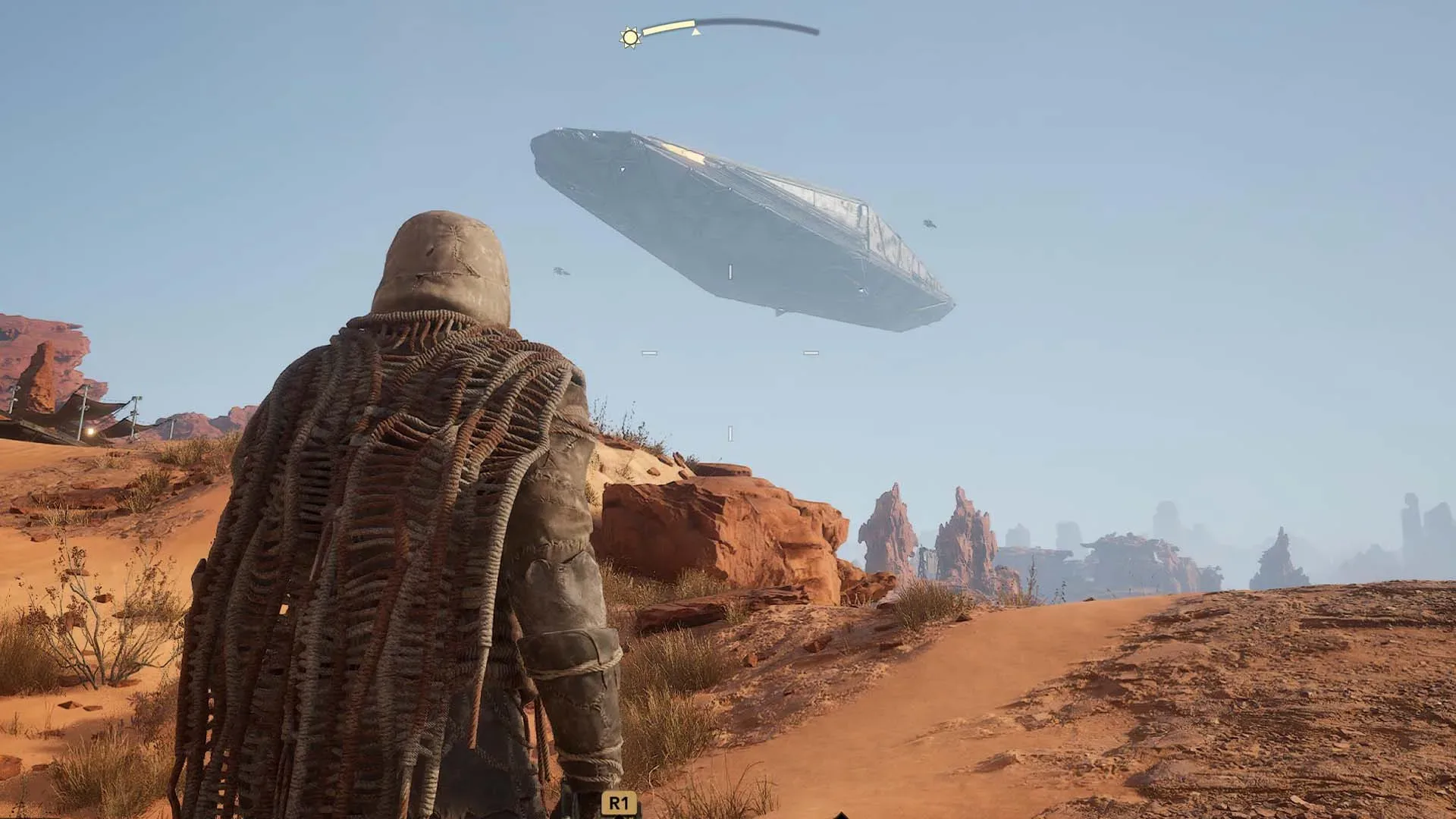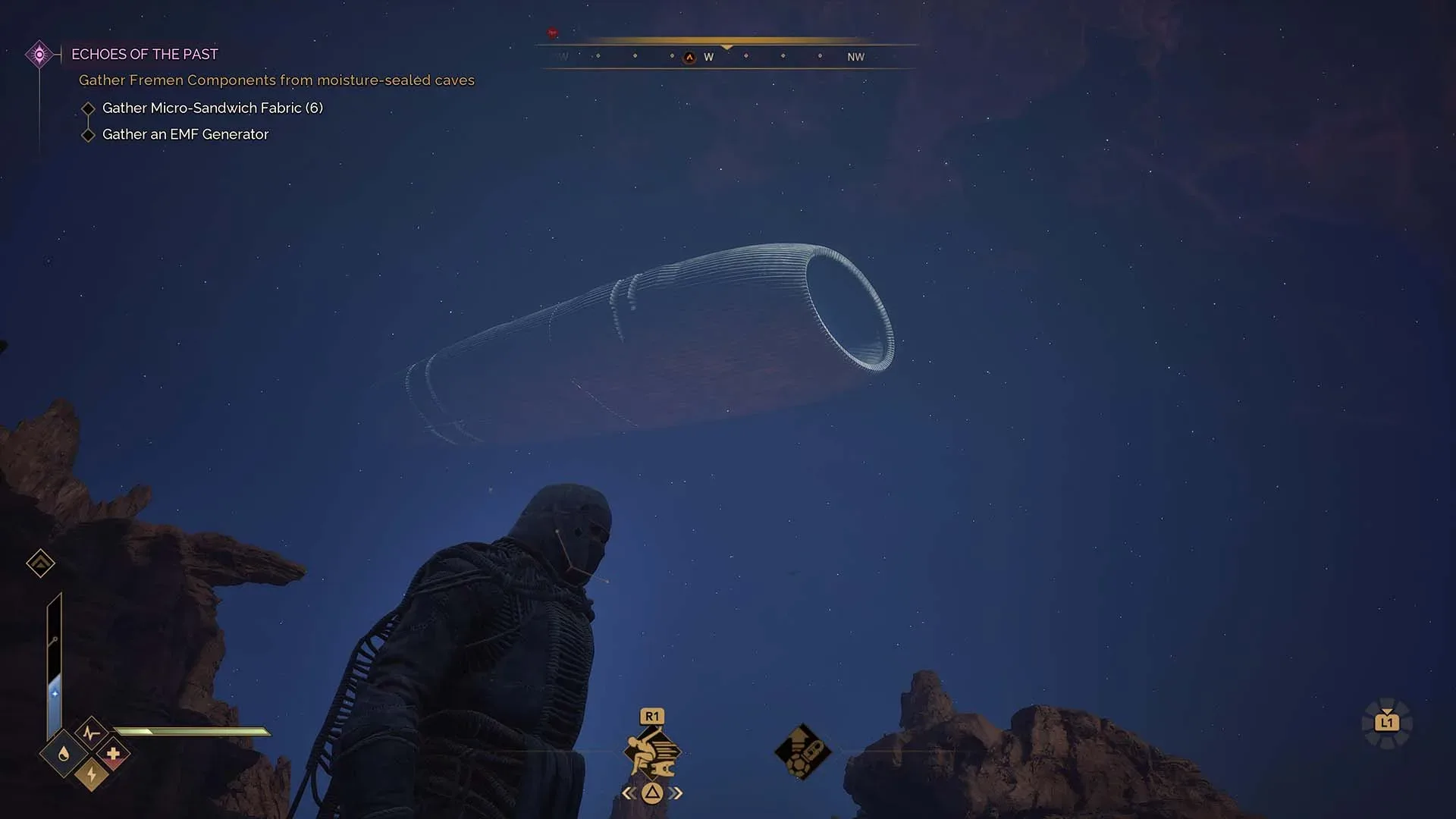
Dune: Awakening has arrived on PS5 and Xbox after launching on PC last year, and its console debut is paired with a sizable update that could make the notoriously demanding survival-crafting genre easier to approach. The third-person sci-fi MMO survival RPG now includes additional gameplay settings, story material, quality-of-life updates, a dedicated single-player mode, and an option for players who prefer to avoid PvP entirely.
That combination is significant because survival games often lose prospective players long before their larger systems have a chance to click. The genre’s familiar loop—gather basic materials, construct shelter, replace lost equipment, then gather more—can feel like repetitive maintenance rather than an adventure. Dune: Awakening’s early PS5 impressions suggest its strength is not that it removes survival pressures, but that it makes the actions surrounding those pressures feel immediate, readable and worthwhile.
Arrakis is still dangerous, but the routine is less punishing
Survival crafting games are sometimes jokingly called “tree punchers,” a shorthand for games where a player begins with little, gathers raw materials directly from the environment, and climbs a long chain of increasingly elaborate recipes and structures. The term points to a common frustration: a game may promise exploration and discovery, then turn much of the experience into repetitive resource labor.
Dune: Awakening appears to reduce that friction in its harvesting loop. Players scan rocks and other usable environmental objects, then use a laser to trace a highlighted extraction point. Once the action is completed, the object breaks apart and resources are collected automatically. The process retains a physical interaction rather than reducing gathering to a menu prompt, but avoids an extended sequence of slow manual collection.
That is a modest mechanical choice with broader implications. In a survival game, resource gathering is not an occasional activity; it is the foundation beneath crafting, base construction, equipment progression and recovery after a loss. If the act of gathering is tedious, every other system inherits that tedium. A quick, legible harvesting interaction can therefore change the perceived pace of the entire game.
The setting gives those resources a clear role. Early progression involves surviving Arrakis through necessities including blood and dew water, while players also hunt bandits and harvest materials to establish a foothold. Dune’s desert is not simply scenic terrain in this setup. It is a hostile environment that makes preparation, supply gathering and route planning matter.
A console control scheme that does not feel like a compromise
One of the clearest positives from the PS5 version is how naturally Dune: Awakening reportedly translates to a controller. Inventory management, building, combat, on-foot travel and vehicle exploration all function well with the PS5 gamepad, rather than feeling as though they were designed exclusively around a mouse and keyboard.
This matters particularly for games with multiple overlapping interfaces. Survival titles ask players to navigate inventories, recipes, construction menus, equipment, maps and combat controls, often in quick succession. A controller implementation that creates unnecessary friction can make even a well-designed progression loop feel cumbersome. Here, the console presentation reportedly helps make Dune: Awakening resemble a large action-adventure experience on a television, rather than a PC-only crafting game transplanted onto a console.
Related coverage includes Dune: Awakening's PS5 Version Makes the Survival Grind Feel Surprisingly Approachable.
Performance and online stability are equally important for that impression. Sessions on PS5 have been described as running smoothly, while multiplayer play has held up with very little lag or other unusual disruption. Those are not guarantees about every server, region or future update, but they are encouraging signs for a game that asks players to carry valuable supplies through a shared online world.
For Xbox players, Dune: Awakening’s arrival also lands amid wider attention on how platform ecosystems handle ownership and libraries. Readers looking at that separate issue can see how Xbox’s disc-to-digital rollout works and why eligible discs still matter.
Solo play is not merely a tutorial with fewer people
The new single-player mode may be one of the update’s most practical additions. It allows players to create a character, work through the opening hours, complete quests and level up without entering the MMO environment. Just as importantly, it has been described as a complete-feeling way to play rather than a hollowed-out version of the online game.
That distinction deserves attention. An MMO, or massively multiplayer online game, is built around a persistent shared world populated by other players. For some people, that shared structure is appealing; for others, it introduces pressure, competition or the prospect of unwanted encounters. A true single-player option gives players room to learn the systems and enjoy Arrakis at their own pace.
The update also lets players avoid PvP, meaning player-versus-player conflict. This is a meaningful accessibility choice in a survival framework. Risk can be thrilling when it comes from weather, creatures, resource scarcity and hostile computer-controlled enemies. It can become exhausting when it also involves the possibility of other players interrupting progress or taking advantage of a player who is still learning. Allowing people to opt out does not erase the game’s danger; it lets them decide which kind of danger they want.
There is one caveat for anyone hoping to move seamlessly between modes. Characters created for the single-player experience cannot transfer to multiplayer servers. Someone who starts alone and later decides to join friends will need to make another character. Thankfully, the opening tutorial and introductory sequence can be skipped after a player has completed them, making the second start less burdensome than it might otherwise be.
Combat gives gathering a purpose
Dune: Awakening does not appear to be positioned as a genre-leading third-person shooter, but its combat has been characterized as responsive, threatening and satisfying enough to seek out voluntarily. Players can move between cover in firefights and use a knife to counter an enemy’s holo-shield, rather than simply waiting for lengthy MMO-style animations to resolve.
That distinction is central to the game’s appeal. In some online RPGs, encounters can feel abstract: activate an ability, watch a sequence play out, repeat. In some survival games, combat can feel stiff or unreliable. A system that instead feels reactive can turn bandit encounters from a required chore into an enjoyable part of an expedition.
It also makes the game’s materials loop more coherent. Bandits provide resources, resources support a growing base, and base-building creates a sense of ownership in an environment that would otherwise feel overwhelming. Co-op further reinforces that loop. Two players can build a small desert shelter, collect what they need and pick fights together, creating shared stories instead of merely splitting a checklist of chores.
The sandworm remains the game’s best argument for respecting the desert
No amount of interface polish changes the fact that Arrakis is meant to be terrifying. The game’s enormous desert worm makes open-sand travel particularly risky. Players who cross exposed dunes carelessly can be swallowed and permanently lose what they are carrying.
That is a form of high-stakes loss familiar to survival-game players: the danger is not only that a character might die, but that time and supplies invested in the current outing can vanish with them. It gives travel weight. Choosing a route, deciding what gear to bring and judging whether an objective is worth the risk all become real decisions rather than background flavor.
It can also produce the kind of unscripted comedy that online survival games do unusually well. One co-op session reportedly ended with a player deliberately shedding gear and running into the dunes to tempt the worm. The inevitable result was less a tactical breakthrough than a reminder that even a severe, atmospheric game can become delightfully ridiculous when friends decide to test its boundaries.
A welcoming on-ramp, not a verdict on the endgame
The early console experience should not be confused with a complete assessment of Dune: Awakening. There is no firm claim here about the quality of its endgame, the long-term balance of its systems, or disputes that may surround its evolving competitive meta. In online games, “meta” refers to the strategies, builds or tactics players collectively consider most effective at a given time, and it can shift rapidly as developers update systems or players discover new advantages.
What the PS5 and Xbox version does appear to offer is a more approachable entry point: smooth controller play, stable online sessions, satisfying basic harvesting, competent combat, a credible solo route and clear options for players uninterested in PvP. That does not mean every survival-game skeptic will suddenly enjoy managing water, supplies and construction. It does mean the game has a chance to win people over through moment-to-moment play before its larger demands wear them down.
For a world built around an unforgiving desert, that may be the most important achievement. Dune: Awakening still wants players to feel vulnerable beneath massive ships, uncertain amid ancient sands and wary of the thing moving under the dunes. But it increasingly seems willing to make the journey through that world engaging rather than exhausting.