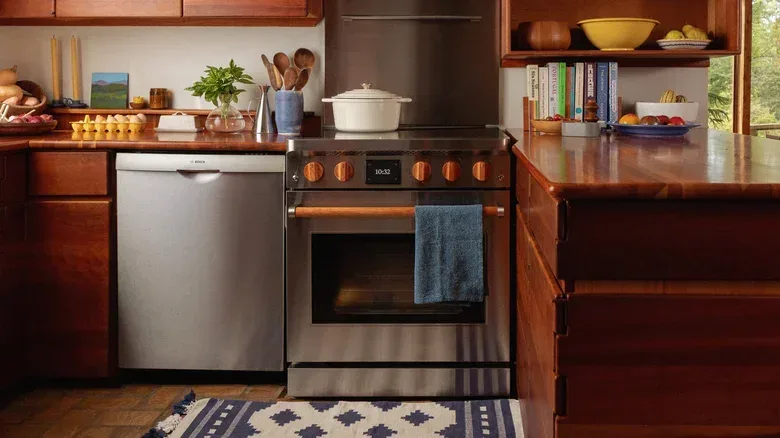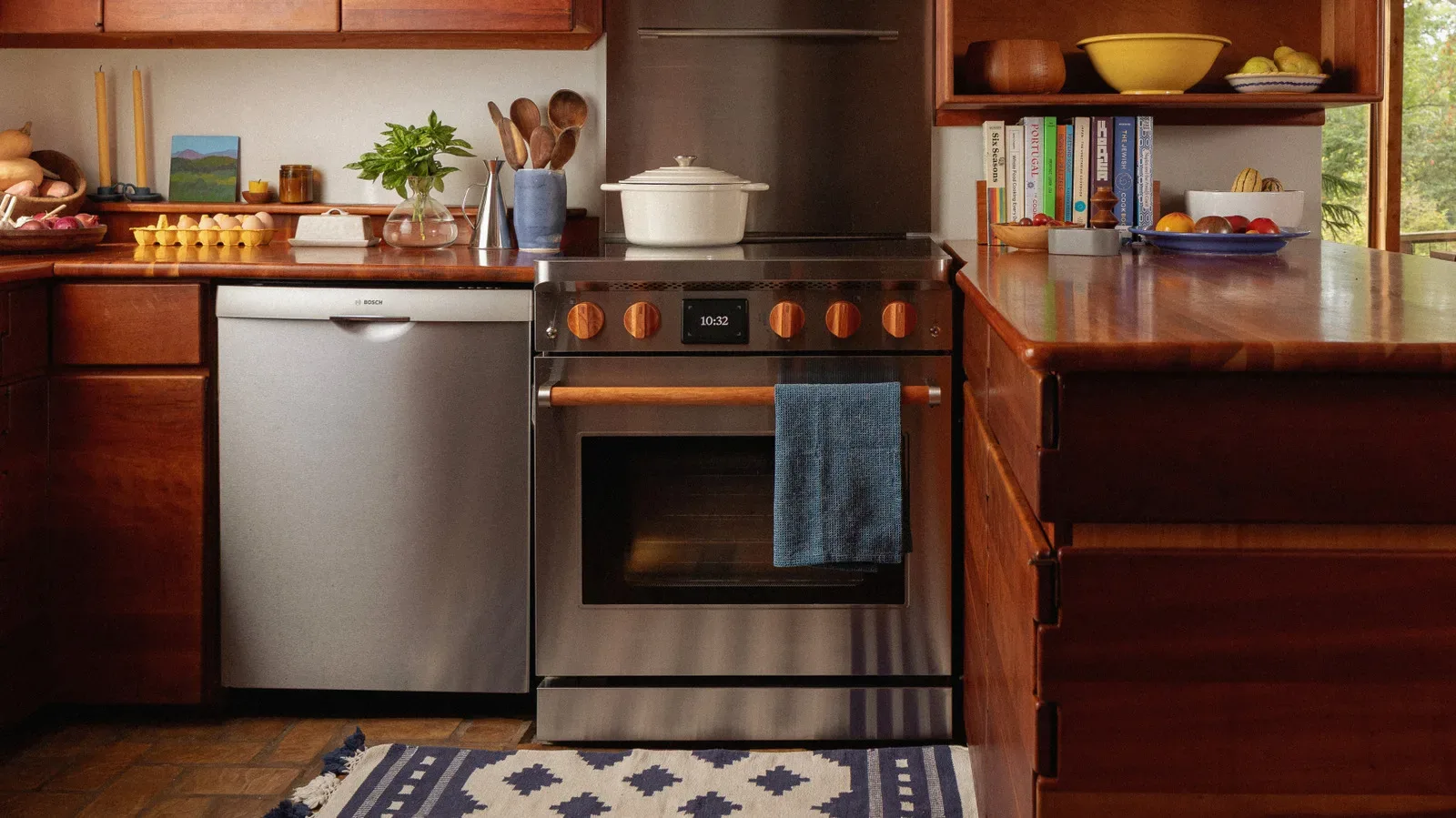
Copper has updated its Charlie induction range with a package of changes aimed at two very different kitchen concerns: cooking performance and installation. The new model increases output for its induction zones and broiler, reduces the stated oven preheat time, and—perhaps most importantly for a replacement appliance—adds support for both 120-volt and 240-volt outlets.
The result is a high-end electric range that is trying to make induction feel less like a kitchen renovation project. It is still unquestionably a premium purchase, with the stainless-steel version priced at $6,799 and the walnut version at $7,199. But compatibility with more outlet types could matter as much as its extra wattage to shoppers deciding whether an old gas or electric range can be swapped without additional electrical work.
The headline change is support for 120V and 240V power
The previous Charlie was limited to 120-volt sockets. The updated range supports both 120V and 240V outlets, broadening the kinds of existing kitchen connections it can work with.
Voltage is the electrical potential supplied by an outlet. In practical appliance-shopping terms, it is a compatibility question: an appliance and the home’s circuit must match appropriately. A standard household outlet and a dedicated high-power range connection are not interchangeable merely because they are physically nearby, so prospective buyers should still verify their own setup and follow installation requirements.
That caveat aside, dual-voltage compatibility is a meaningful design decision. The new Charlie is positioned as an easier range replacement because it can accommodate either of the two supported outlet voltages rather than requiring the 120V-only arrangement of the older model. For homeowners, that potentially shifts part of the conversation from “Will the kitchen need rewiring?” to “What connection is already behind the existing range?”
It is a reminder that home technology is not always a screen, subscription, or app update. Much as consumer technology coverage can encompass software tools and device controls—such as new parental-control features in iOS—the practical success of a connected or advanced appliance often comes down to the unglamorous infrastructure already inside a home.
More power for the broiler and induction zones
Copper’s updated Charlie increases the broiler’s maximum output to 3,000 watts, up from 2,700 watts on the previous version. The induction cooking zones also rise from 2.8kW to 3kW.
A watt is a unit of power; kilowatts, abbreviated kW, are simply 1,000 watts. Those figures do not on their own describe every aspect of cooking performance, since cookware, food quantity, temperature settings, and cooking technique all matter. They do establish that the revised model has higher stated output than the Charlie it replaces.
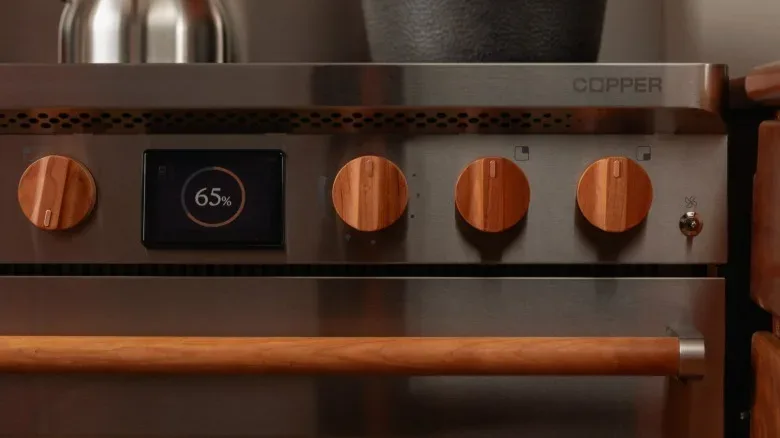
Induction itself is an electric cooking method that heats compatible cookware through an electromagnetic field rather than relying on a conventional exposed electric coil or a gas flame. The cookware is central to the process: the pan needs to be suitable for induction cooking. Copper’s range pairs those induction zones with precise temperature control, an onboard display, and a flat surface designed to be easier to wipe down after use.
The increase from 2.8kW to 3kW per induction zone is not a wholesale reinvention of the cooktop, but it is a targeted performance bump. Likewise, adding 300 watts to the broiler is a focused upgrade. It suggests Copper is refining the Charlie’s high-heat capabilities without abandoning the model’s underlying approach.
A quicker route to 350°F
The new Charlie is rated to preheat its oven to 350 degrees Fahrenheit in three minutes and 50 seconds. That is 40 seconds faster than the earlier Charlie’s stated four-minute, 30-second time for the same temperature. Copper characterizes the improvement as 15%.
Preheating is the period in which an oven brings its interior up to the selected temperature before food goes in. It can affect timing for recipes that expect an oven to be hot from the start. A faster stated preheat time will be attractive to cooks who routinely make weeknight meals, baked dishes, or anything where waiting for the oven feels like the slowest part of preparation.
However, the reported figure should be read specifically: it is a measurement for reaching 350°F. It is useful as a comparison with the old Charlie because the temperature is the same, but it should not be treated as a promise that every cooking task will take 15% less time. Preheating is only one stage of making a meal, and different target temperatures naturally involve different heating demands.
The battery remains part of Charlie’s pitch
The revised model retains a built-in battery, one of the more distinctive elements of the Charlie range. Copper says the battery helps speed up cooking. Alongside the new outlet support, it underscores the product’s unusual goal: combine a range’s high-power ambitions with flexibility around the household electrical connection.
That does not mean buyers should assume every installation will be identical. The supplied information identifies compatibility with 120V and 240V outlets, but it does not lay out every installation condition, circuit requirement, or performance difference between setups. Anyone considering a purchase should confirm the specifics for their kitchen before treating a range replacement as a plug-and-play job.
The rest of the range’s core proposition is unchanged. Charlie continues to offer its display, temperature-control features, induction surface, and easy-clean flat top. Copper is also slated to add cosmetic choices, including cherry-finished handles and knobs, although those options were not listed on the company’s website at the time described.
Miele will manufacture Charlie ranges in Alabama
Copper has also partnered with Miele, which will manufacture Charlie ranges at its factory in Alabama. The manufacturing arrangement is consequential beyond the appliance’s feature list: production capacity and consistency are especially important for a costly, large household product that buyers expect to live with for years.
The partnership may help Copper expand Charlie production and improve reliability. Miele’s role is notable because the appliance company has traditionally been selective about extending its manufacturing capabilities to products made by other companies. Still, the available details do not establish production volumes, delivery timing, or how the manufacturing change will affect individual orders. Those are separate questions from the announced factory relationship.
A luxury price, even in a luxury appliance category
The updated Charlie costs $800 more than the original model. The stainless-steel version is $6,799, while the walnut version is $7,199. That price places the range firmly in the luxury end of the market, where design materials, installation considerations, and manufacturing confidence can carry almost as much weight as raw cooking specifications.
For the right buyer, the proposition is coherent: higher-output induction zones, a stronger broiler, faster stated preheat performance, a battery-assisted design, and wider outlet compatibility in one range. The difficult question is value. An $800 jump is substantial, and the total purchase price leaves little room for a casual upgrade rationale.
That makes the 120V/240V support especially significant. Extra output is appealing, but avoiding a potential electrical alteration could be a more immediate practical benefit for a household replacing an existing range. It cannot be assumed in every kitchen, yet it is the update that most directly addresses the friction between an aspirational appliance and the realities of an established home.
Showroom access in New York and New Jersey
People in the Northeast who want to see the Charlie before committing to its premium price can find it in showrooms across New York and New Jersey through Copper’s arrangement with Royal Green. For an appliance whose appeal includes finish, controls, surface layout, and physical presence, an in-person look may be particularly useful.
The new Charlie is not trying to be an inexpensive path into induction cooking. It is a refined, high-cost range built around the argument that modern electric cooking can offer speed, control, and a cleaner surface while reducing some installation barriers. Its updated electrical flexibility may be the most practical part of that argument; its higher wattage and faster preheat time make the performance case alongside it.