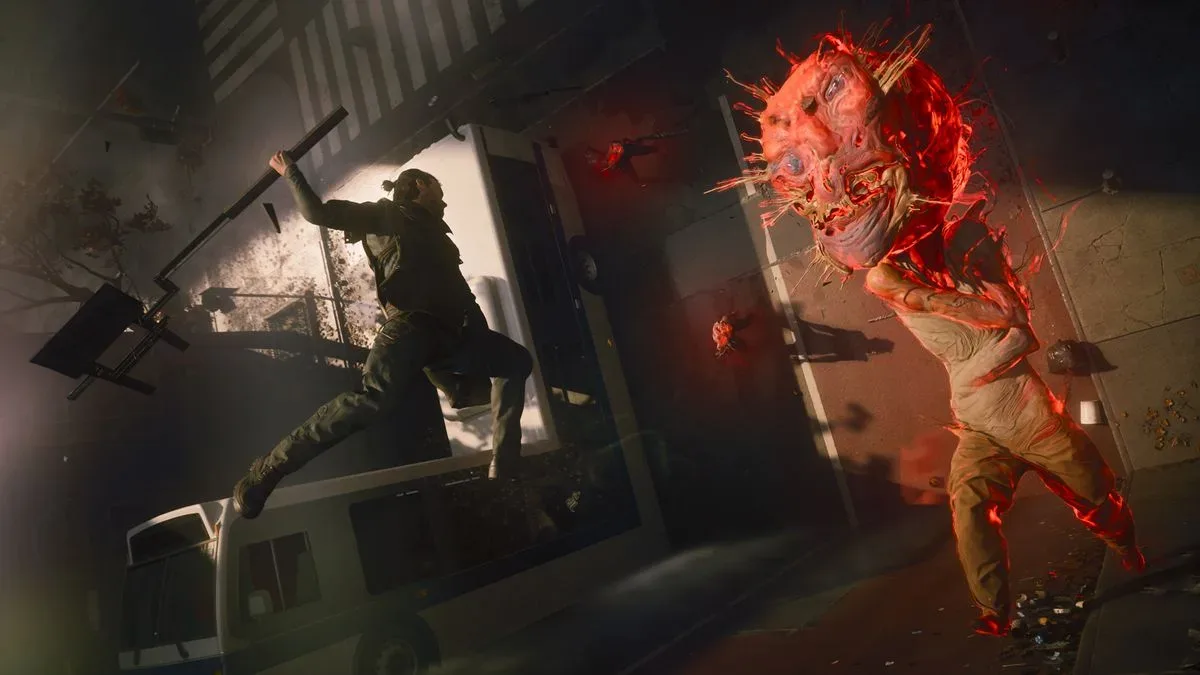
Control Resonant is taking the Federal Bureau of Control out of the Oldest House and into a Manhattan that appears to have lost an argument with a supernatural aquarium. The city’s ordinary pedestrian churn has been replaced by a luminous blue infection called the Mold, and Dylan Faden’s mission involves an especially alarming instruction: consume samples of it.
That alone is an efficient statement of intent. Remedy Entertainment’s 2019 Control made bureaucratic paranormal horror feel tactile through impossible architecture, altered household objects and documents that treated the bizarre with deadpan administrative seriousness. Control Resonant looks set to widen that premise beyond the Bureau’s shifting headquarters, putting Dylan in an overtly contaminated New York while preserving the series’ appetite for reality that has gone visibly, confidently wrong.
The game is scheduled for September 24, 2026 on PC, PlayStation 5 and Xbox Series X. What has been shown so far was a hands-off presentation, so the finer points of responsiveness, progression balance and encounter pacing remain unconfirmed. Still, the systems outlined offer a clear picture: this is an action-RPG built around close-range aggression, mobility and a shapeshifting Object of Power.
A different Faden, a different battlefield
Jesse Faden carried the first game through the unnerving internal geography of the Oldest House. Dylan, her brother, is now taking the lead in an external crisis. The move matters. Manhattan is familiar enough that a Mold takeover can feel like an intrusion into a recognizable place rather than merely another strange room in an already strange building.
It also creates a useful tension for a series about the uncanny. Streets, sidewalks and city landmarks carry expectations. They are supposed to be crowded, loud and routine. An eerily empty Manhattan coated in blue otherworldly matter turns those expectations into a warning sign. The Mold is not merely an enemy material here; it seems positioned as the visual language of a city that has been overwritten.
Dylan is not facing that disaster with conventional firearms. His main tool is the Aberrant, an Object of Power with multiple combat forms. In the shown sequence, its Drill form enables piercing melee strikes against blue, furry Mold creatures. That change does more than exchange one weapon silhouette for another. It reframes combat around staying near threats long enough to build pressure, evade danger and capitalize on openings.
The Aberrant asks players to press forward
The reported combat rules reinforce that close-quarter philosophy. Dylan cannot use healing items during combat. Instead, defeating enemies restores lost health. It is a familiar risk-and-reward structure, but one that can radically change how every room feels: backing away to reset is less attractive when survival is earned by staying engaged.
Dylan can string together attacks while hovering in place, then trigger graphic finishing moves. Those executions temporarily increase his damage output, creating a practical incentive to carry momentum immediately into the next cluster of enemies. The desired rhythm appears to be less “wait safely at range” and more “make an opening, secure a kill, then turn that advantage into another.”
Related coverage includes Control Resonant's Mold-Soaked Manhattan Could Be Its Most Unsettling Weapon.
That does not necessarily mean uncontrolled button-mashing will succeed. The presentation emphasized frequent dodging amid enemy attacks. From what has been revealed, Dylan may operate something like a glass cannon: able to inflict spectacular damage, but potentially vulnerable when caught without an escape route. That is an impression rather than a confirmed stat-sheet description, and it will take playable access to establish how punishing the balance truly is.
The design also distinguishes Control Resonant from a simple attempt to graft Soulslike conventions onto Remedy’s world. There are big bosses, phases, targeted weak points and dangerous arenas, but those ingredients alone do not settle a genre label. The disclosed mechanics point more directly toward a fast, aggressive action-RPG whose healing loop rewards offensive control of the battlefield.
Fans looking for more action-RPG possibilities across Xbox may also want to see how Fable’s Albion is shaping up around player choice, reputation and fortune-building. The games are pursuing very different moods, but both illustrate how broad the modern RPG label can be.
The Collective turns Mold into a monument of bad ideas
The boss encounter shown, called The Collective, sounds designed to sell the scale of the outbreak and the game’s willingness to venture into liminal spaces beyond New York. Dylan is transported from Mold-filled Manhattan into another dimension for the fight, where the boss manifests as multiple huge faces formed from Mold and joined into a grotesque landmark-like mass.
It is not alone. Smaller enemies continually enter the arena, complicating Dylan’s attempt to destroy specific sections of the larger creature through multiple phases. Tentacles are among the threats he must contend with. On paper, it is a fight that asks the player to split focus between an enormous objective and the immediate danger of adds, which could make the healing-on-kill rule especially important.
Whether The Collective is a representative boss, an early showcase or a one-off spectacle is not yet known. But it aligns neatly with what the series does well when it is at its most confident: turn an unsettling concept into something concrete enough to fight, yet strange enough that the player wonders who thought this was an acceptable shape for reality.
Mold powers come with a commitment
Following the boss sequence, Dylan is offered a choice between two Mold-derived abilities. One channels the substance through his arm for direct attacks. The other summons a Mold tentacle from the ground to strike independently. The notable catch is that players can select only one of these powers during a given playthrough.
That limitation could give the choice real identity instead of making it a temporary menu decision. A direct arm-based offense and an independently attacking ground summon imply distinct approaches to positioning and pressure. The former may lean into Dylan’s personal aggression; the latter may create opportunities to control space or divide enemy attention. Exact upgrades, cooldowns and build interactions have not been detailed, so these are still possibilities rather than promises.
There is, however, a safety valve for completionists and experimenters. Existing powers carry into New Game Plus, allowing players to retain their first decision while pursuing the alternative on another run. That approach keeps an initial choice meaningful without permanently shutting the door on the other ability.
The paranormal texture is the real test
Combat has a coherent hook: transform the Aberrant, evade, eliminate enemies to recover, execute targets and convert those finishers into more damage. Yet the crucial question for Control Resonant is not only whether drilling a Mold creature looks satisfying. It is whether the game sustains the disorienting curiosity that made Control more than an efficient third-person action game.
The first entry made players suspicious of the mundane. A refrigerator could be lethal. A maze could reject ordinary navigation. A children’s program could be an unsettling clue instead of harmless background noise. The series thrives when it presents an impossible thing with just enough internal logic to make it feel as though it might be hiding inside the ordinary world.
A blue plague across Manhattan is a strong opening image, but the city needs more than visual contamination. The most exciting prospect is a New York full of peculiar objects, contradictory spaces and institutional remnants that make Dylan’s assignment feel like an investigation into an impossible event—not simply a campaign to clear hostile arenas. The premise of ingesting Mold is particularly promising because it suggests Dylan’s connection to the crisis may be personal, physical and possibly unreliable.
There is also room for the series’ habit of blurring fiction and reality to evolve. The Oldest House’s confined, office-like setting made the uncanny intimate; an infected city could make it public. If Remedy can make streets and landmarks feel as suspect as a Bureau file cabinet, Control Resonant may find an unnerving new scale without losing its identity.
What is confirmed, and what still needs answers
- Release date: September 24, 2026.
- Platforms: PC, PlayStation 5 and Xbox Series X.
- Protagonist: Dylan Faden.
- Setting: New York City, including a Manhattan afflicted by the Mold, plus other liminal dimensions.
- Core weapon: The Aberrant, a multi-form Object of Power; the Drill form has been shown.
- Combat rule: Healing items are unavailable in combat, while defeated enemies restore health.
- Progression: A Mold-power choice is locked for one playthrough, with retained abilities available in New Game Plus.
What remains less certain is just as important: how much exploration Manhattan supports, how the full range of Aberrant forms functions, how severe Dylan’s apparent fragility is, and whether the balance of combat spectacle and paranormal mystery lands as effectively as the premise suggests.
For now, Control Resonant looks like a deliberate change in combat language rather than a retreat from the series’ oddness. Dylan’s drill, executions and hunger for enemy defeats may provide the forward momentum. A silent Manhattan full of blue Mold, impossible spaces and questions nobody in the Bureau can answer should provide the reason to keep walking into danger.