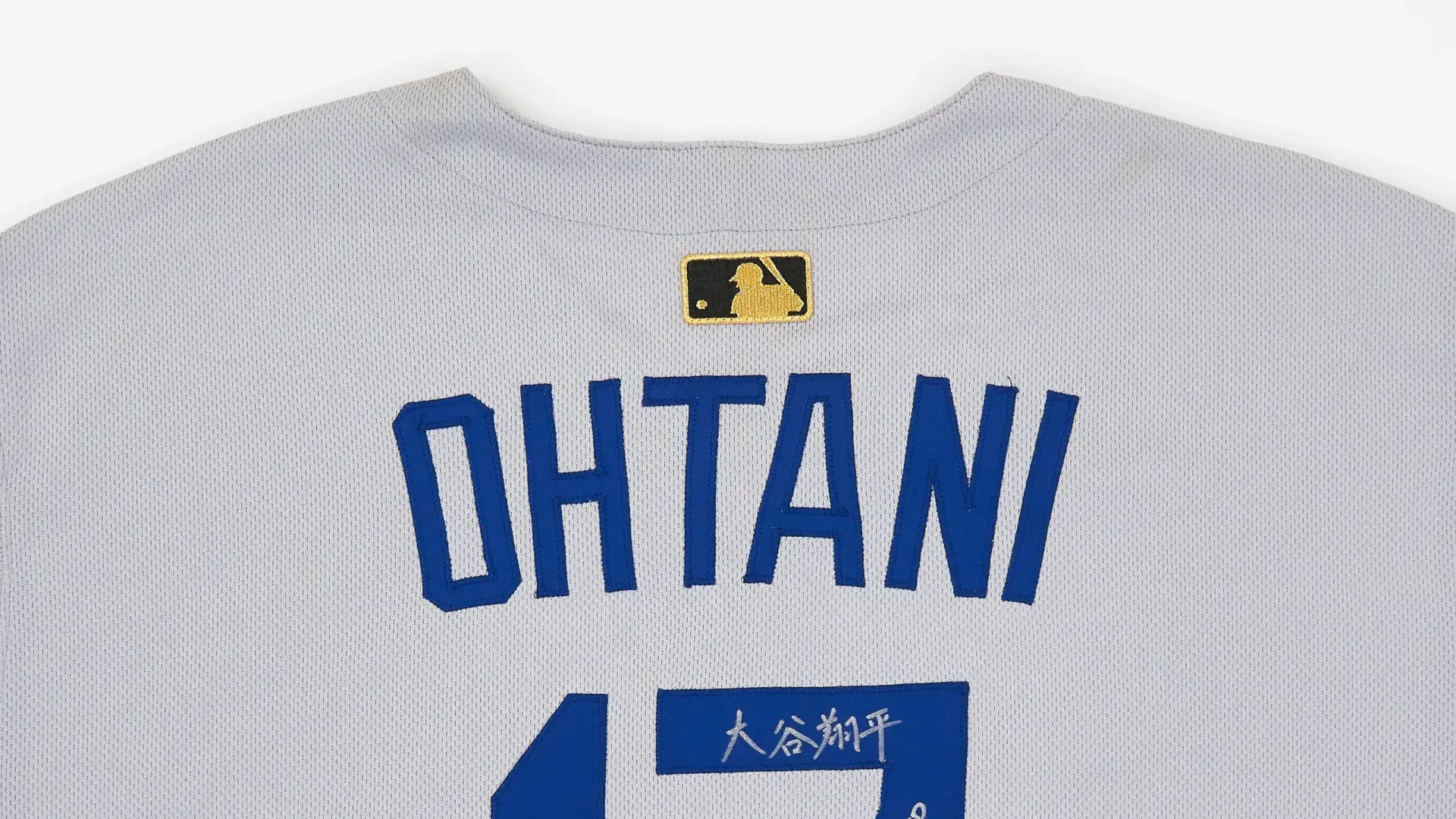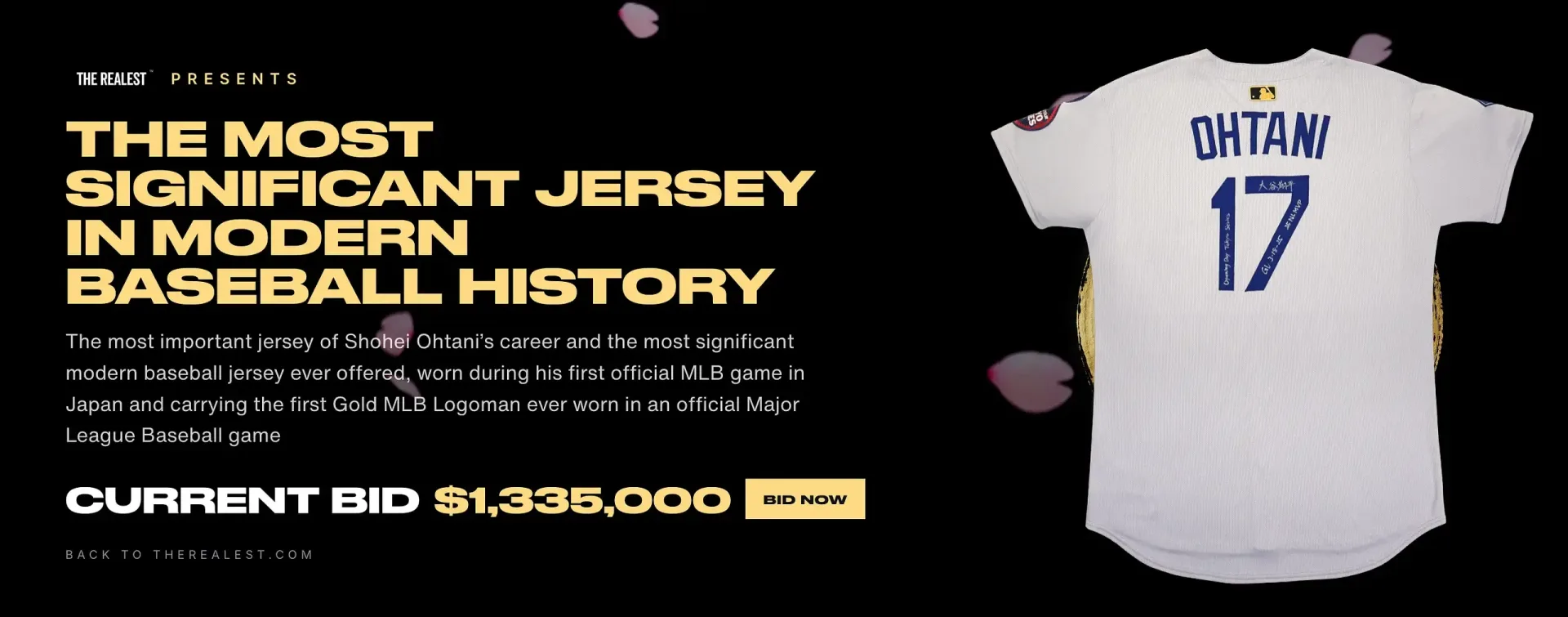
Shohei Ohtani’s Gold Logoman jersey is approaching the finish line of a major memorabilia sale, with bidding standing at $1.335 million with more than two days remaining. The item is notable not merely because it was worn by Ohtani, but because it is presented as the first Gold MLB Logoman ever worn in an official Major League Baseball game.
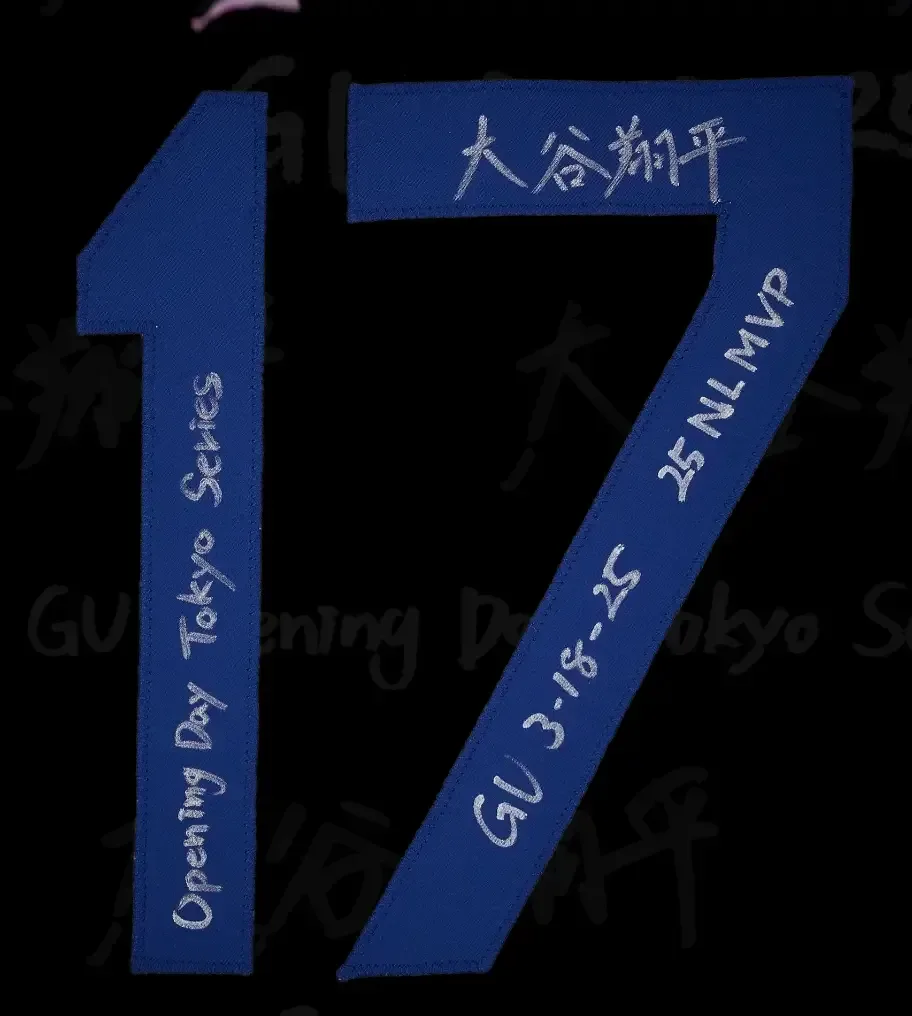
The jersey was worn on Opening Day of the 2025 Tokyo Series, Ohtani’s first official MLB game in Japan. It also carries an Ohtani autograph in Kanji, combining game use, a specific historical occasion, a claimed first-of-its-kind uniform detail and a signed inscription in one item.
The sale is accompanied by a public prediction contest: the closest eligible guess for the final sale price will receive 1% of that final price. No purchase is required to enter. With the auction set to close at 10 p.m. ET on Oct. 17, the contest turns an already high-profile sports-memorabilia result into a question with a direct cash incentive attached.
Why this jersey has a distinctive case
In collecting, “one-of-one” is often used broadly to describe something unique. Here, the argument is unusually specific. The jersey is described as the first Gold Logoman worn by any player in an official MLB game—not simply the first Gold Logoman associated with Ohtani.
A Logoman is the league-logo patch used on MLB uniforms. Its significance in this sale comes from the gold version’s claimed debut status. The value proposition therefore rests on several separate pillars:
- Player: The jersey is connected to Ohtani.
- Event: It was worn during the 2025 Tokyo Series opener in Japan.
- Milestone: It is presented as the first in-game Gold MLB Logoman.
- Autograph: Ohtani signed the jersey in Kanji.
- Singularity: Those attributes exist together in a single game-worn object.
That distinction matters because high-end memorabilia buyers often separate general scarcity from event-specific importance. A uniform can be rare without having been worn in a particularly meaningful game. It can be game-used without carrying a unique design or league milestone. It can be signed without the signature being tied to the object’s central story. This jersey’s appeal is that the facts reinforce one another rather than competing for attention.
The Tokyo setting is also inseparable from its narrative. Ohtani wore it in his home country for an official MLB game, giving the object an occasion that has relevance beyond an ordinary regular-season appearance. The Kanji autograph adds another direct connection to that Japanese context. It is not necessary to treat an autograph style as a guarantee of value to recognize why collectors could view it as a meaningful fit for this particular artifact.
What the $1.335 million bid does—and does not—tell us
The current $1.335 million figure establishes that bidding has already placed the jersey in a rarefied price range. It does not establish its final result. Auctions can change materially in their last days or final moments, particularly when several motivated bidders are waiting to reveal their limits.
That is why the 1% prediction promotion has an inherently difficult target. Contest entrants are not trying to decide whether the jersey is important; the bid level already indicates serious demand. They are instead trying to estimate the precise intersection of competing budgets, bidder urgency and the eventual winning increment.
At the current bid alone, 1% would equal $13,350. If the sale closes higher, the contest payout rises with it. The promotion is funded from the seller’s buyer’s premium, meaning the platform says it is sharing part of its own fee rather than reducing the stated final price by the amount of the prize.
A buyer’s premium is an additional fee paid by the successful bidder on top of the hammer price in many auction formats. The relevant point for the contest is that the stated prize comes from the platform’s share of that structure. Potential entrants should still review the contest entry details and terms where they submit a prediction, especially if there are tie procedures, eligibility limitations or requirements affecting how “closest” is determined.
A useful comparison, but not a price formula
The sale arrives after another enormous jersey result: Michael Jordan’s “Last Dance” jersey sold for $12.26 million, a reported record for a basketball jersey. That result illustrates the premium the market can place on a player widely regarded as generational, a famously significant career moment and a unique item with powerful cultural recognition.
Still, comparisons in elite memorabilia work best as context rather than calculators. Basketball and baseball have different collecting ecosystems. A Jordan jersey and an Ohtani jersey carry different game histories, audiences and supply narratives. Even within a single athlete’s market, a uniform’s exact game, condition, authentication, presentation and provenance can change how bidders assess it.
The more useful takeaway is that major game-worn apparel can command eight-figure prices when the player, occasion and uniqueness align at an exceptional level. Ohtani’s jersey has its own case built around the inaugural Gold Logoman, the Tokyo Series opener and the Kanji signature. Its result will show how bidders weigh that specific combination, not whether it can be mechanically matched to another athlete’s sale.
The Ohtani Gold Logoman precedent in cards
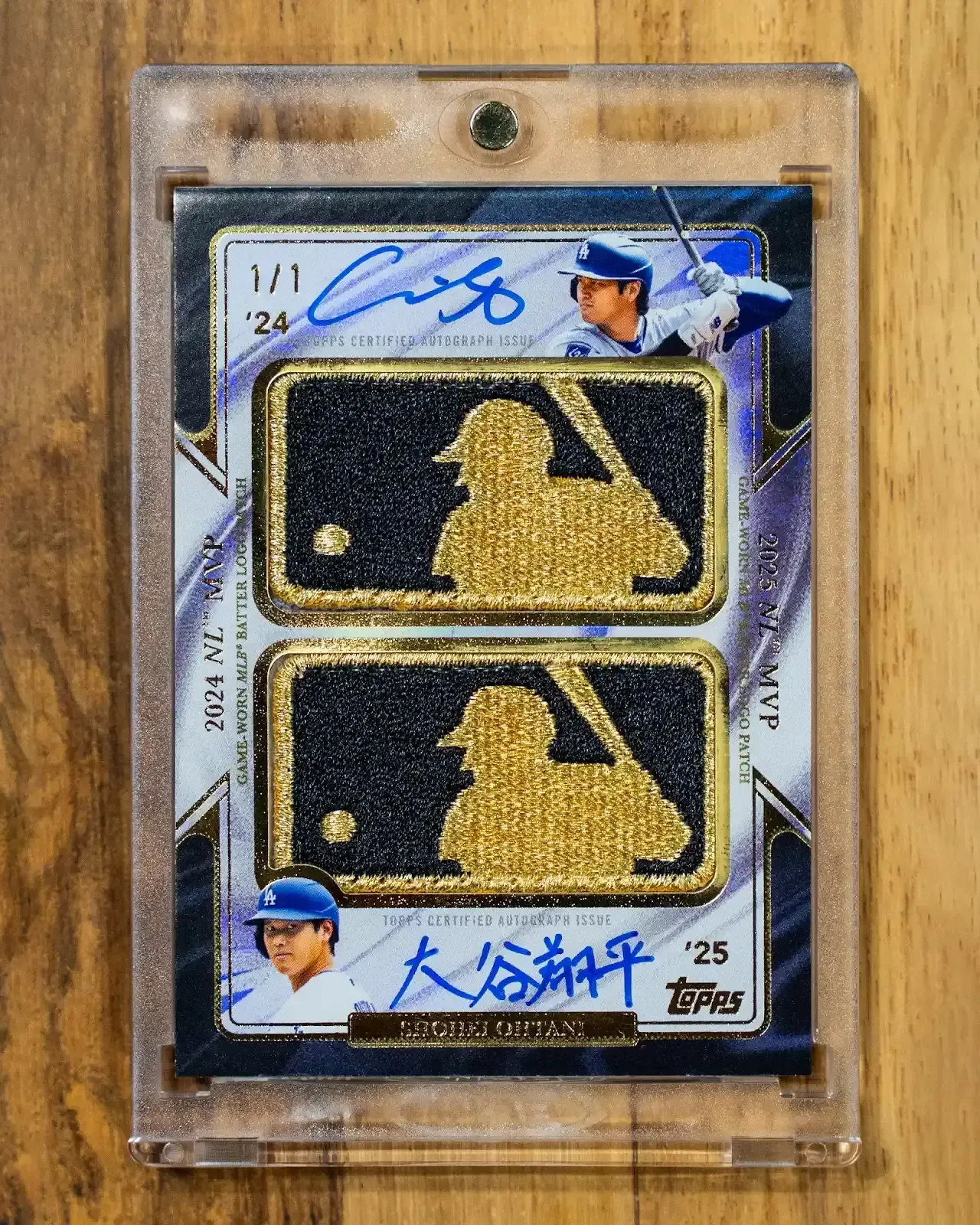
There is also a recent Ohtani-adjacent benchmark from the trading-card world. A collector in Florida pulled a 1/1 Shohei Ohtani Back-to-Back Dual Logoman Autograph card, including a Kanji inscription, and the card later sold to Kevin O’Leary and Shyne for $11 million.
That transaction is not a direct equivalent to a game-worn jersey. A trading card is a manufactured collectible with relic and autograph elements, while this auction concerns a full uniform item tied to a documented on-field occasion. But the card sale is important evidence that high-end buyers have already shown extraordinary appetite for an Ohtani Gold Logoman concept when it is paired with extreme scarcity and an autograph.
It also demonstrates why the wording around “Gold Logoman” deserves care. The card was a 1/1 dual-autograph relic; the jersey is a game-worn garment described as the first Gold Logoman used in an official MLB game. Both may be scarce, both may feature Ohtani and Kanji, but they are separate collectibles with separate reasons for collector interest.
How to think about the prediction contest
For anyone entering, the task is fundamentally a final-price estimate rather than an investment decision. The current bid provides a floor only until another bid is placed. A sensible prediction must account for the fact that there are still more than two days before the close and that a unique, headline-grade item can draw late action.
The highest-profile facts are the ones likely to shape attention: Ohtani’s stature, the Japan homecoming setting, the first Gold Logoman claim and the Kanji autograph. At the same time, a prediction contest rewards closeness, not simply choosing a dramatic number. Entrants should make sure their submission reflects the exact price format requested and is entered before the deadline.
The wider appeal is easy to understand even for people who do not regularly bid on sports artifacts. The sale places a physical piece of baseball history beside the modern language of scarce collectibles: a first, a unique mark, an autograph and a moment tied closely to the athlete’s identity. It is the same sense of singular event history that makes collectible culture compelling across categories, including entertainment projects that lean into nostalgic game-show aesthetics, as seen in a recent retro game-show remix video.
For this auction, though, the only number that will settle the debate is the final sale price after the Oct. 17 close. Until then, $1.335 million is a substantial snapshot of interest—not the answer to the contest.