Babe Ruth’s road jersey from Game 3 of the 1932 World Series sold for $24.12 million, setting a record for sports memorabilia. The gray wool uniform is associated with perhaps the most replayed, debated and mythologized act in baseball: Ruth’s so-called “Called Shot” home run in Chicago.
The staggering total naturally places the jersey in the same conversation as the hobby’s other headline-making landmarks. It surpassed the $12.6 million paid for a 1952 Topps Mickey Mantle card in 2022, as well as the $10.1 million auction result for a Michael Jordan jersey worn in the 1998 NBA Finals. It also puts Ruth’s most valuable uniforms far beyond even his formidable bat market: a 1929-21 game-used Ruth bat brought $1.85 million in April 2023, then a record for a baseball bat.
For Tom Stevens, Ruth’s grandson, the total was enormous but not astonishing. He sees a broad relationship between the heights reached by modern sports economics and the premiums attached to icons from the past. The earlier sale history makes the leap especially vivid: this same jersey changed hands 19 years earlier for $940,000.
That does not mean every piece connected to Ruth carries the same kind of market weight. Nor does it mean that a Ruth family member is simply a bidder waiting for an artifact to appear. Stevens owns a replica of the famed road jersey, follows sales involving his grandfather’s possessions, and keeps family pieces for their stories as much as for any potential valuation. The distinction is the central lesson of the Ruth collecting world: an item’s financial worth can be immense, but its personal meaning may be impossible to price.
A record result tied to an unresolved baseball moment
The jersey’s appeal is inseparable from its claimed connection to the Called Shot. In Game 3 of the 1932 World Series, Ruth gestured during an at-bat and then hit a home run to center field. The outcome is not in dispute. What remains unsettled is the meaning of the gesture: did Ruth deliberately point toward where he intended to hit the ball, or was he responding to the game and crowd in some other way?
That uncertainty is not a defect in the artifact’s story. It may be part of what makes the jersey so potent. Collectors often pursue objects that sit at the intersection of confirmed history and lasting cultural argument. Here, the uniform is linked to an event everyone recognizes, even if the exact choreography will never receive a universally accepted reading.
Stevens has stressed that available film does not conclusively settle the question. The surviving home movie was filmed from behind home plate, limiting what it can establish. He believes it clearly shows Ruth gesturing, while leaving the nature and specifics of that gesture open to interpretation. Family testimony has consistently leaned the other way: Ruth’s daughter Julia Ruth Stevens said he did point, and granddaughter Linda Ruth Tosetti recalled an eyewitness approaching her mother, Dorothy Ruth Pirone, in Cooperstown decades later to insist that Ruth had done so.
That is a useful distinction for collectors and fans. An artifact can have strong, well-documented connection to a game and a player without proving every legendary detail attached to that game. The jersey’s sale does not make the Called Shot debate disappear. Rather, it illustrates that the debate has become part of the object’s historical identity.
What “game-used” means in this context
Game-used refers to an item worn or used in competition, as opposed to a retail replica, a later commemorative piece, or equipment merely associated with a player. That status can dramatically affect collector interest because it connects an object to an athlete’s working career rather than to their public image alone.
But game use is only one layer of appeal. A Ruth uniform from an ordinary game and a Ruth uniform connected to a defining World Series moment do not carry the same narrative force. The 1932 jersey combines player, event, team, postseason stage and a century-old piece of sporting folklore in a single garment. That density of association helps explain why it became a record-setting object.
The family collection is a story archive, not a vault of trophies
Stevens says he was surrounded by Ruth material while growing up. His mother, Julia Ruth Stevens, displayed authorized Ruth merchandise and family photographs in her home. The range included statuettes, mugs, plates, steins, a Wheaties box and Red Rock Cola bottles bearing Ruth-related labels. There were also photos of Ruth with family members and celebrities, reflecting how thoroughly he crossed from baseball stardom into American popular culture.
Some of the most meaningful pieces in Stevens’ possession are not necessarily the artifacts likely to produce the most dramatic auction estimate. He treasures a baseball bearing the signatures of Ty Cobb, Tris Speaker and Ruth, a gift from his grandmother Claire. He also has Ruth signatures on materials such as bank deposit slips, though he notes that signatures rendered as George Ruth or G. H. Ruth do not typically command the same market as a classic “Babe Ruth” autograph.
That difference highlights a basic principle of autograph collecting. A signature is not a single, uniform product. Presentation matters: the exact form of the autograph, the item signed, the condition of both signature and surface, and whether additional signatures change the display appeal can all shape collector demand. A pristine ball signed only by Ruth can be more commercially desirable than a multi-signed ball, even where the latter has deeper family significance.
Claire Ruth also received continuing autograph requests after her husband’s death. Stevens recalled that she sometimes provided cancelled checks or bank documents. This is a reminder that the public’s appetite for Ruth’s signature did not begin with the modern auction boom. It was sustained by decades of fan interest, including direct requests to those closest to him.
An autograph culture built on access and generosity
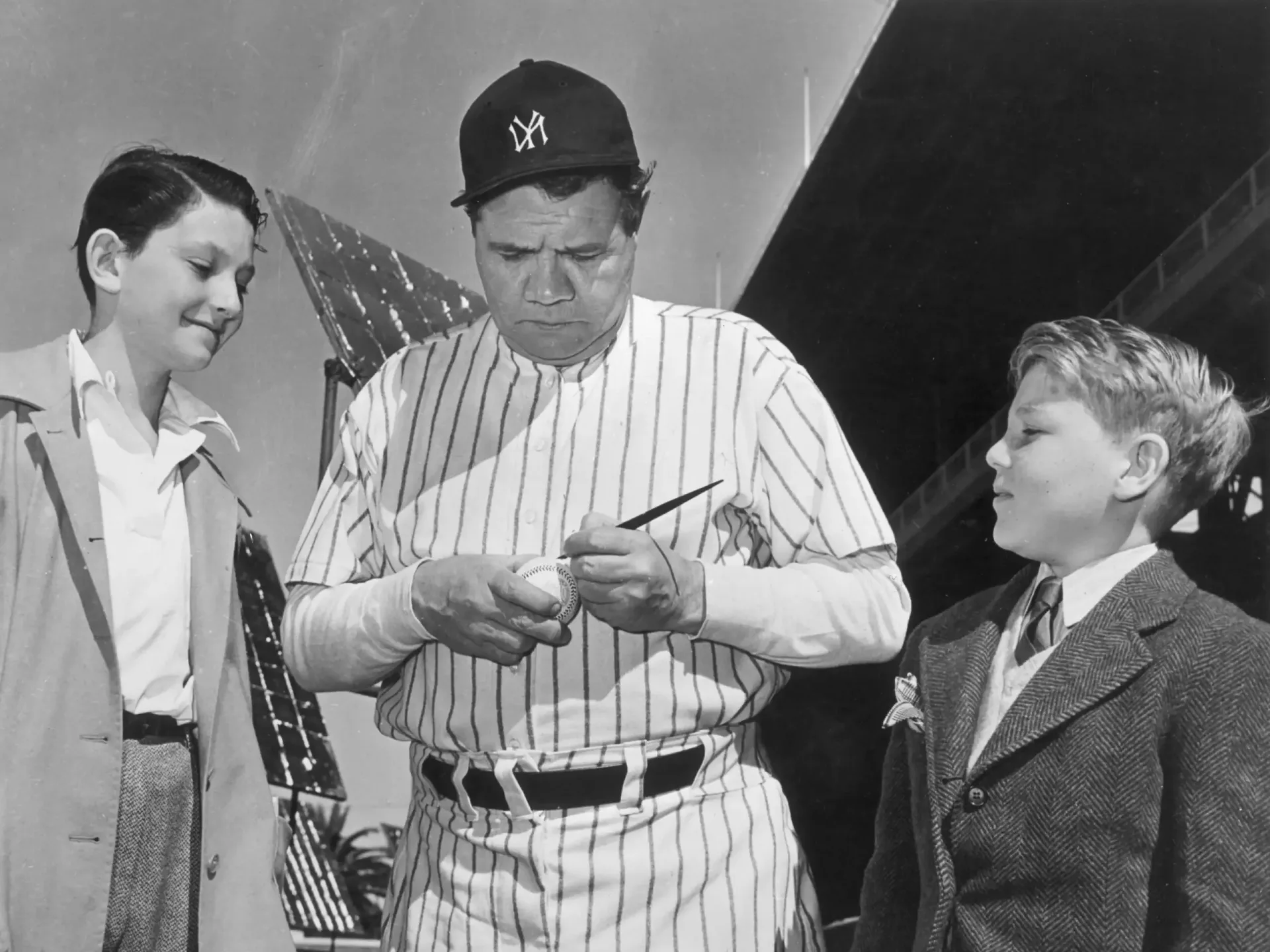
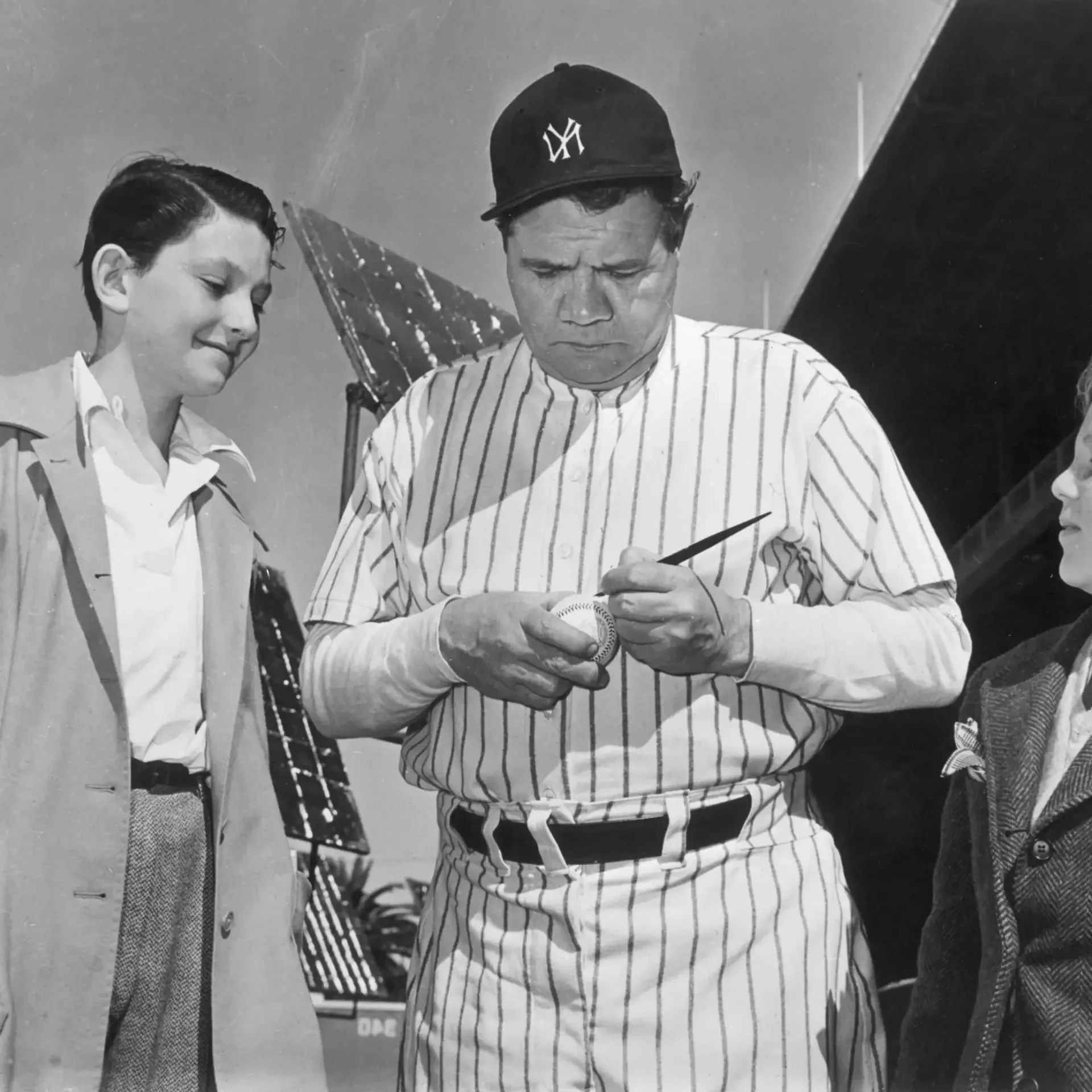
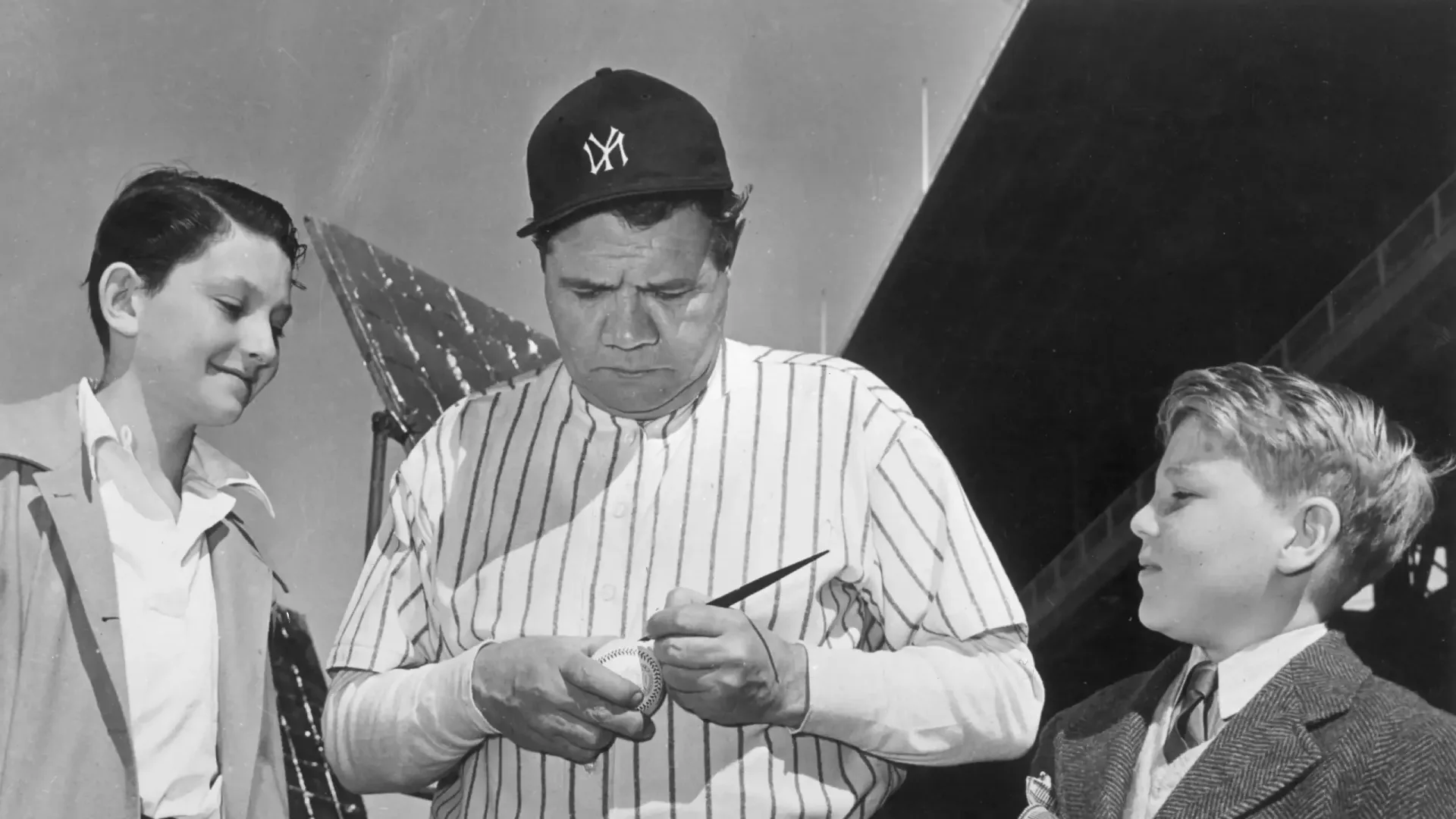
Ruth’s autograph legacy is unusually large in part because he was known as a generous signer. Stories passed down in the family describe him signing for children even late in life, including during his final hospitalization, when youngsters waited below his window. The signed items were reportedly delivered by a nurse or dropped down to the fans.
Stevens experienced a later version of baseball’s comparatively accessible autograph culture through his grandmother. As a child, he spent spring breaks visiting Claire Ruth and attending Yankees games, sometimes on Opening Day. He came away with photographs alongside Mickey Mantle, Roger Maris, Tom Tresh, Bobby Richardson, Elston Howard and Clete Boyer. He had collected cards too, especially pursuing Mantle and Willie Mays, but personal access offered something a card could not: a memory of meeting the athletes.
Those early encounters also explain why condition cannot be the only consideration in a family collection. Stevens says many autographs he obtained have faded. In a commercial setting, fading usually reduces appeal because legibility and visual strength are important. In a personal archive, the diminished ink does not erase the event behind it. The object is still evidence of a visit, a relationship and an era of baseball.
For modern collectors, that is a worthwhile boundary to remember. A collection can contain investment-grade pieces, personal keepsakes, display objects and historical documents all at once. Treating every item solely as inventory strips away the context that made many collections worth assembling in the first place.
Why the biggest Ruth artifacts are outside the family
Stevens does not have the game-used bats and uniforms that could transform a family collection into an auction powerhouse. In Claire Ruth’s Riverside Drive apartment, he remembers a cedar chest holding uniforms and a duffle bag filled with bats. As a boy, he tried to swing them, initially needing to choke up close to the trademark before gradually moving his hands farther down the handle.
He never reached the knob. That detail matters because the knob was developed by Louisville Slugger for Ruth’s end-of-the-bat grip. It is a small, physical connection to the way an iconic hitter handled his tools—and a glimpse of why a game-used Ruth bat means more than merely old wood with a famous name attached.
Those bats and uniforms eventually ended up elsewhere. Meanwhile, Ruth’s executors gave almost all of his memorabilia to the Baseball Hall of Fame, which Stevens says Ruth wanted to support. The institution has enough Ruth material that it rotates objects rather than displaying every artifact at once, and it maintains a dedicated Ruth gallery rather than only a small display case.
That decision has a major practical consequence: important Ruth material can be preserved for public storytelling instead of being permanently hidden in a private collection. It also means scarcity in the marketplace should not be confused with scarcity of history. There may be fewer premier pieces available to buy precisely because so much significant material was directed toward institutional preservation.
The issue of private ownership versus public preservation is relevant far beyond baseball. A recent debate around game prototypes and a developer archive shows how collectibles of all kinds can carry obligations as cultural records, not just potential resale value.
Ruth remains a benchmark, even as the records change
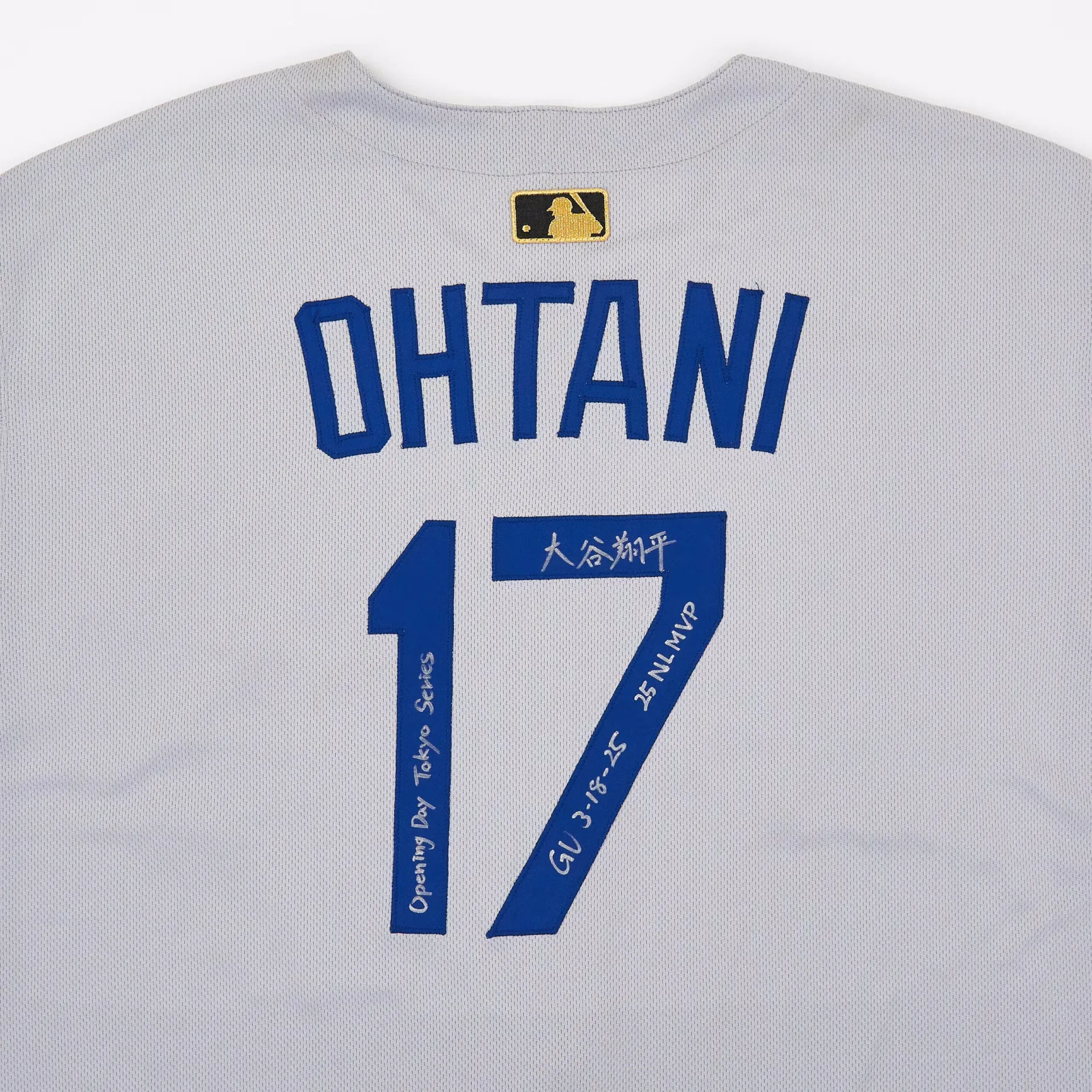
Ruth’s cultural power is not based on one jersey, one autograph or one disputed gesture. It survives because his on-field profile remains extraordinary. Stevens noted that Ruth’s two-way legacy has again become a major point of reference in the era of Shohei Ohtani. Ruth’s career WAR is listed at 182.6, nearly 15 points ahead of Walter Johnson, with his pitching and hitting combined in the same figure.
WAR, short for wins above replacement, is a statistic designed to estimate how many wins a player adds compared with a readily available replacement-level player. In Ruth’s case, the combined value is especially notable because it incorporates both the pitching excellence he established early in his career and the offensive dominance that made him a legend.
He is also credited here with the greatest career OPS and OPS+. OPS adds on-base percentage and slugging percentage, combining a player’s ability to reach base with their power production. OPS+ adjusts OPS for league and ballpark context, making it useful for comparisons across different environments. These measures help explain why Ruth still occupies a special place even after many of the more than 50 MLB and American League records he retired with were surpassed.
Ruth’s World Series pitching marks and his unusual blend of pitching and hitting preserve that relevance. So does the simple durability of the mythology around him. More than 70 books have been written about Ruth, Stevens says, and new ones continue to appear. He and Ruth’s great-grandson Brent Stevens have added Out of the Mouth of Babe, a coffee-table book compiling famous attributed quotations along with lesser-known facts and trivia.
What the $24.12 million jersey actually says about collecting
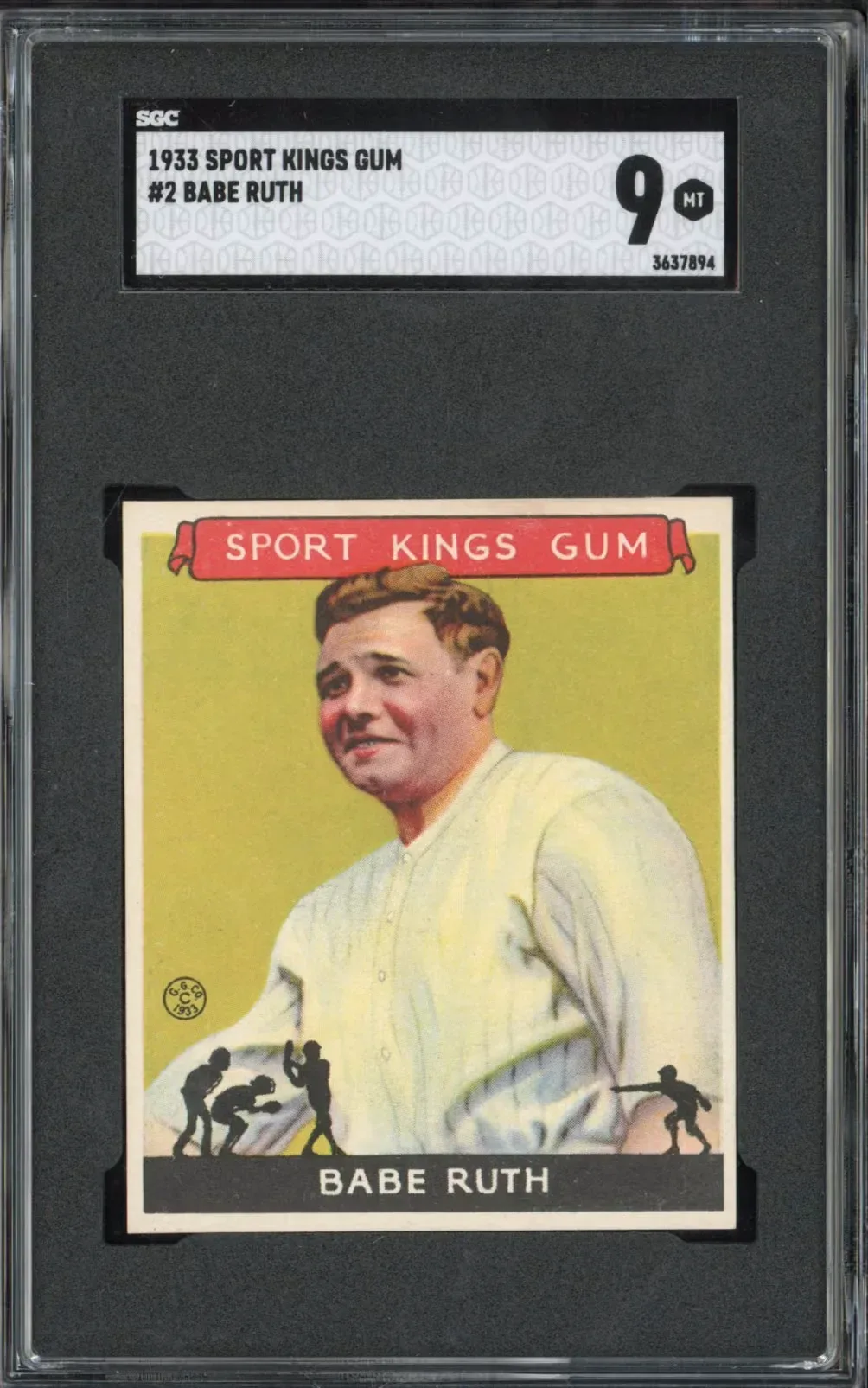
The record jersey is not a blueprint for ordinary collectors; almost no one can participate at that financial level. Its more useful message is about the ingredients that endure. Ruth’s market has not been sustained by one collectible category. It encompasses uniforms, bats, signatures, contracts, cleats, photographs, family material, promotional merchandise and cards.
It is also driven by a story that remains legible to new fans. The Called Shot is easy to describe, hard to conclusively settle and impossible to detach from Ruth’s larger image. That combination gives the 1932 jersey unusual power: it is an object from a real game attached to a legend that keeps generating conversation.
For those watching sports collectibles at any budget, the best takeaway is not that every historic item will rise from $940,000 to more than $24 million. High-profile results are exceptional, and the market is shaped by factors far beyond fame. Instead, Ruth’s example shows why provenance, context, condition, authenticity and narrative association should be considered together. The more clearly an artifact connects to a meaningful moment, the more durable its appeal may be.
Stevens has four grandchildren, and says they are now becoming interested in Babe Ruth. That is perhaps the most revealing detail in the entire story. A record auction can quantify public demand, but legacy moves through family stories, museum displays, faded signatures and young people asking why an old gray wool jersey matters. In Ruth’s case, the answer is still being written.