A notably unusual version of Hartung’s Game Master handheld has appeared in an eBay listing, giving retro-hardware collectors another chance to examine a machine that spent much of its life outside the better-recorded history of Nintendo and Sega’s portable systems.
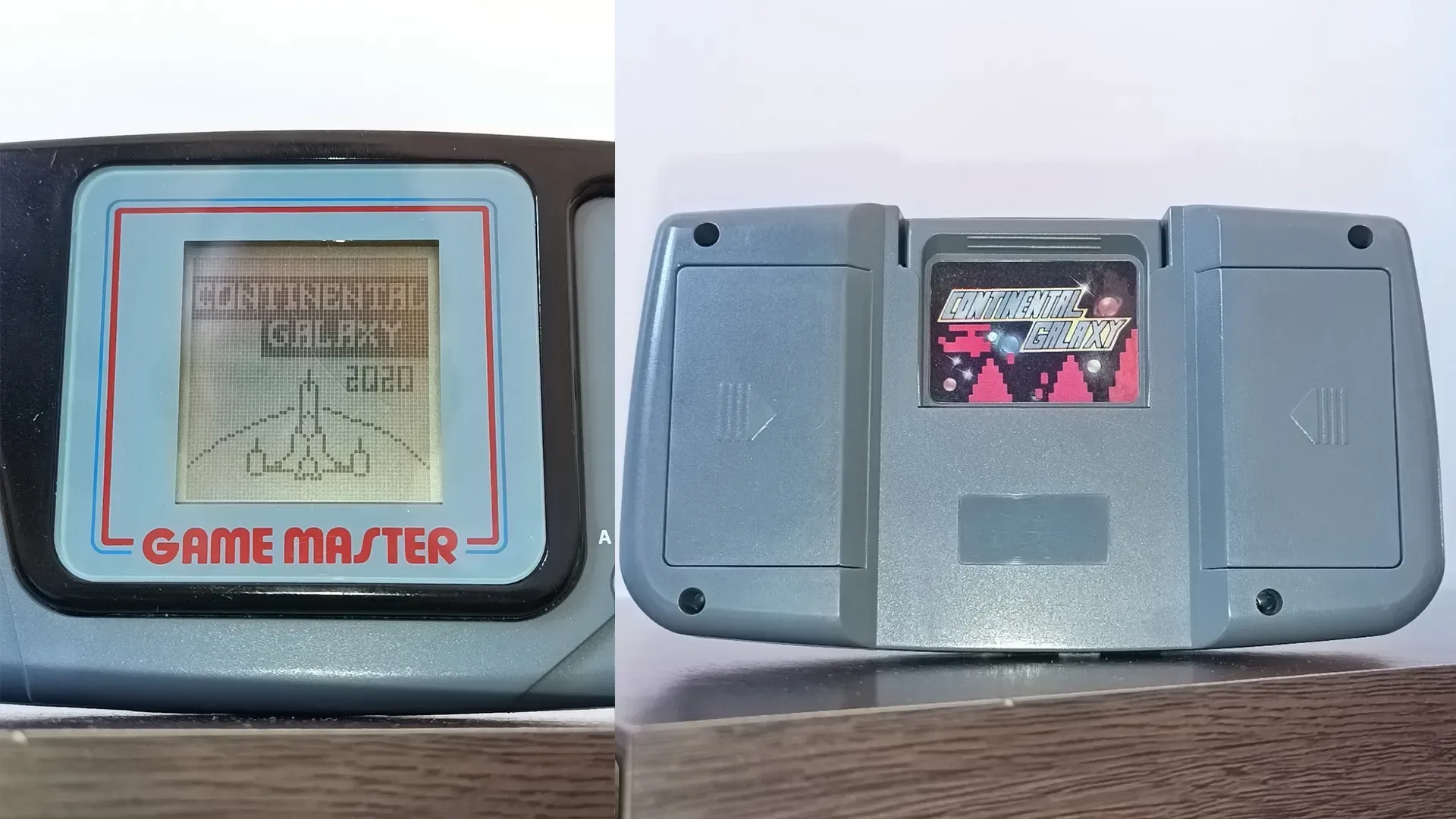
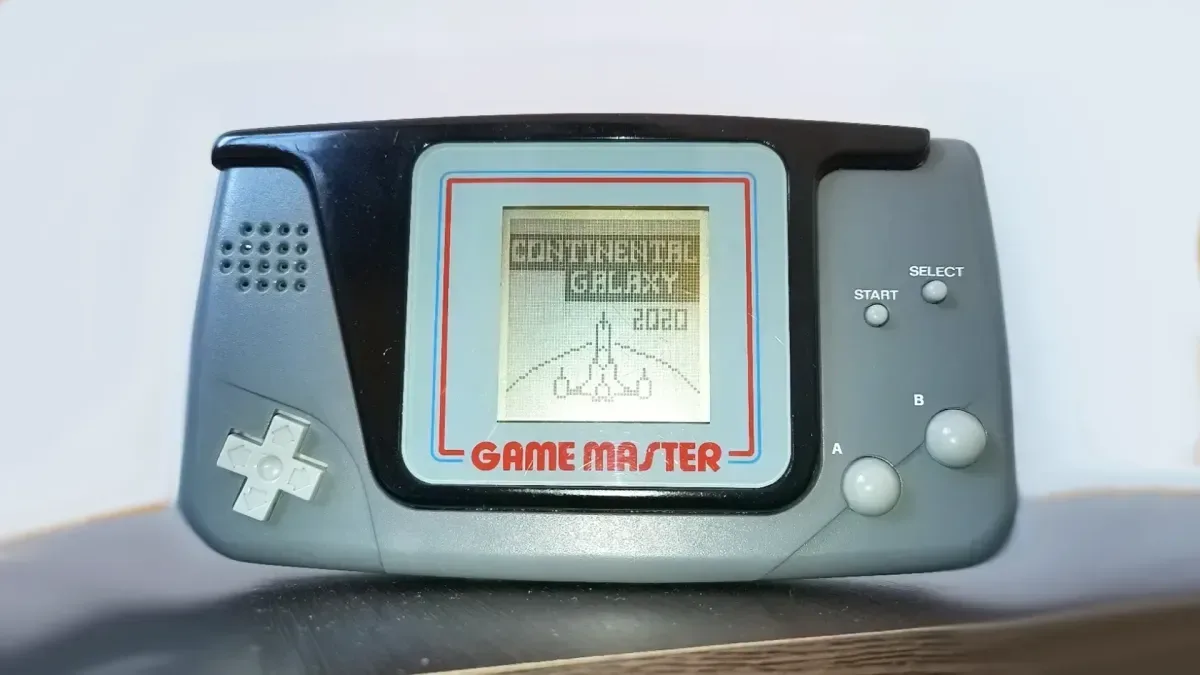
The console is presented as a Game Master from an early Taiwanese production run. Its most immediately visible distinction is a red-and-blue screen surround paired with grey buttons. The seller also points to an unmarked battery compartment as another feature separating it from more familiar examples. Those details make the unit interesting; they do not, on their own, establish its production order, distribution territory, or total surviving population.
That distinction matters. The seller says only three examples have been documented in their research and regards this as one of them, but there is no supplied production data confirming that only three were manufactured or still exist. The idea that it was a Taiwanese exclusive is similarly presented as a possibility rather than a settled fact. For a genuinely obscure machine with multiple regional names, cautious language is not a hedge—it is the most useful way to describe it.
A forgotten challenger with many names
Hartung made the Game Master as a handheld competitor in the era of Nintendo’s Game Boy. The system is associated with 1990 and was originally sold in Germany, later reaching the UK, Italy, France, Spain and China. Its fragmented identity is part of the reason that identifying variants can be difficult today: the same basic family was also known as the Game Plus, Systema 2000, Super Game and Game Tronic.
That naming history is more than a piece of trivia for collectors. A variant is a version of a product distinguished by traits such as casing graphics, buttons, labels, internal revision or regional branding. When one hardware family is sold under several names across several territories, online searches can split the surviving record into separate pockets. A collector looking only for “Game Master” may miss a comparable console listed under one of its alternative names, while a difference that looks regional may instead reflect a different production batch—or simply a change made at an unknown point in manufacturing.
The listed handheld is described as a Game Master rather than one of those alternate brands, but its claimed Taiwanese origin is precisely the kind of question that demands documentation beyond a single surviving object. Without factory records, confirmed retail packaging, catalogues, distributor material, or a wider set of matching examples, the most responsible description is that it is an unusual purported Taiwanese early-run unit.
What is claimed to set this Game Master apart
The listing identifies three physical characteristics as the basis for its early-production claim:
- Grey buttons rather than silver ones.
- No stickers or markings in the battery area.
- A red-and-blue colour treatment around the display that differs from other examples.
These are useful identification notes, especially because they are concrete and can be checked in photographs. They may help future owners and researchers compare examples without relying only on memory or marketplace descriptions. Still, “first production run” is a stronger claim than “visibly different.” A first run normally means the earliest manufacturing batch, and proving it ordinarily requires dated evidence or a reliable sequence of revisions. The supplied information does not establish that sequence.
Related coverage includes Ultra-Rare Game Master Handheld Listing Highlights a Forgotten Game Boy Rival.
There is also a practical preservation angle here. The absence of battery corrosion is specifically noted, as is a working display. On a vintage handheld, battery leakage can damage contacts and nearby circuitry, so a clean battery compartment is a meaningful condition point rather than cosmetic window dressing. A functioning screen is equally relevant, although neither detail confirms the condition of every component or cartridge connector.
The console is said to include Continental Galaxy 2020, adding an original game cartridge to the package. That makes the lot more complete as a display and research item, but it should not be mistaken for confirmation that the cartridge was originally bundled with this particular hardware variant. The available details only establish that it is included with this listing.
Why the machine matters despite its limited reputation
The Game Master never became a mainstream portable success, and its design is described as resembling Sega’s Game Gear in form. Its wider appeal today is therefore unlikely to come from nostalgia on the same scale as the Game Boy’s. Instead, the interest is in seeing an alternative path from the early handheld market: a device that tried to compete with much larger rivals, reached several markets under shifting identities, and now survives in comparatively thin numbers and records.
That is an important difference between rarity and demand. Rarity describes how seldom an item appears or how few examples may remain. Demand describes how many people actively want it. A mainstream console can have extensive collector demand even when many units survive. A little-known handheld can be very hard to find while still appealing to a narrower audience. Neither quality automatically proves a marketplace value; condition, originality, documentation, regional appeal and the number of motivated buyers all play a role.
For the Game Master, uncertainty is part of the object’s story. There is no confirmed count of Taiwanese units, no documented proof in the available information that three is the total number of survivors, and no verified explanation for every visible difference. That leaves room for future research—but it also means a buyer should value the machine for what can be seen and supported, rather than treating an unverified scarcity claim as settled history.
The asking price and what a buyer should document
The listing carries a buy-it-now price of €1,000, also presented as £838 and $1,120. Those figures identify the seller’s asking price at the time described, not a confirmed sale value or market benchmark. With an item this uncommon, a single listing is especially poor evidence for a stable price: there may be few direct comparisons, and the eventual sale outcome is not provided.
Anyone considering an obscure handheld at that level would be wise to preserve the listing photographs and description before a purchase. The useful record is not merely proof of payment; it is a snapshot of the details used to identify this unit. In this case, that includes the display colours, button colour, battery compartment, casing condition, cartridge, and the stated claims around origin and production timing.
Buyers should also separate observations from interpretations. “The battery compartment has no corrosion” is an observable condition statement. “This is one of only three in existence” is a population claim that currently lacks confirmed supporting data. Keeping those categories separate is good collecting practice, particularly with hardware whose history may only be reconstructed one console at a time.
Originality deserves the same care. Before treating a difference as a factory variation, a purchaser would want close images of the shell, screws, labels, battery contacts, cartridge slot and display area, along with any available provenance. Provenance means an item’s ownership and history of origin. It can be helpful evidence, but it is not automatically conclusive, especially when a device’s early distribution is unclear.
A listing that could help build the record
Even if the “one of three” wording cannot be verified, this Game Master has value as a documented data point. Clear photographs and a careful record of its features may help enthusiasts identify additional related units in the future. If another red-and-blue, grey-button example appears with the same unmarked battery area, the case for a discrete revision becomes stronger. If examples surface with conflicting details, the story may prove more complicated.
That slow accumulation of evidence is familiar across unusual physical collections. Individual owners often bring little-known pieces to light through online listings, though the challenge is distinguishing an item’s demonstrable traits from the story attached to it. The same wider dynamic can be seen when personal collections enter public marketplaces, as with high-profile personal items moving into online listings: visibility can create a useful public record, but it does not replace careful authentication and research.
For now, the strongest supported description is straightforward. This is a well-preserved, working Game Master with a distinctive red-and-blue faceplate, grey buttons, an unmarked battery compartment and an included Continental Galaxy 2020 cartridge. It is offered as an early Taiwanese-run example, but that attribution and its reported three-unit documentation count remain unconfirmed. For collectors of overlooked portable hardware, that combination of visible differences and unanswered questions may be exactly what makes it worth watching.