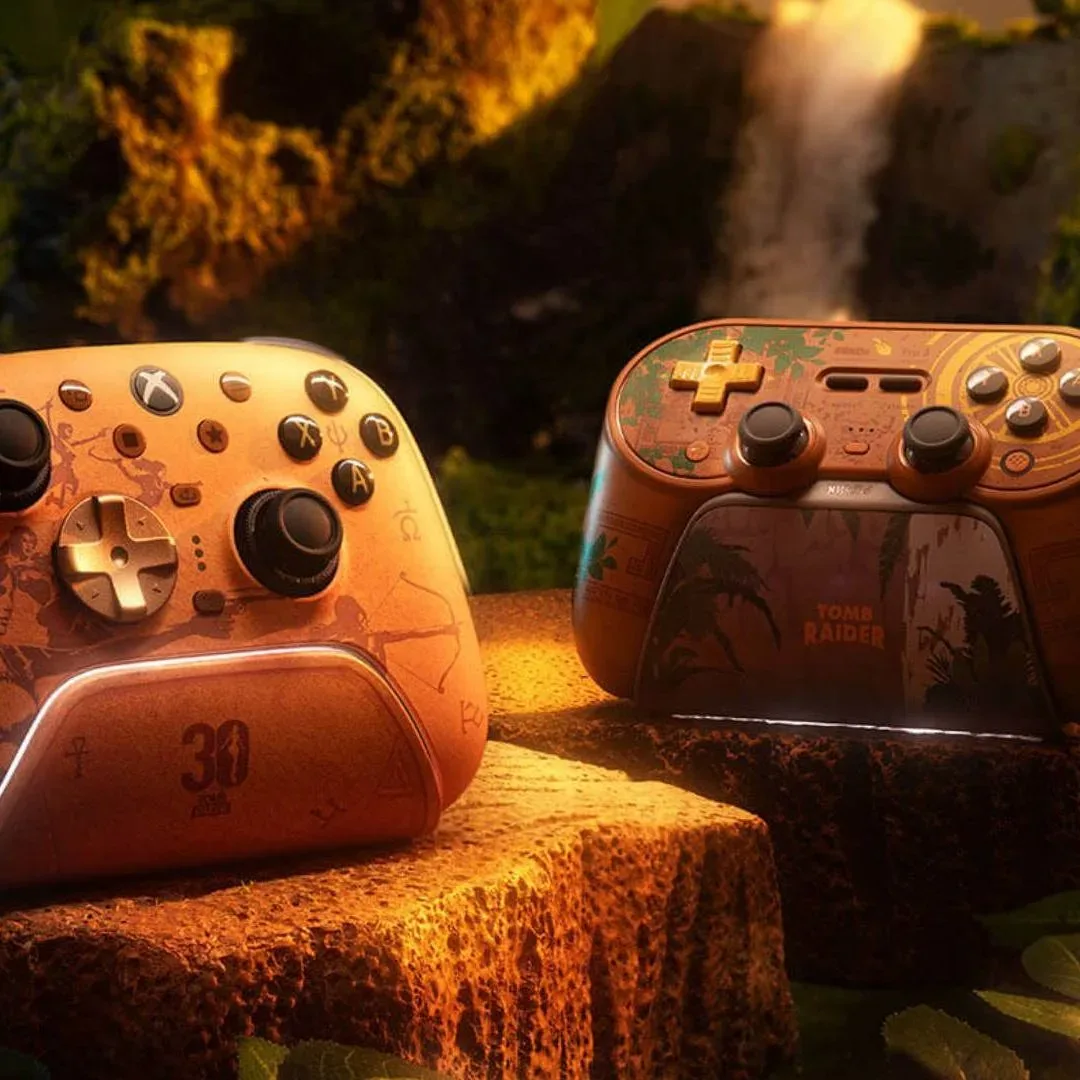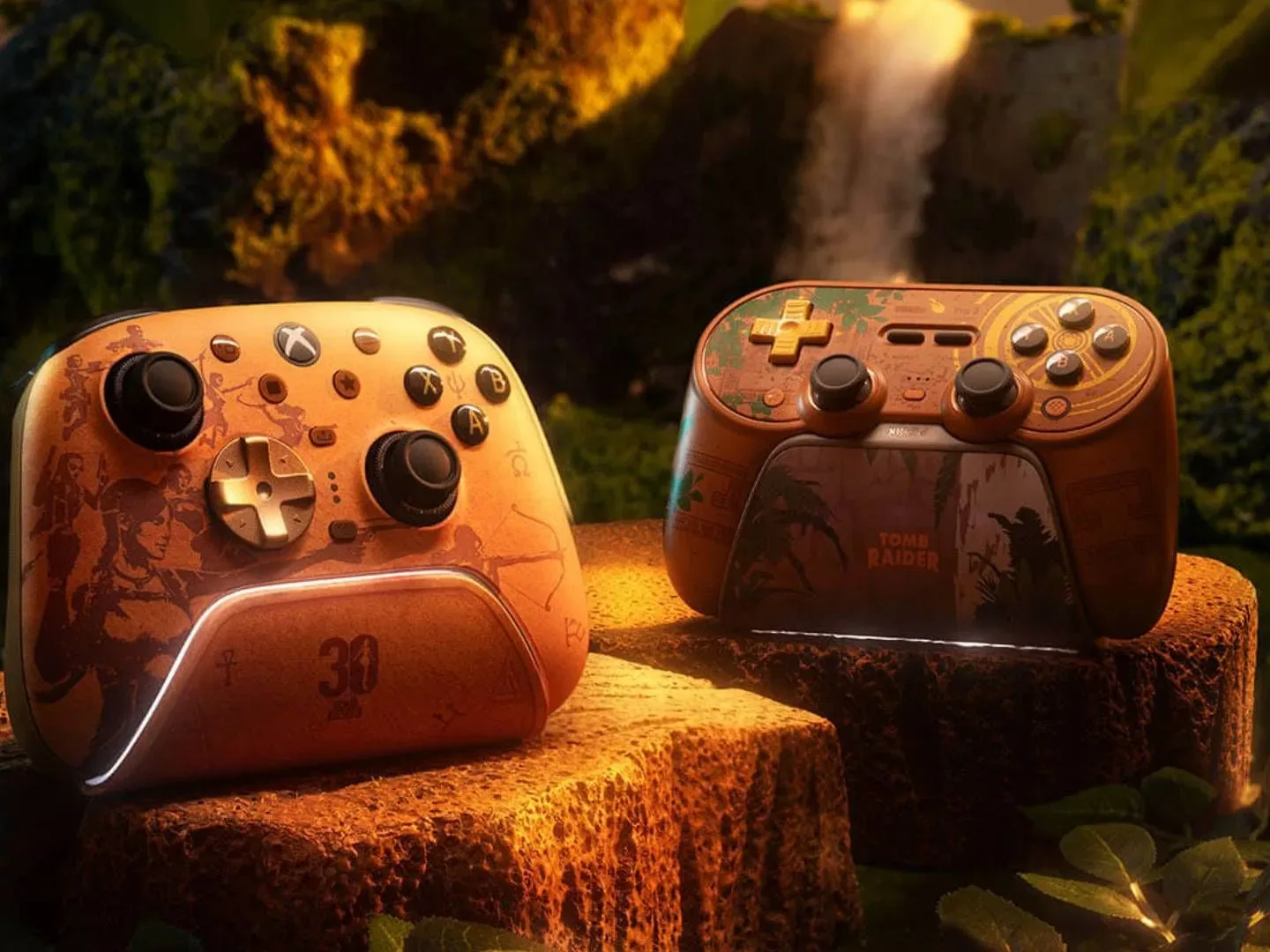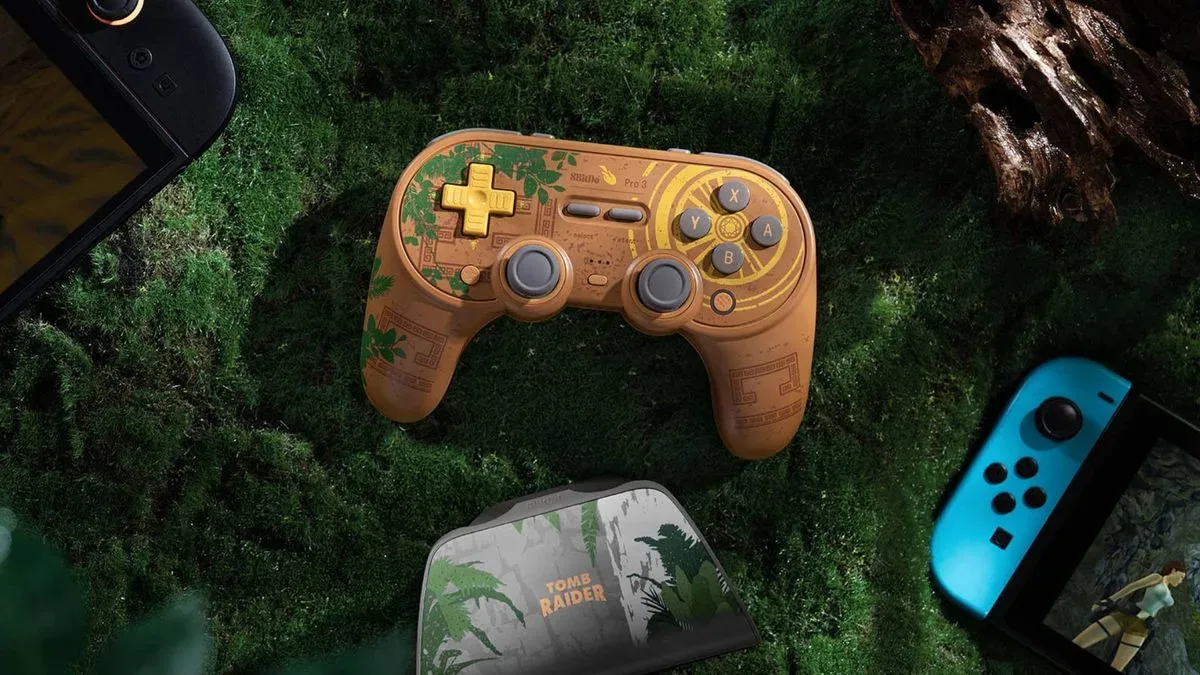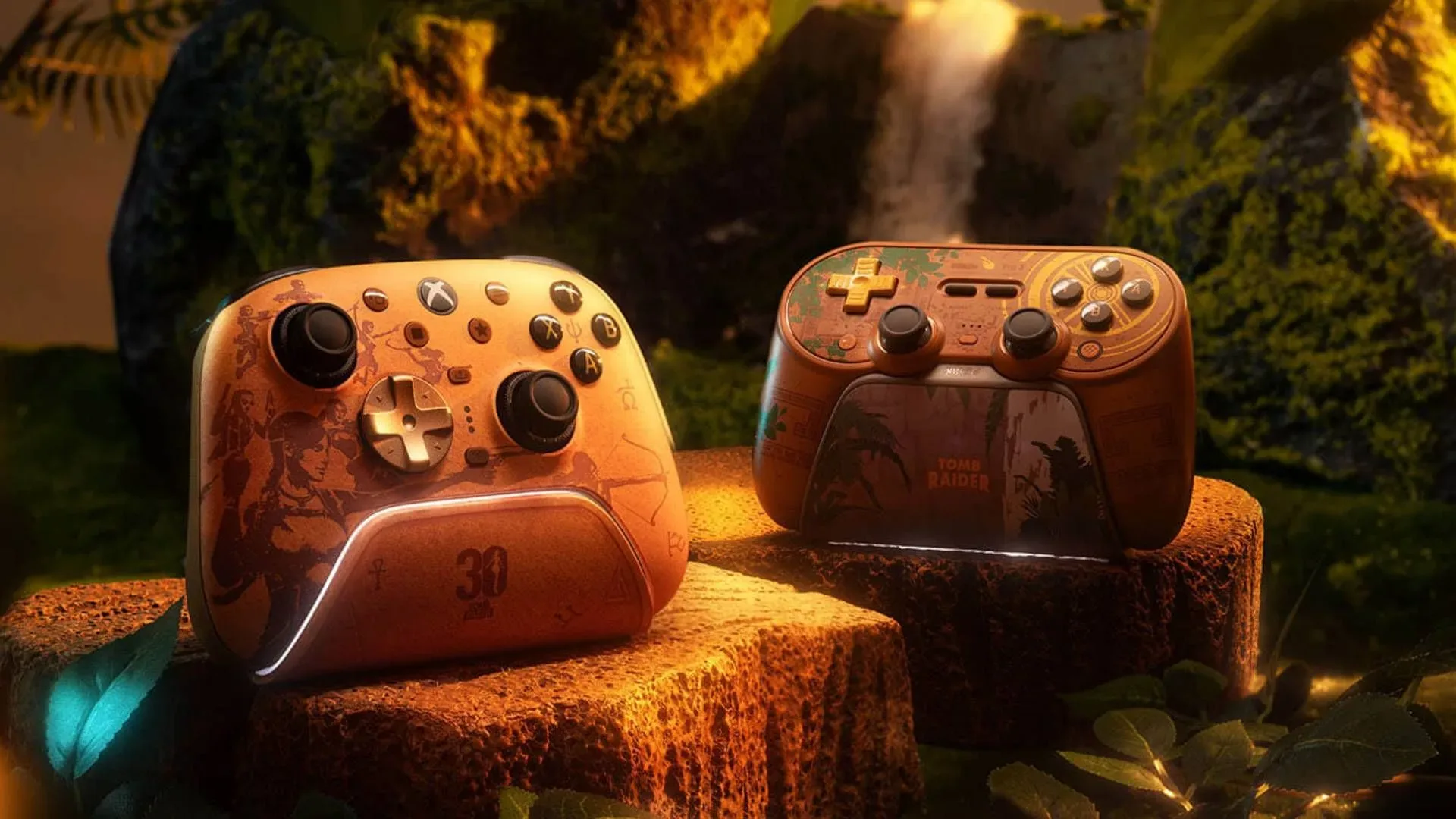
Tomb Raider began in 1996, and 8BitDo is marking the series’ 30th anniversary with two official controllers that approach Lara Croft’s legacy from notably different directions. The Tomb Raider editions of the Ultimate 3 and Pro 3 retain the core hardware and layouts of their respective existing models, but their visual treatment is anything but incidental: one is built around Lara across multiple eras, while the other leans into the ancient, perilous atmosphere of the original game’s Lost Valley.
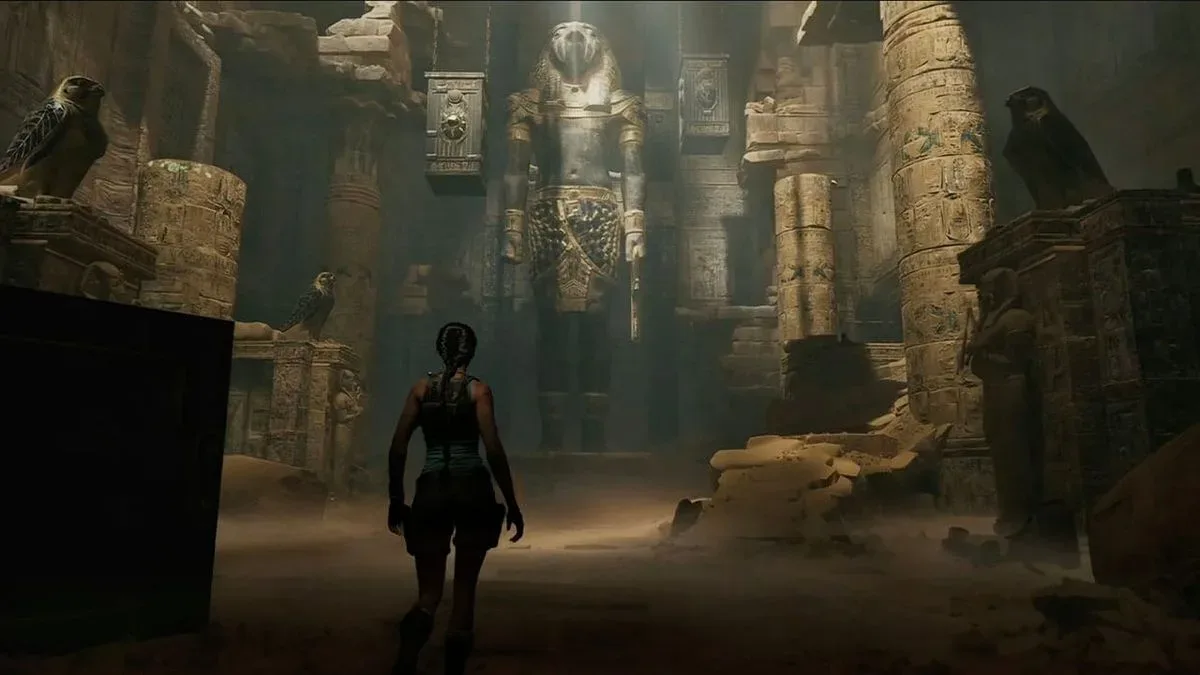
Both controllers are expected to launch on October 24. The timing gives Tomb Raider fans anniversary hardware well before Tomb Raider Legacy of Atlantis, which is listed for release on February 12, 2027. That makes the pads less a tie-in to one newly released game than a compact retrospective of a series that has repeatedly reinterpreted its central character.
Two controllers, two readings of Tomb Raider
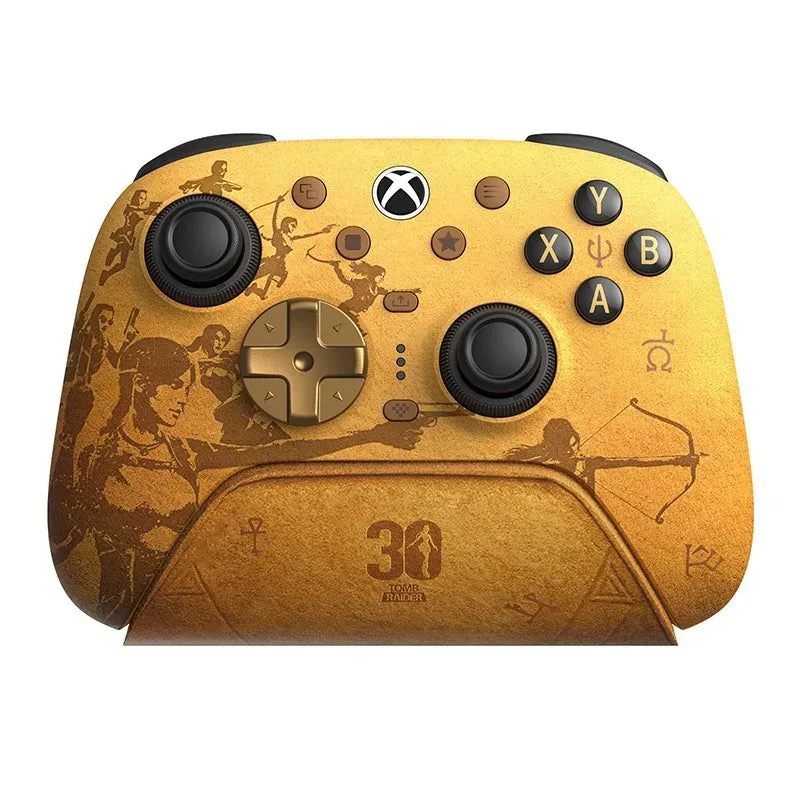
The Tomb Raider Ultimate 3 treats Lara herself as the centerpiece. Its left-side artwork presents dark-gold silhouettes of several versions of the adventurer, including the new Legacy of Atlantis depiction, Survivor-era Lara, and the original polygonal incarnation. It is a useful distinction for a 30th-anniversary item: this design is not limited to one game, costume, or generation of players.
Gold details run through the Ultimate 3’s presentation, including its zinc-alloy D-pad and a matching 30th Anniversary charging stand. The effect is deliberately artifact-like rather than merely logo-forward. It gives the controller a more ceremonial identity than a normal color variant, while keeping its artwork tied to Lara’s evolution from the angular 1990s original to her later reinventions.
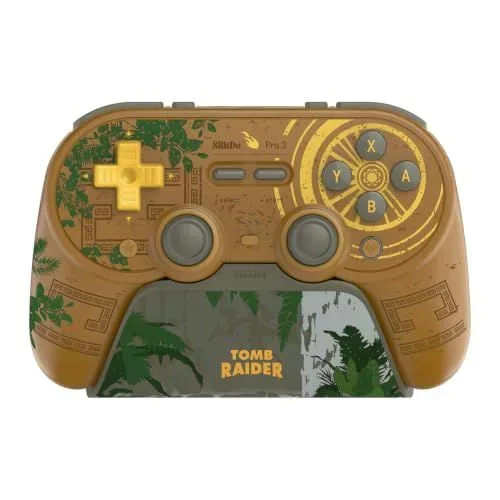
The Tomb Raider Pro 3 takes the opposite route. Instead of surveying the whole franchise through Lara’s changing appearance, it pays tribute to the Lost Valley, an iconic original-game location associated with the T-Rex encounter. Its faceplate uses an ancient-relic visual language, and its charging stand has a stone-texture print intended to resemble a plinth displaying a recovered treasure.
That makes the Pro 3 the more specific nostalgia piece. The original Tomb Raider’s environments, creatures, and sense of archaeological danger are the focus, rather than Lara as a character icon. It is also an especially fitting match for the Pro 3’s controller shape, which recalls the original PlayStation SCPH-1080 controller.
What is included with the Pro 3 edition
8BitDo’s Pro 3 package adds more than a themed shell and stand. It includes interchangeable ball-top joystick caps in a turquoise shade that echoes Lara’s original outfit, along with a set of grips coordinated with the relic-style faceplate design. Those accessories matter because they extend the concept beyond a printed surface. Owners can alter the visible controls and grips while staying within the same Tomb Raider design language.
The stand is arguably the defining display feature of this edition. Charging stands are often treated as utility accessories, but the stone-plinth treatment turns this one into part of the presentation. For someone who intends to leave the controller on a desk or shelf between sessions, that makes the Pro 3 read more like a deliberately composed anniversary object than a controller that happens to carry franchise branding.
Related coverage includes 8BitDo Reveals Tomb Raider 30th Anniversary Ultimate 3 and Pro 3 Controllers.
The practical hardware remains familiar
Neither product is a ground-up controller redesign. These are special editions of existing 8BitDo models, and that is important for prospective buyers weighing their visual appeal against the premium over standard versions.
The Tomb Raider Ultimate 3 has TMR sticks, Hall-effect trigger buttons, remappable bumper buttons and back buttons, plus Bluetooth and 2.4GHz wireless support. In practical terms, remappable inputs are controls that can be reassigned to other functions, letting players move preferred commands to bumpers or rear buttons when supported by the controller’s configuration options. Bluetooth and 2.4GHz are two wireless connection methods included with the model.
Its listed price is $119.99. A standard Ultimate 3 is stated to cost $10 less, so the anniversary treatment carries a $10 difference for its franchise art, gold-finished details, and themed stand rather than an exclusive change to the core feature set.
The Pro 3 retains its own modern additions: TMR sticks, back buttons, and magnetic ABXY buttons. The ABXY labels refer to the familiar cluster of face buttons on many controllers. The model’s stated MSRP in other colorways is $69.99, while the Tomb Raider version is listed at $79.99 at Amazon—again, a $10 gap that puts the special-edition value primarily in its design and included themed components.
For readers comparing controller collaborations on function first, the compatibility details should remain central. A themed peripheral can be attractive on a shelf, but its input layout, wireless options, and platform fit are what determine whether it will become a daily-use pad. That distinction was also central to the appeal of the CRKD Les Paul controller’s Xbox and PC compatibility discussion: licensed hardware is most compelling when the practical use case is clear alongside the branding.
Which anniversary controller fits which fan?
The choice is less about a major divide in technical ambition and more about what a buyer wants the controller to commemorate.
- Choose the Ultimate 3 for Lara’s full history. Its silhouette artwork explicitly spans different versions of the character, making it the broader celebration of the franchise’s changing identity.
- Choose the Pro 3 for original-game atmosphere. The Lost Valley theme, turquoise joystick caps, relic-style faceplate, and stone-print stand give it a concentrated 1996-era identity.
- Compare against the standard models if appearance is not decisive. The Tomb Raider editions cost $10 more than the cited standard-model pricing, while the described functional feature sets remain those of the normal Ultimate 3 and Pro 3.
- Think about display as well as play. Each includes a themed charging stand, but the Pro 3’s plinth-like stand has the more overt artifact-display approach.
Why the designs work as anniversary hardware
Anniversary peripherals can sometimes stop at a logo, a color swap, and a commemorative number. These two designs instead pull from recognizable parts of Tomb Raider’s visual vocabulary. The Ultimate 3 uses the central figure who has carried the franchise through successive incarnations. The Pro 3 reaches for place, mood, and one of the original game’s most memorable threats.
That split is meaningful because Tomb Raider has enough history to support both approaches. Lara Croft is the immediately recognizable symbol; Lost Valley and the T-Rex are the more targeted references for players whose attachment begins with the first game. The special editions do not force either group into the same version of nostalgia.
The approaching release of Tomb Raider Legacy of Atlantis also gives the Ultimate 3’s mix of Lara designs an added point of interest. Its center-stage depiction of the new version sits beside Survivor Lara and the original polygonal model, visually compressing decades of character redesign into a single controller face.
At their listed prices, the question is straightforward. Buyers seeking the standard feature set as cheaply as possible can save $10 with the cited regular editions. Buyers who want anniversary artwork, dedicated stands, and—in the Pro 3’s case—additional themed caps and grips are the audience for these releases. With both expected on October 24, 8BitDo’s pair offers two distinct ways to put Tomb Raider’s 30-year legacy in players’ hands.
Shop the products
Check current price, model and availability at the retailer.