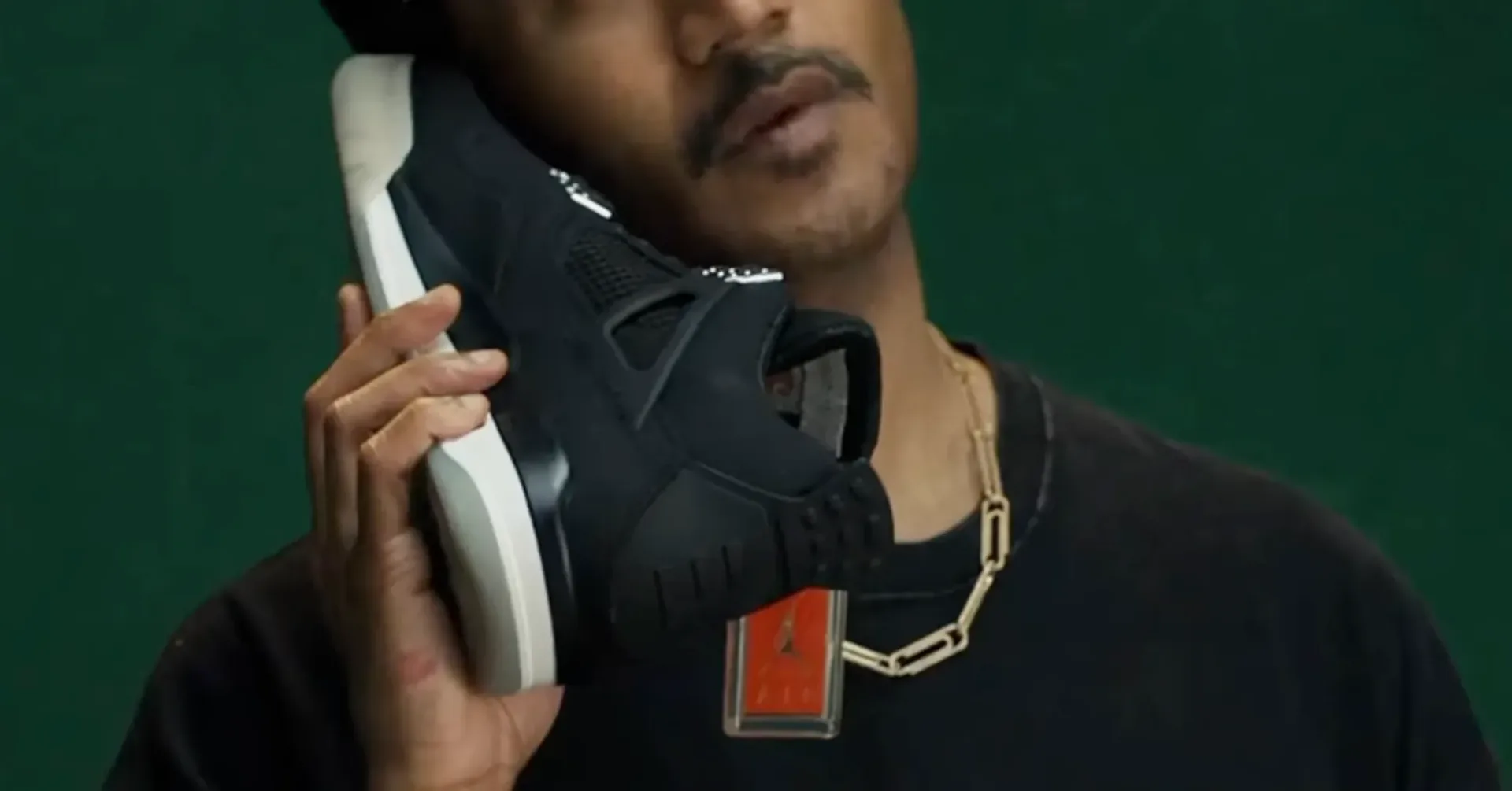
Don C is putting 14 pieces from his personal collection onto StockX Listings, creating a tightly curated sale that spans unreleased footwear, development samples, luxury bags and apparel. The asking prices range from $600 to $50,000, but the headline is not merely the upper end of that range. It is the concentration of objects that were never standard retail products in the first place.
The Just Don founder’s selection is the second instalment of the platform’s LISTED series, following a collection associated with former NBA player P.J. Tucker. For sneaker and streetwear collectors, the Don C group is notable because it combines several different kinds of scarcity: an unreleased shoe, samples, a stated one-of-one bag, collaborative releases and pieces connected to long-running overlaps between music, basketball, luxury fashion and sneaker culture.
An unreleased Kanye West x Nike Air 180 is the central attraction
The most consequential item in the group is a Kanye West x Nike Air 180 made around the period of The College Dropout that was never publicly released. An unreleased product differs fundamentally from a difficult retail release. A limited shoe may have had a small production run and a public route to purchase; an unreleased shoe was not made available to the broader buying public at all.
That distinction matters because collectors cannot use a conventional retail history to assess an item’s place in the market. There is no original launch date, official shelf price or widely established number of pairs included in the available details. Its appeal instead rests on its association with an earlier era of Kanye West’s Nike relationship, the Air 180 silhouette and its status as a piece that did not reach consumers.
It also makes comparisons difficult. Asking prices are seller-set figures, not completed-sale records, and a rare item can be especially hard to benchmark when there are few, if any, public points of comparison. A $50,000 ask may communicate how highly a seller values an object, but it does not establish a final market value. The ultimate sale result, if a sale occurs, is the more meaningful data point for collectors watching the category.
What “sample” and “one-of-one” mean here
Several lots are identified as samples, including two Travis Scott x Air Jordan 4 pairs, a volt Nike LeBron 9 Elite and an NBA x Louis Vuitton leather jacket. In product-development language, a sample is generally a version made during the process of developing, evaluating or presenting a product rather than a normal consumer-retail unit. It may differ from a final release, may never have been sold at retail, or may represent a project that did not proceed in the same form.
That label is important, but it is not a universal shortcut to value. Collectors will care about the precise model, the connections around it, its physical state, whether it is visibly distinct from a production version and what documentation accompanies it. The supplied sale details establish that the listed Travis Scott x Air Jordan 4s and LeBron 9 Elite are samples; they do not provide a production count, condition description or a complete development history for each one.
The collection also includes a Louis Vuitton Christopher Backpack described as a one-of-one designed by Don C himself. One-of-one means that an item is presented as a singular example rather than one member of an edition or retail run. That can make it compelling to buyers who value uniqueness, particularly when the design is tied directly to a figure with a long-standing role in the streetwear scene. Yet uniqueness and liquidity are not the same thing: an object can be genuinely singular while still having a relatively narrow group of potential buyers.
That is why the collection is more interesting as a set of individual stories than as a uniform investment category. The Air 180 speaks to unreleased sneaker history. The backpack foregrounds designer authorship. The samples invite interest in the development process. The released collaborations offer more familiar reference points. Each item needs to be judged on the evidence available for that particular listing rather than treated as interchangeable “rare” merchandise.
The broader lineup crosses footwear, fashion and bags
The footwear is not limited to early Kanye West material or Jordan samples. Don C’s listings also include grey and black KAWS x Air Jordan 4 pairs, as well as the Carhartt x Eminem x Air Jordan 4. Those names point to a collector landscape where collaboration itself is part of the object’s identity: a sneaker can represent not just a design but a meeting point of artist, musician, brand and cultural moment.
On the luxury side, the group includes Ye’s white Louis Vuitton Jasper, multiple Louis Vuitton x Supreme bags and a Gucci x adidas shoulder bag. The Jasper is especially consistent with the broader theme of a collection built around the intersections of Ye, luxury fashion and sneakers. The Louis Vuitton x Supreme bags bring another major fashion collaboration into the sale, while the Gucci x adidas piece reflects a more recent-style brand crossover within the assortment.
The NBA x Louis Vuitton leather jacket sample expands the sale beyond what many people narrowly call sneaker collecting. This is a closet sale in the literal sense: shoes sit beside bags and clothing, and each category attracts a somewhat different kind of buyer. Someone seeking a wearable accessory may assess a bag differently from a collector pursuing a historically important prototype. Someone pursuing a jacket sample may be interested in its place in a collaboration rather than in sneaker-market comparables.
In practical terms, the mixed format means browsing every listing’s individual details is more useful than reacting to the sale as one block. A buyer interested in one pair of sneakers may have no reason to value a bag or jacket in the same way. Conversely, the full collection may appeal to collectors interested in the through-line of Don C’s career and network rather than one particular product category.
Why Don C’s connection to these pieces matters
Don C founded Just Don in 2011 and helped run RSVP Gallery with Virgil Abloh. He has also been a long-time member of Kanye West’s inner circle. Those connections give context to why a personal collection might include pieces linked to Ye, Nike, Air Jordan, Louis Vuitton and related circles of fashion and music.
Provenance is a key term in collecting: it refers to an object’s ownership history and, more broadly, the record that helps establish where it came from. A collection offered by someone who is directly tied to the creative and cultural communities surrounding its contents can be more compelling than an anonymous grouping of similar goods. Here, Don C’s stated personal ownership and professional history are part of the story around the lots.
Still, provenance should be considered carefully rather than romantically. The available information identifies the sale as coming from Don C’s personal collection, but it does not lay out item-by-item documentation, wear, accessories, original packaging or condition grading. Those are material considerations in physical collecting, especially at the high end. The headline names draw attention, but the particulars of a given lot can affect both what a buyer is willing to pay and how easily the piece might later change hands.
Collectors looking at this kind of sale should therefore separate three questions: what makes the item culturally notable, what information the listing supplies about that individual object, and what the buyer is prepared to pay. Those questions overlap, but they are not identical. A compelling origin story does not automatically answer questions about physical condition, completeness or future demand.
A notable test for StockX Listings
The sale is also a significant showcase for StockX Listings, a feature introduced earlier this year for buying and selling used sneakers and apparel. The Don C collection puts the service in front of a category of items that is more complicated than a standard new-in-box release: used goods, samples, unreleased products and luxury accessories can require more context from prospective buyers.
That does not mean every lot is necessarily used; the service is designed to support used sneakers and apparel, while this collection contains several types of items. It does mean the sale arrives as the platform broadens beyond the simpler framework of a standard, publicly released product with an established size run and familiar retail specifications.
For the wider collector market, sales such as this can shape attention even before a transaction closes. They remind buyers that rare shoes are not limited to conventional hyped releases, and that personal collections can bring samples and singular fashion objects into public view. If the listings produce completed sales, they may also become reference points for future negotiations involving comparable material. But no result should be assumed until an item actually sells.
There is a useful parallel with the care required in other online collectible purchases: collecting-focused buyers may find the checklist approach in this guide to cross-border buying for retro games helpful as a reminder to verify listing specifics, total costs and return considerations before checkout. The product categories are different, but the habit of reading the particulars rather than buying the headline applies broadly.
What to watch as the 14 listings move through the market
The practical question is not whether all 14 pieces are rare. They plainly represent different levels and types of rarity. The more revealing question is which type attracts the strongest response. The unreleased Kanye West x Nike Air 180 could draw interest because it combines a never-released status with a pivotal association. The one-of-one Christopher Backpack has a different proposition, built around direct design authorship and singularity. The Jordan and LeBron samples may appeal to collectors who value variants and developmental artifacts. The Louis Vuitton, Supreme, Gucci and adidas items provide recognizable fashion-collaboration appeal.
Buyers should also remember the distinction between an asking price and a transaction. The announced $600-to-$50,000 range describes the sellers’ listed expectations. It does not tell us where final deals will settle, whether every item will sell, or which lots will establish durable market reference points.
For Don C, the sale turns a personal archive into an unusually public snapshot of the relationships that have shaped his position across streetwear and luxury. For collectors, it offers an uncommon chance to examine products that range from recognizable collaborative releases to pieces that never had a public retail life at all. That variety—not one single shoe—is what makes the 14-item drop worth watching.