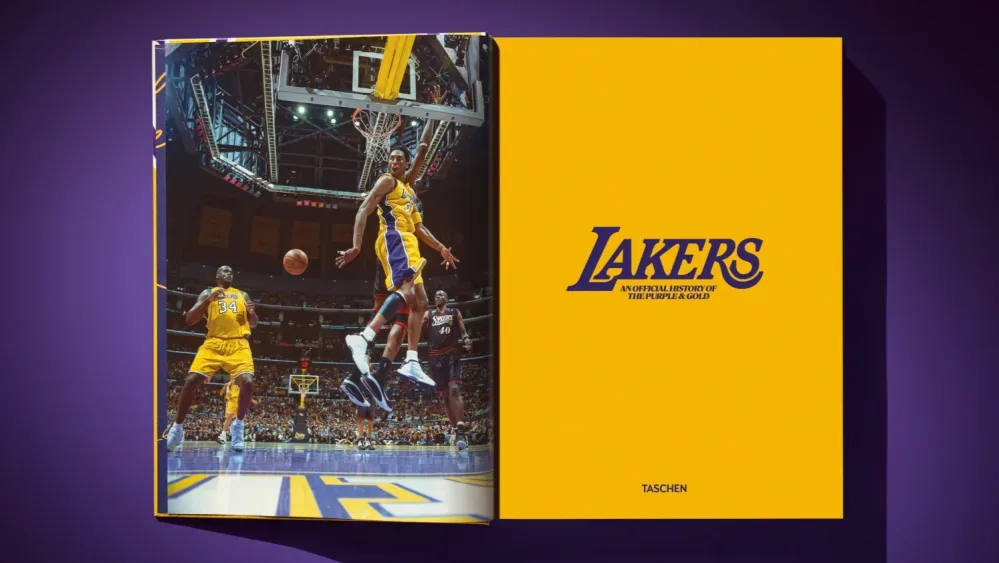
The Los Angeles Lakers’ official history book is entering a much more rarefied collecting bracket. Taschen and the team have introduced two limited editions of Lakers: An Official History of the Purple & Gold, building on the standard edition with memorabilia, artist-designed presentation and autographed elements tied to several eras of Lakers history.
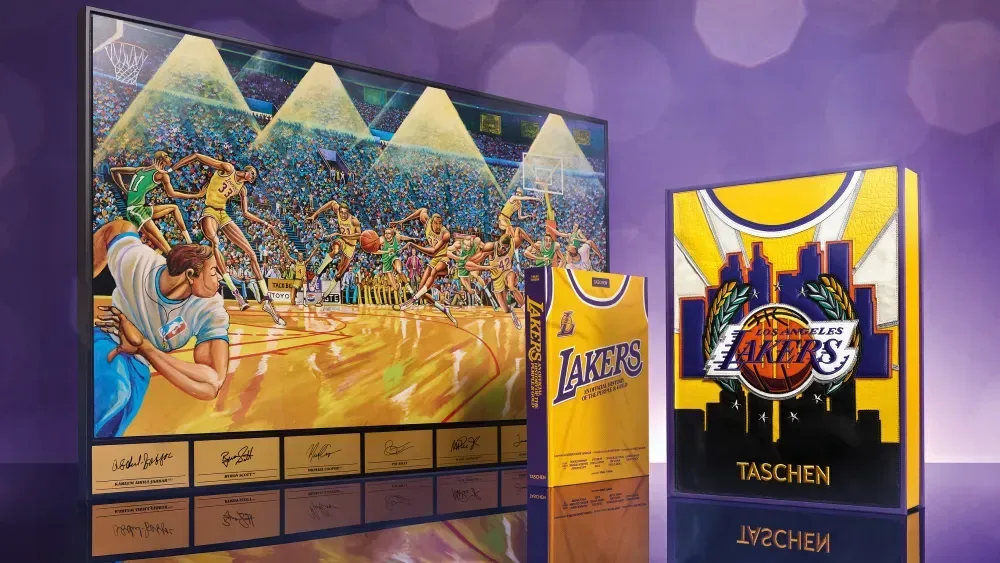
The editions are not merely alternate covers for the 528-page book. Each is presented in a custom leather clamshell box designed by Jeff Hamilton, whose elaborate leather jackets commemorated Lakers championship runs in 2000, 2001, 2002 and 2020. Inside, buyers receive the book alongside an authenticated piece of hardwood from the original Staples Center floor and an original handprint from one of seven figures associated with the Showtime period.
There will be 1,100 copies across both releases: 1,000 Collector’s Editions at $2,400 apiece, and 100 Art Editions at $9,600 each. The distinction matters. The Collector’s Edition is the principal limited book-and-memorabilia package; the Art Edition adds a numbered, authenticated large-format print with a much smaller production total.
What is included in both Lakers limited editions?
At the center of both packages is the original 528-page Lakers: An Official History of the Purple & Gold. The standard version arrived in September at a stated $100 price, while these releases shift the emphasis from the reading experience alone to the physical package surrounding it.
The leather clamshell is a protective presentation case with a fitted lid, rather than an ordinary slipcase. In this instance, its design is part of the object’s appeal: Hamilton has an established connection to the team through his celebratory Lakers jackets. That association gives the box a direct Lakers-fashion link without turning the book into an item of apparel memorabilia.
Every limited-edition box also contains hardwood authenticated as coming from the original Staples Center floor. The significance is specific rather than abstract. The source floor is identified as the court on which the Lakers won five championships, and where Kobe Bryant played his final NBA game. For collectors, authenticated means the item is represented as verified in origin; it is distinct from simply receiving a loose fragment accompanied only by a story about where it may have come from.
That provenance is a key practical consideration for memorabilia buyers. A floor fragment has meaning because its stated origin is connected to a particular venue and moments in team history. The physical wood itself is only one part of the collectible. Its authentication is the link between the material and that claimed history.
A handprint arrives as a genuine surprise
The other shared feature is an original handprint from one of seven Showtime-era Lakers figures: Magic Johnson, Kareem Abdul-Jabbar, James Worthy, Michael Cooper, Kurt Rambis, Byron Scott or Pat Riley. Buyers will not be told which person’s handprint is in their copy until the package is delivered.
That makes the identity a blind allocation, not a selection option. Someone purchasing a box cannot treat the listing as a way to guarantee a Johnson, Abdul-Jabbar or Riley piece. The edition promises a handprint from the named pool, while the individual allocation remains undisclosed before delivery.
It is also worth being precise about what is and is not described. The package includes an original handprint from a listed Showtime figure. The available details do not state the distribution of handprints among the seven people, whether every figure appears in equal numbers, or whether particular names are scarcer than others. Those unanswered questions are important for anyone assessing the package as a collectible rather than purchasing it chiefly as a Lakers display piece.
Showtime is the label commonly attached to the Lakers’ fast-moving, star-led identity in the era represented by these players and coach. Here, it functions as a focused historical thread within a book that spans considerably more ground. The limited editions pair that thread with a fragment of the arena floor connected to later championship teams and Bryant’s last game, so the package combines different chapters of the franchise rather than isolating one season or lineup.
What the $9,600 Art Edition adds
The 100-copy Art Edition includes everything in the Collector’s Edition, plus a large-format print of Fastbreak by Ernie Barnes. The work was originally commissioned by the Lakers in 1987 and depicts the team during its Showtime period.
The print measures 41 by 24.5 inches and carries seven signature plates hand-signed by the players and coach portrayed in the painting. It is numbered and authenticated by the Estate of Ernie Barnes. That combination makes the Art Edition meaningfully different from an enlarged book illustration: it adds a separately presented work associated with a Lakers-commissioned image, with numbered status, estate authentication and signatures connected to the people depicted.
“Signature plates” should not be confused with saying that each person signed directly onto the printed image itself. The published description specifies that the edition features signature plates hand-signed by the players and coach portrayed. Buyers interested in the exact physical construction of the artwork should keep that terminology in mind.
The Art Edition’s additional elements also explain the major price separation. It costs four times the $2,400 Collector’s Edition, while its edition size falls from 1,000 to 100. The source material does not assign a standalone value to the print, the signatures, the hardwood or the handprint, so there is no supported basis for treating any one component as the sole driver of the difference. What is clear is that the Art Edition is built around a substantially scarcer art-and-autograph package.
A book designed to cover basketball and the culture around it
The standard book’s contributor list signals its broad approach to the Lakers’ public history. Abdul-Jabbar wrote the foreword, Lakers governor Jeanie Buss provided the introduction, and former coach Phil Jackson wrote the afterword. Additional contributors include Johnson, Shaquille O’Neal, Pau Gasol, LeBron James and Luka Dončić, along with Jack Nicholson, Paula Abdul, Flea and Lou Adler.
That mix reaches beyond players, coaches and team executives. It places the Lakers in an overlapping world of basketball, entertainment, music, fashion and celebrity fandom—the same range that the limited editions attempt to represent physically through Hamilton’s box design, arena-floor material and Barnes artwork.
“The Lakers have had an extraordinary impact on basketball and pop culture, and we wanted this book to capture the full scope of that influence, from the game itself to art, fashion, music, and beyond,” Tobak said in a statement. “The Limited Edition takes that vision a step further, bringing together rare memorabilia, artwork, and personal contributions from the people who helped shape the team’s history.”
The limited editions therefore sit at the intersection of sports publishing and physical memorabilia. They are not trading cards, and they do not offer a conventional autograph checklist in which a buyer knows exactly which signer is in the box. Instead, they use a premium art-book format to assemble multiple forms of Lakers-associated material: a historical volume, an arena artifact, a mystery handprint and, for the Art Edition, a signed and authenticated Barnes print.
What prospective collectors should weigh
The first decision is straightforward: whether the Barnes print and the much smaller 100-copy run are worth the move from $2,400 to $9,600. The second is preference for certainty versus discovery. Both editions include a handprint, but no buyer knows the identity before delivery. Fans primarily seeking a particular member of the Showtime group should recognize that limitation before viewing either package as a route to a guaranteed personal favorite.
Collectors should also separate the edition’s stated facts from assumptions about future value. The releases are limited, but scarcity alone does not establish later market pricing. The reported details support the print runs, prices, authentication claims and included materials; they do not establish resale outcomes, comparative rarity among the seven handprints or the number of copies bearing each figure.
For buyers who value provenance, the named authentication attached to the Staples Center hardwood and the Barnes print is among the most concrete information provided. For those chiefly interested in the book’s editorial content, the standard edition contains the same 528-page volume and contributor lineup without the limited-edition memorabilia structure. The premium versions are best understood as elaborate display-and-collecting objects that use the book as their foundation.
The project also arrives amid a wider overlap between sports, culture and commercial partnerships. That crossover has been visible in areas such as the recent expansion of sports brand-partnership work, though the Lakers book package is its own specific proposition: a licensed historical volume expanded with authenticated material, signed art and a deliberately limited print run.
Both the Collector’s Edition and Art Edition are available through Taschen’s website. With only 1,100 total copies, a concealed handprint assignment and just 100 of the print-inclusive Art Edition, the offer is aimed less at the casual reader than at Lakers collectors who want the franchise’s history delivered as a substantial physical artifact.