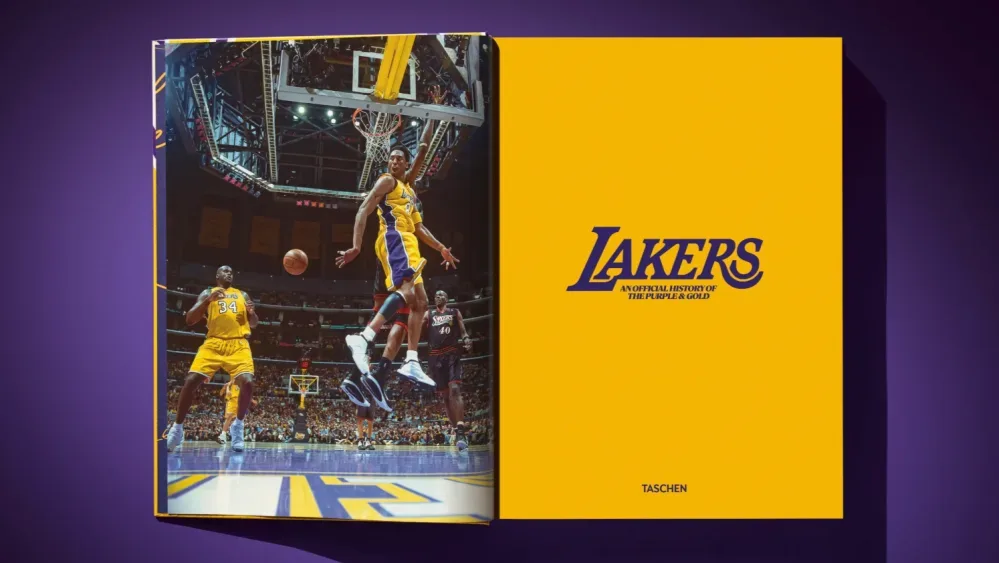
The Los Angeles Lakers are the subject of a substantial new collectible book: Lakers: An Official History of the Purple & Gold, a 528-page authorized volume from Taschen. It follows the franchise from its Minneapolis beginnings through several defining eras in Los Angeles, framing the team not solely as a basketball institution but as a lasting part of celebrity, fashion, entertainment and fan culture.
That scope is the point. Sports histories often organize themselves around seasons, records and championship totals. This book does cover the Lakers’ title-winning stretches, but its stated approach is wider: the purple-and-gold story is treated as a Los Angeles cultural object as much as a sequence of results on the court. For collectors, that makes the release potentially relevant beyond readers looking for a straightforward team chronology. It is also a designed archival object, with foldout layouts and reproduced material intended to be studied page by page rather than read only once and shelved.
The book is available through Taschen’s website now, with a wider retail release planned for Oct. 1.
A franchise history built around its championship eras
Edited by Vikki Tobak, Lakers: An Official History of the Purple & Gold is arranged across 10 chapters. Its timeline begins in Minneapolis, continues into the Showtime period, and moves through the Shaquille O’Neal-and-Kobe Bryant three-peat, the championships of 2009 and 2010, and the 2020 title.
Each championship run has its own gold-themed section, bringing together the roster, head coach and major playoff moments associated with that title. That structure gives the book two complementary uses. A reader can follow the broad progression of the franchise from era to era, while someone interested in a particular title team can go directly to the relevant section rather than treating the volume as an uninterrupted linear history.
The Lakers’ place in popular culture is central to the presentation. In addition to basketball figures, the book includes names associated with music, film and the team’s high-profile courtside identity. Magic Johnson, Shaquille O’Neal, Pau Gasol, LeBron James and Luka Dončić are among the players featured. Pat Riley also appears alongside Paula Abdul, Flea, Jack Nicholson, Lou Adler and Dyan Cannon.
The framing matters because it recognizes that a club’s collectible history does not live only in box scores. Promotional pieces, uniform designs, celebrity connections and visual branding can be as important to a fan’s memory of an era as a playoff series. The book’s inclusion of that material gives it a different purpose from a season guide or an encyclopedia of statistics.
What makes this a collector-focused art book
Taschen is associated here with the luxury art-book format, and the announced contents suggest that the physical construction and layouts are a major part of the appeal. The volume includes several oversized presentation features:
Related coverage includes Lakers’ 528-Page Official History Brings Purple and Gold Legacy to the Coffee Table.
- a four-page gatefold devoted to the Lakers’ 17 championship rings;
- a separate gatefold charting the evolution of the team’s uniforms;
- a four-page presentation of retired numbers;
- historic promotional material;
- play diagrams; and
- postgame analysis notes.
A gatefold is a page or group of pages that folds outward, creating a wider display than a standard spread. In practical terms, it is useful for material that benefits from scale: a lineup of rings, a visual uniform timeline or a grouped display of retired numbers can be viewed as a single large composition instead of being broken across conventional pages. It also means the book asks for a little more care in handling than a typical paperback or small-format annual.
The promised archival components are equally notable. Promotional material preserves how a team and its stars were presented to the public at a particular time. Play diagrams offer a view of basketball’s tactical side, while postgame notes bring the language and immediate analysis around important games into the visual record. None of those items replaces a detailed statistical database, but together they can help make a title run feel like a specific historical moment with its own design, messaging and on-court identity.
Major Lakers voices shape the volume
Kareem Abdul-Jabbar provides the foreword. Lakers governor Jeanie Buss writes the introduction, and former head coach Phil Jackson supplies the afterword. The pairing establishes a broad perspective around the main body: Abdul-Jabbar represents a foundational playing legacy, Buss writes from the organization’s leadership, and Jackson brings the viewpoint of a coach closely linked to the franchise’s championship history.
Buss described the Lakers as a global phenomenon and characterized the project as a love letter to the people who have been part of that history. That sentiment aligns with the book’s stated emphasis on fan culture and Los Angeles visibility. The collection of contributors and featured personalities appears designed to show that the Lakers’ audience has extended far beyond a conventional local sports following.
It is also worth separating authorized history from a fully independent account. An authorized book is made with the participation or approval of the subject organization. That status can provide access to official archival material and recognized figures, which is especially valuable for a highly visual retrospective. At the same time, prospective readers should understand the format for what it is: a celebratory, official presentation of a franchise legacy, not necessarily a critical investigation of every period in its history.
Why the physical format is part of the proposition
In an era when team imagery is constantly circulated online, a 528-page print object has a different role. Its value is not simply that it contains pictures or summaries of familiar championship runs. It is the arrangement: the ability to place uniforms, rings, old promotional design, tactical documents and cultural figures within one edited object.
That is why books like this can sit at the intersection of sports memorabilia and design collecting. They are not game-used equipment, signed photos or trading cards, and there is no indication that this release includes those things. Instead, the collectible appeal comes from official status, deep presentation, visual curation and the physical ambition of the edition. Collectors deciding whether a book belongs alongside other Lakers items may care most about those qualities.
Its announced focus on uniform evolution is particularly useful in that regard. Uniforms are one of the clearest visual ways a long-running sports brand marks an era. A chronological presentation can show continuity in the purple-and-gold identity while making visible the changes that distinguish different generations of teams. The retired-number spread works similarly, concentrating a franchise’s honored player legacy into a display-oriented section rather than leaving it scattered through separate chapters.
Practical considerations for collectors
Anyone buying a large-format illustrated book as a long-term display or collection piece should think about storage before ordering. The four-page foldouts are a key feature, but they are also the pages most likely to be stressed by rough handling. Opening them on a clean, flat surface and avoiding tight shelving can help reduce pressure on folds and corners.
For display, sunlight and moisture are the obvious enemies of printed material. Direct light can affect covers and pages over time, while humid conditions can cause warping. Keeping a book upright with adequate support, or laying it flat if its size and weight make upright storage awkward, is generally more considerate of a substantial coffee-table format than cramming it into a narrow shelf.
Buyers should also distinguish between a book they want to browse and one they hope to preserve in the best possible condition. Those goals are not incompatible, but repeatedly opening foldouts, transporting a large volume, or using it as a literal coffee-table surface creates more opportunities for wear. For a display-minded collection, retaining any original packaging and recording the edition details at purchase is sensible, even though no special edition, limitation or signature has been specified for this release.
The wider collecting conversation around sports-adjacent releases is increasingly shaped by how cultural objects move from giveaway or merchandise into resale listings. A recent example came from gaming event apparel, where free promotional items quickly appeared online at ambitious prices; GTA 6 Tokyo Game Show shirts listed for up to $200 show why collectors benefit from separating an item’s initial retail context from later asking prices. There is no basis here to predict a resale outcome for the Lakers book, but the same practical principle applies: buy a physical release for its confirmed content, design and personal relevance, rather than treating possible future scarcity as a guarantee.
A record of basketball, design and Los Angeles identity
The most distinctive aspect of Lakers: An Official History of the Purple & Gold is the attempt to bind the team’s basketball achievements to the visual and celebrity ecosystem around them. The title teams receive dedicated attention, but the stated materials reach toward the objects and images that made those eras recognizable: uniforms, rings, promotional artifacts, notes and famous fans.
For Lakers followers, the result is positioned as a broad franchise keepsake. For sports-book collectors, it is an authorized, heavily illustrated history with a clear focus on presentation. And for readers interested in Los Angeles pop culture, the featured mix of players, coaches, artists and screen figures underscores the argument that the Lakers’ story has always been larger than the court.