

 Nicolas CageJohn Madden
 Christian BaleAl Davis
 Kathryn HahnVirginia Madden
 Sienna MillerCarol Davis
 John MulaneyTrip Hawkins
 Snoop DoggSnoop Dogg
 Shane GillisVince McGary
 Marshawn LynchJerry Bell
 Julian EdelmanGary Kapeck
 Joel MurrayPat Summerall
 Rick HoffmanHoward Cosell
 Colleen CampMrs. Simmons
Madden has an inherently inviting subject: John Madden, a figure whose name reaches across American football, television commentary and video games. Yet this portrait of the coach-turned-commentator and gaming inspiration reportedly moves so quickly through the latter half of his life that recognition is not the same thing as understanding. The film establishes Madden’s public significance, but it has far less success getting beneath it.
David O. Russell frames the story with faux-documentary material, allowing Madden, his wife Virginia and his boss Al Davis to explain accomplishments and personal philosophies as the years pass. In principle, that structure could supply a useful counterpoint to the biographical sweep: public testimony set against the events that shaped those statements. In practice, the device appears to add to a presentation already racing forward. The result is a film that presents milestones and noise in roughly equal measure, without consistently creating the breathing room needed for a life story to gather emotional or psychological force.
That lack of space is the central problem. A movie about an enormously recognizable public figure does not need to catalogue every part of a career, but it does need to decide what makes that person worth following beyond the headline achievements. Here, the film conveys that Madden made a lasting impact and that he was warmly received by the public. What remains frustratingly vague is the engine underneath that impact: what drove him, how his fixations shaped him, and what connected his private frustrations to his towering public identity.
Nicolas Cage breaks through the prosthetics
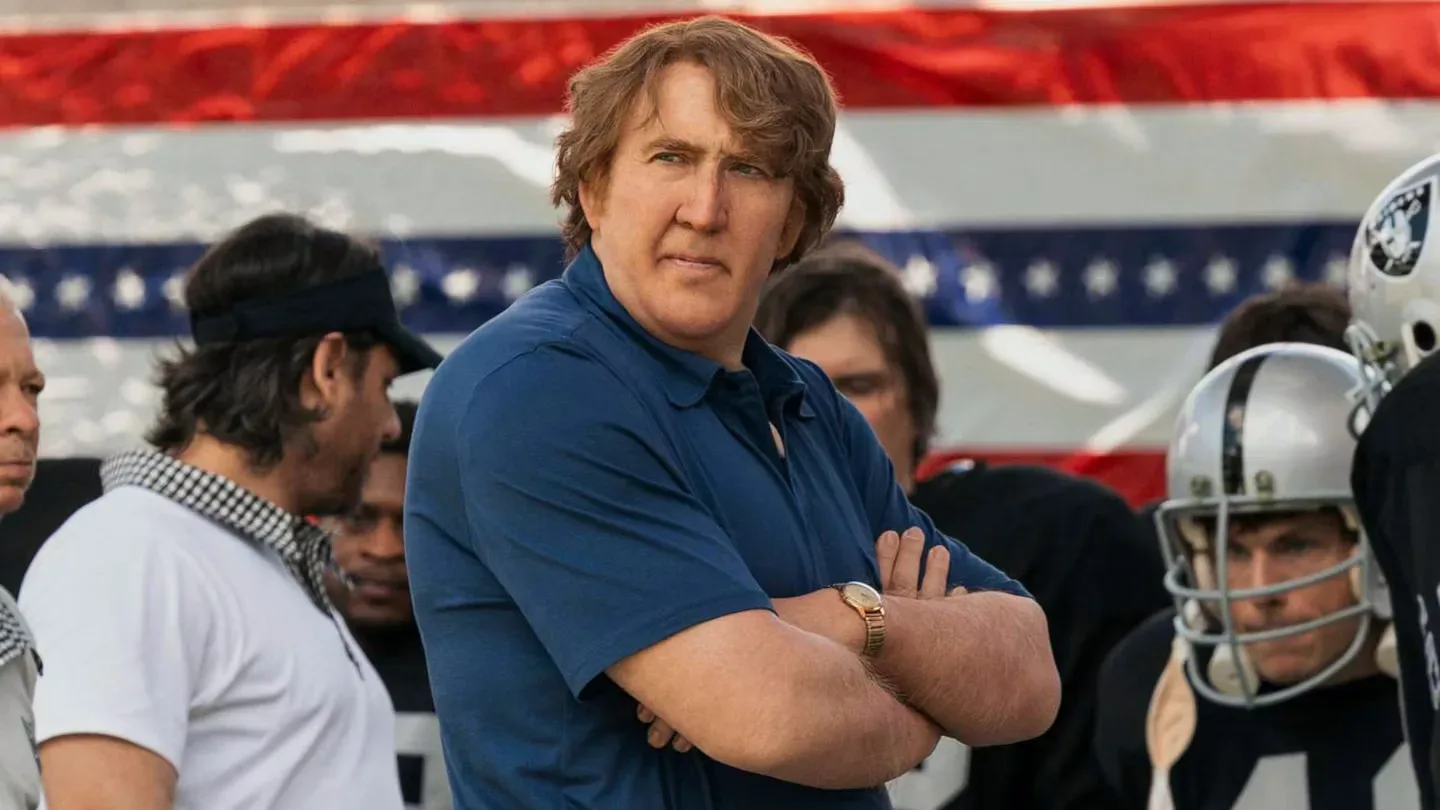
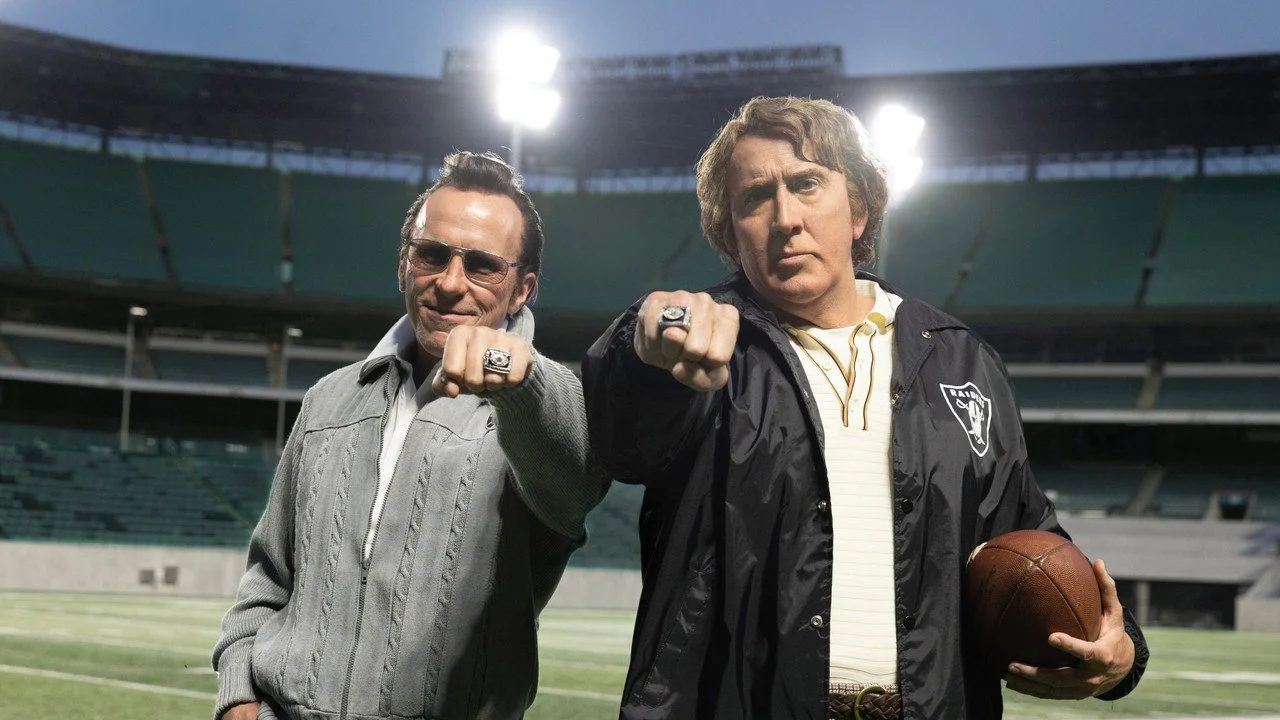
Nicolas Cage’s casting initially seems to invite attention for the wrong reason. The physical transformation is described as distracting, with substantial latex creating a barrier between performer and audience. But Cage eventually pushes through that barrier. The performance is not presented as a perfect illusion, nor does it need to be one to become the film’s clearest asset. Beneath the conspicuous makeup, Cage finds an intensely likeable Madden whose single-minded interests can strain his relationship with Virginia.
That tension gives the portrayal its most promising human dimension. Madden is not simply positioned as a beloved icon; he is also a man with fixations that frustrate his long-suffering wife. The material does not appear to develop this conflict deeply enough to transform it into a full portrait of the marriage, but it gives Cage something more specific to play than public enthusiasm. His commitment suggests enormous charisma, and the best moments arrive when that charisma has an outlet: Madden’s colourful commentary and encounters with his adoring public reportedly feel especially alive.
Those scenes matter because they show the film briefly locating the quality that made Madden compelling. It is not merely that crowds know his name. Cage communicates the charisma, likeability and connection with the public that make the reaction believable. For viewers who know Madden principally as a cultural reference point, those flashes may be enough to clarify why he mattered. For viewers looking for the deeper interior story behind that appeal, they are likely to feel like glimpses rather than a sustained revelation.
Energy without control
The film’s tempo is its most damaging creative decision. Its approach is described as frenetic from early on, to the point where the accumulation of scenes and information begins to register as noise. Fast pacing can be an apt way to express a personality or era, especially for a subject associated with outsized public energy. But speed requires shape. Without a clear sense of what each leap in time adds to Madden’s character, a pell-mell approach risks reducing a life to a blur of movement.
That is where the storytelling appears particularly sloppy. The film has many components capable of generating momentum—career changes, work relationships, domestic strain and public fame—but they do not cohere into a persuasive dramatic line. The faux-documentary explanations may clarify selected achievements, yet explanation alone cannot replace a well-built progression. The problem is not simply that the story is busy; it is that the busyness reportedly obscures rather than illuminates its subject.
Russell’s direction has been associated with energy and chaos, but here those qualities are not sufficiently corralled. This is an important distinction. Disorder can be expressive when it reveals competing wants, social pressure or a protagonist’s turbulent inner world. In Madden, the disorder seems to flatten the experience instead. The film’s louder and broader choices leave too few moments that feel genuinely penetrating.
A supporting cast fighting the mayhem
Christian Bale plays Al Davis beneath prosthetics as well, but his broad portrayal is said to increase the agitation rather than provide a useful counterweight to Cage. This may be partly a tonal issue: when a film already moves at a fevered clip, a large performance can amplify the sense that everything is competing for attention. Rather than sharpening the professional relationship at the story’s centre, the character work appears to become another source of overload.
Kathryn Hahn, as Virginia Madden, fares better in the limited moments that cut through. The role carries the potential to ground the film through its picture of a wife dealing with Madden’s particular fixations, and Hahn is among the performers able to make an impression despite the surrounding turbulence. Sienna Miller, playing Carol Davis, also earns notice in isolated moments. Their presence is valuable not because the film suddenly becomes a fully rounded ensemble piece, but because it indicates how much more effective it can be when it pauses long enough to let a performance land.
The recurring frustration is one of unrealized access. The cast can supply individual sparks, and Cage supplies the strongest of them, but a biographical drama needs those sparks to illuminate a coherent whole. The film reportedly never develops sufficient clarity about Madden’s inner motivations. As a result, the viewer may leave knowing that he was a nice, influential and highly visible figure while still feeling no wiser about the person behind the legend.
Who this is for
Fans of Cage may find the most to appreciate, particularly if the appeal lies in watching him commit wholeheartedly to a difficult transformation. His work provides a reason to stay engaged even as the storytelling grows exhausting. People with an existing interest in football, sports broadcasting or Madden’s video-game legacy may also enjoy seeing a familiar cultural figure dramatized, especially in the livelier stretches of commentary and public connection.
But the film is a weaker proposition for anyone hoping for a measured, revealing account of how its subject became such a consequential name. Its narrative rush and shallow characterization make it hard to recommend as a satisfying introduction to Madden’s life or as a penetrating study of fame, work and personal drive. There is a worthwhile central performance here, but the movie around it does not give that performance enough room to turn charisma into insight.