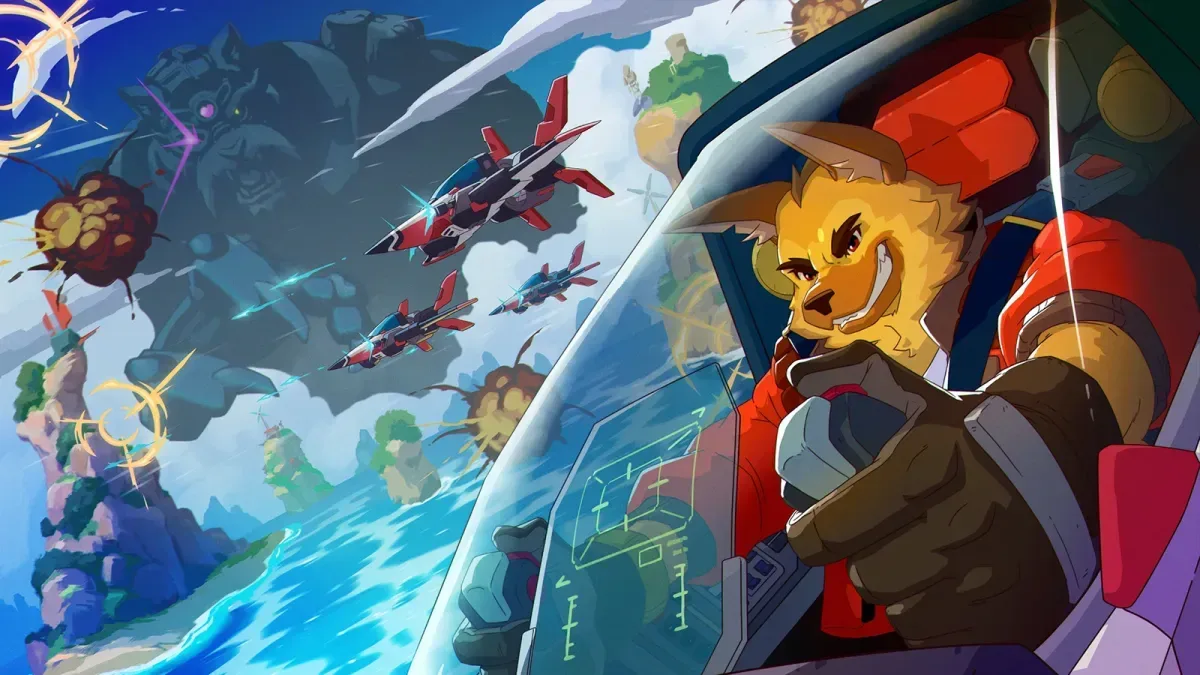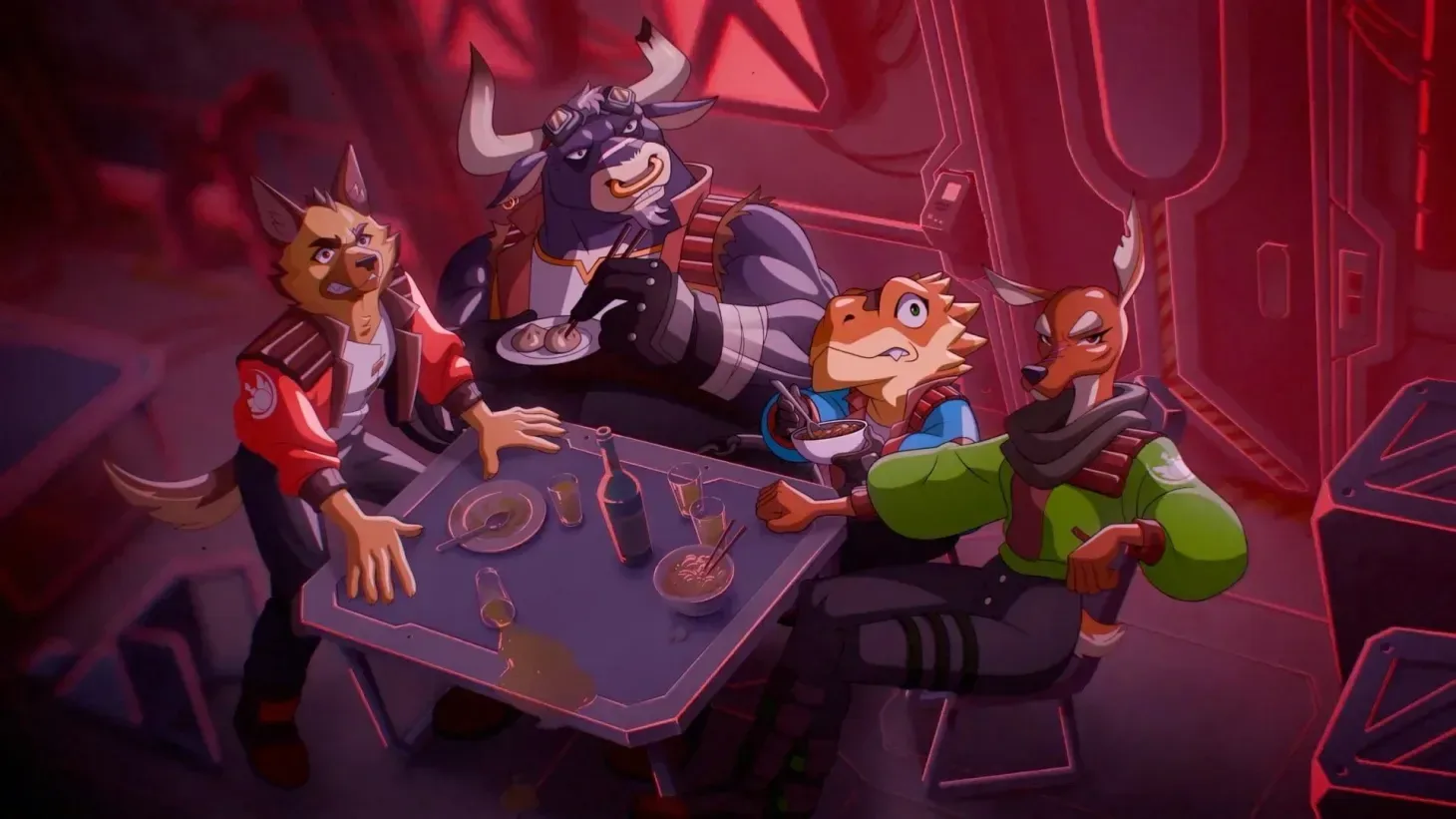
Wild Blue Skies wears its inspiration on the outside of its cockpit. Chuhai Labs and Vitei Backroom Inc. have built a colorful aerial action game around a familiar fantasy: a wisecracking animal squadron, a menacing animal villain, branching missions, boss encounters, and a spacecraft tearing through danger. Its lead pilot is Bowie, an anthropomorphic dog, and the chief threat is Grimclaw, an anthropomorphic tiger whose enormous cyborg head makes a deliberately loud first impression.
That setup gives Wild Blue Skies an immediate, readable appeal. It is plainly reaching back to Star Fox 64, the Nintendo 64 rail-shooter whose quick missions, route changes, chatter-filled dogfights, and arcade-style replay loop remain a powerful template. Homage is not inherently a problem; it can be a terrific starting point for a modern take on an old format. The larger issue is that Wild Blue Skies often settles for recognition instead of refinement. Its strongest moments capture the pleasure of darting through a colorful combat course, but the controls, combat rules, level construction, and difficulty spikes repeatedly get in the way.
A familiar mission briefing
Bowie travels through a campaign made primarily of on-rails missions, supplemented by stages that open into smaller free-roaming spaces. The objective is to take down Grimclaw, with a crew of teammates along for the ride. It is a premise that understands the broad appeal of classic arcade flying games: get players into a striking machine, send waves of targets across the screen, punctuate the route with a giant boss, and invite another run afterward.
The campaign also uses alternate routes and challenges to encourage repeat visits. Reaching the credits is presented as attainable, while players who want to explore every branch have reasons to return. That structure is one of the game’s clearest connections to its Nintendo 64 forebear, and it remains a good fit for an action game designed around short, score-minded missions rather than a massive map.
For anyone revisiting that era through original hardware, the basics of keeping an older library accessible can matter as much as finding the next homage. Our guide on how to store retro games focuses on organizing a collection so the games are still easy to locate and play. Wild Blue Skies, meanwhile, makes a case for why the old rail-shooter formula is still tempting—but also why copying its surface elements is not enough on its own.
Combat that creates unnecessary friction
The ship controls are serviceable, yet the act of targeting enemies can become more laborious than exhilarating. The aiming reticle’s placement and perspective can obscure what Bowie is shooting at. There is no first-person viewpoint option to change that relationship with the action. In a genre built around split-second target tracking, reduced visibility is more than a minor annoyance; it undermines the confidence that makes flying and firing feel fluid.
The problem is especially notable when the game moves away from a strict rail. In the more open areas, collisions with walls can send the ship bouncing around dramatically. Instead of feeling like a meaningful penalty that players can cleanly recover from, the rebound effect can turn a brief mistake into a disorienting pinball sequence. Such moments are particularly costly when enemies, hazards, and level boundaries all compete for attention.
Wild Blue Skies also separates lock-on functionality and standard laser fire across different buttons. That means the player may have to choose between engaging the lock-on system and firing ordinary shots, a restriction that reduces the satisfying multitasking expected from this style of shooter. The stronger homing attack further suffers from a short lock-on range. By the time an enemy is acquired, it may already have passed out of view, making the supposedly powerful option feel unreliable at precisely the moment it ought to reward accurate pursuit.
These are not complaints about a game asking players to learn its systems. Arcade action benefits from demanding inputs and carefully timed decisions. The concern is that Wild Blue Skies’ limitations can make players feel as though they are wrestling its interface rather than responding to an enemy formation. A good rail shooter produces a quick dialogue between awareness, movement, and attack. Here, that dialogue too often pauses while the player fights the camera, reticle, collision response, or targeting distance.
Colorful skies, vague destinations
Visually, the game offers a brighter outlook. Its color palette is lively, its ships have appealing designs, and its animal cast has a strong enough visual presence to make the squad recognizable at a glance. The voice performances for the central team, bosses, and supporting characters are another point in its favor. The cast sounds committed to the heightened cartoon adventure around them.
Yet strong delivery cannot entirely compensate for thin characterization. The bosses boast and shout with broad confidence, while the heroes trade the kinds of comments expected from an airborne squadron. When teammates protest accidental friendly fire, the exchange can generate a momentary pang of guilt—or a wry laugh—but the characters do not develop sharply distinct identities. Much of the dialogue could seemingly be reassigned among the cast without fundamentally changing how anyone reads.
The environments face a similar tension. A desert stage followed by an icy one brings welcome visual variation, and a hurricane, hailstorm, tornado, or lava-filled route sounds exciting on a mission list. But these concepts rarely gain enough unusual design detail to become memorable destinations. Repeated emphasis on poor visibility, whether caused by snow or storms, also raises an awkward issue: dramatic weather can feel less like an atmospheric obstacle and more like cover for limited draw distance.
That distinction is important. Obscured sightlines can create suspense when a game gives players dependable tools to react. When targeting and collision already feel temperamental, obscuring the battlefield can instead deepen the sense that the player lacks useful information. Bosses at the end of these courses can additionally take too long to defeat, elongating encounters after the stage has already tested patience.
Replay value needs a fairer runway
Branching paths and optional challenges should be a natural strength for Wild Blue Skies. They support the kind of repeatable campaign where players learn routes, improve performance, and uncover missions they missed. But the game’s most frustrating defeats can weaken that loop. Health drops are scarce, and losses may result from clipping a stray enemy, ricocheting against geometry, or being engulfed by hazards that fill the screen without leaving a convincing path to safety.
Failure is a crucial ingredient in score-chasing action games, but it has to feel instructive. Players should understand what happened and believe the next attempt can be cleaner. When deaths feel more attributable to unclear threats or awkward movement than to a missed read, retrying becomes less inviting. The stakes rise further because exhausting lives can return the player to the beginning of the campaign. That old-school consequence can create tension, but it is much harder to accept when the game has not consistently earned the player’s trust.
There is a useful lesson here for nostalgic design generally. Preserving an older game’s structure is different from preserving every rough edge associated with it. The best retro-minded releases identify the original appeal, then reconsider controls, readability, pacing, and accessibility through years of subsequent design knowledge. Players setting up classic systems can take a similarly practical approach with our checklist for choosing a retro console HDMI adapter: understand the original connection, then make deliberate choices about how it works today.
An homage without enough of its own voice
Wild Blue Skies has flashes of satisfying arcade action and an attractive presentation, and its route-based campaign gives it a sensible reason to be replayed. Bowie, Grimclaw, the colorful spacecraft, and the animated animal-squad framing all establish a clear affection for the rail-shooter tradition. The game never disguises what it wants to evoke, which is preferable to coy imitation.
Still, its reverence becomes a ceiling. The game does not consistently show where it improves on the genre’s established ideas, and its mechanical frustrations make its tribute less effective than it could be. The comparison is also difficult to avoid given the release of an excellent Star Fox 64 remake for Switch 2 in 2026. Even without that immediate point of comparison, though, Wild Blue Skies would need more precise combat, clearer visibility, fairer damage handling, and a more distinctive personality to turn its fondness for a 1997 classic into a convincing new flight plan.