Turn-based strategy is often associated with patience: study the board, count your options, then make the move that looks safest. Invisible Inc uses that patience as the foundation for something much more nervous. Its missions let players stop and inspect a situation in detail, but the security system grows more dangerous with every turn. Thoughtful planning is possible; leisurely planning is not.
That tension comes from a particularly sharp set of design decisions. The game gives unusually clear information once an agent can see a guard or device, while withholding the overall shape of each procedurally generated facility. It removes the uncertainty of hit percentages from combat, then replaces it with an escalating alarm network that turns time itself into a cost. It uses roguelike-style randomisation and permanent consequences without making every mistake an immediate end to a campaign.
The result is a stealth tactics game where a player is rarely asking, “Will this work?” More often, the important question is, “Can I afford for this to work this way, right now?”
A corporate spy campaign built around survival
Invisible Inc is set in the late 21st century and follows a technologically advanced private espionage organisation hunted by powerful corporations. The player directs its surviving agents through corporate offices, laboratories and bank vaults, gathering information, money and equipment. Survival and resource collection matter across the campaign because they build toward the chance to enter an enemy headquarters and shut down its systems.
That premise gives the missions a useful double purpose. An agent is not simply trying to reach an exit. They may need to complete an objective, search workstations, raid safes, acquire equipment and locate further operatives to rescue. Every optional detour can strengthen the wider campaign, but it also means spending more turns inside a building whose defences are continually improving.
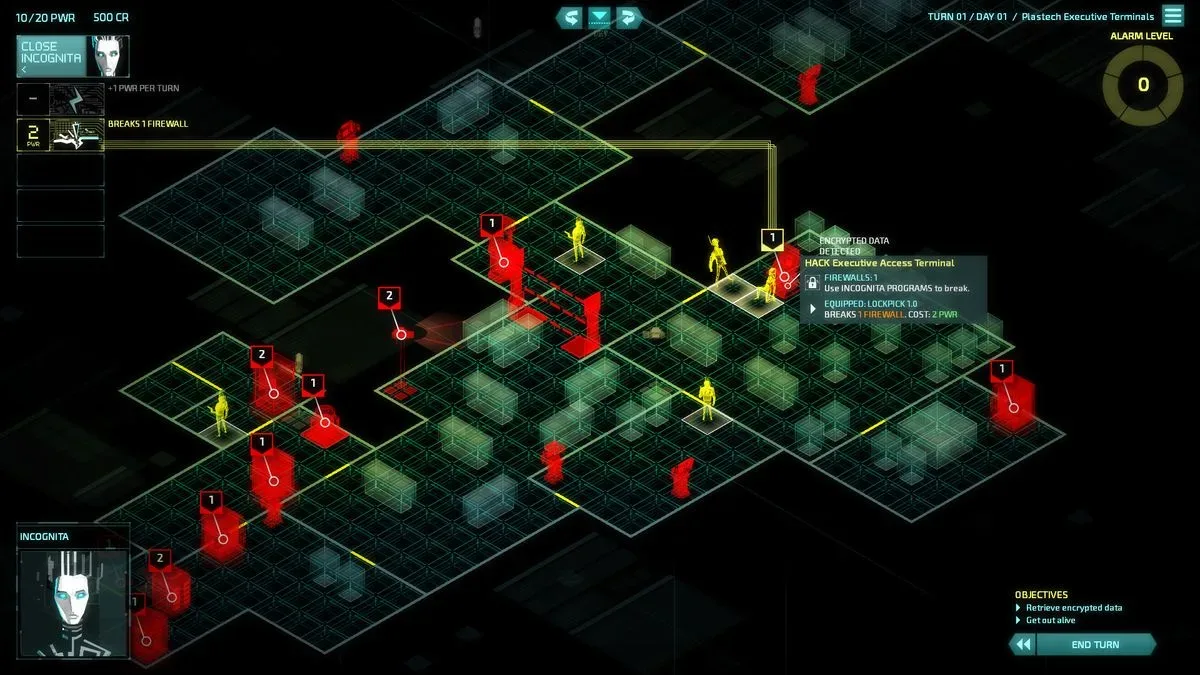
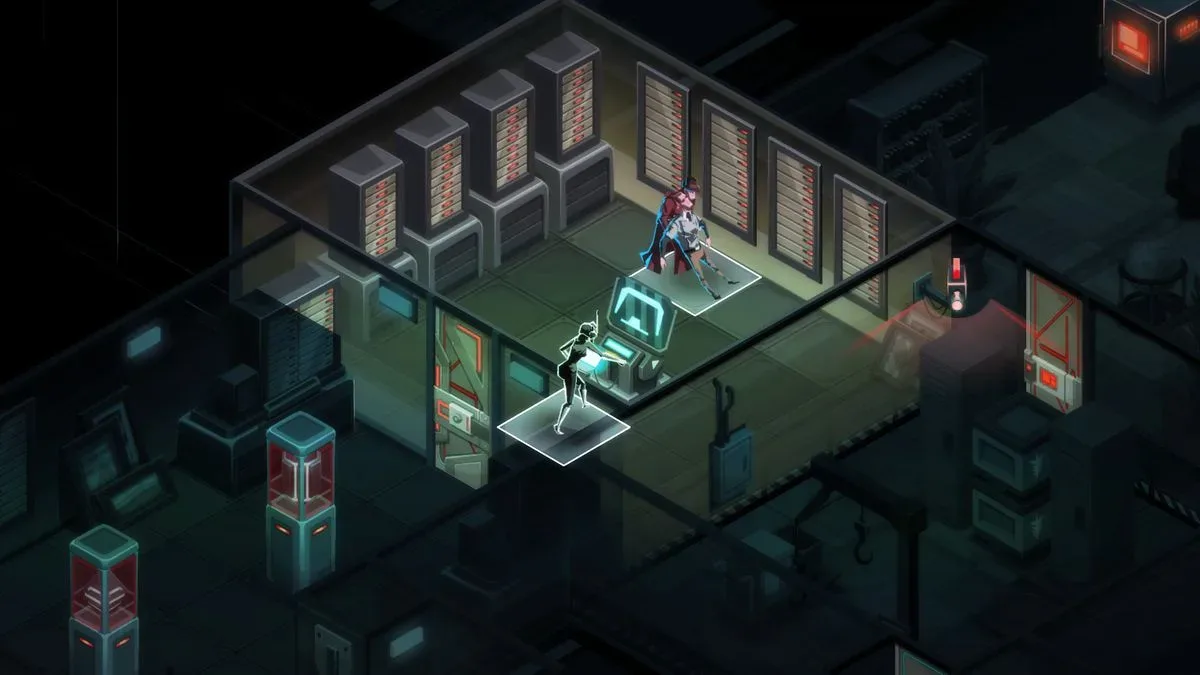
The basic vocabulary will be familiar to tactics players. Missions use grids, agents have action points, usually shortened to AP, and careful positioning matters. An action point is a unit that limits what a character can do in a single turn: move, interact, inspect an enemy’s coming route or carry out another task. Cover, line of sight and guard patrols establish the conventional stealth rules. Avoid being seen, examine the path ahead, and treat direct confrontation as a last resort.
But the team’s movement budget is only one part of the equation. The other major resource is power. Power enables remote interference with the facility: disabling cameras, drones and laser grids, opening access to locked workstations and safes, and otherwise challenging the building’s security. Players replenish it through relevant programs and by drawing it from terminals within the map. An agent can therefore be physically well positioned and still be unable to progress because the electronic side of the infiltration lacks the resources to support them.
Unknown building, highly knowable danger
Invisible Inc’s most effective contrast is between uncertainty at the mission level and precision at the immediate level. A run begins with a limited view of a procedurally generated location. The objective and exit exist somewhere in the facility, but their locations are not initially known. Guards may be close by or much deeper in the structure. Opening doors and moving into new rooms is genuine scouting, not just a formal prelude to executing a fixed route.
Related coverage includes Why Invisible Inc Still Makes Turn-Based Stealth Feel Like a Heist Thriller.
Procedural generation means the layout is assembled differently from mission to mission rather than remaining a single hand-authored map. This does not merely make corridors look different. It changes the tactical problem. A large space containing several intersecting patrol routes calls for a different plan than a chain of small rooms guarded by stationary enemies. The relationship between the objective and the exit can change which direction feels safe and when it makes sense to abandon a detour.
Once something becomes visible, however, the game is remarkably direct about what it is and what it can do. A revealed guard can show armour, special abilities and an exact vision cone. Spend an action point and it is possible to inspect the guard’s next movement route. This clarity continues a line-of-sight approach also associated with Klei Entertainment’s Mark of the Ninja: seeing an element means receiving meaningful information about it.
In a turn-based setting, that information becomes a tactical tool rather than merely a warning. A player may move through a guard’s peripheral vision toward cover, deliberately directing the guard’s attention to that point. That can create an opening to slip behind them, search their pockets or leave the area unseen. The game is not asking players to gamble on an enemy reacting plausibly. It supplies a readable system and asks them to exploit it.
This is also why combat is described by certainty rather than percentages. If an agent has the appropriate weapon to knock out or kill a guard, the effect is assured. If not, it is not a viable solution. There is no familiar tactical-game moment in which a seemingly perfect attack misses because a displayed probability failed. The risk moves away from chance and into positioning, resource use and the consequences of using another turn.
Transparency does not mean safety
It would be easy to mistake all this information for leniency. Instead, it makes responsibility clearer. When an agent walks into an avoidable vision cone, leaves a route unsecured or commits to an expensive hack without an escape plan, the problem is usually not that the game concealed a dice roll. It is that the player made a costly decision, perhaps because they explored too aggressively or treated one more safe as essential.
That approach makes the game’s danger legible without making it gentle. There is still an unknown building ahead, a finite supply of power and a team whose position can become impossible. Yet the player is offered enough detail to create a plan, revise it and understand why it succeeded or failed. In stealth games, that is an important distinction: unclear detection rules can feel arbitrary, while explicit rules make pressure feel earned.
The alarm turns every turn into a bill
The force that prevents Invisible Inc from becoming a slow-motion puzzle is the alarm level. The agents enter a facility undetected, but the defending security network grows increasingly alert after every turn. At certain thresholds, the environment gains new threats, including additional cameras, tougher firewalls and more guards. Being spotted, encountering booby-trapped systems or using lethal force can increase the alarm further.
This structure makes turns the campaign’s most valuable resource. AP limits an individual agent’s immediate actions; power determines how much security infrastructure the team can disrupt. But each turn advances the entire facility toward a more hostile state. A player who takes a perfectly valid action may still make the larger mission worse simply because it required more time.
That produces decisions with no universally correct answer:
- Split agents to reveal more of the map, or keep them together to deal with threats as a group.
- Bypass a guard slowly, or knock them out and accept the time and consequences involved.
- Carry an incapacitated guard to keep them contained, or leave them behind knowing they may recover and begin searching.
- Spend a large portion of power on an immediate security solution, or preserve it for what may lie farther ahead.
- Risk a daemon-protected hack for valuable information or loot, knowing the defensive program may disrupt the team’s own systems.
A daemon, in this context, is a hostile program attached to a system. It makes a tempting hack less like a free reward and more like a calculated exposure. The facility can offer the tools needed to survive, but it can also punish the attempt to take them.
The key design achievement is that the alarm creates urgency without revoking deliberation. Players can pause, inspect and calculate, because the game is turn-based. But no amount of contemplation stops the clock once the next turn begins. The pressure is not dexterity-based; it is strategic. A move can be obvious in isolation but wrong within the mission’s remaining time.
Loot greed is not a side activity
Getting at least one agent to the exit is enough to preserve the run, but a minimal escape is not necessarily a strong campaign outcome. Extracting the whole team, fulfilling the main task and collecting valuable resources better prepares the player for the harder endgame. That turns optional looting into a genuine strategic temptation rather than decorative completionism.
Consider the late-mission dilemma built into that structure. One agent may be tucked into a dead end far from the exit, waiting for enough power to hack a guarded safe. The rest of the team may already be near the escape point. Waiting could secure useful equipment or funds. It could also push the facility into the next alarm threshold, strengthen the escape route’s defences and transform a manageable withdrawal into a disaster.
The choice is compelling because neither instinct is foolish. Leaving immediately can feel like abandoning necessary long-term preparation. Waiting can feel like honouring the purpose of an infiltration. Invisible Inc repeatedly asks players to identify the instant when ambition becomes overreach. A turn spent doing nothing except allowing power to recover may be one of the most frightening actions in the game, because it is still an action in the alarm economy.
This is part of why the game can resemble a heist thriller even with a grid and discrete turns. Its suspense does not depend on an enemy suddenly breaking the rules. It comes from a plan that remains viable only if the team leaves before the situation closes around it. The player knows the route, sees the patrols and understands the system—and still has to decide whether to risk one more room.
Roguelike stakes with room to recover
Invisible Inc combines randomised missions and repeat play with a campaign that can feel closer to a conventional adventure than a rapid series of disposable runs. Its Beginner difficulty teaches the systems, and the campaign can be completed in around six hours on a first attempt. Replays then provide increased challenge and opportunities to explore the deeper interactions between agents, hacking programs and mission conditions.
Different starting characters and hacking programs unlock over time, supplying new possibilities and constraints even when the broad mission loop remains familiar. The source material also notes a substantial DLC package that changes the experience further. The important point is not that the facilities become unrecognisable, but that changes in tools and parameters alter how a player approaches the same high-level problem: enter, learn the map, take what matters and leave before security overwhelms the team.
Its use of permadeath is similarly moderated. Permadeath means losses can persist rather than being erased by a normal checkpoint reload. Yet an agent being downed is not automatically the end. With multiple agents in play, a teammate may resuscitate the fallen operative or drag them to the exit after the immediate danger has passed. There is also a limited rewind feature that can replay whole turns, creating a safety valve for errors while retaining consequences when a plan genuinely collapses.
At Expert and Expert Plus difficulty, the campaign can still end with the entire team lost, including close to the finish of a run. But the game gives players space to assess the situation and attempt a rescue or improvisation. That matters. Permanent failure has more weight when it follows choices the player had time to understand than when it arrives as sudden, opaque punishment.
The broader lesson for tactics design is that uncertainty and fairness need not be opposites. Invisible Inc withholds the map but clarifies the threats that have been found. It removes random attack outcomes but installs a persistent alarm that punishes inefficient certainty. It supports a full campaign while preserving the changing circumstances and replay value associated with roguelike structure.
Players interested in other forms of mounting extraction-game pressure may also find this report on a reported Halo project that evolved into an extraction shooter relevant context, even though Invisible Inc arrives at its tension through turn-based stealth rather than real-time action.
Invisible Inc’s lasting trick is simple to state and difficult to balance: it makes information abundant but time scarce. Every revealed cone of vision, patrol route, firewall and safe turns a dangerous situation into a solvable one. Then the alarm system makes that solution expensive. The player is granted control, but never enough control to relax.