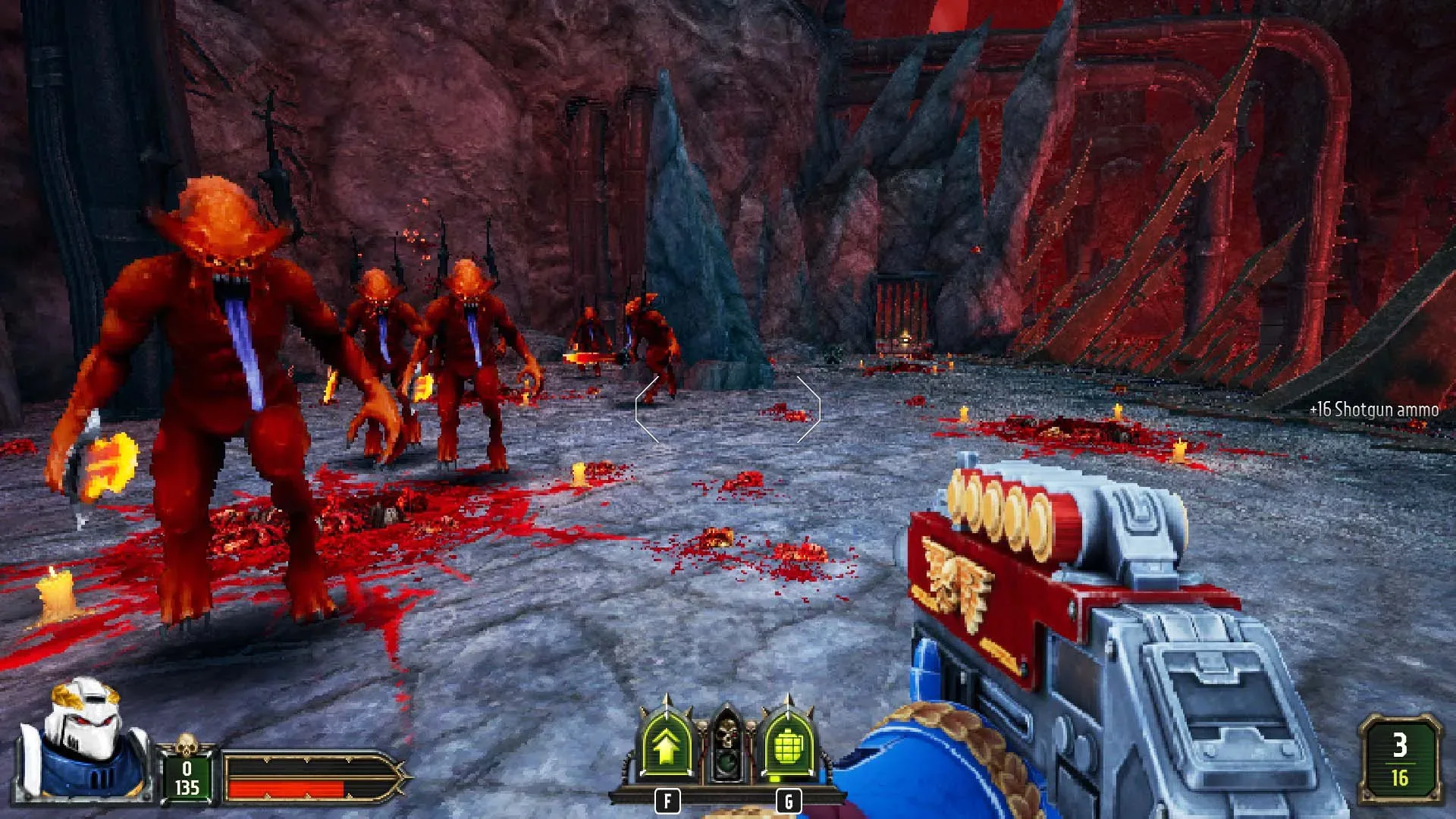
Warhammer 40,000: Boltgun 2 takes the blunt-force appeal of its predecessor and gives it more room to breathe. The sequel continues the original game’s story, but its premise remains deliberately direct: a Space Marine is sent to violently remove enemies of the Imperium of Man, using very large weapons and very little diplomacy.
The important change is not a reinvention of that premise. Boltgun 2 appears to be refining it across the campaign with two playable fighters, a wider weapon selection, more varied enemies and environments, and levels built around interconnected routes rather than an overreliance on sealed combat arenas. It is a sequel with a clear understanding of what should stay intact: rapid shooting, chunky retro presentation, grim Warhammer 40,000 absurdity, and an arsenal designed to make every trigger pull feel consequential.
It is also positioned as an approachable starting point. The plot follows on from the first Boltgun, yet prior knowledge of that game is not required to begin this one. That matters for a setting as famously dense as Warhammer 40,000. Boltgun 2’s immediate objective is intelligible even to newcomers: move through hostile territory and destroy the forces standing in the way.
Two heroes create a meaningful change of pace
The sequel’s most obvious new feature is its pair of playable protagonists. Returning hero Malum Caedo is joined by Battle Sister Nyla Veyrath. Both are portrayed as formidable combatants, but their distinct handling and loadouts give players different ways to approach the same campaign spaces.
Caedo is the heavier option. He moves more slowly but hits harder, and he retains weapons associated with the first game, including the boltgun itself and a shotgun. The boltgun is the franchise’s signature firearm: a weapon whose identity, in this game’s action-focused interpretation, is all about forceful, rapid projectile combat. The shotgun serves a similarly direct purpose, offering the close-range payoff expected of a fast retro shooter.
Veyrath, meanwhile, is the more nimble character. Her equipment includes a flamethrower and a powerful crossbow, giving her a noticeably different combat silhouette from Caedo’s gun-heavy kit. A flamethrower suggests strong short-range area control, while the crossbow presents a contrasting, more deliberate kind of firepower. The supplied details do not define every mechanical difference between the two heroes, but they establish a straightforward choice between heavier and faster play.
Players can complete campaign levels as one character and return to replay them as the other at any time. That is useful flexibility rather than a claim that every mission becomes an entirely new game on a second run. The moment-to-moment feel changes, particularly where an encounter may favor movement or brute damage, but the stages are not described as radically transformed by the character swap.
What replayable character choice means in practice
The practical value is player agency. Someone who prefers Caedo’s slower, punishing style can stay with him for an initial campaign run. A player drawn to speed and Veyrath’s alternative weapons can take the other route without being locked out of the same overall story progression. Later, revisiting a difficult or favorite mission with the other protagonist offers a compact reason to reassess its fights.
Related coverage includes Warhammer 40,000: Boltgun 2 Expands the Formula With Two Playable Heroes and Bigger Battlefields.
That design is especially well suited to retro-inspired shooters. These games often live or die on whether their arenas, enemy combinations, movement demands and weapons keep producing small tactical decisions. Changing the fighter does not need to rewrite a level to matter. It can change where a player feels safest, which targets need immediate attention, and which tools solve a chaotic room most efficiently.
Variety is the sequel’s largest expansion
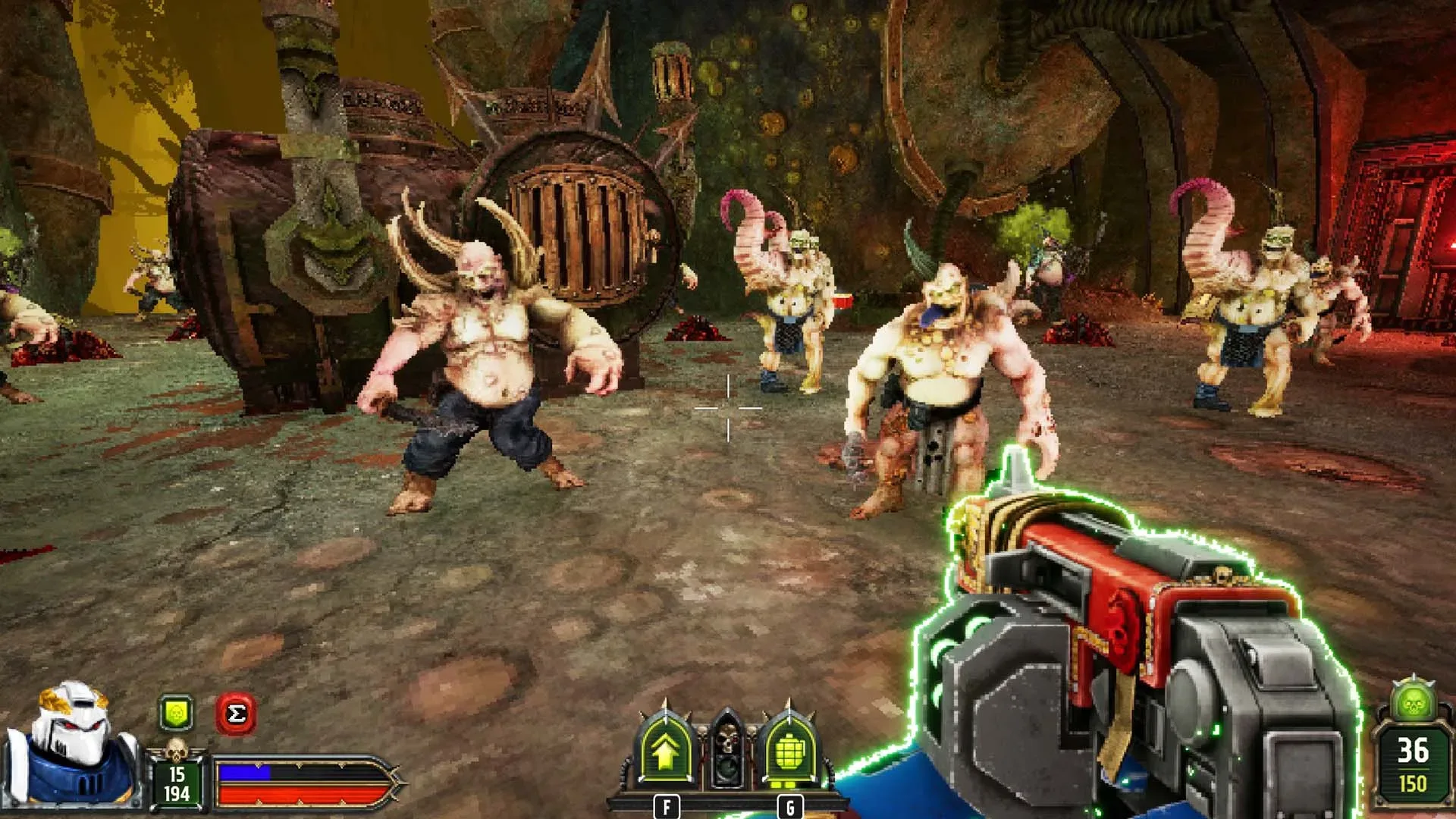
Boltgun 2 broadens both the places players visit and the things trying to kill them. The earlier game could make its corridors and foes feel repetitive over time. In contrast, the sequel moves through a gothic space-castle setting populated by armed cultists, a swamp containing zombies and toads, and a hellish landscape with snipers and red demons.
Those examples matter because they point to more than a visual palette swap. Enemy types shape the rhythm of a shooter encounter. Cultists with firearms, shambling zombies, toad-like threats, distant snipers and demons naturally ask the player to watch different ranges and directions. A sniper changes the priority of cover and movement; a mass of slower enemies changes the value of crowd-clearing weapons; a demon-heavy hellscape brings a different atmosphere and threat profile from a fortress full of armed opponents.
The changing environments also help the campaign feel like a larger Warhammer 40,000 journey rather than an extended trip through one architectural theme. A gothic fortress, murky swamp and nightmare realm each support the setting’s tendency toward maximal contrast: militaristic grandeur, biological decay and supernatural horror all exist comfortably beside one another.
Analysis: This kind of environmental and enemy rotation is particularly important for a game rooted in old-school shooter language. “Retro” does not simply mean pixelated visuals or references to the 1990s. At its best, it describes a design approach built around readable weapons, quick movement, memorable spaces and escalating combat complications. If every room and opponent asks the same question, the nostalgia fades quickly. Boltgun 2’s wider range of locations and adversaries is therefore a substantive response to a potential weakness, not merely extra decoration.
Levels favor routes over repeated arena lockdowns
The most consequential structural improvement may be the level design. The first Boltgun frequently placed players in enclosed spaces and demanded that they clear large enemy waves before moving on. That can be exciting: it concentrates the action, makes survival the entire focus, and lets a shooter test whether the player understands its tools. But used too frequently, the pattern can become predictable.
Boltgun 2 still delivers combat, but its stages are described as having winding paths, larger rooms, smaller adjoining sections and routes that loop back around. This is a classic quality of the shooters that inspired it, particularly games from the 1990s and early 2000s. Instead of a purely linear sequence of doors and locked arenas, the player is asked to build a working sense of place.
Interconnected level design means areas have spatial relationships beyond “the room before” and “the room after.” A large chamber may lead to several smaller rooms; another passage may return the player to a previously seen section from a new angle. This can make a map feel more convincing and more adventurous without making it an open-world game. It also gives combat encounters different shapes, since an enemy attack can happen in a corridor, at an intersection, inside a broad chamber, or while the player is deciding which route advances the objective.
The game includes a safety net for players who lose their bearings. At the press of a button, a line appears on the ground and points toward the main objective. That is a smart compromise between old-school maze-like spaces and modern usability. The level can retain detours and loops without turning confusion into the core challenge.
For players interested in how earlier design ideas are being adapted rather than simply copied, Joking Joystick has also covered how cross-device retro gaming tools are evolving. Boltgun 2 approaches the past from another direction: not by preserving an older game, but by using familiar spatial and combat principles in a contemporary Warhammer 40,000 release.
Navigation help protects the campaign’s momentum
An objective trail may sound small, but it changes who can enjoy a more elaborate map. Players who want to search every branch can do so, while those who mainly want the next fight are not punished for failing to memorize a layout. It prevents exploration from becoming a wall between the player and the game’s strongest stated feature: aggressive shooting.
That is an especially practical feature in a campaign with branching level choices. Progression includes different levels players must choose between as the story advances. The exact consequences of those choices are not detailed, so it would be premature to call the campaign fully branching. Still, the presence of selections between stages supports the broader impression of a more sprawling structure.
A sequel focused on refinement, not replacement
Boltgun 2 does not appear to be throwing out the foundation that made the first game attractive. Its central identity remains a fast, gory Warhammer 40,000 shooter with crunchy retro visuals, forceful guns and dark humor. The sequel’s approach is more measured: preserve the shooting and atmosphere, then broaden the contexts in which they operate.
- Two playable heroes offer a heavy, returning Space Marine style and a faster Battle Sister alternative.
- Character-specific arms include Caedo’s boltgun and shotgun, plus Veyrath’s flamethrower and crossbow.
- Campaign replay options allow completed levels to be revisited with either hero.
- More distinct settings and foes include cultists in a gothic fortress, swamp enemies, snipers and red demons.
- More connected maps replace some of the prior game’s repeated closed-arena rhythm with loops, side spaces and winding routes.
- An objective guide can be summoned to point toward the next main goal when navigation becomes unclear.
There is a useful restraint in that design. Bigger does not automatically mean better for a shooter if the extra scale blunts the pace. Here, the reported additions are closely connected to the genre’s essentials: more weapon approaches, more varied targets, more memorable combat spaces, and enough navigational support to keep progress moving.
The early picture is of a sequel that understands why the original worked while directly addressing where it could grow. It keeps the violent, retro-styled core intact, but gives that core more enemies, stranger places and better-shaped levels in which to do its work. For Warhammer 40,000 fans and players seeking an old-school shooter structure with a modern convenience or two, Boltgun 2’s campaign changes are the details worth watching.