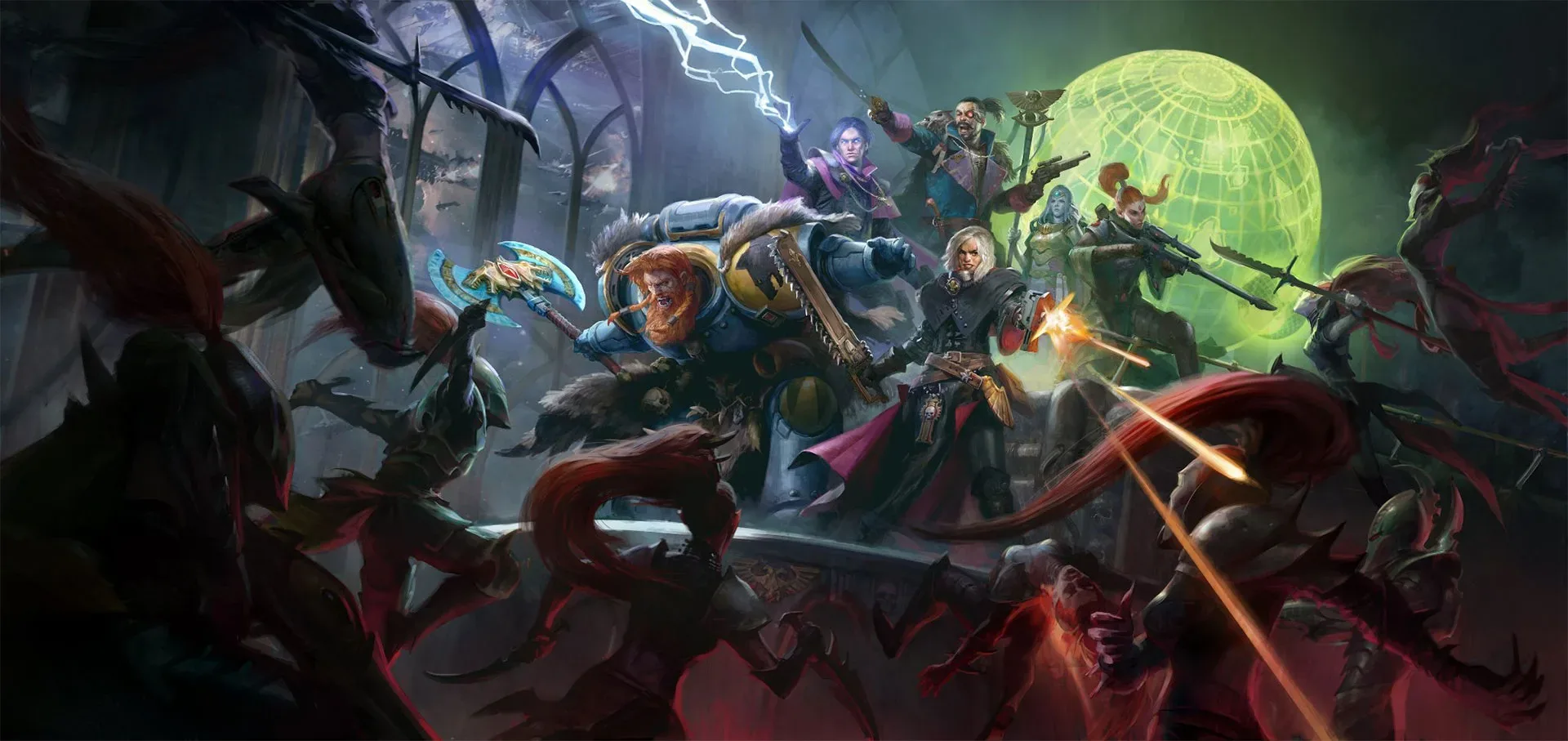
There is a particular kind of role-playing game temptation that asks players to save everyone, say the compassionate thing and emerge from every crisis with an admirably clean conscience. Warhammer 40,000: Rogue Trader points that temptation at a flaming voidship, surrounds it with heretics and Warp trouble, then quietly asks whether a clean conscience is even compatible with survival.
That is a large part of the game’s appeal. Owlcat Games’ top-down CRPG—short for computer role-playing game—does not merely place familiar Warhammer language around a conventional heroic journey. Its early choices frame authority, faith, cruelty and expedience as practical problems inside an extraordinarily brutal setting. A player can still make compassionate decisions, but the world makes a strong case that kindness without force, planning or consequences may be inadequate.
It is also a compelling on-ramp for someone drawn to Warhammer 40,000’s lore but uninterested in making the jump to physical miniatures and tabletop wargaming. The game supplies a character-focused route through the setting: an opportunity to learn what terms such as the Imperium, the Warp and Chaos mean because they matter to a decision in front of the player, not simply because a glossary says they do.
A human-scale route into a giant setting
Warhammer 40,000 can seem built around enormous icons. The Adeptus Astartes, better known as Space Marines, loom large in the imagination, particularly for readers coming from the early Horus Heresy novels or viewers who arrived through the animated Warhammer 40,000 episode in Secret Level. Those stories invite attention toward transhuman soldiers, catastrophic civil war and the vast machinery of Imperial belief.
Rogue Trader takes a different angle. Its protagonist is human: a scion of House von Valancius who is violently and unexpectedly elevated into the position of Rogue Trader. There is no Space Marine origin waiting on the character-creation screen. That could initially sound like a compromise for anyone who wants the full armored, bolter-heavy fantasy. Instead, it is an effective perspective for a game about power.
A Rogue Trader has authority, a voidship and responsibilities extending across the people under their command. This turns the fantasy away from being the strongest person in the room and toward being the person whose decision changes what happens to everyone else in the room. The weight comes not just from shooting enemies but from judging appeals, imposing discipline and deciding which version of a bad situation will be allowed to continue.
That human perspective makes the setting’s scale easier to feel. A Space Marine may embody the Imperium’s military myth. A Rogue Trader has to operate amid the human costs of that myth: crew, workers, dependents, factions and the anxious machinery that keeps a voidship functioning. The player does not need to be an Adeptus Astartes to encounter the setting’s severity. They need only be in charge when something goes wrong.
The prologue understands the assignment
The opening aboard Theodora von Valancius’ voidship makes the game’s intentions clear. Theodora has summoned potential successors, including the player character, when her ship comes under attack. A betrayal follows. The player is knocked unconscious and implanted with a nascent Chaos entity that reacts to the presence of the Warp. Theodora disappears amid the crisis.
Related coverage includes Warhammer 40,000: Rogue Trader Makes a Strong Case for Embracing the Imperium's Cruelty.
For newcomers, a few terms do substantial work here. The Warp is the dangerous otherworldly realm tied to psychic and supernatural forces in Warhammer 40,000. Chaos refers to the corrupting forces associated with it. Calling an entity “nascent” means it is not yet fully developed, but that is hardly reassuring when it is inside a character’s brain. The scenario instantly gives the setting’s cosmic horror a personal stake.
Then comes a choice at a barrier of flame. The player can accept aid from an apparition offering power, rely on faith in the Emperor to walk through the blaze, or turn back to aid the besieged crew. It is a concise role-playing crossroads: temptation, belief or responsibility.
Crucially, the choice is richer for players who have encountered related ideas elsewhere in Warhammer fiction, but it does not require prior study. Choosing faith in the Emperor can recall Mersadie Oliton’s experience in Galaxy in Flames, the third Horus Heresy novel. In this case, passing through the fire unharmed also burns out the Warp creature. That kind of connection is valuable because it rewards recognition without turning the scene into homework. A reader sees a familiar echo; a newcomer sees a dramatic gamble with a clear result.
That is arguably the ideal use of lore in an adaptation. The setting’s established material should deepen the scene for invested fans while the scene itself remains understandable as an immediate decision. Rogue Trader uses its Warhammer vocabulary as lived context rather than a museum label.
Turn-based combat, clear stakes
The game’s combat system is similarly legible in broad terms. Characters have movement points and action points. Movement points govern repositioning; action points cover the things a character does. When those resources are spent, that character’s turn ends. It is a turn-based structure that asks players to consider positioning and timing rather than simply issuing commands in real time.
Describing the game as less dense than Baldur’s Gate III gives a useful sense of its accessibility without suggesting the two are identical. The important point is that Rogue Trader has an understandable combat rhythm: move, act, assess what remains, and commit to the end of the turn. For a fiction-heavy universe, that clarity matters. A player can concentrate on the tactical situation and the surrounding role-play rather than feeling immediately buried beneath systems.
Class choice adds another layer of tonal commitment. The Commissar option fits a player who wants to lean into Warhammer 40,000’s grim military discipline. One perk is bluntly titled “One for the enemies, two for the traitors.” The class can even allow a player to shoot allies in the back to make them stronger. It is an outrageous premise, but it captures the setting’s willingness to frame a person as an asset to be hardened, deployed and, if necessary, sacrificed.
That does not mean a player must regard the Imperium’s logic as admirable. The role-playing value is in being allowed to inhabit it, test it and recognize how its cruelty can start to sound functional under pressure. The game gives the player room to say: this is appalling, but in this moment it may also be effective. That uncomfortable overlap is distinctly Warhammer.
Not evil, exactly—just appointed to command
The most interesting role-playing turn here is not necessarily becoming an obvious villain. It is discovering that the setting makes a stern, unpleasant answer feel more fitting than the answer one would ordinarily choose.
Early on, the player is called to the lower decks to address children orphaned when the voidship was attacked. The available responses include offering encouragement, dismissing them by throwing candy, or delivering a harsh lesson: life is terrible, and they must become stronger if they want the capacity to change it.
In many games, the warm response is easy to recognize as the “correct” moral selection. In Rogue Trader, the harsh response can feel less like cartoon villainy and more like an attempt to prepare people for the awful conditions the game has already established. It is still harsh. It is still directed at grieving children. But the game’s world is not arranged to flatter conventional heroism or reassure players that good intentions will protect everyone.
That is why these decisions can enable a player to leave their usual Paragon-style instincts behind. “Paragon” has become shorthand for the consistently selfless, diplomatic RPG path: the version of a protagonist who tries to preserve dignity wherever possible. Rogue Trader does not remove that impulse, but it pressures it. The question becomes whether the player’s character is being merciful, naive, evasive or simply unwilling to use power.
There is a meaningful difference between cruelty for its own sake and a character who believes survival demands cruelty. The latter is the more useful role-playing territory because it creates friction. Players can feel the attraction of decisive, hard-edged authority while remaining aware of its cost. An Imperium-shaped “villain era” can therefore be less about malicious laughter and more about realizing that leadership in this universe often means making choices one would reject almost anywhere else.
Why the Warhammer fit works
Warhammer 40,000 is often summarized as grimdark, a label for fiction where the future is exceptionally bleak and institutions are frequently monstrous. That description is useful but incomplete. The effective part of grimdark is not simply that everything is terrible. It is that characters must act inside conditions terrible enough to distort the meaning of bravery, compassion, faith and duty.
Rogue Trader appears to understand that distinction. Its strongest hook is not that it lets a player be rude. Plenty of games permit that. Its hook is that it creates circumstances in which rudeness, brutality and ideological certainty can seem coherent with the world’s demands. The player has agency, but the setting argues back.
For prospective players, that suggests a productive way to approach the game. Do not enter expecting a Space Marine power fantasy; enter expecting a command fantasy under moral pressure. Choose a background or class that sounds entertaining, then allow the situation—not a predetermined good-or-evil checklist—to shape the character’s decisions. The Commissar is a particularly direct route into that approach, but the underlying appeal is larger: the game lets authority be theatrical, frightening and occasionally ridiculous without pretending authority is consequence-free.
It also demonstrates why a game can be a satisfying companion to novels and lore videos. Books such as the opening Horus Heresy trilogy offer enormous historical and ideological drama. A CRPG offers something different: participation. A remembered scene can turn a dialogue option into a moment of recognition, while an unfamiliar term can gain definition from the danger it presents right now.
There is a related appeal in role-playing games that resist perfectly polished heroes. As argued in a look at why character creators need room for imperfection, a character becomes more interesting when they are allowed to be specific rather than merely ideal. Rogue Trader applies that principle to decisions. A leader who is principled but severe, devout despite uncertainty, or useful to allies in deeply alarming ways can be more memorable than a generic saint.
A few major quests into the campaign, the game’s human scale seems to be precisely what makes its Warhammer 40,000 setting land. The Adeptus Astartes civil war may be the initial draw for many fans, but a voidship full of frightened people, a suspicious apparition and one difficult choice after another can make the universe feel just as engrossing. It is a reminder that, in the far future, the most dangerous weapon may be the person given permission to decide what everyone else has to endure.