Steam may be heading toward an extraordinary year. Estimates attributed to Alinea Analytics put the PC storefront at $1.7 billion in game-sales revenue during September 2026, $5.5 billion across the third quarter, and $16.5 billion so far this year. Extrapolated across the remaining months, that has prompted talk of a $20 billion year.
Those figures should be treated as estimates, not a complete set of company accounts. Valve is privately held, so the public does not have an official breakdown of Steam revenue, operating costs, profit, hardware income, or payments to rights holders. The estimates are also described as game-sales figures rather than a measure of every part of Valve’s business. Still, even allowing for uncertainty, the scale suggested by the numbers is enormous—and it makes an old PC-gaming argument newly urgent.
What does a storefront do when it has the resources to be more than a checkout page?
The useful answer is not “spend money because the number is big.” Steam operates infrastructure, processes payments, runs a vast catalog, handles moderation challenges and supports a global audience. Those things cost money. The sharper question is whether some of Steam’s financial upside could be used to make the marketplace work materially better for the people creating games and the people trying to find them.
There are several practical places to begin: the revenue share paid by smaller developers, the way games are surfaced, the bluntness of user reviews, and the degree to which developers can help shape the platform they rely on.
The estimate matters because Steam is not just another shop
A digital storefront is a platform: it is the intermediary that supplies distribution, discovery, transactions and access to customers. For a developer, it can be the most direct route to a PC audience. For a player, it can be where a library, social connections, wishlists, reviews and purchasing habits all reside.
That concentration is convenient, but it also gives storefront choices outsized consequences. Steam’s standard 30% share of a sale has long been a focal point. Valve’s 2018 revenue-share structure reduced that share to 25% after a game earned $10 million, and to 20% after $50 million. In other words, the standard rate applies through the earliest and often most financially precarious stage of a game’s commercial life, while the largest successes receive lower rates at higher sales thresholds.
That structure has a clear business rationale: the biggest releases bring traffic and are valuable to keep on the platform. But it also creates an uncomfortable contrast. A small team that has spent years making one game has much less room to absorb the storefront share than a publisher behind a huge hit. For a modest release, the money retained or lost after the platform cut can determine whether a studio has runway for patches, a port, another project, or simply continued employment.
Related coverage includes Steam’s Reported Billions Raise Bigger Questions for PC Game Developers.
Steam is not alone in charging for distribution. Its competitor Epic Games Store has promoted a 12% cut, with that rate applying only after a game reaches its first $1 million in revenue. That model has its own trade-offs, including the basic challenge of attracting buyers to a smaller store. The recent availability of System Shock 2: 25th Anniversary Remaster on Epic is a reminder that competing storefronts can give players another route to games, but a lower platform fee alone does not solve visibility or audience-building.
Steam does not need to copy a rival’s exact policy to make a meaningful change. It could instead build a genuinely progressive revenue-share system: lower fees for early revenue, smaller studios, or games below a defined earnings threshold, with a standard rate later on. The details would matter. A simple threshold tied to a game’s sales is easier to administer than trying to audit every developer’s size or budget. Crucially, the direction should be reversed from the present volume discount: the least secure sellers should receive the earliest relief.
A lower early cut would be meaningful, not symbolic
Take a straightforward example already suggested by the current economics. A developer selling 5,000 copies of a $20 game brings in $100,000 before the store’s share and other costs. At 30%, Steam’s cut is $30,000. That is not an abstract accounting outcome to a small team. It can be months of wages, outside localization, accessibility work, quality assurance, trailer production, or the difference between cancelling and starting the next game.
No storefront is obliged to operate for free, and a policy change would need careful safeguards against abuse. But an early-revenue exemption or reduced tier could be structured to reward actual small-scale launches without pretending that platform services have no value. The case is strongest precisely because it is targeted. The first $100,000 or $200,000 of a game’s revenue means vastly different things to a tiny studio than it does to a large publisher.
This would also be easier to defend than an across-the-board reduction that treats every seller identically. Large releases would still have access to Steam’s audience and tools. Smaller games would gain financial breathing room at the moment when it is most valuable. If the reported annual revenue range is even broadly close, this is the kind of change that deserves serious modeling rather than immediate dismissal.
Discovery needs people as well as algorithms
Steam’s scale creates a discovery problem. Around 20,000 games launch on the service every year, by the estimate cited alongside the revenue discussion. A catalog that large gives players choice, but choice without useful navigation can become noise. A game can be good, unusual, competently made and exactly right for a particular audience—and still be difficult to encounter.
Algorithms are the automated systems that decide which games or pages to show people based on patterns such as purchases, wishlists, browsing, tags, release timing and behavior from similar users. They are necessary at Steam’s size. No editorial team can individually present every game to every potential buyer. But algorithmic recommendations are not neutral magic. They reflect inputs and goals chosen by humans, and they can amplify the games that already have attention while leaving less obvious work behind.
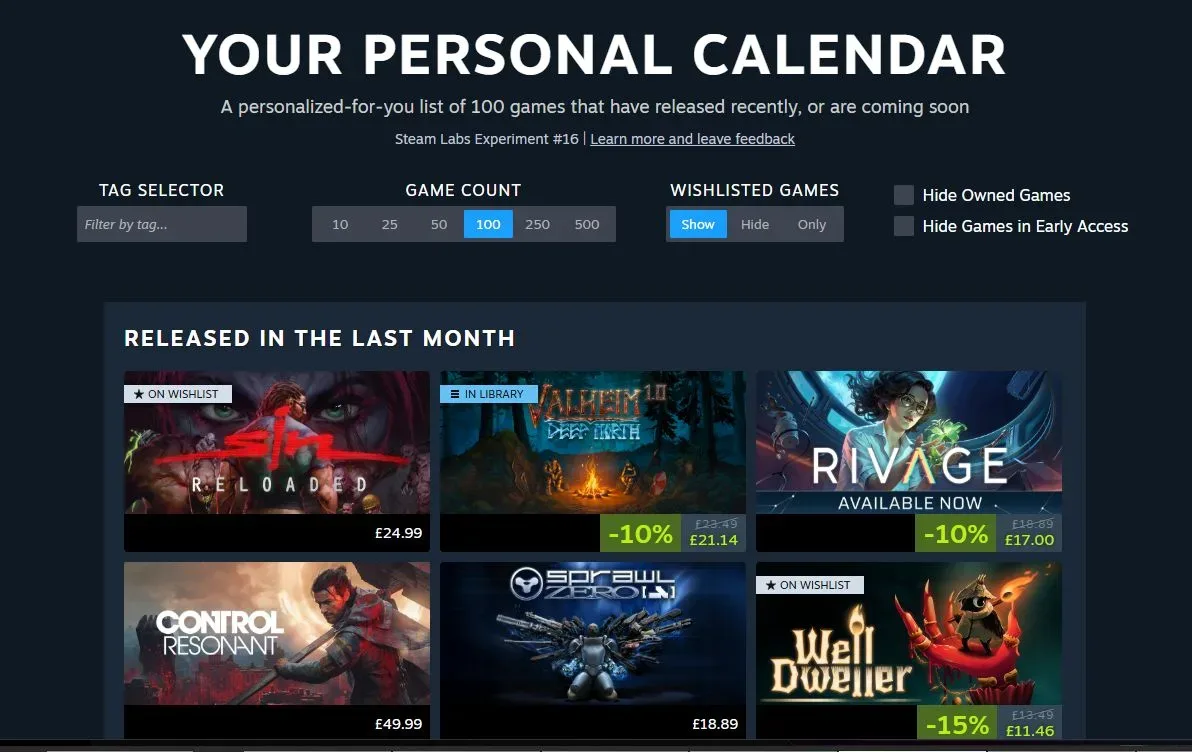
Valve’s Personal Calendar is a useful indication of the kind of discovery feature that can help. It presents recently released and upcoming games likely to interest a particular user, grouping them by windows including the past month, the past week and releases still to come. That basic premise is strong: instead of asking shoppers to excavate an endless stream of releases, it gives them a tailored release calendar.
The problem is placement. A recommendation tool that people struggle to find cannot fulfill its potential. Features that genuinely help surface smaller games should be prominent during routine browsing and especially during sales, when storefront pages can become dense with promotions.
Human curation should supplement that system, not replace it. Steam has used tighter gatekeeping in earlier eras, then Greenlight voting in 2012, before moving to Steam Direct in 2017. Steam Direct lowered the barrier to submitting a game, and broad access has benefits: it does not make a small group the sole arbiter of what deserves to exist. The downside is that a largely open catalog can be crowded with low-effort releases, asset flips and derivative projects designed more to occupy store space than earn attention.
Editorial curation does not have to mean rejecting everything outside a narrow idea of prestige. It can mean hiring people with different interests to identify work worth showing to the right players: experimental games, niche simulations, adult-oriented work, inventive genre pieces, accessible games, and projects from teams that lack marketing budgets. A visible “recommended” label is only one option. Better placement in personalized pages, themed collections, and discovery events could be just as valuable.
The key distinction is between catalog access and editorial attention. Steam can preserve broad catalog access while applying more judgment to what it elevates. Those are not mutually exclusive policies.
Developers need a formal route into product decisions
Steam’s users are not just customers. Developers and publishers are also platform participants whose livelihoods can be affected by a small change to a tag, recommendation system, page layout or review display. A formal developer panel would give Valve a standing way to hear from people facing those effects directly.
This should not be a ceremonial advisory board that meets occasionally and disappears behind a nondisclosure agreement. It should include independent developers, small publishers and representatives with experience in tools, marketing, accessibility and community management. Membership should be varied enough that it does not only represent already-successful studios. Its remit should include discovery, onboarding, store tools, sales events, abuse reporting and communication around policy changes.
There is a practical benefit here beyond goodwill. Product teams can test a feature internally, but they cannot fully predict how it will alter a studio’s launch plan or whether it introduces an unexpected disadvantage. Developers can identify failures early, explain why a feature is hard to use, and point to trade-offs invisible in aggregate sales data.
Valve can then pair that input with experiments. A/B testing is a method in which different groups see different versions of a page or feature, allowing a company to compare outcomes. It must be used carefully—especially where transparency and livelihoods are involved—but it can help answer concrete questions. Does a clearer Personal Calendar entry lead to more wishlists? Do curated lists introduce buyers to games they would not otherwise see? Does a new review display help players understand a game without harming legitimate criticism?
Data can reveal a result. A developer panel is more likely to explain why that result happened and whether it creates collateral damage.
Steam reviews need a better middle ground
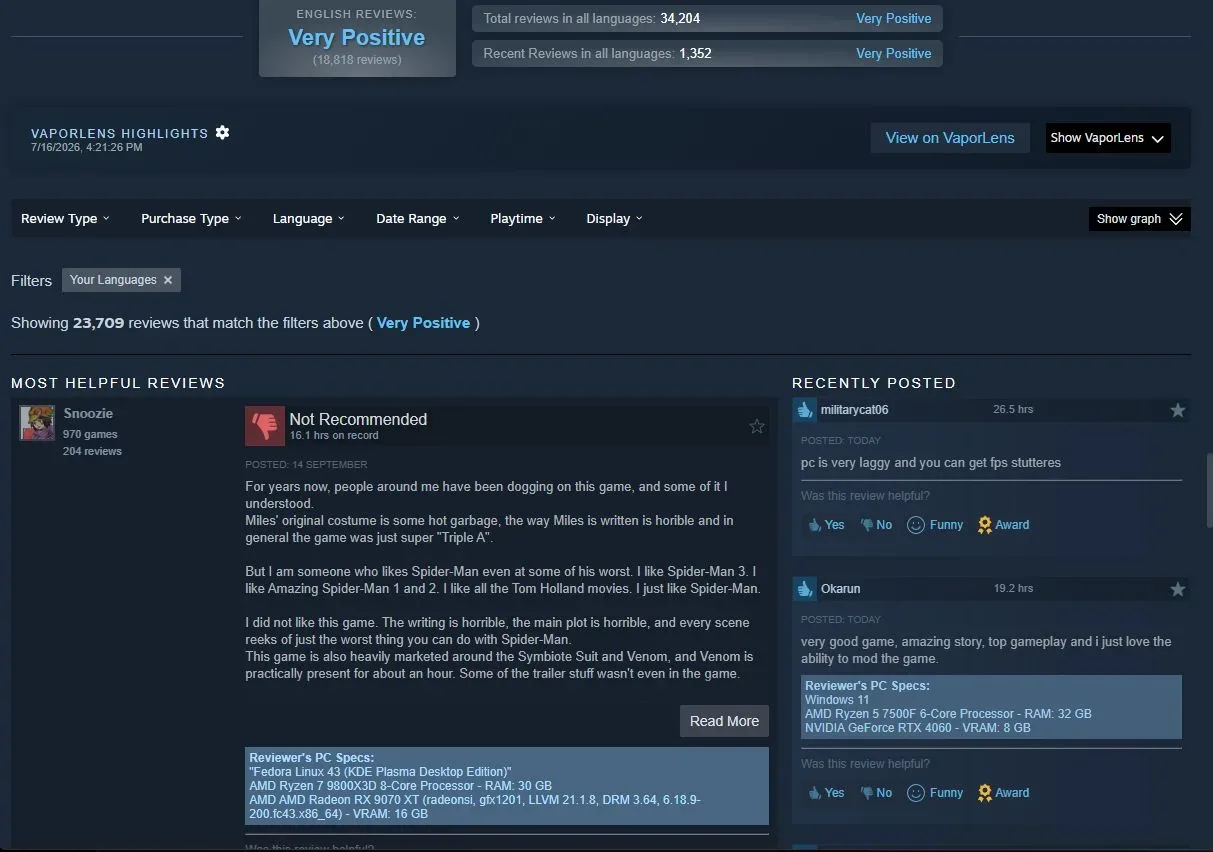
The current Steam review prompt asks whether a user recommends a game, ultimately producing a positive or negative result. That is admirably direct, but it turns a complicated opinion into a binary signal. A player may think a game is good but poorly optimized, interesting but overpriced, excellent for a genre audience but not for newcomers, or simply decent rather than essential. The existing written review field can express that nuance, but the score itself cannot.
The result is a percentage assembled from yes-or-no recommendations. A middling overall rating may look like consensus, even if it actually represents a divide between people who strongly loved the game and people who strongly disliked it. That is useful information only if the reader knows how to interpret it.
A third response such as “Unsure” or “Recommended with reservations” would not make reviews perfect, but it could capture a meaningful portion of real buyer sentiment. Valve could retain the established positive/negative system for continuity while testing an additional layer that explains confidence, context or common caveats.
Review bombing is the other obvious challenge: a sudden flood of negative reviews responding to something outside the game itself, or to a controversy that does not necessarily describe the product’s quality. Players should be able to criticize developers and publishers, including for decisions surrounding a game. But storefront presentation can distinguish a sustained pattern of hands-on feedback from a short-term surge, making the context clear rather than allowing a single number to do all the speaking.
That is not a request to hide criticism. It is a request to make criticism more legible. Store reviews should help a prospective player answer useful questions: Is the game stable? Is the premise delivered well? Who is likely to enjoy it? Has a recent issue changed the experience? A more expressive system could better serve those needs.
A platform this large can choose ambition
The reported revenue estimate does not prove exactly how much cash Valve has available, and it should not be treated as a guarantee that every desirable reform is simple. But it does put the scale of Steam’s influence into perspective. With that influence comes an opportunity to improve an ecosystem rather than merely extract from it.
A reduced early revenue cut for small games, a properly empowered developer panel, stronger human-led discovery, more visible personalized recommendations, and reviews that allow for nuance are not moonshot concepts. They are specific platform choices. Each would require investment, policy work and iteration. Each could also make Steam more useful to players and more sustainable for the people who supply its enormous catalog.
There is an even broader choice available to any exceptionally successful private company: directing some of its resources beyond its own marketplace. But Steam’s first responsibility is closer to home. Before promising a grand reinvention of PC gaming, it can make the basic bargain between storefront, player and developer fairer, clearer and easier to navigate.