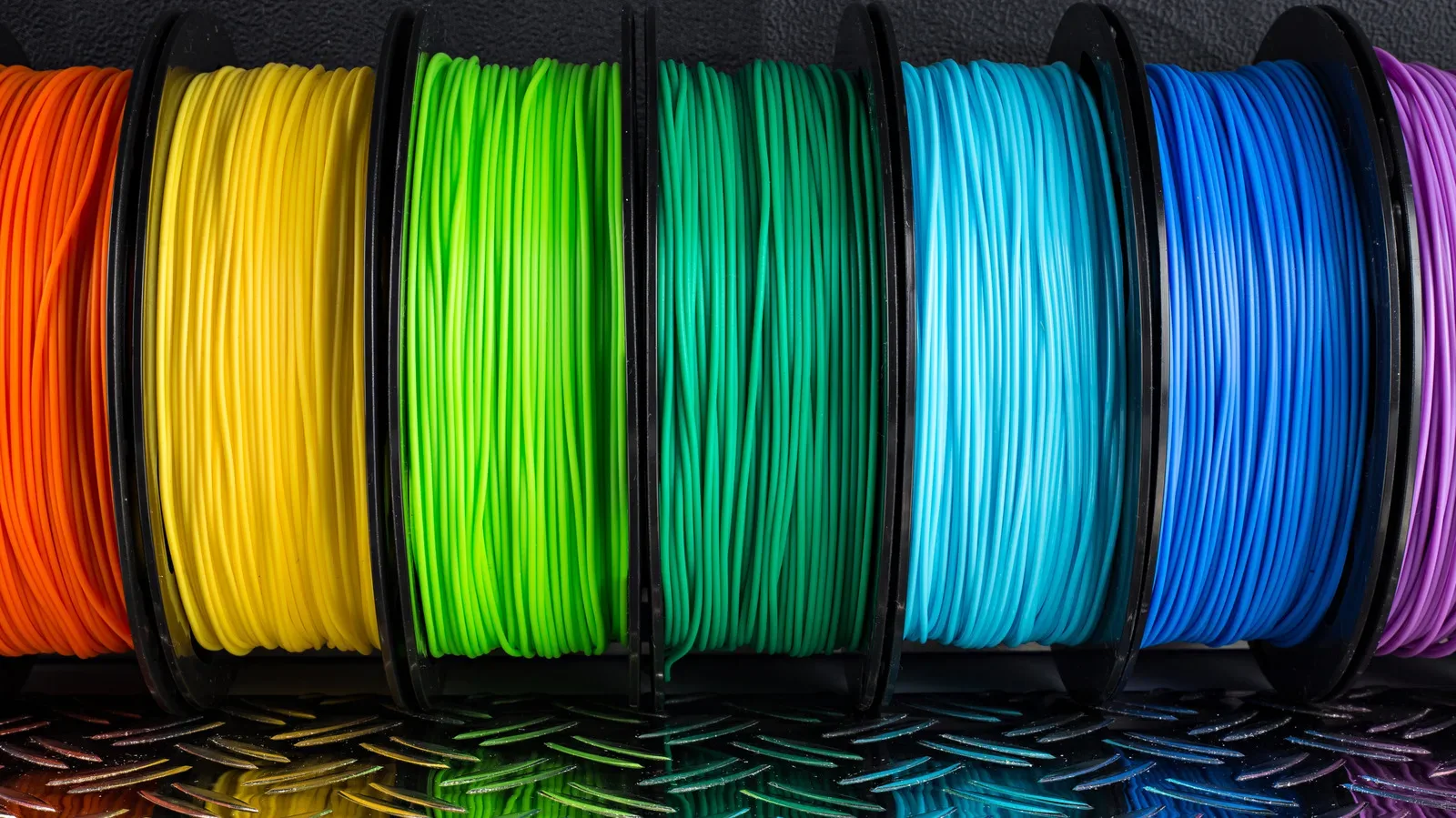
3D printing is often pitched as an easy route to custom controller stands, headset hooks, handheld docks, cable clips and display pieces. For purely decorative projects, everyday PLA or PETG may be entirely adequate. But when a part must carry weight, hold its shape near heat, or survive repeated use, filament choice becomes a more serious engineering decision.
Two materials stand out among practical, maker-accessible filament options for rigid functional parts: carbon-fiber-reinforced nylon, often abbreviated as PA-CF, and polycarbonate, or PC. Both represent a substantial step up from PLA and PETG for demanding jobs, but neither turns an entry-level printer into an automatic factory for indestructible accessories.
That last distinction matters. “Strong” can refer to several different properties, and a material data point is not a promise that every model printed from it will behave identically. Part geometry, wall thickness, internal fill, print orientation, temperature control and moisture handling can all influence the result. The material is only one part of the build.
First, define what the part actually needs to do
A rigid bracket and an impact-resistant clip do not necessarily benefit from exactly the same material behavior. The available comparison here focuses on rigidity: resisting bending under load. That is a useful priority for items such as brackets, mounts, fixtures and supports that need to stay aligned rather than gradually flex out of position.
Two measurements help frame the decision:
- Bending strength describes resistance to failure while a sample is bent. It is commonly stated in megapascals (MPa), a unit of stress.
- Tensile strength describes resistance to being pulled apart. In filament printing, it can vary substantially depending on whether force runs across the printed layers or tries to separate them.
This is especially important with fused-filament printing, where a model is constructed from many deposited layers. A part does not have the same properties in every direction. Load applied along a well-supported direction can produce a different outcome from load that pulls layers away from one another.
Before selecting a premium spool, ask a simple question: where will the force go? A wall-mounted or desk-mounted holder needs its geometry and layer orientation considered alongside the filament choice. More walls, thoughtful infill and a shape that avoids concentrated stress can matter as much as moving up from one engineering plastic to another.
PA-CF: the rigidity-focused structural option
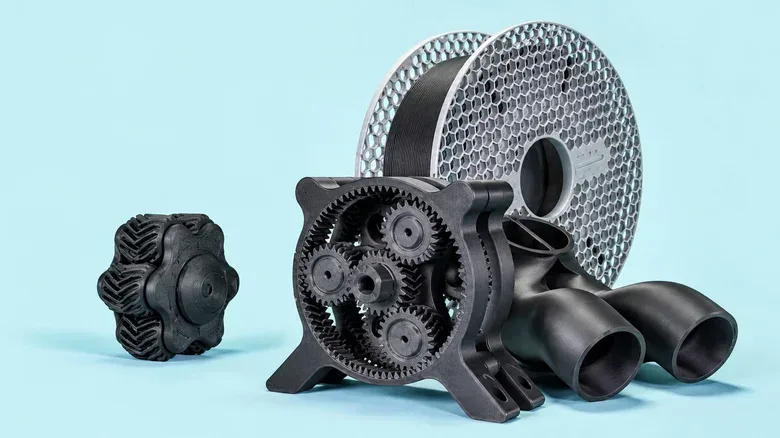
Carbon-fiber nylon blends nylon with short carbon fibers. Nylon is already suited to demanding functional parts; the fibers add stiffness and improve resistance to bending under load. That makes PA-CF a logical candidate where the goal is a firm structural piece rather than a decorative prop that will only sit on a shelf.
A dry-state test for carbon-fiber-reinforced nylon 6, or PA6-CF, records 151 MPa of bending strength. It also lists a heat-deflection temperature of 186 degrees Celsius. Heat deflection is a material test describing how long a sample resists deforming under a specified load as temperature rises. It should not be read as a universal operating guarantee for every printed object, but it does illustrate why this class of material is considered for more punishing functional applications.
In practical terms, PA-CF’s appeal is its ability to make stiff brackets, fixtures and supports that resist bending better than common hobby filaments. That does not mean every PA-CF print will reach the cited test figure. A thin, poorly oriented component with inadequate walls can still become the weak point, regardless of an impressive number on a product sheet.
The trade-offs are part of the purchase
Carbon fiber brings complications as well as stiffness. The fibers are abrasive, so a conventional brass nozzle may wear quickly. A hardened steel nozzle is recommended for PA6-CF. This is not merely an optional flourish: worn nozzles can undermine the consistency required for parts intended to fit, support or align something accurately.
Moisture preparation is another requirement. PA6-CF must be dried before printing. A user considering this material should treat that as part of the workflow and not a peripheral extra. The listed nozzle range is 260 to 290 degrees Celsius, and an enclosed printer is recommended. Those requirements immediately narrow the field of suitable machines.
Price is also meaningfully higher than basic filament. A 1kg spool of Fiberon PA6-CF20 was listed at $52.99 at the time the pricing was noted. That can be justified for a working part whose failure would be especially inconvenient, but it is less compelling for prototypes or purely visual prints.
For a gaming-adjacent project, PA-CF is best viewed as a material for the load-bearing portion of a setup: a purpose-built bracket, a rigid fixture or another component where minimizing bend is more important than minimizing material cost and setup effort. It is not a universal upgrade for every game-room print.
Polycarbonate: serious strength without abrasive fibers
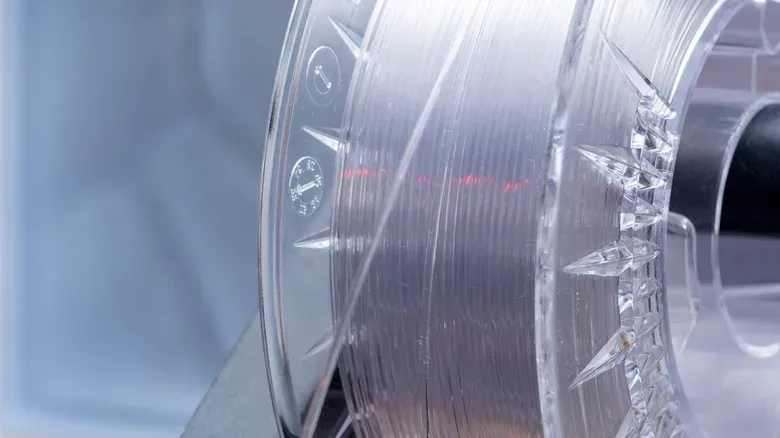
Polycarbonate takes a different route. It is a stiff engineering plastic with good heat resistance, but it does not rely on chopped carbon fibers. PC can suit housings, brackets and other items expected to cope with more than light duty, while avoiding the abrasive-fiber issue associated with PA-CF.
The supplied figures show how its strength profile compares. Polycarbonate measured 69.1 MPa in tensile strength across printed layers and 52.8 MPa between layers. The distinction is useful evidence of why print direction must be considered before declaring an object strong. Its measured bending strength was 106 MPa, below the 151 MPa figure cited for PA6-CF but still in a class beyond casual decorative filament use.
The plain-English interpretation is not that PC is weak. It is that PA-CF has the stronger bending figure in this comparison, while PC remains a robust engineering-oriented choice with a less complicated nozzle situation. A maker who does not need the maximum listed bending performance may find that distinction more valuable than a single headline number.
PC still demands capable hardware
Polycarbonate is not a low-temperature, open-printer convenience material. Suggested settings include a 250 to 270 degrees Celsius nozzle and a heated bed of 90 to 105 degrees Celsius, along with an enclosed printer. Large, dense parts may require a heated chamber to reduce uneven cooling and warping.
Warping occurs when different regions of a print cool and contract at different rates, causing the part to distort or pull away from the bed. For a compact decorative item that may be frustrating. For a bracket, enclosure or support designed around precise dimensions, it can make the item unusable. The demand for stable temperature control is therefore central to PC’s practicality, not an obscure tuning detail.
Lower-cost printers may struggle to hold the temperatures PC prefers. Anyone shopping filament should assess the machine first: can its nozzle reach the required range, can its bed get hot enough, and does it have the enclosure needed to manage cooling? Buying a less expensive spool does not help if the printer cannot process it reliably.
PC is notably less expensive than the cited carbon-fiber nylon example. A 1kg spool of PolyLite PC was listed at $29.99, compared with $19.99 for a 1kg spool of PolyLite PLA. The premium over PLA remains real, but PC’s price makes it an appealing middle ground for makers who want a stronger functional material without PA-CF’s fiber-related nozzle wear.
Material choice is only one part of a durable design
It is easy to turn filament selection into a shopping-list contest, but the more useful approach is to design around failure modes. If a part must resist bending, avoid shapes that place all load on a thin neck or a single sharp corner. If it will see repeated load, provide sufficient wall thickness and consider how the internal structure supports the outer shell. If it has to fit another object, remember that warping can be just as damaging as an outright crack.
Orientation is particularly consequential. The PC tensile measurements—69.1 MPa across layers and 52.8 MPa between them—demonstrate that a print’s directionality is not theoretical. A model placed on the bed for convenience may place its layer bonds in the worst possible orientation for the intended force. Changing orientation can involve trade-offs in surface finish, supports or print duration, but it belongs in the design stage for any part meant to do real work.
Those same ideas apply to PC hardware projects more broadly. People already accustomed to considering thermal limits and reliable operation in a desktop system may find useful context in this look at what happens when GPU driver support ends: the dependable result comes from matching requirements to the equipment, rather than assuming a single upgrade solves every constraint.
Safety and workspace requirements should be non-negotiable
High-performance prints require more than a capable hot end. The National Institute for Occupational Safety and Health notes that fused-filament desktop printers can emit respiratory irritants and ultrafine particles. Ventilation or filtration deserves consideration for both PA-CF and PC, while PC guidance also calls for good workplace ventilation or exhaust.
This is a practical part of deciding whether either material fits a project. An enclosed printer can support temperature control, but it does not eliminate the need to think about the workspace. A maker should plan the print environment before beginning rather than treating ventilation as an afterthought once a high-temperature spool is already loaded.
Which one makes sense?
Choose PA-CF when rigidity and bending resistance are the leading priorities, the printer has an enclosure, a hardened steel nozzle is available, and proper drying is part of the plan. Its 151 MPa bending-strength figure and 186-degree-Celsius heat-deflection figure explain the appeal for serious structural parts, though the higher material cost and equipment demands must be accepted.
Choose PC when a strong, heat-resistant engineering plastic is needed without carbon-fiber nozzle abrasion, and the printer can sustain its demanding nozzle, bed and enclosure conditions. Its 106 MPa bending-strength figure is lower than the cited PA-CF result, but it remains a substantial functional option at a lower cited spool price.
For prototypes, low-stress accessories and decorative gaming pieces, PLA or PETG may still be the sensible starting point. For the parts that must hold, align, support or survive, the lesson is more nuanced: select the material for the force involved, then give it a design, orientation, machine and workspace worthy of the job.