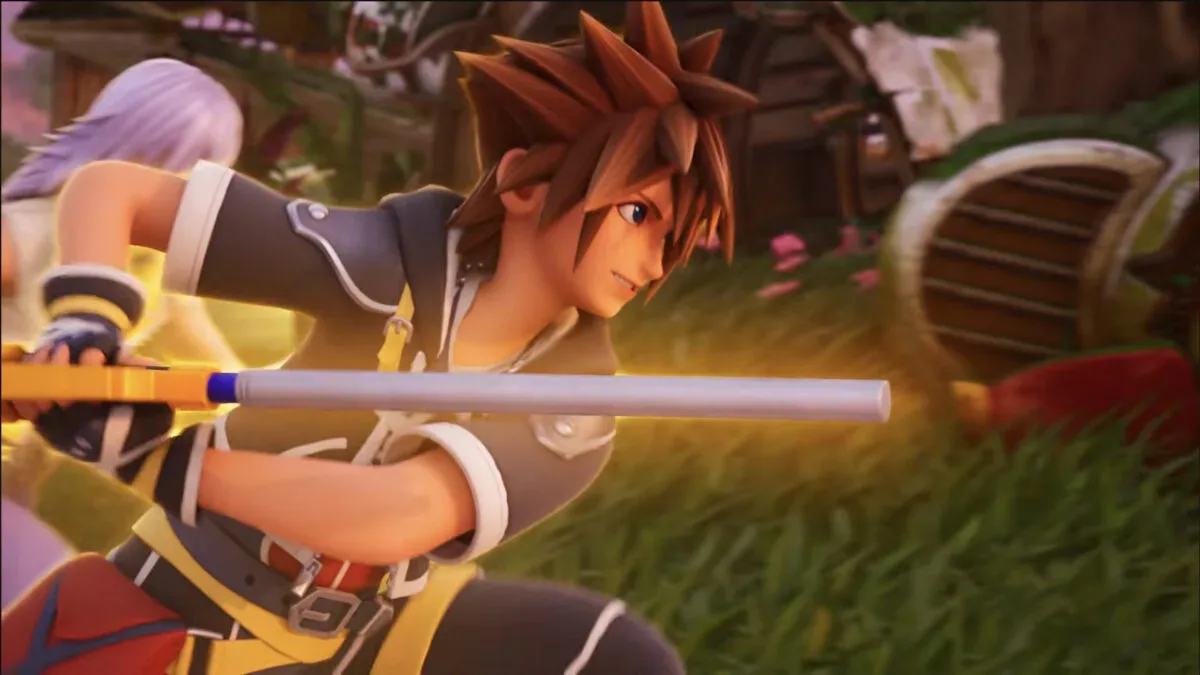
Kingdom Hearts does not ease players into its Disney-and-Final Fantasy crossover with cheery castle gates or a familiar animated sidekick. It begins with a fall.
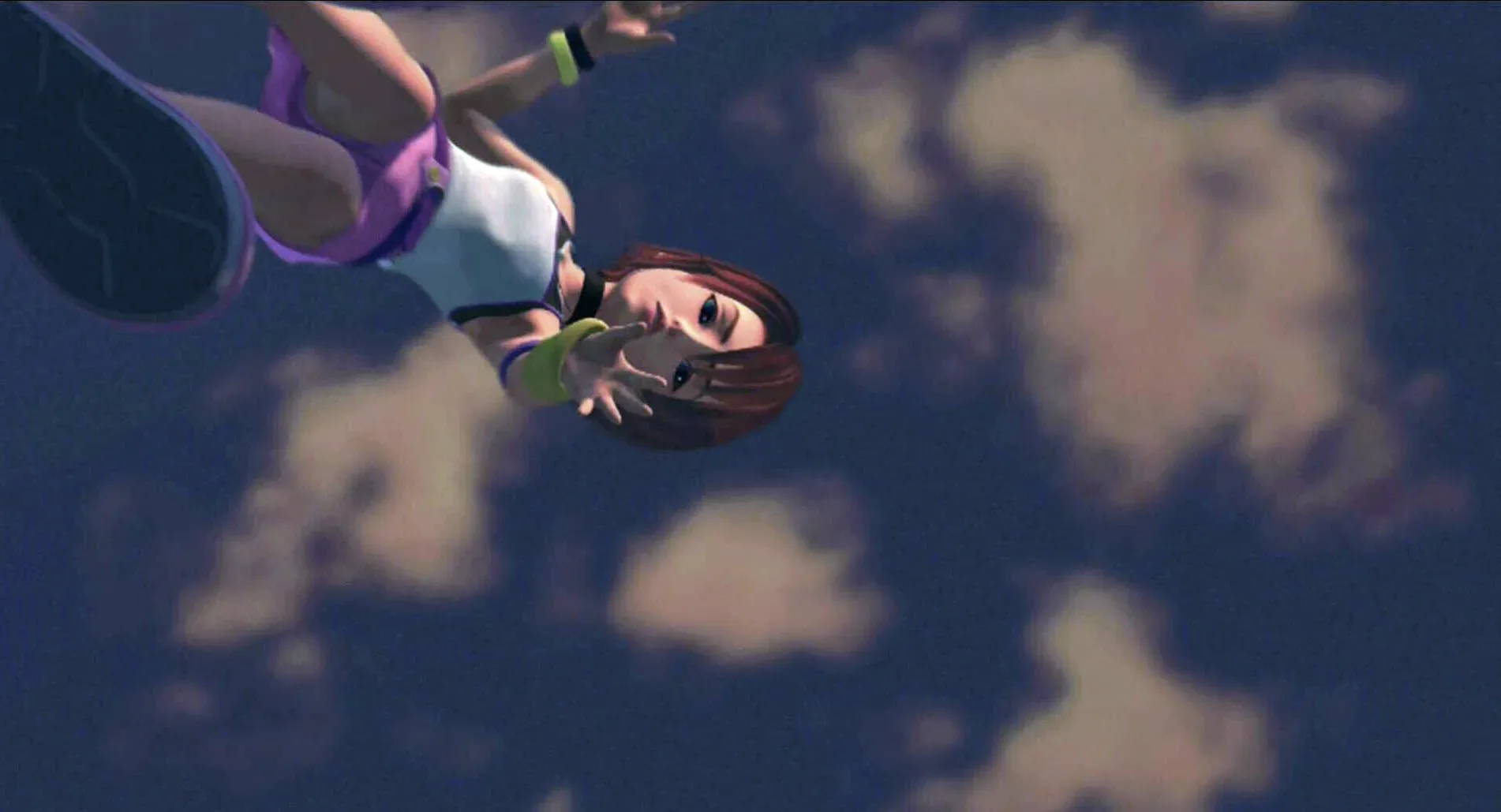
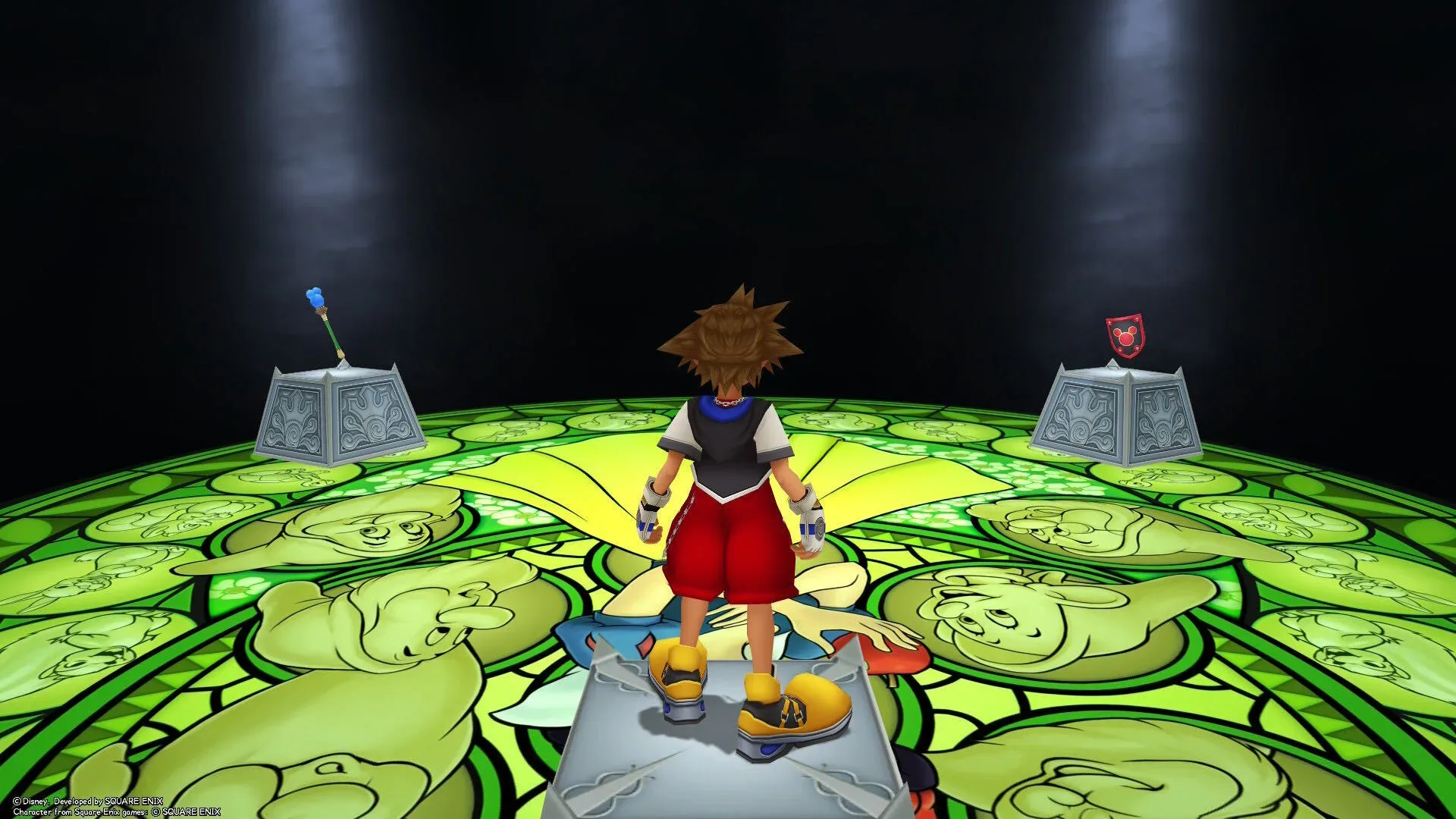
After the opening cinematic set to Utada Hikaru’s “Simple and Clean,” Sora drops through an abyss and lands on an enormous stained-glass platform depicting Snow White. The sequence is beautiful, but it is also deeply odd: Sora has not met Snow White, and Disney characters are still hours away. Before the game establishes the basic pleasures suggested by its crossover premise, it introduces symbols, warning signs, disembodied instructions, and darkness.
That choice is a large part of why the original game’s opening remains so memorable. Its tutorial teaches the expected practical fundamentals—movement, attacks, enemies, and saving—but it frames those lessons as a frightening dream with implications the player cannot yet understand. It turns familiar mechanical onboarding into an early piece of atmosphere and foreshadowing.
The Dive to the Heart is a tutorial space with a secretive purpose
The opening location is called the Dive to the Heart, a physical representation of an individual’s heart. That definition matters because Kingdom Hearts uses “heart” as more than an emotional metaphor. Within the series’ mythology, hearts, darkness, light, connections and separation carry direct narrative weight. The game does not stop its opening to deliver a glossary, however. Instead, it lets the player walk across the imagery before explaining why any of it matters.
Snow White is only one of several princesses represented on the platforms. Their inclusion is initially disorienting rather than explanatory. Sora has no reason to recognize a personal relationship with them, and the game offers no immediate objective connected to the images. Yet later returns to Dive to the Heart-like spaces across the series suggest that the figures are not arbitrary decoration; their hearts appear to be sealed in some manner.
That is a strong example of what the opening withholds. A conventional tutorial often aims to eliminate uncertainty as quickly as possible. Kingdom Hearts does the opposite. It provides enough information to act but preserves uncertainty over what the action means. The player knows how to swing a weapon. They do not know why princesses from distant Disney films appear inside Sora’s dream, why a voice seems to be preparing him for an enormous task, or what is coming for him.
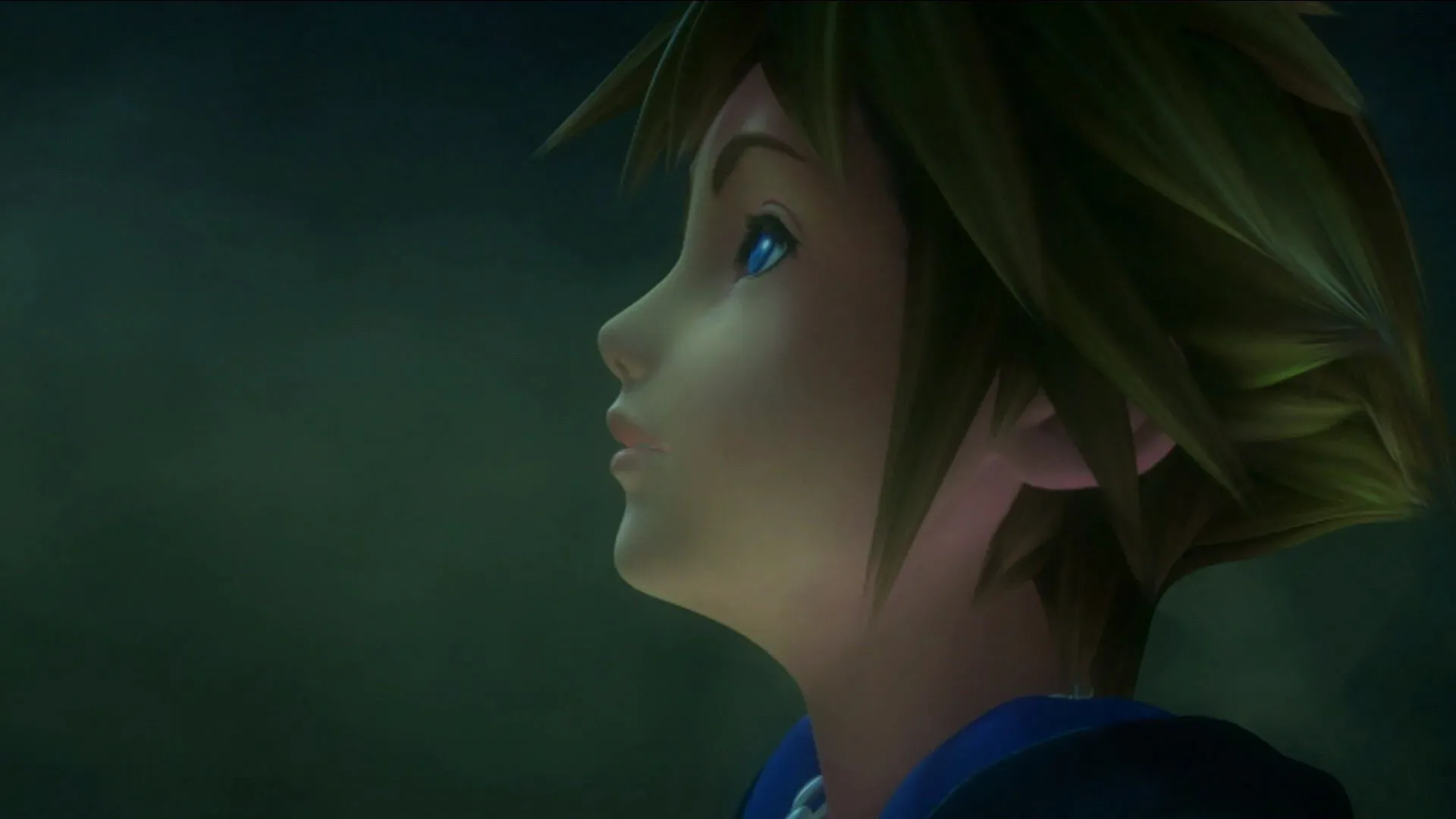
The result is an opening that makes the player feel slightly behind the story. In this instance, that is not a failure of clarity. It is the intended emotional position. Sora is only 14, and he is just as unprepared as the person holding the controller.
One early choice quietly shapes Sora’s growth
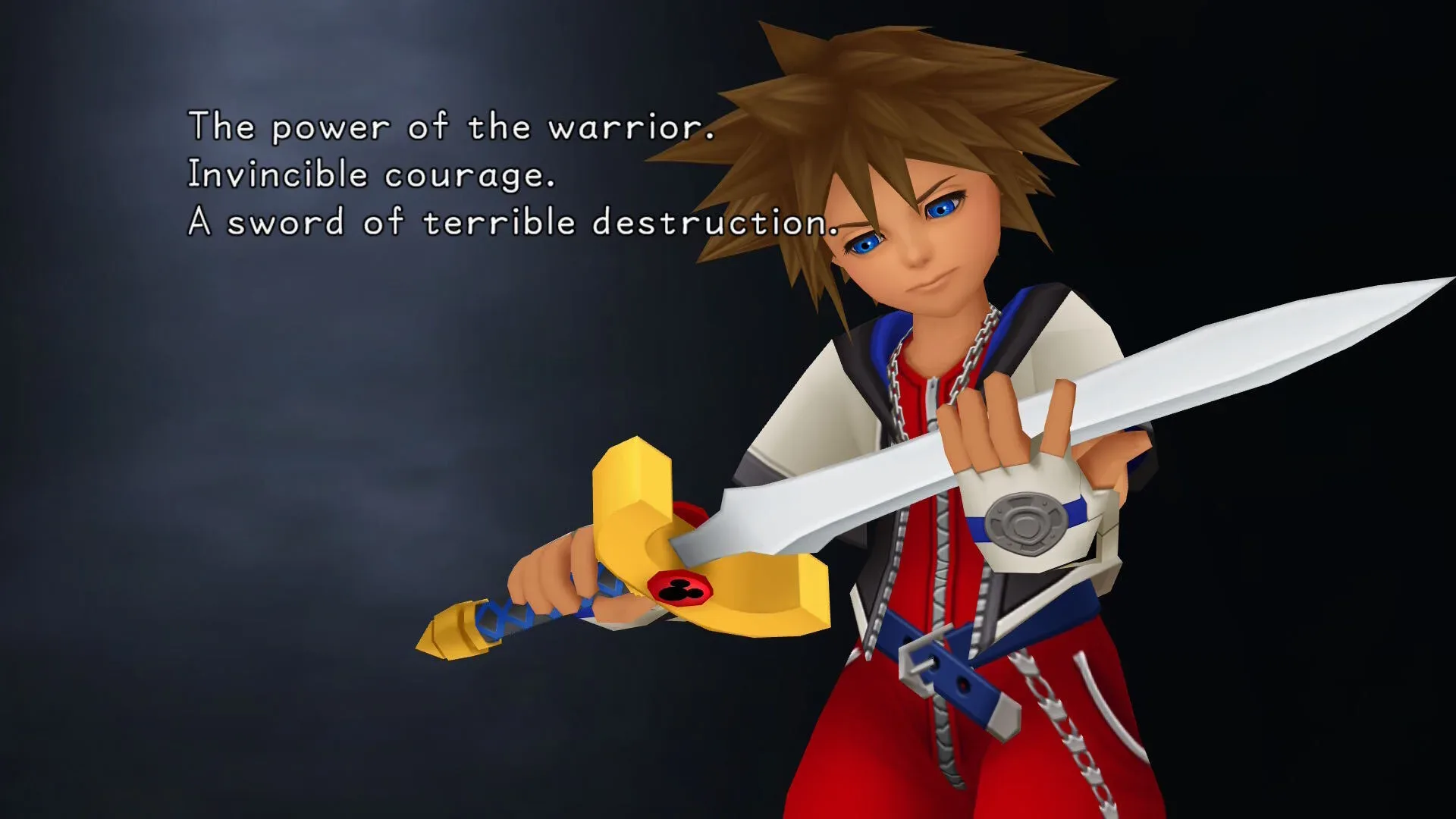
The most important mechanical decision arrives before the game gives it a plain-language explanation. Players choose between a sword, a staff and a shield, then surrender one of the two remaining options. The presentation feels symbolic: choose a path, reject another. Under the hood, though, it has concrete role-playing consequences.
The decision affects Sora’s baseline stats for the full game and the order in which he acquires skills. In role-playing terms, it works like an unnamed specialization: an early commitment that emphasizes particular strengths and alters how a character develops. The game does not put a big “build selection” screen in front of the player or plainly spell out the statistical tradeoffs. It asks them to interpret a set of objects and live with the choice.
That opacity is especially striking in retrospect. A player can still take Sora through the game regardless of the choice, because he remains broadly capable rather than locked into a narrow job. But the opening decision is meaningful. It changes the texture of progression even if it does not impose a single correct answer.
There is a practical lesson for returning players here: the opening is not merely a cinematic preamble to rush through. The sword, staff and shield scene makes a lasting selection. Anyone replaying should approach it as a character-development choice, not only a piece of dramatic staging. The game’s mysterious language may be part of its charm, but the decision has genuine gameplay consequences.
It is also revealing that this mechanical fork is presented through sacrifice. The player does not simply pick what Sora will gain; they must give something away. Even before the story explains its central conflicts, the tutorial establishes a pattern of choices that are emotionally framed rather than clinically labeled.
The music makes the familiar feel threatening
The setting should be comforting on paper. A young hero is moving through imagery associated with Disney films, then visiting a version of his home on Destiny Islands. Instead, much of the sequence is accompanied by a somber choral arrangement. The score refuses to let the player settle into the expectation of a lightweight trip through beloved movie worlds.
This contrast is central to the opening’s power. Disney iconography is instantly recognizable, but recognition is not the same as safety. The stained glass does not function like a friendly museum exhibit. It feels ceremonial and uncanny. The familiar faces carry a significance beyond Sora’s present knowledge, while the music makes it clear that the game is pointing toward a threat rather than a vacation.
That tonal tension also helps explain why the series’ supposedly convoluted reputation can obscure its basics. The first game is not simply piling mysteries onto a whimsical crossover. From the opening minutes, it is deliberately combining childhood familiarity with fear, loss and a sense of looming destiny. Its big concepts may become more elaborate across many entries, but the impulse to put darkness behind bright, recognizable imagery is present from the start.
The relationship between soundtrack and tutorial is worth emphasizing. A tutorial is normally a pause in a game’s momentum, where fiction steps aside for instruction. Here, the instruction is part of the fiction. The choir, the stained glass and the voice guiding Sora make even a basic attack lesson feel like a rite of passage.
Destiny Islands asks questions Sora cannot possibly answer
After the Dive to the Heart, the game briefly shifts to a facsimile of Destiny Islands, Sora’s childhood home. The change does not remove the unease. Three Final Fantasy characters question him about the things he values, fears and hopes for. Those are not ordinary tutorial prompts. They are existential questions placed in front of a teenager whose life is about to become much larger and stranger than he expects.
Mechanically, questions like these are another means of setting the player’s path. Narratively, they communicate that Sora’s ordinary life is already ending. The game is not asking only whether the player understands a button command. It is asking what kind of future they imagine for him, then placing that imagined future under pressure.
There is a useful distinction between foreshadowing and explanation here. Foreshadowing plants details that will gain meaning later; explanation clarifies the detail at the moment it appears. The opening overwhelmingly favors foreshadowing. It repeatedly implies that a great journey and an approaching darkness are unavoidable, without telling a first-time player how those elements connect. That is why the sequence can feel ominous even when its immediate tasks are simple.
Games frequently use character creators, skill trees and dialogue choices to establish agency. Kingdom Hearts turns that same structural work into a mood piece. Its questions and object choices are not just systems attached to a story. They are systems made to feel like prophecy.
Darkside is a spectacle of helplessness, not a skill check
The opening’s fear takes physical form in Darkside, a gigantic Heartless that has become one of the series’ defining bosses. The fight is not described as difficult, and it is not intended to showcase the elaborate acrobatics Sora gains later. He attacks its fists as they slam down on the platform. The encounter is direct, readable and useful as a combat lesson.
But Darkside’s size changes the emotional terms of that lesson. Everything before it has been strange and unsettling; Darkside gives the dread a body. The boss looks overwhelming relative to the inexperienced Sora, even if the battle itself is manageable. It teaches a key idea that the rest of the journey repeatedly develops: a player may win the immediate exchange without having solved the larger danger.
That is exactly what happens. Defeating Darkside does not allow Sora to escape. Darkness still swallows him. It is an unusually bold beat for an introductory boss, because the expected tutorial rhythm is victory followed by security. Here, victory is acknowledged but not sufficient.
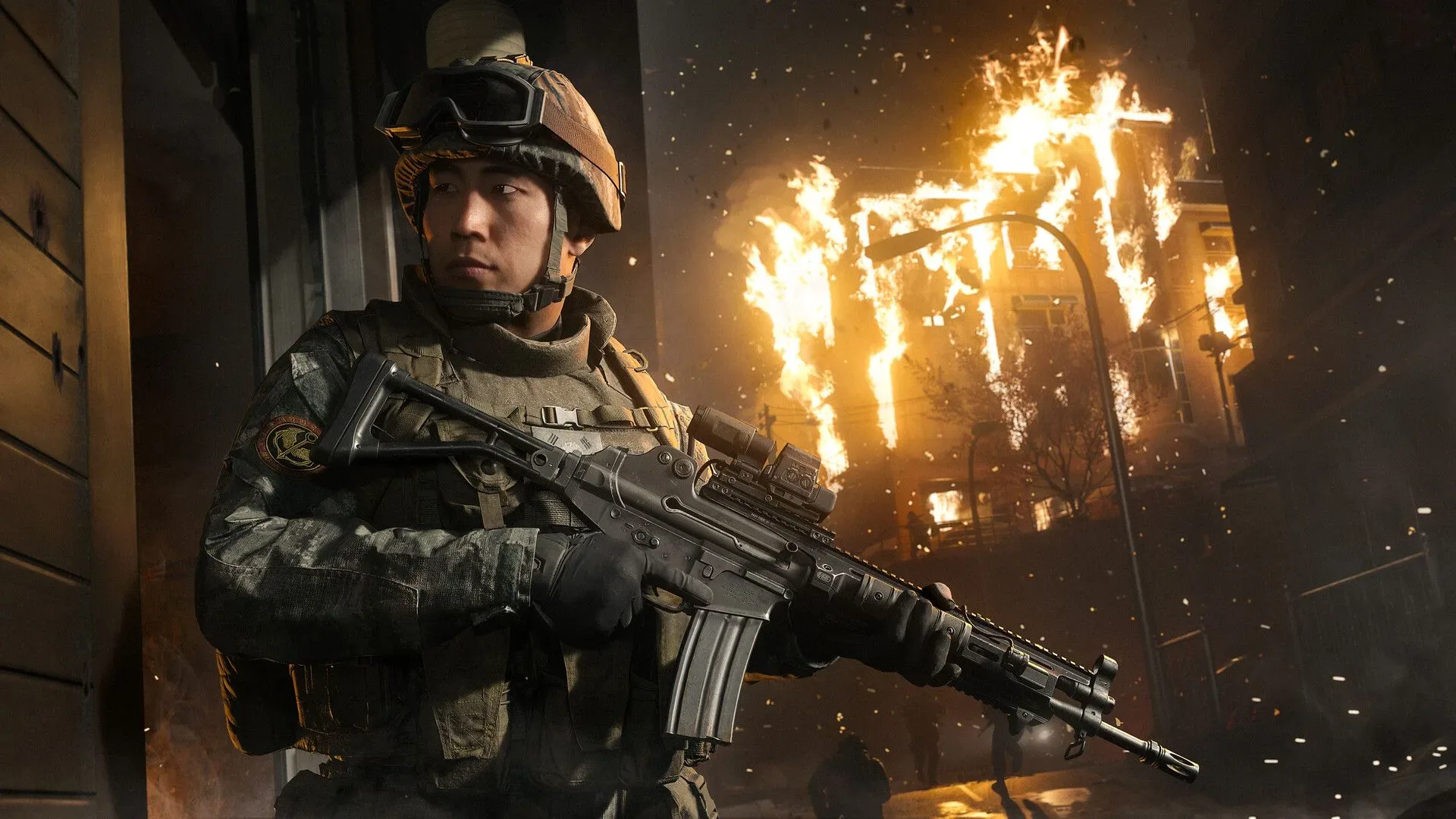
For another recent example of how a campaign’s narrative aims can be illuminated by the works it invokes, see this look at the stated touchstones behind Modern Warfare 4’s campaign. The comparison is not about shared subject matter; it is about the value of understanding how a game establishes tone before its larger story fully unfolds.
An opening that understands mystery is part of the appeal
The original Kingdom Hearts tutorial endures because it knows exactly what information to postpone. It tells the player that Sora has a weapon, that dark creatures can be defeated, that choices shape him, and that an extraordinary journey is beginning. It does not tell them why certain princesses appear in the Dive to the Heart, what the full threat is, or how often darkness will define Sora’s path.
That restraint is important. There is no need for the opening to answer every question in order for the player to understand their immediate goal. The mystery makes the eventual movement toward more whimsical Disney material feel like a reprieve, while ensuring that the dread never fully disappears. The game’s foundational contrast—childlike wonder against an unsettling mythology—is already complete.
“The closer you get to the light, the longer your shadow becomes.”
The early message encapsulates the tutorial’s strange confidence. It sounds like a warning, but it also asks the player not to be afraid. Sora is told that he holds the mightiest weapon and will open the door. The game gives him a destiny before it gives him the vocabulary to understand it.
That is why the opening still lands. It is not simply a fondly remembered PlayStation 2-era introduction, nor merely a hidden-stat setup disguised as a dream. It is the series in miniature: gorgeous, melodramatic, mechanically purposeful, a little unnerving, and far more interested in the cost of stepping into the light than its colorful crossover surface first suggests.