Grand Theft Auto has always understood that a city is funnier when its background clutter has an opinion. Ads, radio chatter, signage and disposable bits of consumer culture do a lot of the series’ satirical heavy lifting. In GTA 6, though, one of the most revealing pieces of set dressing may be much smaller: a fantasy novel on Jason Duval’s nightstand.
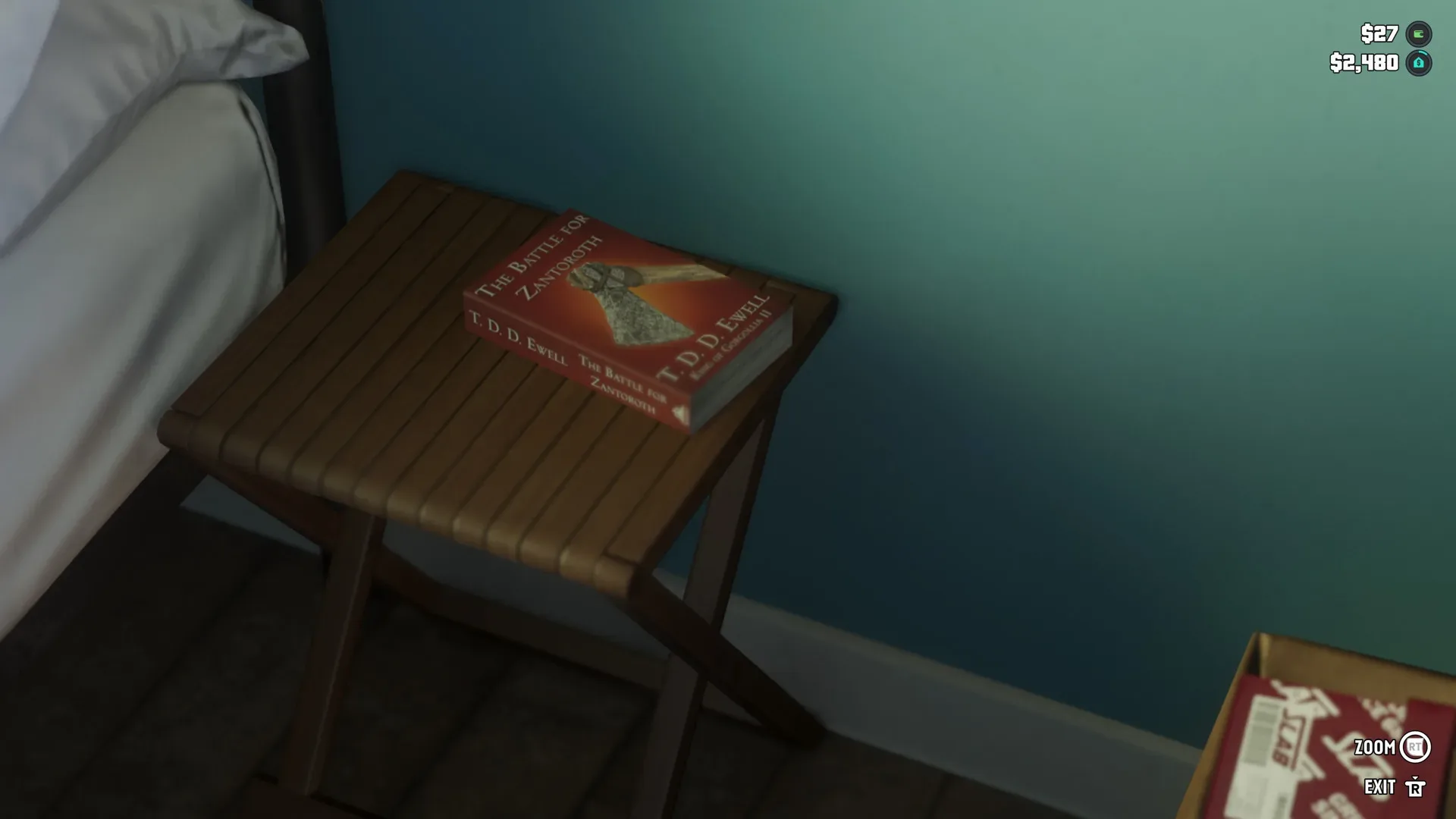
The book is titled The Battle For Zantoroth, credited to T. D. D. Ewell. Its cover identifies it as part of a series called King of Gorgolla, and it appears to be the second entry. It is placed beside Jason’s bed rather than buried among generic apartment debris, a choice that strongly suggests it is meant to be a book he is currently reading. That tiny placement turns an otherwise throwaway prop into a character question: Jason has apparently made room in his life for a continuing fantasy saga.
There is an important limitation here. The novel does not appear to be readable in the same way as some of the other books found around Jason’s home. Players can inspect other reading material, but no interaction prompt has been found for The Battle For Zantoroth. That means the text, its tone, and whether it is sincerely written lore or an elaborate gag remain unknown. The available evidence supports curiosity, not a definitive biography of Jason as Vice City’s most committed dragon-book devotee.
Still, that uncertainty is exactly why the detail works. A game world becomes more convincing when it leaves room for an object to imply a life beyond the player’s immediate mission. Jason does not have to announce that he likes speculative fiction. He does not need a quest explaining the history of Gorgolla. The book being there—apparently mid-series—is funnier and more human than a big reveal could be.
A bedroom prop with more personality than a dossier
Jason’s early presentation has encouraged a fairly narrow first impression. Before Lucia leaves prison, players spend several hours controlling him, and the character can come across as quiet and restrained. Those traits do not automatically tell us what he reads, finds amusing, or thinks about when he is off the clock. The apartment does.
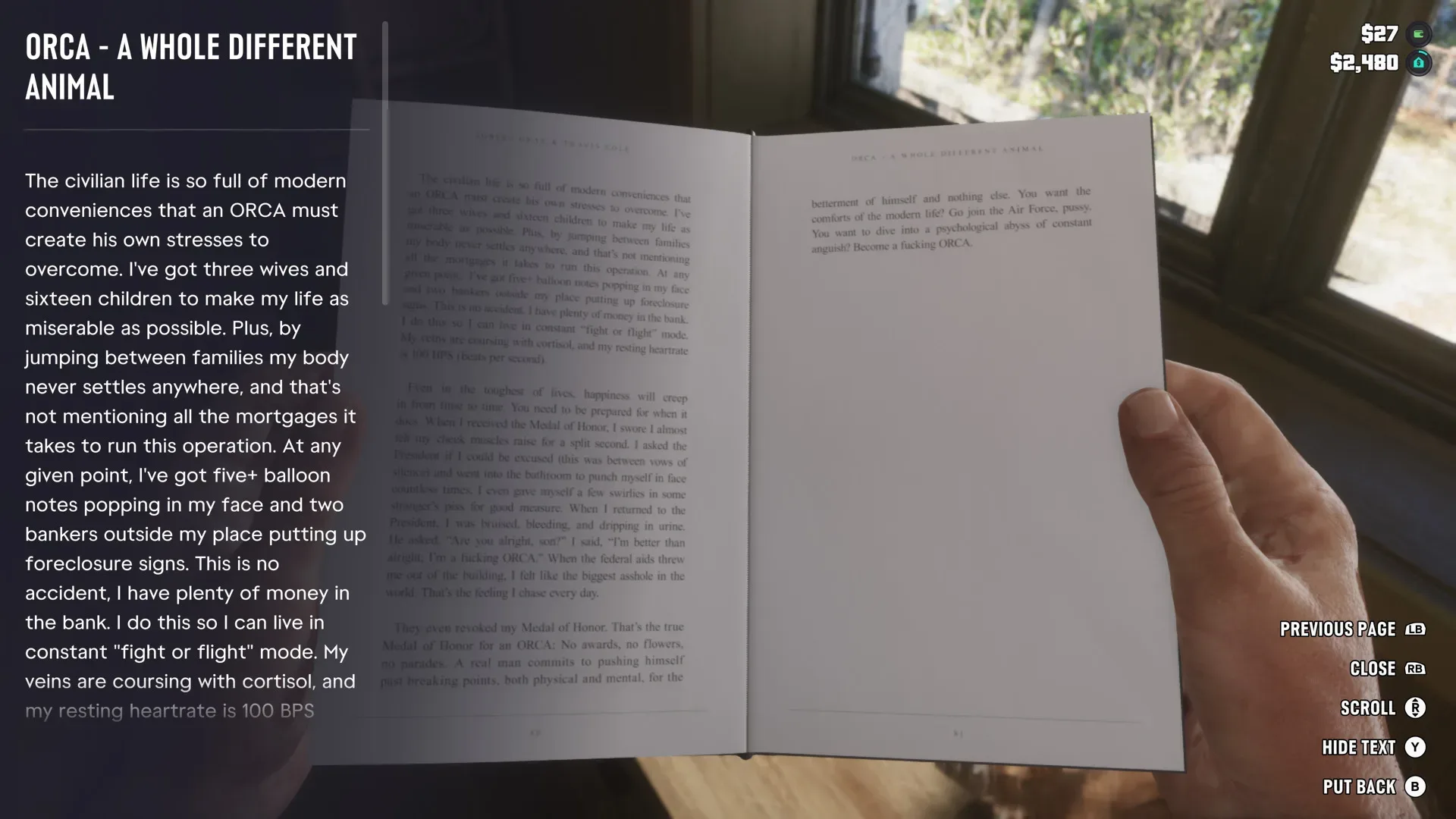
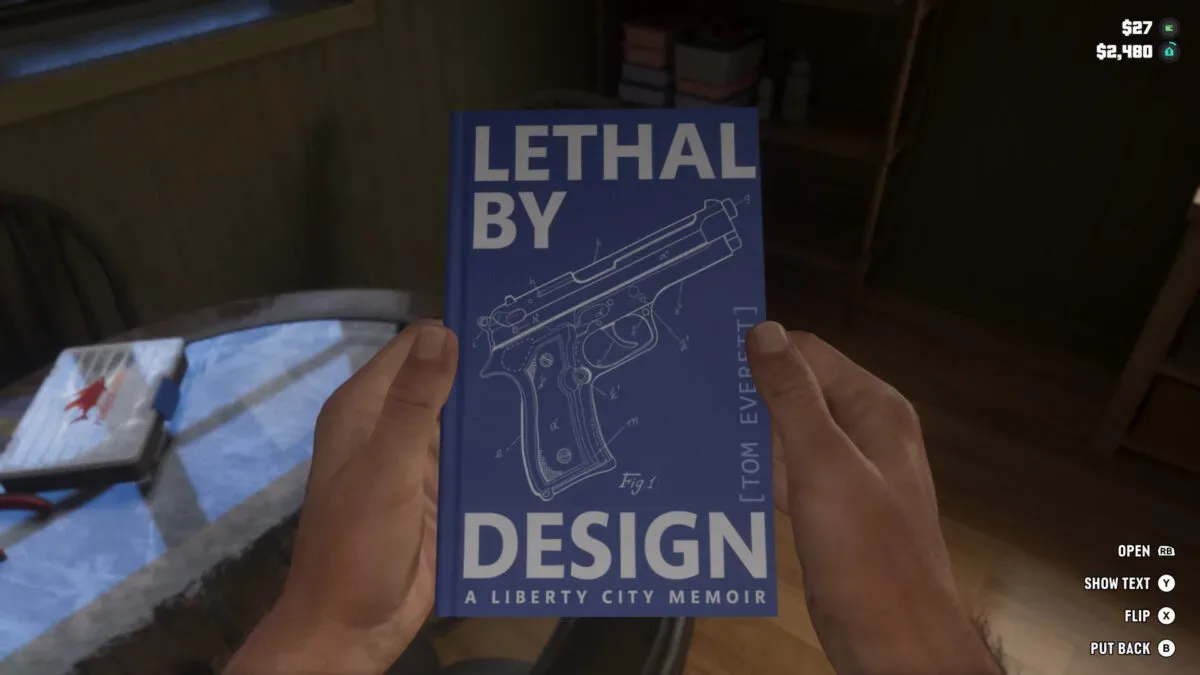
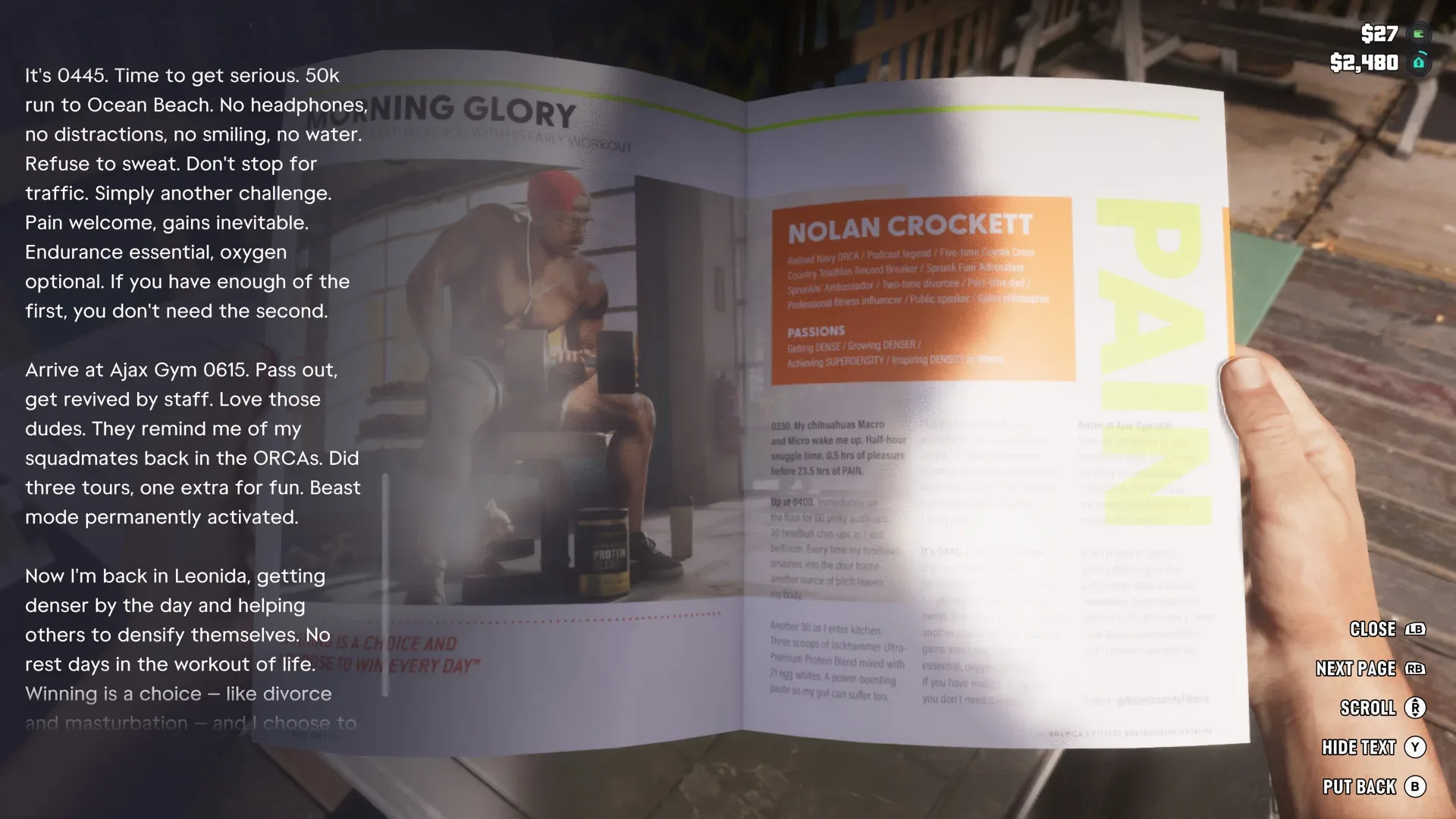
Its readable material includes exaggerated military-oriented fiction, a book connected to the game’s ORCA military unit, and a fitness magazine with aggressively absurd subject matter. Taken together, those items fit the broad, brash kind of masculinity that Grand Theft Auto loves to lampoon. They may be things Jason enjoys, things that happened to be lying around, or objects selected primarily to sell a particular domestic atmosphere. None should be treated as an airtight psychological profile.
But The Battle For Zantoroth differs because of its position. A nightstand is not merely a shelf. In environmental storytelling—the game-design practice of conveying information through spaces and objects rather than direct exposition—where an item sits can matter as much as what it is. A book next to a bed carries an everyday implication: someone has recently been reading it, intends to continue reading it, or wants it close at hand.
The fact that it is the second King of Gorgolla book adds another amusing layer. Series fiction asks for a modest degree of commitment. If Jason is working through volume two, the most natural reading is that he either read the first book or is at least interested enough in the setting to start partway in. Neither possibility is earth-shattering. Both are richer than treating him as a one-note criminal archetype.
Related coverage includes GTA 6's Jason Duval May Be Hiding a Fantasy-Novel Obsession.
Why the fantasy angle is so amusing
There is an immediate visual joke in putting a pulpy fantasy cover among the militaristic clutter of Jason’s home. The book’s presentation recalls the familiar design language of epic fantasy paperbacks: an imposing title, a fictional world or name that sounds built for a map, and an author byline composed of multiple initials. Those elements can evoke famous genre traditions without establishing that the in-game series is parodying any single real-world author or franchise.
That distinction matters. The fictional author name T. D. D. Ewell may simply be genre shorthand. Multiple initials are common enough in science fiction and fantasy that they do not prove a specific allusion. Likewise, the presence of a grandly named battle and a place called Zantoroth tells us more about the cultural silhouette Rockstar’s fictional book is drawing than it does about its unseen plot.
But genre shorthand is a useful tool here. Players recognize the promise being made by a title like The Battle For Zantoroth: dynasties, wars, mythical creatures, betrayals, possibly a sword that has been waiting centuries for a chosen accountant. It is a sharp contrast with the lived-in, low-rent reality implied by Jason’s apartment. That contrast does not diminish him. It gives him texture.
It is also an excellent joke because it refuses to make Jason’s possible nerdiness neat or aspirational. He is not shown curating an elegant library for guests. The evidence is one battered-looking series novel sitting by his bed. That is specific in a way a grand collection would not be. Lots of people have a private genre interest that does not align with the public persona others assign to them.
The unreadable book is an intentional-feeling tease
The frustrating part is that this is the one book that seems especially worth opening, and it is apparently the one players cannot read. Other volumes around the apartment can be examined, while The Battle For Zantoroth remains out of reach. It is possible this is simply a non-interactive decorative asset, rather than a hidden secret or a breadcrumb to later content.
That caveat should temper any theory-building. There is no basis yet to claim that Gorgolla will matter to a mission, that Jason’s reading habits unlock anything, or that the title foreshadows a plot point. A well-placed prop does not automatically become a mystery. It can just be a very good prop.
Yet the lack of access gives it a strangely effective mystique. An openable book would turn the question into a collectible text dump: players would quickly establish whether it was silly, sincere, or a spoof, then move on. An unreadable cover keeps the fiction suspended in possibility. The player fills in the gap, imagining Jason dutifully following the war for Zantoroth after a long day of crimes, repairs, dishes, and attempted self-improvement.
That is a practical lesson in how tiny environmental details can serve a massive open-world game. Not every object needs to provide loot, a task, a codex entry, or a reward. Some objects earn their place by giving players something to notice and discuss. The value is interpretive rather than mechanical.
Jason’s apartment may be doing quieter satire
The apartment’s reading material also points toward a more restrained version of the series’ satire. The ORCA material, macho military fiction, and extreme fitness messaging suggest a world of brands and fantasies selling a heavily stylized idea of toughness. A fantasy book on the bedside table does not necessarily puncture that image, but it complicates it.
There are several plausible readings, and the game has not settled between them:
- Sincere fandom: Jason genuinely follows King of Gorgolla, with the second volume indicating an established hobby.
- New curiosity: He may only be trying the series now, making the book a small sign of a character reaching outside his usual routine.
- In-world satire: The saga could itself be an intentionally ridiculous fictional product, matching the tone of other printed material in the apartment.
- Set-dressing contrast: The developers may simply be using an unexpected paperback to make the room—and its resident—feel less generic.
These interpretations can overlap. A fictional fantasy series can be silly while its fictional reader enjoys it sincerely. In fact, that combination is arguably the most Grand Theft Auto outcome: the game gets to make a joke about a genre’s excesses without insisting that its characters, or its players, are foolish for liking it.
It is too early to treat Jason’s bookshelf as a reliable morality meter, too. Reading fantasy would not make him secretly gentle, and military pulp would not prove the opposite. What it does do is push back against the lazy assumption that a stoic criminal protagonist must be empty between mission markers. The apartment implies habits. Habits imply interiority.
What players should and should not take from the detail
For players exploring Jason’s home, the immediate takeaway is simple: inspect the readable objects and pay attention to placement, not just interaction prompts. The game’s domestic spaces appear capable of communicating character through ordinary clutter. It is worth resisting the urge to view every object only through the question of whether it starts a mission or grants a benefit.
At the same time, do not mistake this for a gameplay guide to a secret item. There is no indication that The Battle For Zantoroth can currently be picked up, read, collected, or used to unlock anything. It is not an established collectible, and there is no evidence that completing some other activity will make it interactive. If you are looking for a decision with known consequences, see our breakdown of whether to spare or kill Arnold in “Hey Arnold!”.
The better reason to care about the novel is that it suggests a welcome ambition in the game’s smaller details. Massive worlds can feel impersonal when their homes are only containers for ammunition, menus, and mission triggers. Jason’s nightstand, by contrast, appears arranged to invite a half-serious argument about a man we barely know. Is he a veteran fantasy reader? Is he sampling a trashy series? Is he just between chapters of an in-universe cultural phenomenon?
Until the game offers more, the honest answer is: maybe. But the question itself is a win. Among the weapons, heists, corporate absurdities, and extremely questionable magazines, Jason Duval may be quietly following the fate of Gorgolla. That is not proof of hidden nobility or a promise of a grand fantasy subplot. It is simply a wonderfully particular detail—and perhaps the strongest case yet for looking at what this supposedly hard-edged protagonist keeps beside his bed.