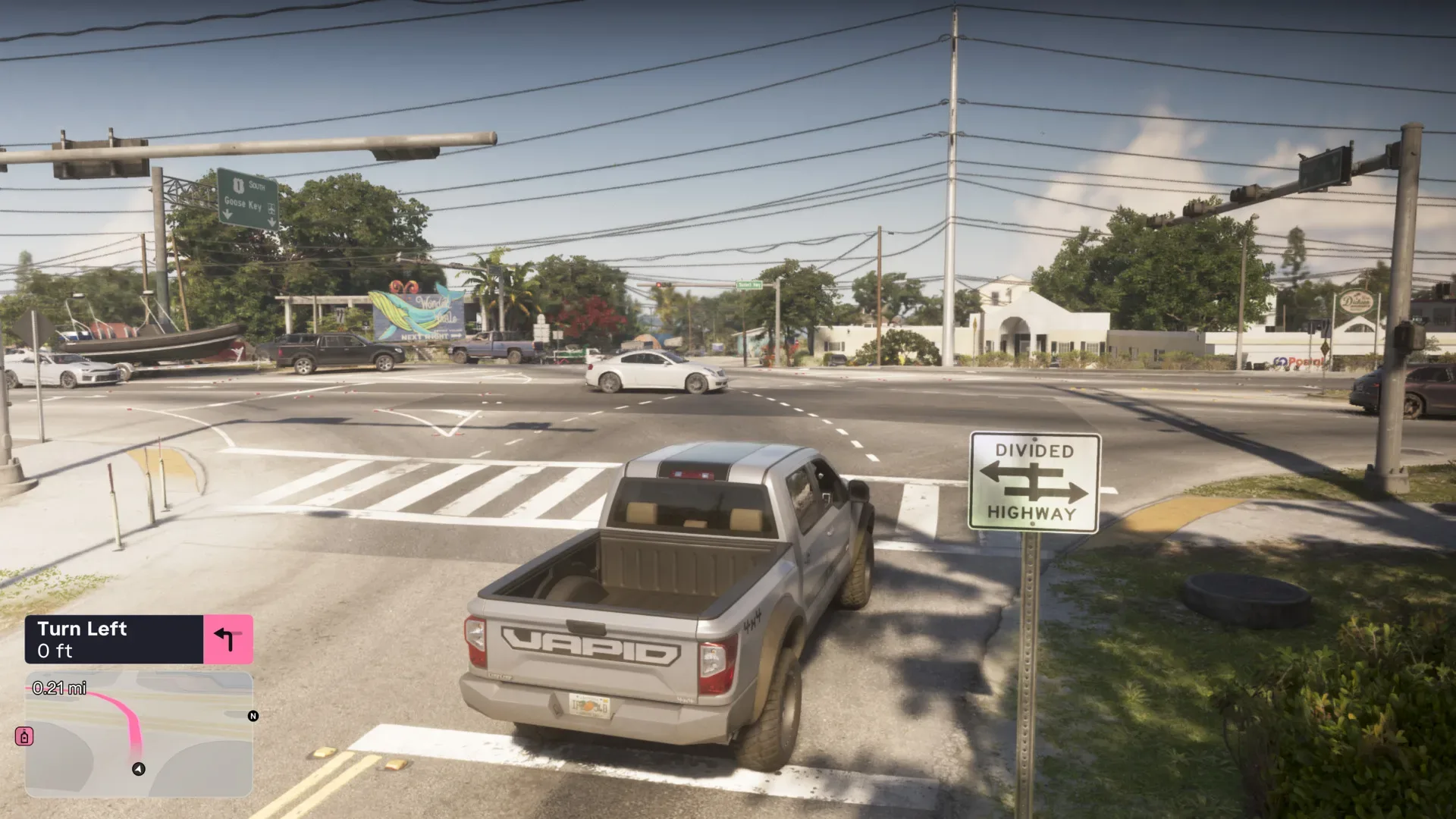
Grand Theft Auto has long built its version of America from familiar shapes with the labels sanded off. Its cities resemble real places, its media resembles real media, and its shops, cars, fast-food chains and apps are close enough to recognize without using the names on the signs outside our own windows. That distance serves more than one purpose. It keeps the world fictional, lets the series satirize consumer culture, and gives Rockstar room to build a connected comic language across its games.
But a parody universe has to keep moving. The observation emerging around Grand Theft Auto 6 is not that fictional brands are a problem; they are one of the series’ most useful tools. The more interesting question is whether every inherited joke still earns its place when the game’s dialogue, characterization and broader worldbuilding are aiming for greater dramatic weight.
That is an editorial issue, not a demand for GTA to suddenly become solemn. A world without ridiculous adverts, opportunistic television channels or suspiciously familiar burger chains would not feel like Grand Theft Auto. The series’ best fake brands make a place feel denser because they communicate an idea instantly: what kind of corporation this is, what cultural target it is skewering, and why it belongs in the specific environment the player is exploring.
The weak ones do the reverse. They stop feeling like details of a world and start feeling like a writer nudging the audience with an elbow. In a game capable of balancing character-driven scenes with a highly recognizable analogue of contemporary life, that distinction matters more than it would in a purely broad farce.
Parody brands are part of GTA’s visual grammar
A parody brand is a fictional business designed to evoke a real-world category, company or cultural habit without directly being that company. In Grand Theft Auto, this can mean a beer, a clothing shop, a news organization, a social-media-like service, a vehicle maker or a restaurant. The point is not always one-to-one imitation. Sometimes the name is enough to establish the joke; sometimes an advertisement, logo, radio segment or product description completes it.
That shorthand is exceptionally useful in an open world. Players pass hundreds of signs while driving, walking and escaping the consequences of choices. A name that quickly conveys “this is the game’s version of a familiar thing” reduces the amount of explanation required. It also gives background artists, mission designers and writers a shared vocabulary. A billboard is not merely scenery if it reinforces the same corporate culture heard on the radio or glimpsed on a phone.
Several established examples show why the approach works. Taco Bomb clearly signals its fast-food target while preserving a loud, exaggerated retail personality. ZIP is concise as a clothing-store analogue. Weazel News works as a media joke because “weasel” adds a judgment about the outlet’s perceived conduct rather than simply swapping one word for another. Snapmatic communicates the basic idea of an image-sharing service almost immediately.
These are not necessarily subtle, nor do they need to be. They are functional. Each name is short, readable at a glance and grounded in a recognizable product or institution. More importantly, each can support a wider fictional identity. A good fake brand has room to appear across a city without exhausting itself on first contact.
Related coverage includes Grand Theft Auto 6 Could Leave Its Weakest Brand Jokes Behind.
When the punchline overwhelms the place
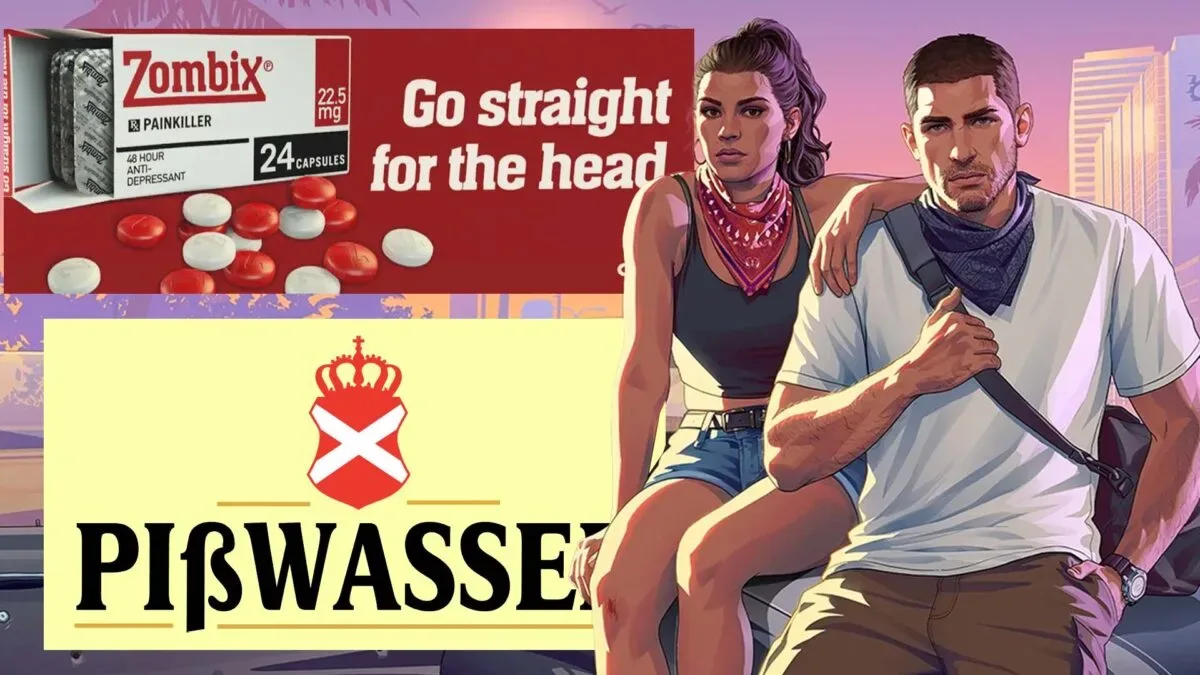
The trouble begins when a brand’s entire identity is a blunt bodily-function gag or a pun that has little to say beyond its sound. Pisswasser, the in-game beer name, illustrates the issue neatly. It has a direct, juvenile comic premise that is easy to understand. As a one-off sight gag, that may be sufficient. Repeated across advertising, sponsorships and other parts of a large world, however, the joke can begin to feel more prominent than the fictional business it is supposed to represent.
The same concern applies to Marbles selling a burger called Big Balls. The reference is easy to decode, but decoding is effectively all there is. The gag leans on a familiar menu-item structure and replaces the key word with an anatomical joke. It is not that crude humor is automatically incompatible with GTA; the franchise has always used it. The question is whether that particular kind of humor contributes to a richer satirical picture of fast-food marketing, or simply announces itself as a pun.
Zombix is another example of the underlying problem: a name can be recognizable without being memorable or especially expressive. There is a difference between a brand that sounds plausibly like something a company would call itself and a brand that sounds like a placeholder designed to get a quick reaction.
This is ultimately a question of tonal coherence. Tone is the emotional and stylistic consistency that lets comedy, action and drama share the same work without constantly breaking each other apart. GTA does not need to choose either seriousness or silliness. Its distinctive strength is the collision between them. But the collision works best when the joke feels observed, targeted or built into the world, rather than merely inserted into it.
Stronger narrative scenes ask players to invest in people and consequences. The setting around those scenes should still be capable of being ridiculous, but it should also feel credible enough that the characters’ concerns register. A freeway chase beneath a billboard can be funny and visually distinctive; the billboard does not need to rely on the broadest available wordplay to do that job.
Growth does not mean sanitizing the series
There is an easy but mistaken reading of this critique: that Grand Theft Auto should become more respectable by removing the parts that are immature, loud or tasteless. That would misunderstand the function of satire and the appeal of the series. Commercialism, tabloid media, cynical branding and low-rent spectacle are central to the kind of contemporary-world parody GTA constructs. Its fictional corporations should sometimes be absurd because the real cultural pressures they caricature are absurd.
The case for change is narrower: selectivity is not censorship. Keeping the sharp material and losing the worn material is a way to preserve the identity of a long-running series rather than flatten it. A joke can be raunchy, irreverent and effective. It can also be raunchy, irreverent and tired. Those are separate judgments.
That distinction is especially useful for legacy material. Long-running fictional settings accumulate names, callbacks and recurring motifs. Some survive because they continue to offer new comic possibilities. Others survive chiefly because they are familiar. Familiarity can be comforting for returning players, but it should not become the only reason a piece of worldbuilding persists.
Real commercial landscapes change constantly. Companies appear, fail, merge, rename themselves and drift out of cultural attention. A fictional analogue of the present does not become less believable when parts of its corporate scenery disappear. It may become more believable if its designers allow the landscape to change with each new setting and story.
That offers Rockstar a practical alternative to either preserving every brand or wiping the slate clean: use an ongoing editorial audit. For every returning name, the relevant questions are straightforward.
- Does the name still create a clear, immediate idea?
- Does it support the setting, the satire or a wider corporate personality?
- Can it be used more than once without the joke becoming exhausting?
- Does it fit alongside the game’s current character writing and dramatic ambitions?
- Would a new brand do the job better?
Those questions do not require a rigid formula. They simply make room for the possibility that continuity can be revised. A fictional car line such as Obey need not appear merely because it appeared before. If it serves a new game’s social landscape, retain it. If not, replace it with a sharper idea. Players are unlikely to lose their understanding of a city because one old logo has been retired.
The strongest jokes leave room for the player
The most durable GTA satire tends to do more than identify its target. It gives players enough information to complete the joke themselves. A news brand that implies opportunism or dishonesty invites an inference about the media culture surrounding it. An app name that mimics the language of online self-presentation makes its point through recognition. A restaurant or retailer can suggest price, aspiration, social class, marketing language or regional character without spelling out every part of the gag.
That is why good fictional branding can improve immersion rather than interrupt it. Immersion does not mean pretending a game world is real in every respect. It means that its details follow a logic persuasive enough for the player to remain engaged. A ludicrous commercial can feel immersive if it sounds like it was made by people who exist in that fictional economy. A shallow joke can feel artificial when it appears to have been made only for the audience outside it.
GTA 6 has an opportunity to treat background comedy with the same care apparent in the discussion of its stronger writing. Better fake brands would not make the game less funny; they could make its humor more varied. Instead of repeatedly relying on names that announce one type of joke, the world can make room for corporate doublespeak, hollow luxury language, weird tech promises, regional rivalry, media opportunism and the countless other ways everyday branding invites satire.
That approach also benefits replay value. An overt pun may provide its entire meaning in a second. A richer fictional company can reveal more through a chain of adverts, a website-like interface, a news story, a sponsorship or an incidental line of dialogue. Players who only speed past a storefront still understand it, while players who linger find additional texture.
An evolving world needs an evolving joke book
No one needs to be wrong for enjoying the cruder corner of Grand Theft Auto’s fake-commercial universe. These names are part of a style that many players associate with the series, and a clean break from every old gag would be unnecessary. The more persuasive argument is that a franchise does not honor its past by treating every old idea as untouchable.
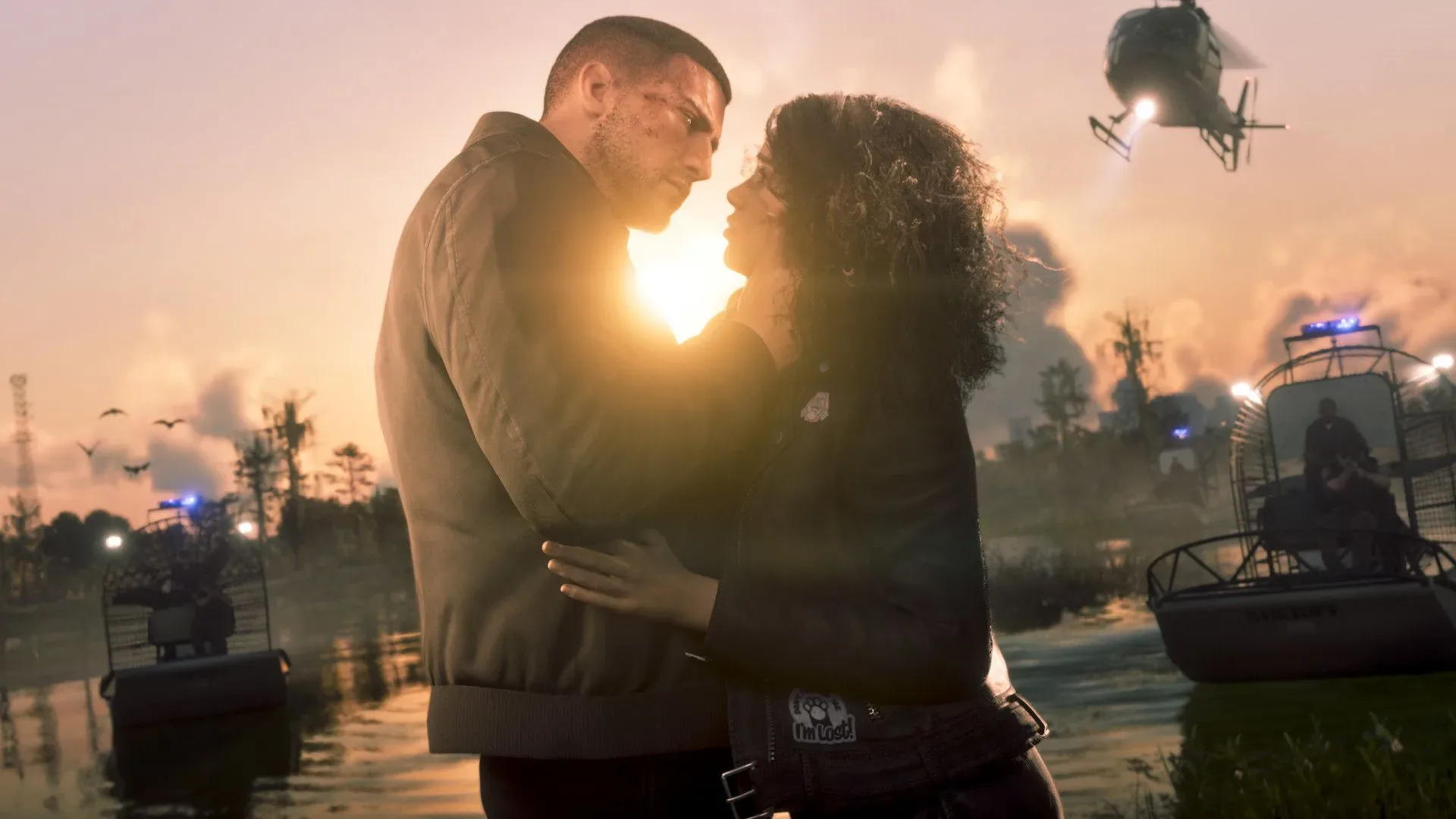
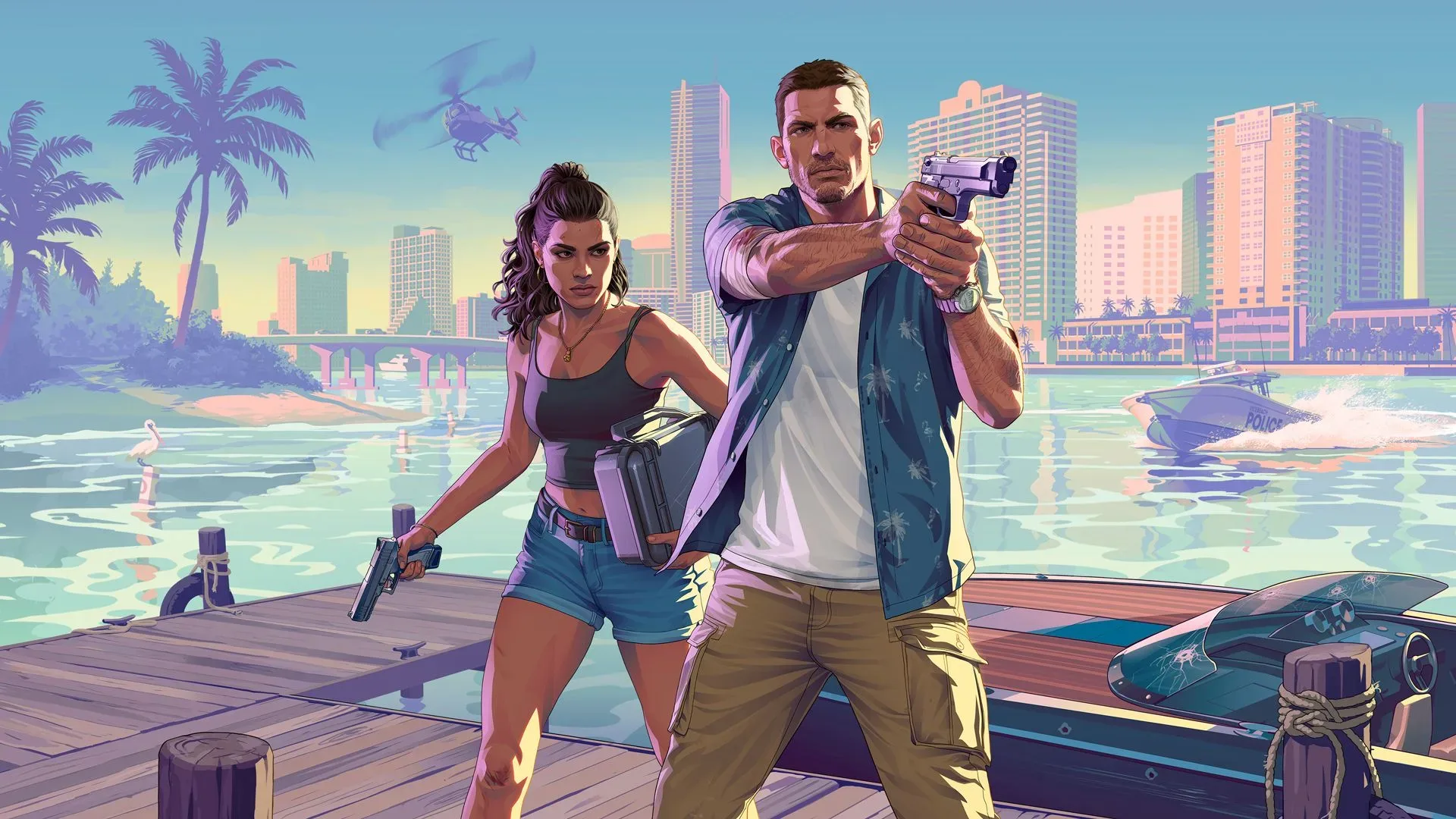
Grand Theft Auto 6 is being discussed as a game with especially compelling characters, more confident dialogue and a more fully realized world. Those qualities raise the standard for the small details around them. When an open world is trying to feel like a coherent place rather than a box of disconnected references, its billboards, menus and storefronts matter.
Rockstar’s next audit of its imaginary commercial landscape need not be dramatic. Keep the names that still have bite. Refresh the ones whose targets have changed. Retire the gags that are only coasting on recognition. The result would not be a less recognizable Grand Theft Auto. It would be a version of the series whose satire stays as alert as its storytelling.
For more discussion of how game worlds can extend beyond their core action, see our look at why a world larger than the match can matter.