There is a special kind of video-game confidence that arrives after you have correctly stopped at a red light while every vehicle around you appears to be auditioning for a stunt reel. In Grand Theft Auto 6, Leonida’s roads can inspire exactly that feeling: the player who uses a turn signal, yields in a turn lane and waits at a stop sign begins to feel less like an ordinary motorist and more like the last licensed driver in the state.
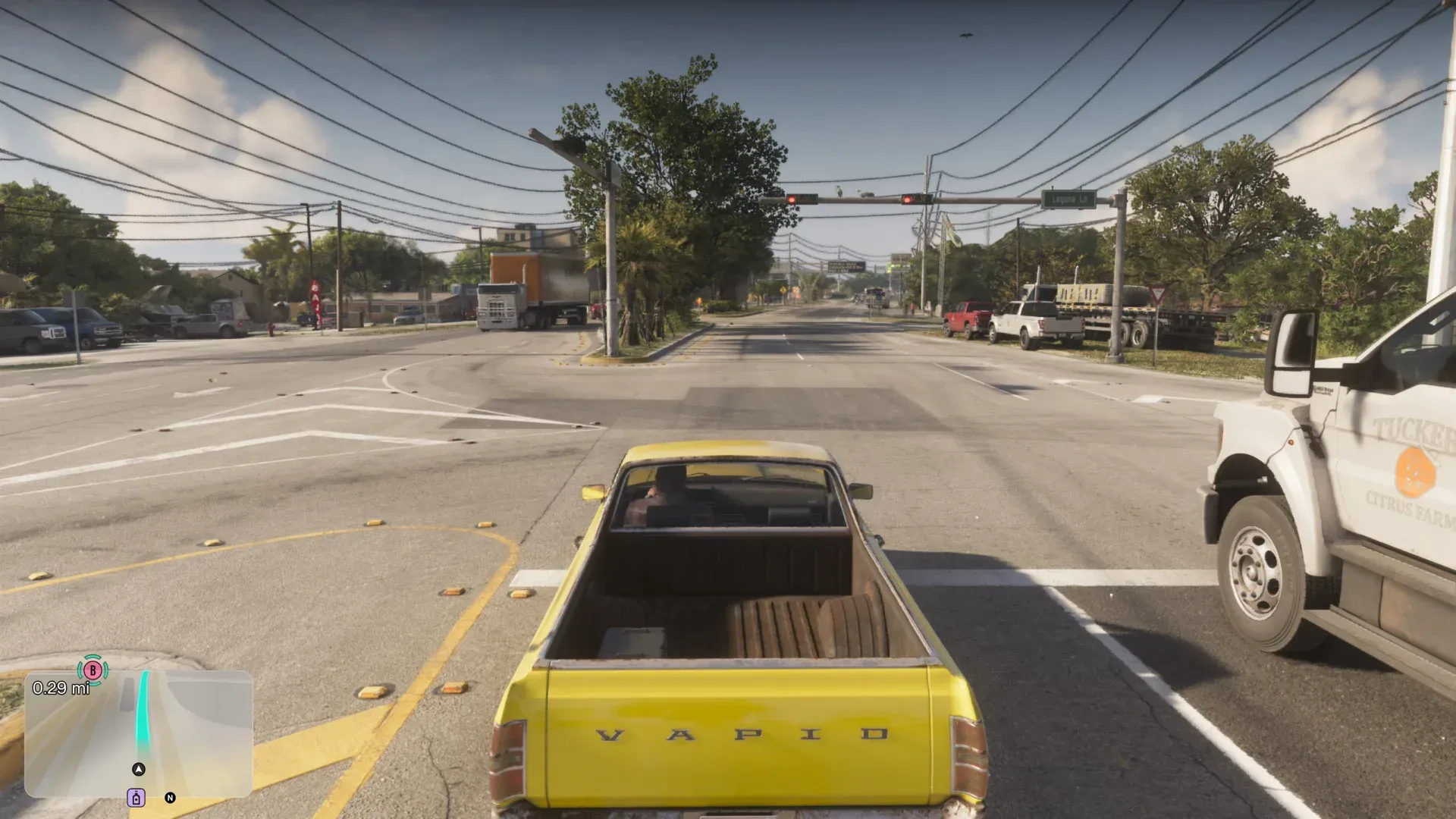
That is the joke at the center of the reported roadside mayhem. A first outing in Jason’s 1970 Vapid Ganado involved some uncertainty over the controls, including the turn signals. Yet that small learning curve was quickly overshadowed by the conduct of surrounding traffic. The encounters described are not merely the usual open-world grumbles about a car drifting over a lane line or cutting somebody off. They suggest a city where a driver may leave the pavement, hit a pole, and continue down the street while everyone else processes the newly fallen traffic infrastructure by driving straight over it.
In a series famous for making vehicles central to both movement and mischief, that chaos is not necessarily a defect in the simple sense. It can be part of the world’s personality. But it also makes a useful point about the difference between traffic that is busy and traffic that is legible. A road system can look alive because cars honk, speed, swerve and collide. It becomes playable, however, only when a person behind the controller can read what is happening early enough to make a meaningful decision.
The pole incident is a tiny open-world disaster movie
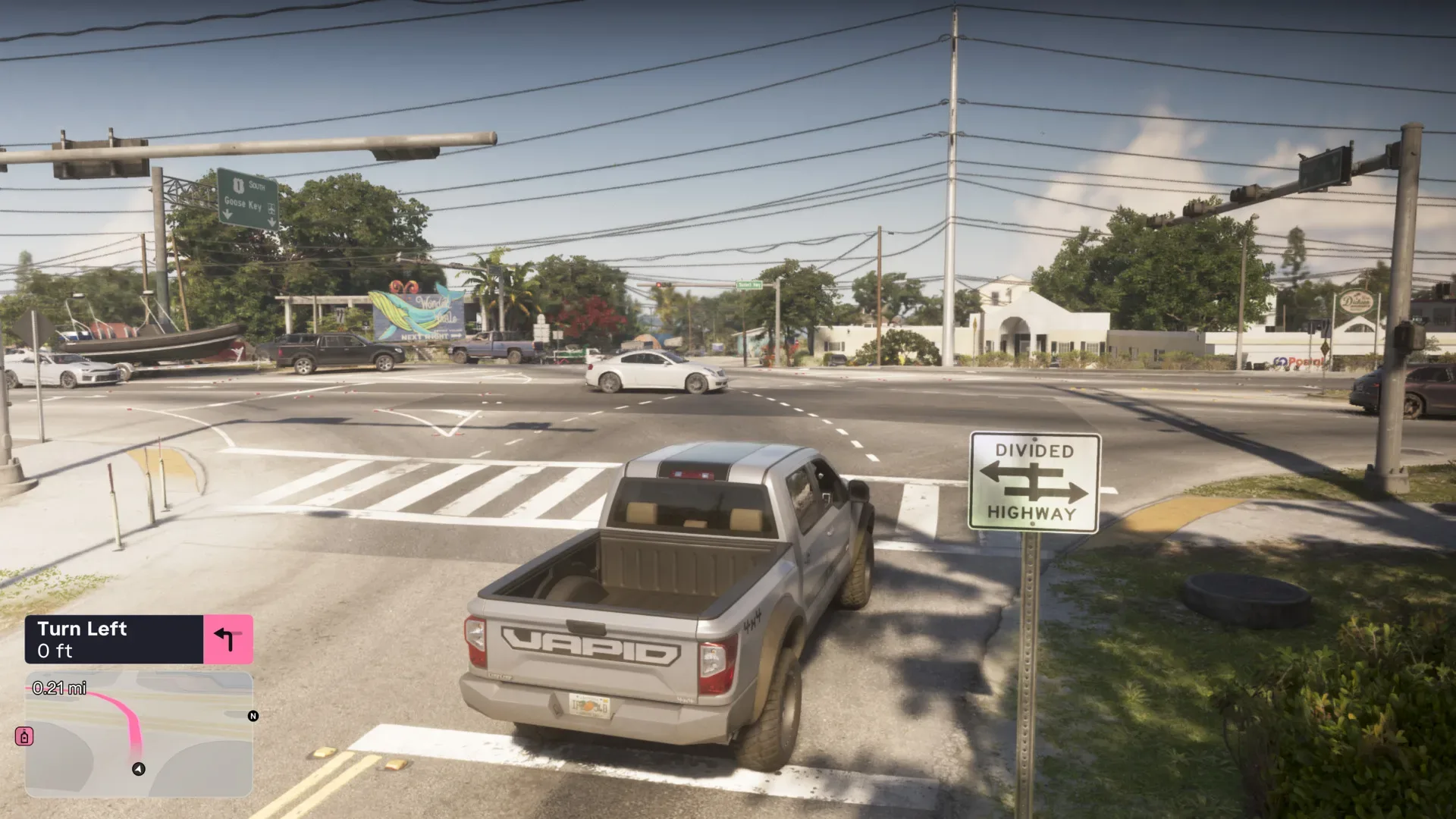
One early drive reportedly placed Jason’s Ganado in a left-turn lane on a green light. The driver waited for oncoming traffic to clear before completing the turn—an almost aggressively responsible choice in a GTA game. During that wait, a small white van veered off the road and struck a traffic-light pole. The van carried on, but the light’s overhead beam came down into the roadway. Other vehicles continued moving over the obstruction, albeit with plenty of horn use.
It is a wonderfully compact example of emergent chaos. That term describes events produced by systems interacting rather than by a fixed, scripted scene. The reported collision sets off a sequence: a vehicle loses control, street furniture becomes debris, traffic encounters an altered road, and the ambient crowd reacts—or fails to react—in ways the player did not arrange. The result is memorable precisely because it is more specific than “cars crash sometimes.” A fallen signal arm is an absurdly concrete problem, and the decision of drivers to treat it as a speed bump gives the scene its punchline.
There is an important caveat: a striking incident does not, by itself, establish a universal rule for every road or every play session. Open-world simulations are variable by design. Still, it is enough to show why traffic behavior draws attention. The player is not watching an isolated background animation. They are dealing with a moving system capable of changing the immediate route, blocking a lane, provoking honks and turning the apparent rules of the road into a recommendation rather than a contract.
When defensive driving meets aggressive AI
Another reported encounter is less spectacular but arguably more irritating. While traveling straight in the left lane, the player was hit by a vehicle coming up on the right that immediately attempted to merge into occupied space without signalling. Honking did not prevent the contact; the impact forced the player into the median. The other motorist then exited and acted as if the player were at fault.
That sequence hits on one of the oldest frustrations in driving games: predictability. Players can adapt to difficult traffic if it follows recognizable rules. A packed avenue, fast vehicles and tight merges can all be manageable if cars telegraph their intentions or leave a reasonable gap. The annoyance arrives when the safe response appears to be correct—stay in lane, maintain course, use the horn—yet the simulated driver commits anyway.
Related coverage includes GTA 6's Leonida Traffic Is a Daily Test of Patience.
In practical terms, that changes what “good driving” means. It may not be enough to obey a signal or hold a lane. A cautious player may need to leave extra space alongside adjacent traffic, assume a nearby car can merge abruptly, and treat a horn as an expression of displeasure rather than a reliable avoidance tool. That is not a guide to real-world driving; it is an interpretation of the hazardous behavior described on Leonida’s roads. In the game’s comic logic, defensive driving becomes less about right-of-way and more about preparing for somebody else’s terrible idea.
The absurdity is amplified when the aggressor becomes confrontational after the collision. GTA has always made room for escalation between strangers. Here, a mundane lane-change dispute can flip into an argument at the roadside, turning an otherwise routine trip into an encounter. The road is not just a route between missions; it is a generator for small conflicts.
Traffic lights need to communicate before they regulate
Not every close call can be placed on the AI drivers. The reported criticism of Leonida’s traffic lights is very specific: signals can appear too small to read, and their colors can be hard to distinguish at distance, especially in daylight. If that view reflects a recurring experience, it matters because a traffic light is a piece of visual interface design as much as a piece of scenery.
In design terms, readability means that players can quickly perceive and understand the information needed to act. A traffic signal may be realistically placed far away on an intersection, but realism alone does not solve the gameplay question. Can someone approaching at driving speed identify the light, distinguish red from green and react without already knowing the junction by memory? If the answer is often no, the simulation is asking the player to respond to information it has not communicated clearly.
That is particularly relevant when the surrounding traffic is already described as unpredictable. A hard-to-see red light is inconvenient in a calm city. In a city full of swerving cars, last-second merges and drivers who honk at stopping vehicles, it compounds the pressure. The player must monitor the road ahead, side traffic, lane position, pedestrians and navigation while also trying to spot a distant signal. A collision can feel less like the consequence of a deliberate risk and more like the endpoint of an overloaded screen.
There is also a pleasing contradiction in the situation. Players have been treating turn signals as part of Leonida’s driving culture, as explored in this look at GTA 6 players using turn signals. But signalling is only one half of the social agreement. It works best when other traffic recognizes it, gives space and behaves as though lanes are more than decorative paint. The anecdotes here argue that the rest of Leonida has not signed that agreement.
Why the bad drivers are funny instead of merely frustrating
Unruly NPC traffic is funny because it clashes with the fantasy people often bring to GTA. The genre encourages speed, freedom and a certain appetite for chaos. Yet there is a distinct pleasure in deciding to behave normally for five minutes: listen to the radio, drive a vintage vehicle, wait for a safe turn and perhaps signal before merging. The world’s response, in these stories, is to put a van into a light pole and then send an uninvited lane changer into the player’s car.
The player’s restraint makes everyone else’s conduct look even stranger. Stopping at signs and lights should be the least notable thing on a road. When those actions prompt honks from other drivers, careful behavior becomes a comic performance. Leonida effectively reverses the expected hierarchy: the person attempting to follow the rules feels like the eccentric one, while the reckless majority behaves with complete confidence.
That reversal also gives the city texture. A perfectly obedient traffic simulation might be easier to navigate, but it could be less memorable. The stories that stick are the weirdly specific ones: the unexplained swerve into a tree seen from a parking lot, the collision that becomes an argument, the infrastructure failure that everybody decides to ignore. They create the impression of a place continuing to malfunction whether or not the player is participating.
The sensible way to read Leonida’s road rage
There is no need to declare every collision evidence that the game’s driving systems are broken. The available examples are anecdotes, and their value lies in the situations they reveal: chaotic traffic can generate comedy, tension and unscripted stories, while unclear signals can make the same chaos harder to manage. Those are different issues. One is about the behavior of vehicles in the world; the other is about the information offered to the player.
For players who want a calmer cruise, the safest expectation may be that Leonida is not a place where moral superiority at a four-way stop guarantees safety. Leave room. Watch adjacent lanes. Do not presume a signal will be respected. And if a stranger plows into the median before angrily getting out of their vehicle, perhaps accept that the road has moved beyond the jurisdiction of ordinary driver’s ed.
For everyone else, the chaos may be the entertainment. The roads can supply a low-stakes drama between bigger objectives: a soundtrack on the radio, a clean left turn, a completely avoidable crash caused by somebody else, and the growing conviction that the only person who understands how traffic works is the player holding the controller. In Leonida, that may be less arrogance than basic situational awareness.