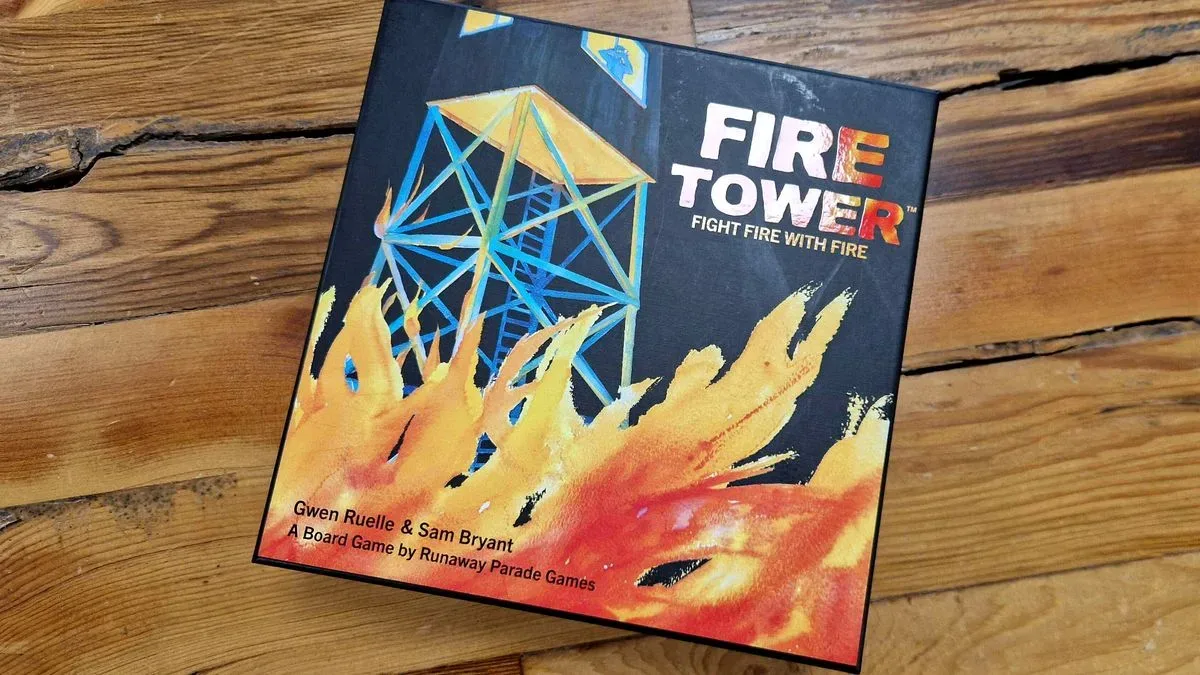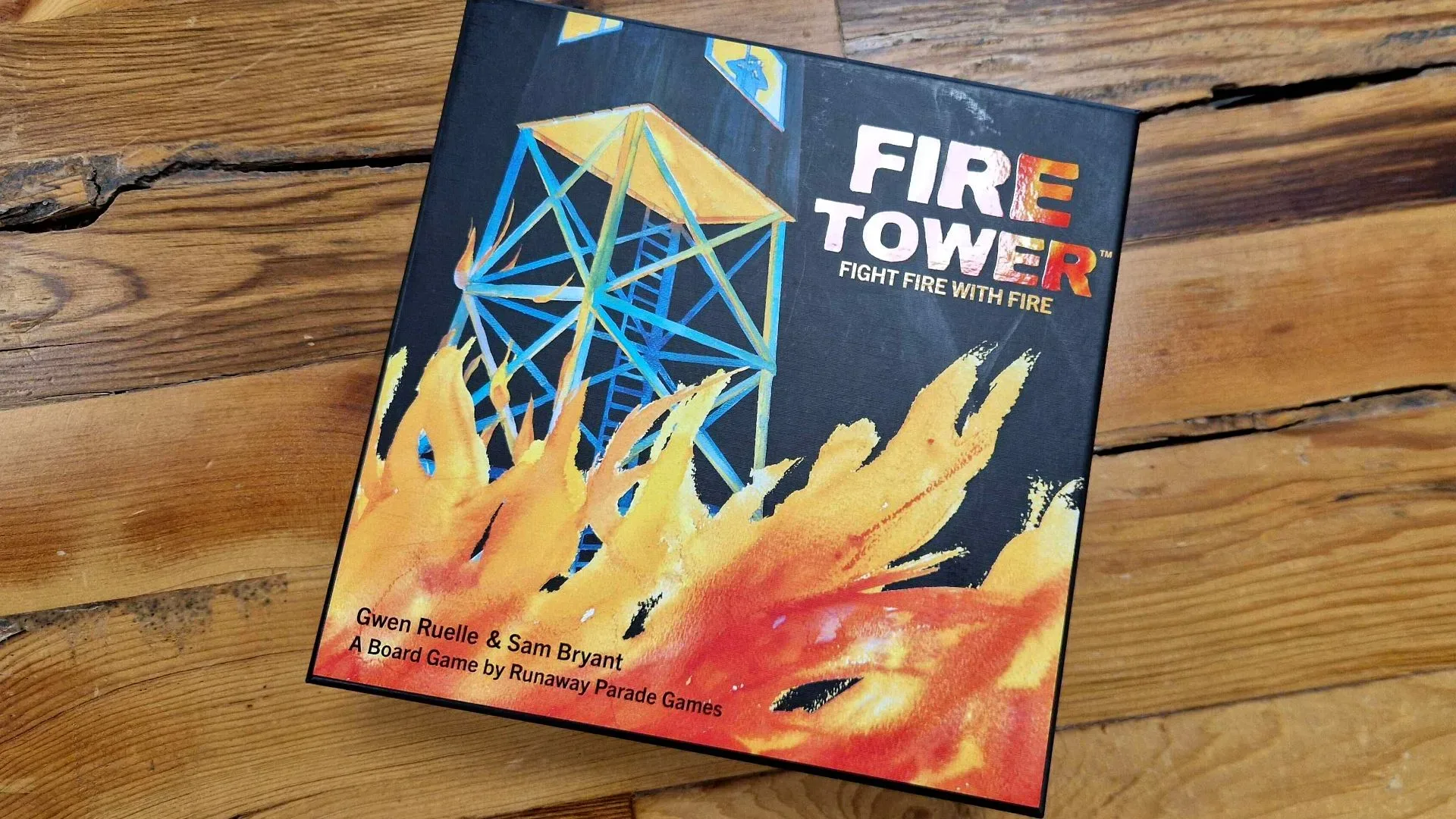
Some tabletop games bury their best idea under a long teach. Fire Tower appears to take the opposite route: one central rule—fire moves with the wind—supports a competitive strategy game built around positioning, timing and the occasionally ruthless pleasure of making a rival’s problems much worse.
Players take the role of lookouts around a forest fire, but the competitive objective is not a shared victory over the blaze. Each player wants their own tower to remain standing after the others have burned. On a turn, a fire token is placed in the direction currently indicated by the wind: north, south, east or west. A player then uses a card from their hand. Those cards can alter the conditions, stop fires, or turn the board into a far more dangerous place for someone else.
The result is a game whose rules can be grasped quickly without making its decisions trivial. That distinction matters. “Easy to learn” is often used to describe games with little staying power; here, the accessible core seems to leave room for planning a turn or two ahead, concealing an attack card until its impact is greatest, and reacting when a seemingly safe stretch of board abruptly becomes the path of the fire.
A board state that refuses to stay settled
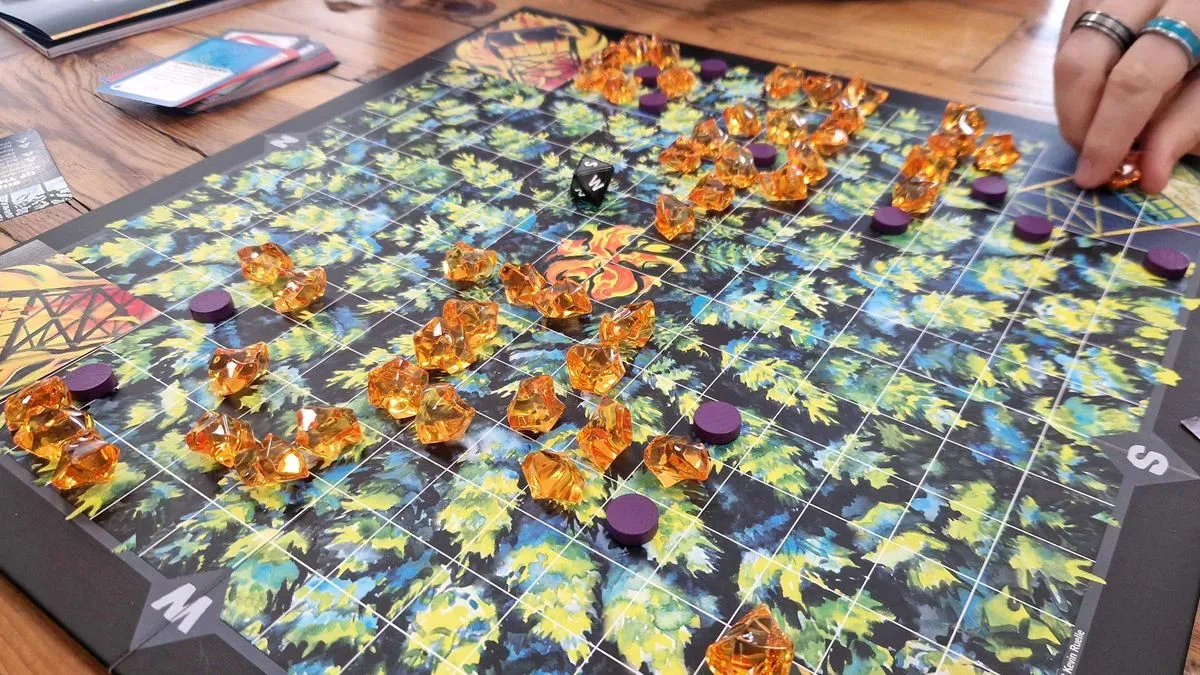
The wind rule gives Fire Tower a clear technical foundation. A board state is simply the current arrangement of fire tokens, defensive elements and towers on the grid. In many strategy games, players can build toward a stable defensive position. Fire Tower instead makes stability conditional, because a change in wind can alter which spaces are immediately threatening.
Cards are where that shifting geography becomes personal. Some can change wind direction or extinguish flames, while more aggressive options can leap fire across the board, place several fire tokens, or spread a blaze over multiple spaces at once. The important strategic question is therefore not merely whether a card is powerful. It is whether the board, wind and opponents’ defenses make that card powerful now.
That is a useful design choice for a shorter game. A player does not need to memorize a huge tech tree or manage a pile of resources to create a reversal. They need to recognize a vulnerable route, understand how the fire will travel, and decide whether to spend a disruptive card before the opportunity disappears.
It also means an apparently modest effect may be more consequential than an explosive one. Redirecting the wind can open a way around a defense. Removing a firebreak can make a later fire-placement effect lethal. Extinguishing fire may buy a player time, but it can also change the options available to everyone at the table. The grid supplies the visible puzzle; the cards let players rewrite parts of it.
Why the game’s attacks are more than cheap shots
Direct conflict is not a side dish in Fire Tower. It is the mechanism that gives the game its energy. The aim of keeping the last tower intact naturally encourages players to push fire toward rivals, and the strongest moments appear to come from holding a harmful card until an opponent is exposed.
Related coverage includes Fire Tower Is a Fast, Fiendish Board Game About Turning the Wind Against Your Friends.
That can sound chaotic, but the reported tools suggest the game does not reduce everything to picking on the nearest player. Firebreaks can redirect incoming flames. Other effects can remove those barriers. Players can put out a larger area of fire, while a last-ditch bucket of water can be used when the fire reaches a tower. Wind changes may also allow a player to bypass an obstruction rather than breaking through it.
Those are comeback tools: rules that give a pressured player ways to re-enter the contest rather than simply waiting to be eliminated. Their presence is particularly important in a free-for-all. Multiplayer conflict can become frustrating when players identify a leader and collectively target them, or when one person becomes the table’s habitual victim. A game cannot completely solve the social dynamics of a group, but defenses, rerouting and emergency responses can make a pile-on less decisive.
Fire Tower still seems best suited to players who can enjoy that pressure. A game about steering danger at friends will inevitably produce temporary alliances, opportunistic targeting and gloating over a well-timed reversal. Groups that strongly dislike take-that interaction—where one player actively harms another’s position—should take that seriously before treating its simple rules as an all-purpose family-game recommendation.
Fast play, but not necessarily lightweight play
The appeal here is the combination of a short teach with a reported play time below half an hour. That makes Fire Tower potentially useful for a gaming night where participants want a complete contest rather than a filler that exists only while waiting for something bigger to start. It may also work for people who are not regular board-game players but still want choices that feel consequential.
The practical promise is not that every decision has equal depth. Rather, Fire Tower concentrates its tension into a small set of easily legible questions:
- Where will the next fire token go under the current wind?
- Which player is most vulnerable to that path?
- Should a defensive option be used immediately or saved for a more dangerous moment?
- Is a firebreak genuinely protecting a tower, or can it be bypassed?
- Will using an attack now leave the player exposed when the wind shifts again?
Those questions are enough to establish a tactical game loop. Tactics are short-term choices shaped by the current board; they differ from a long-range strategy that depends on an elaborate multi-round plan. Fire Tower’s fire and wind system appears designed for tactics: players inspect the immediate situation, anticipate the next opening, and make a decision before another card or wind change turns the layout upside down.
For another example of a compact game idea being designed around an immediate puzzle rather than a huge rules burden, see FIRSTS’ tile-falling mini crossword, which is heading to mobile, web and iOS and Android platforms.
Free-for-all is the natural fit
Fire Tower includes a two-versus-two cooperative mode, but the available details point most strongly toward the every-player-for-themselves format. That is where the game’s spiteful card timing, sudden shifts in wind and fragile defenses have their fullest meaning. In a team game, an attack is aimed at an opposing side. In a free-for-all, every action also broadcasts information: who looks safe, who has made themselves a threat, and who might be worth helping indirectly because somebody else is ahead.
This is often called table politics, though it need not mean lengthy bargaining. Even without formal deals, players assess the leader and choose targets accordingly. A player who has escaped danger for most of the game can become the focus of everyone else’s attention. Conversely, a player who looks nearly beaten may be ignored until a card, a redirected wind and one exposed route create a route back into contention.
That volatility is likely a feature rather than a flaw for the right group. The game’s central appeal is not careful optimization in isolation. It is watching a sensible board position become unsafe because another player understood the timing better.
The theme deserves a clear warning
There is an important caveat around Fire Tower’s wildfire theme. Forest fires have caused real and devastating harm, and a competitive game that frames the spreading blaze as an engine for player conflict can be uncomfortable or inappropriate for some people. That response is valid, particularly in communities directly affected by wildfires or amid recent disasters.
The game is described as abstract in its handling of the subject rather than graphic or simulation-focused, but abstraction does not erase the issue for every potential player. This is not a question a rules explanation can settle. Anyone considering Fire Tower for a family gathering or mixed group should account for the people at the table, rather than assuming a game’s mechanical cleverness outweighs the subject matter.
Rising Flames and the value of a complete base game
Players who enjoy the core format can also look to Rising Flames, an expansion intended to add further variety. The key word is “can.” The base game already has a clear, self-contained loop: follow the wind, use a card, protect a tower and exploit openings in other players’ defenses. An expansion may be appealing to a group that returns to the game often, but the reported strengths do not depend on extra material.
That makes Fire Tower’s proposition unusually clean. It presents a readable physical puzzle, injects uncertainty through wind and cards, then gives players enough means to attack and recover that a lead is not automatically permanent. It will not be a peaceful pick, and it is not a universal recommendation because of both its confrontational play and sensitive premise. For a group seeking a short, sharp strategy game where the map can turn hostile in a single decision, however, its streamlined rules appear to be doing serious work.
Shop the products
Check current price, model and availability at the retailer.