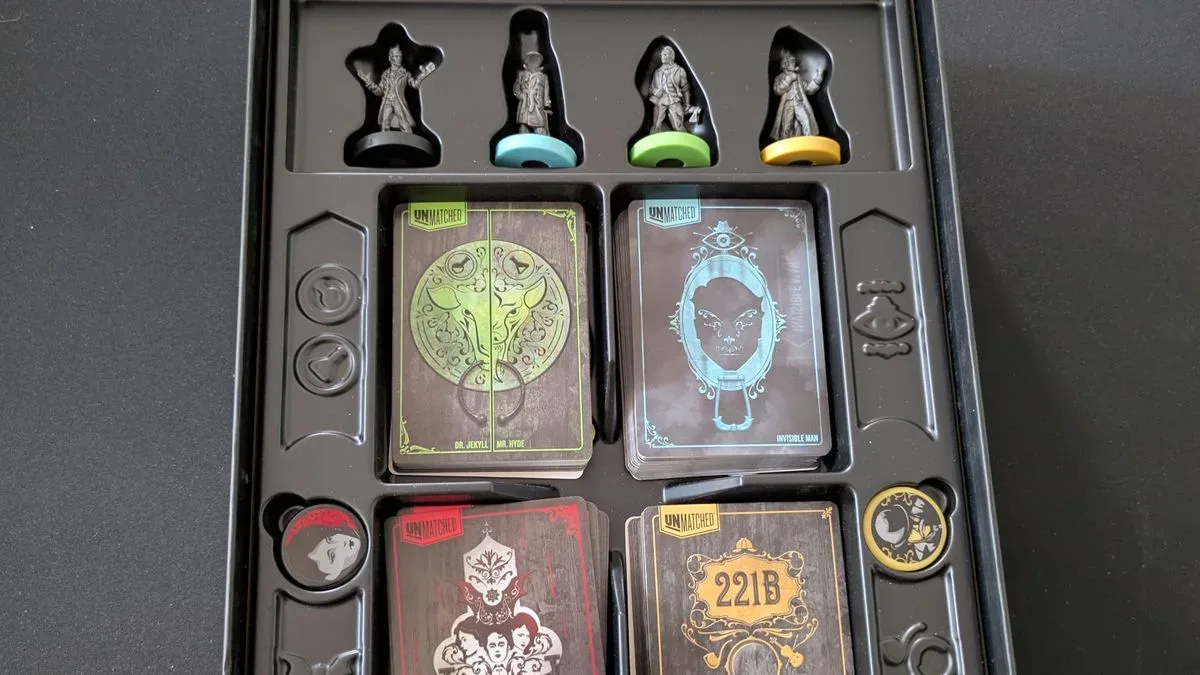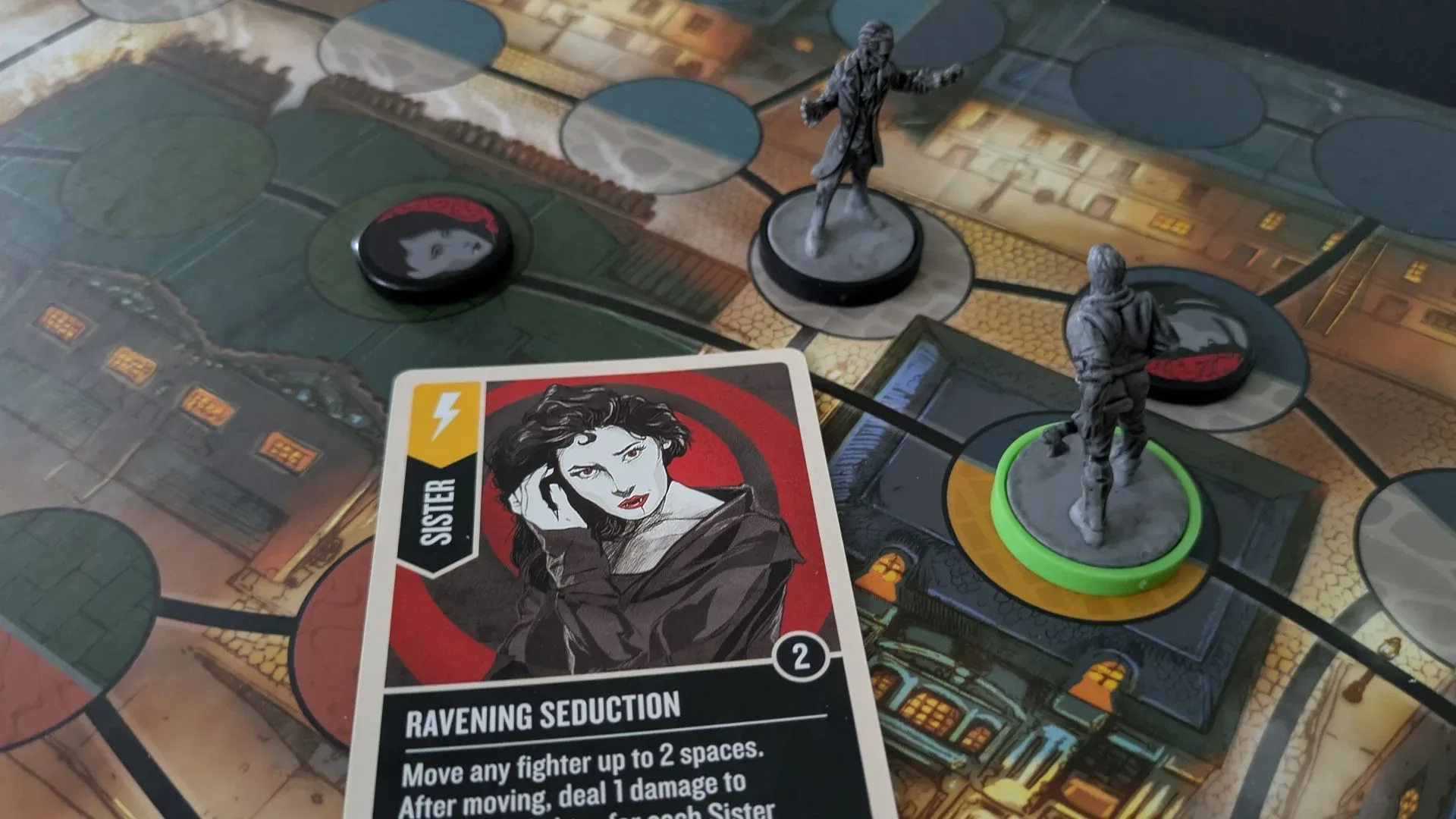
Unmatched: Cobble & Fog takes a remarkably direct tabletop premise—put two fighters on a board and let them battle—and dresses it in Victorian fog, secret routes, predatory vampires and impossible disappearances. The set brings Dracula, the Invisible Man, Dr. Jekyll and Mr. Hyde, and Sherlock Holmes into the same system, giving each a distinct deck, special abilities and a different way to control the board.
That combination is the point. This is not a story-driven mystery game in which Holmes gradually identifies Dracula, nor a cooperative hunt for a monster. It is a head-to-head skirmish game: a game focused on a compact tactical confrontation between small groups of pieces. Its horror and literary trappings are carried through the art, maps and—more importantly—the way the characters actually operate in play.
Cobble & Fog works as a standalone box, while also being compatible with other Unmatched sets. That gives it two potential roles. It can be a self-contained Victorian horror duel collection, or it can become a source of fighters for stranger cross-set matchups within the wider Unmatched system.
A gothic theme with mechanical weight
The box’s presentation establishes its atmosphere with dark, ink-washed miniatures, pen-and-ink card art, and a double-sided board featuring ominous locations and hidden passages. But the thematic achievement is not merely visual. Each fighter’s rules reinforce a particular fantasy: Dracula hunts with his sisters, the Invisible Man turns fog into an escape network, Jekyll shifts between human and monstrous states, and Holmes studies the opposition while working alongside Dr. Watson.
That matters in a genre where a recognizable character can otherwise become a coat of paint over generic actions. In Cobble & Fog, the pieces and decks aim to make the famous names feel different at the table. A Dracula player is encouraged to surround and pressure. An Invisible Man player is positioned to evade, misdirect and create sudden angles of attack. Holmes leans into investigation rather than brute force.
The result is a useful lesson in what makes a licensed or character-driven board game compelling: the theme is strongest when it changes decision-making. Fog is not just artwork on the board; it supports the Invisible Man’s defensive options and movement. Dracula’s companions are not background decoration; they change routes and help create traps.
Dracula: pressure, encirclement and hypnosis
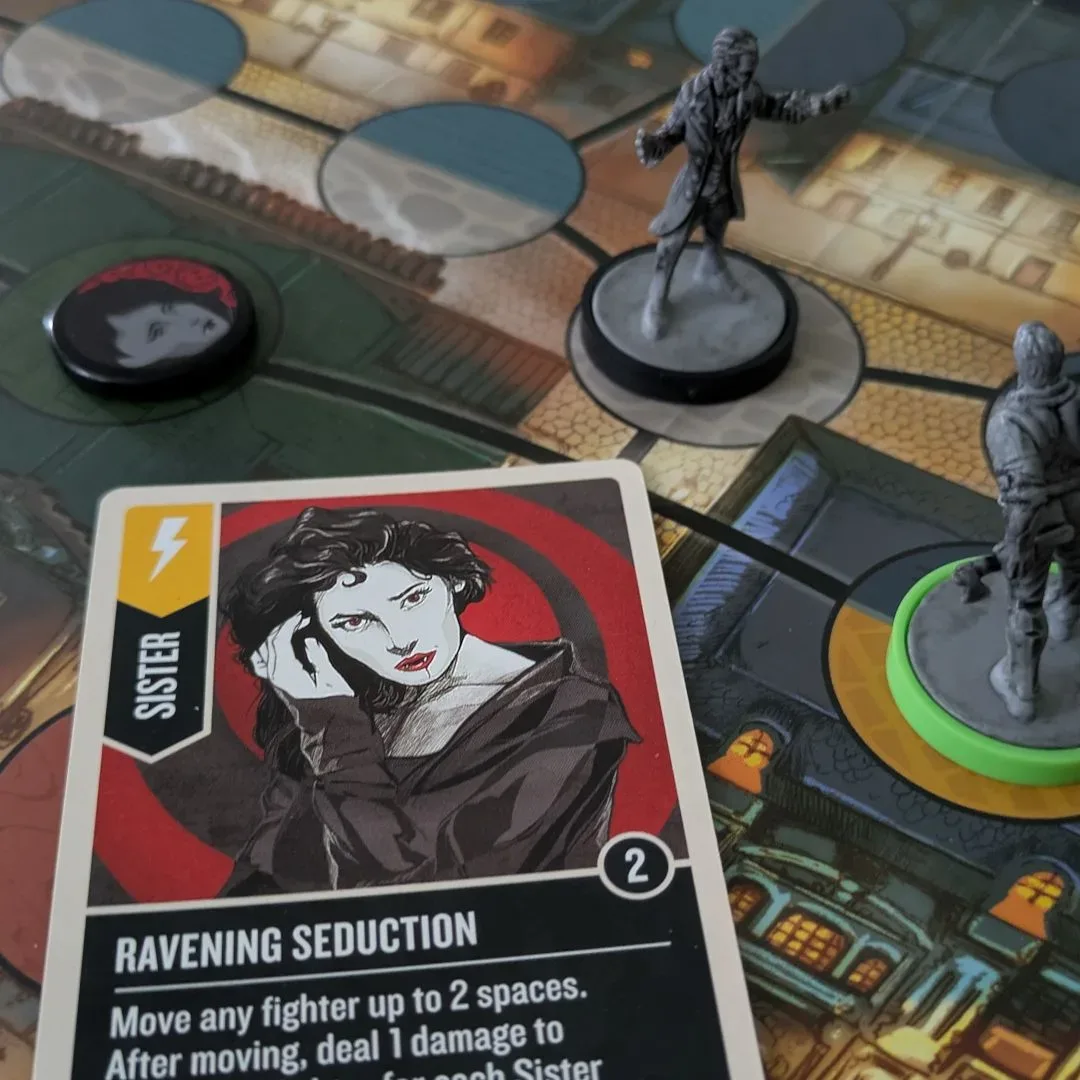
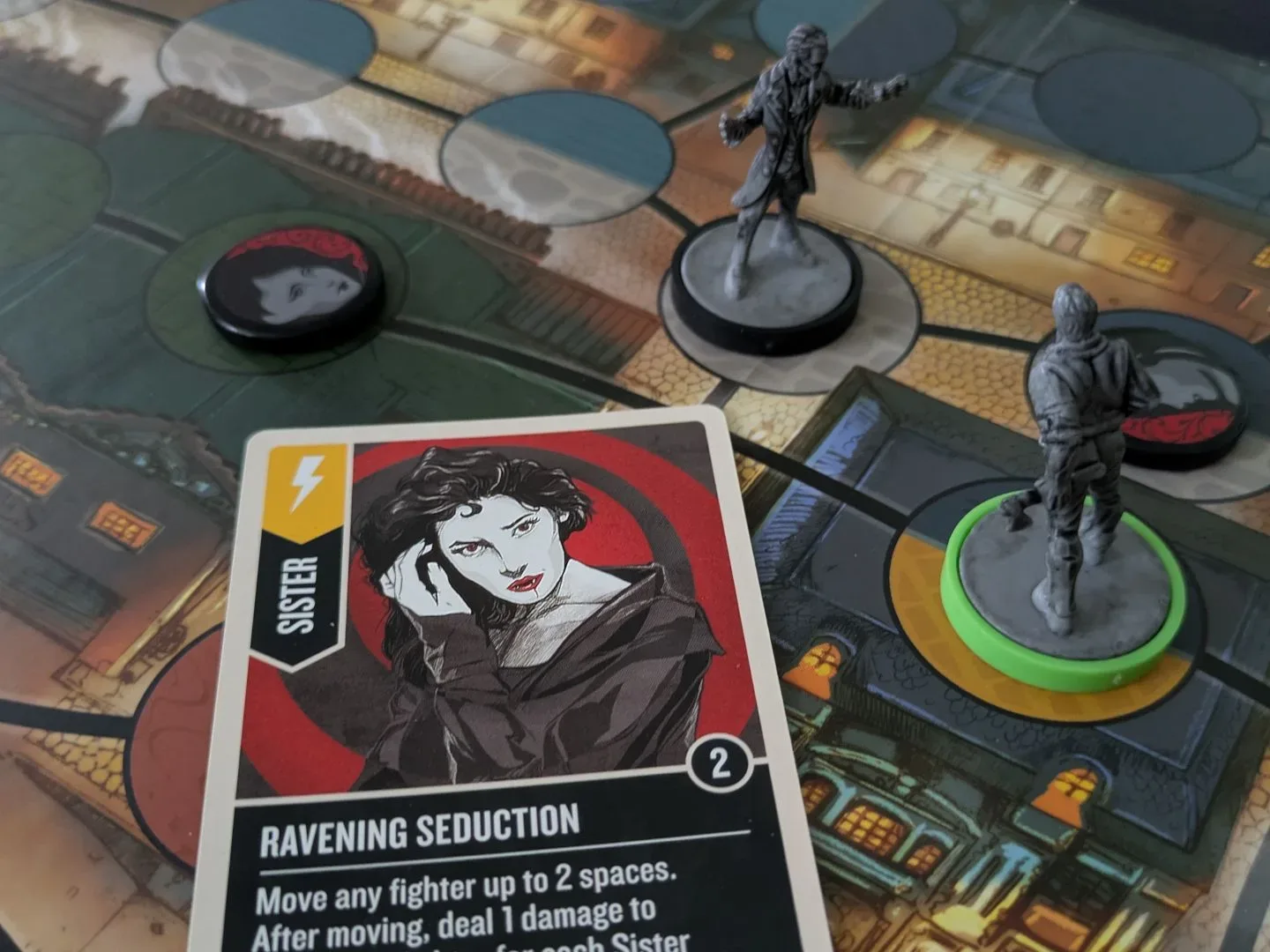
Dracula is joined by three “sisters” tokens. They are vulnerable in direct confrontations, but their value is positional. On a point-to-point map—where movement follows connected spaces rather than a free measuring system—blocking a route can be as consequential as landing an immediate blow. The sisters let Dracula constrain where an opponent can go and make an attempted escape costly or impossible.
His deck supports that board pressure. Some combat cards reward the player for getting enemies surrounded by the sisters, turning careful placement into stronger attacks. Dracula also has hypnosis effects that reveal information about the opposing deck.
Related coverage includes Unmatched: Cobble & Fog Turns Victorian Horror Into a Brilliant Battle of Wits.
That information is significant because Unmatched is driven by cards, not just movement. Knowing something about what an opponent might have available can affect whether Dracula attacks now, holds position, or tries to force the other player into an awkward response. In practical terms, Dracula appears built for players who enjoy converting spatial control into a decisive attack rather than simply chasing the opponent around the map.
There is a natural risk attached to that style. The sisters are described as fragile, so using them aggressively exposes a key part of Dracula’s setup. Their role is not simply to charge ahead. Their power comes from being placed where they interfere with movement, limit exits and support the Count at the moment he chooses to strike.
The Invisible Man turns the board into a bluff
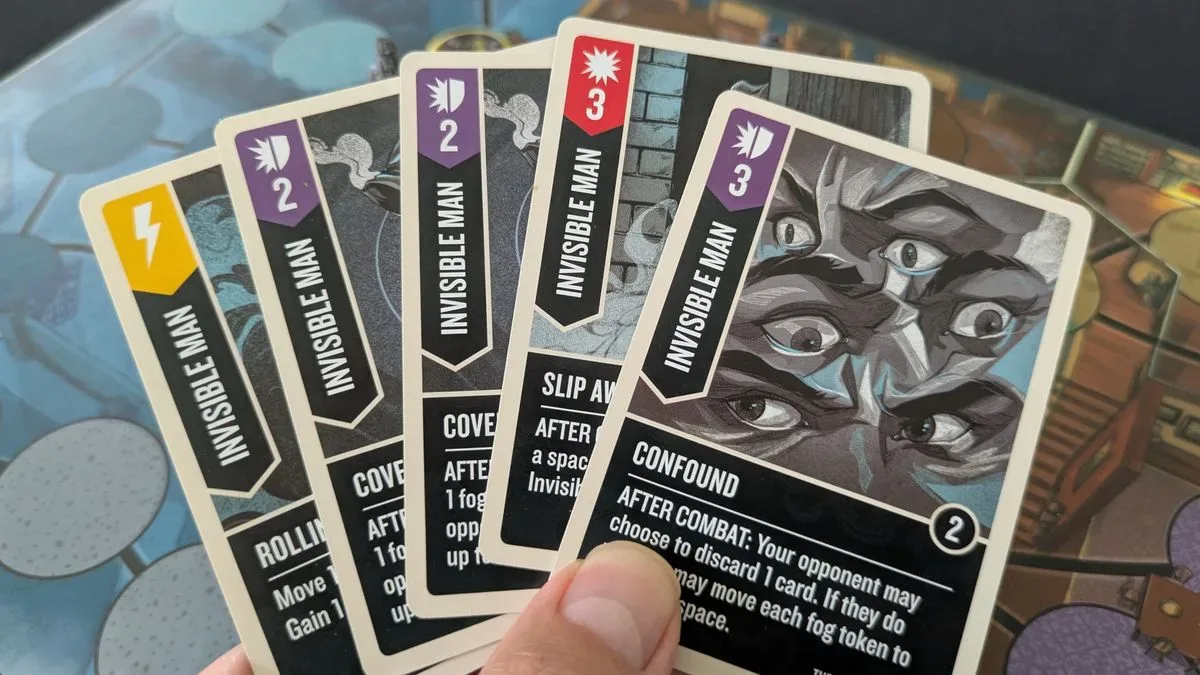
The Invisible Man controls three fog tokens. These provide a defensive benefit and establish a teleportation network: whenever he moves, he can travel between any of his fog tokens. This makes him difficult to corner, especially when the fog has been placed across useful areas of the map.
Teleportation here is less about spectacle than uncertainty. An opponent may think they have established a safe distance or shut down a route, only for the Invisible Man to relocate through fog and alter the confrontation. His deck is not presented as obviously overpowering. Instead, it relies on surprise movement, feints and the ability to draw enemies into poor decisions.
That makes him a natural fit for a more reactive, patient approach. Rather than trying to win each exchange through raw force, an Invisible Man player can use fog to preserve options and make the opponent worry about threats from multiple positions. The aim is to create a mistake, then capitalize when the opponent is depleted.
“Card economy” is the useful technical term here. It means managing the cards available to you and your opponent as a limited resource. Because Unmatched creates tension around drawing and spending cards, a fighter capable of avoiding unfavorable encounters can pressure the other player into spending too much. The Invisible Man’s mobility and deception tools seem especially well suited to that kind of game plan.
Holmes investigates; Jekyll and Hyde transform
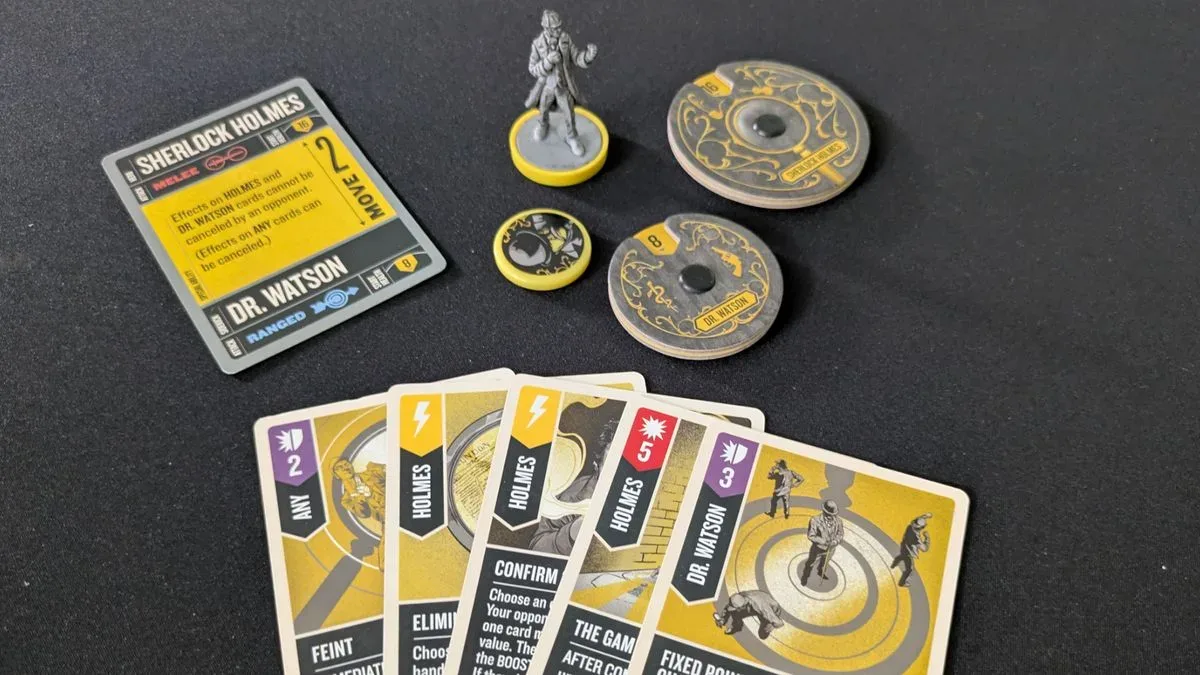
Sherlock Holmes continues the box’s emphasis on character-specific play. He investigates the opponent’s cards, a fitting mechanical expression of deduction, and he receives ranged backing from Dr. Watson and his sidearm. While the available details do not spell out every card interaction, the identity is clear: Holmes gains leverage from information and support rather than from the same surrounding tactics used by Dracula or the evasive repositioning of the Invisible Man.
Dr. Jekyll and Mr. Hyde flips between human and monster forms. Of the four options, this is presented as the least distinctive, though still enjoyable. Form-switching nevertheless gives the fighter a recognizable dramatic hook: a player must account for an identity that does not stay fixed. It is another case of the game making its source concept part of its mechanics rather than leaving it in the artwork alone.
Together, the roster offers contrasting tactical personalities without demanding a new rules system for every character. That balance is central to an asymmetrical game. Asymmetrical means the sides have different powers, pieces or objectives rather than using identical toolkits. The challenge is to make those differences meaningful without making the core experience needlessly hard to learn. Cobble & Fog’s shared structure aims to provide the common language; the decks and powers supply the personality.
The core tension: cards are both ammunition and survival
Under the gothic texture sits a deliberately accessible turn structure. A player may move and draw, use a card for an effect, or play a card to attack. That is easy to explain, but it creates a sharp recurring dilemma: cards cannot be endlessly spent without replenishment.
Choosing an aggressive turn can advance a plan, but it also consumes resources. Eventually, a player who repeatedly attacks can run low on cards, reducing their capacity to respond to a counterattack. Running through the deck is itself dangerous, since depletion can lead to defeat. In other words, the deck is simultaneously a toolbox for attacks and effects, a source of defensive responses, and a timer that players must not recklessly exhaust.
This is why a duel between Dracula and the Invisible Man can feel like more than a simple exchange of attacks. Dracula wants to translate his sisters’ positioning into a punishing moment. The Invisible Man wants to preserve mobility and entice an opponent into overcommitting. Holmes can look for informational advantage, while Jekyll and Hyde bring their changing form to the confrontation. The map matters, but so does the decision to spend a card now rather than wait for a better opening.
For newcomers, the clearest practical takeaway is that an early attack is not automatically a good attack. Before playing one, it is worth asking a few basic questions:
- Will this attack leave enough cards to answer a counterattack?
- Does the current board position make the attack unusually valuable?
- Is the opponent likely to escape or reposition on their next turn?
- Would drawing cards or using an effect create a more favorable exchange later?
Those questions are simple, but the four characters approach them differently. That is where Cobble & Fog’s replay value appears to come from: not from a complicated rules burden, but from learning how each fighter converts the same basic actions into a different tactical advantage.
Why the setting fits this kind of duel
Victorian horror often thrives on pursuit, concealment, unreliable appearances and threats hidden within familiar spaces. Cobble & Fog maps those ideas neatly onto a tactical board. Dracula’s companions can close paths. The Invisible Man’s fog turns the map into a question mark. Holmes’s investigation implies that information itself is a weapon. Secret passages and creepy locations support that sense that safety is temporary and proximity is never fully predictable.
That makes the game a particularly logical pick for players who want Halloween mood without giving up competition. The horror is not a separate narrative layer pasted over the game; it supplies the texture of every maneuver. A trap, an escape, an exposed hand of cards and a sudden reposition all serve the central gothic-cat-and-mouse tone.
Players seeking more seasonal game ideas beyond the tabletop can also look at what is confirmed for Roblox The Hollow. Cobble & Fog, however, takes a distinctly analogue route: its scares come from the possibility that the opponent has one more trick, one more route through the mist, or just enough cards left to turn a bold attack into a disaster.
A strong fit for gothic strategists
Unmatched: Cobble & Fog is best understood as a tactical skirmish game whose atmosphere is earned through systems as much as visuals. It offers a standalone package with four recognizable Victorian-era heroes and monsters, a double-sided setting, and character kits that support sharply different styles of play.
The appeal will be strongest for two-player groups that enjoy reading an opponent, managing a limited hand and maneuvering for a favorable fight. Fans of Dracula, Sherlock Holmes, the Invisible Man or Jekyll and Hyde have an additional reason to pay attention: the box gives each of them a gameplay identity rooted in the kind of menace, deduction or transformation associated with the character.
It is a fog-laden contest of positioning and restraint. Attack too freely and the deck can become a liability. Give the opponent too much room and Dracula may close the exits, the Invisible Man may vanish through the mist, or Holmes may find the information he needs. That is a persuasive foundation for a game where every famous figure arrives with a different idea of how to win the night.
Shop the products
Check current price, model and availability at the retailer.