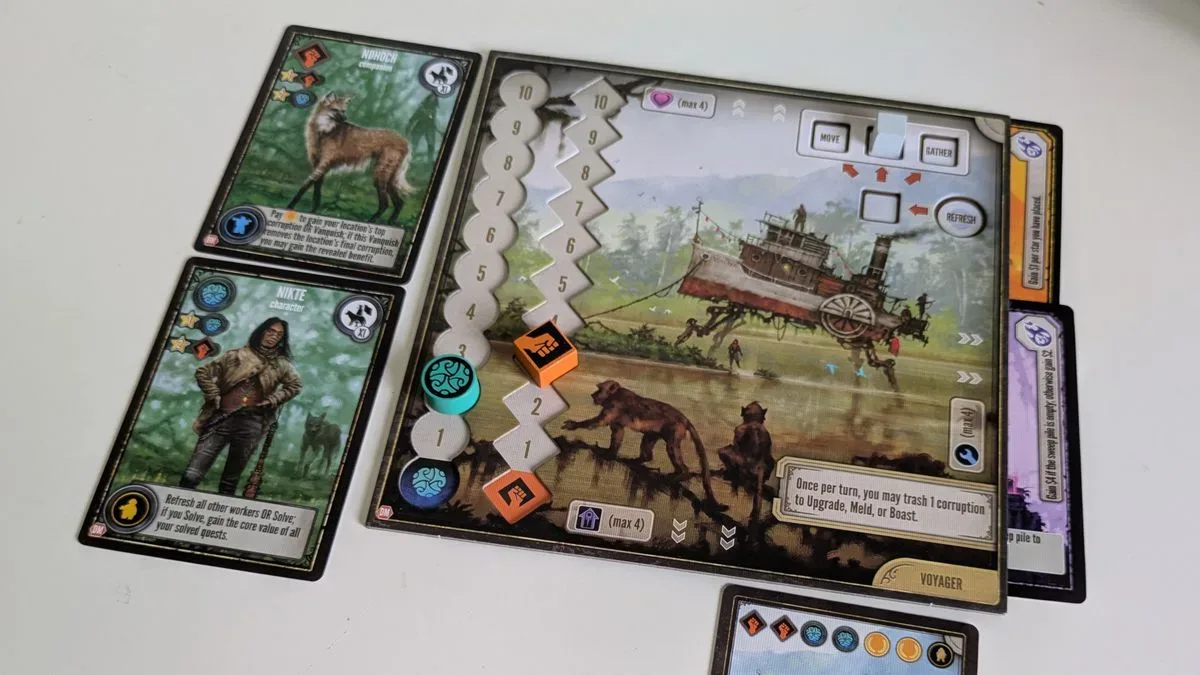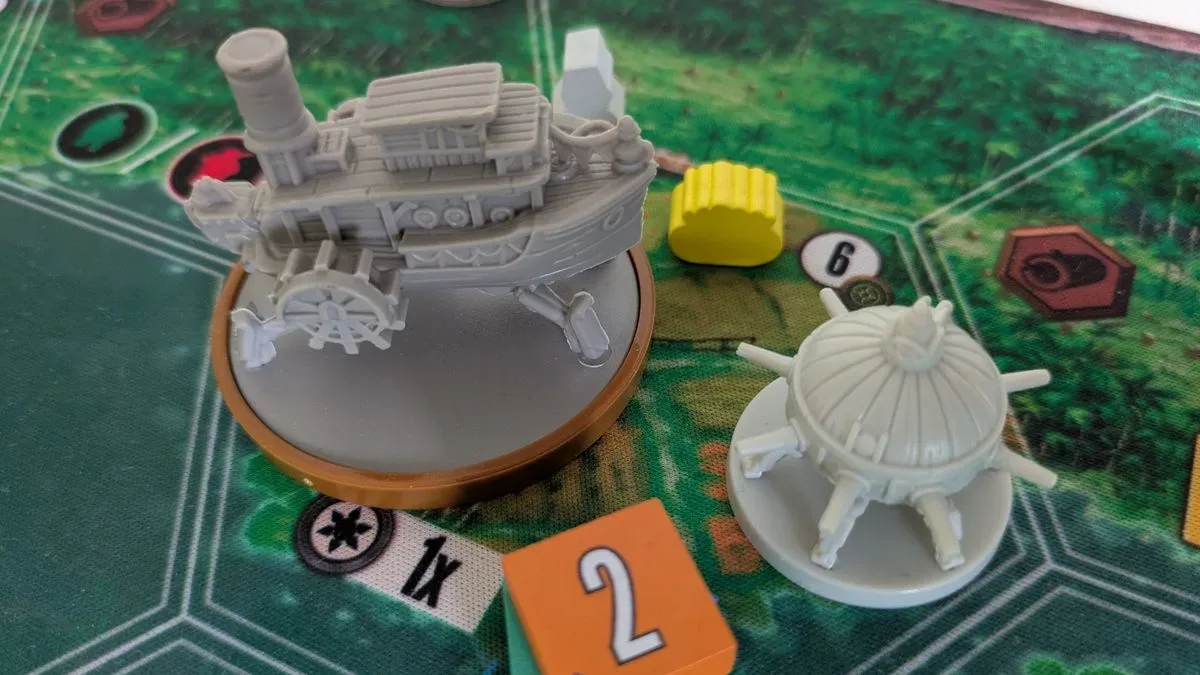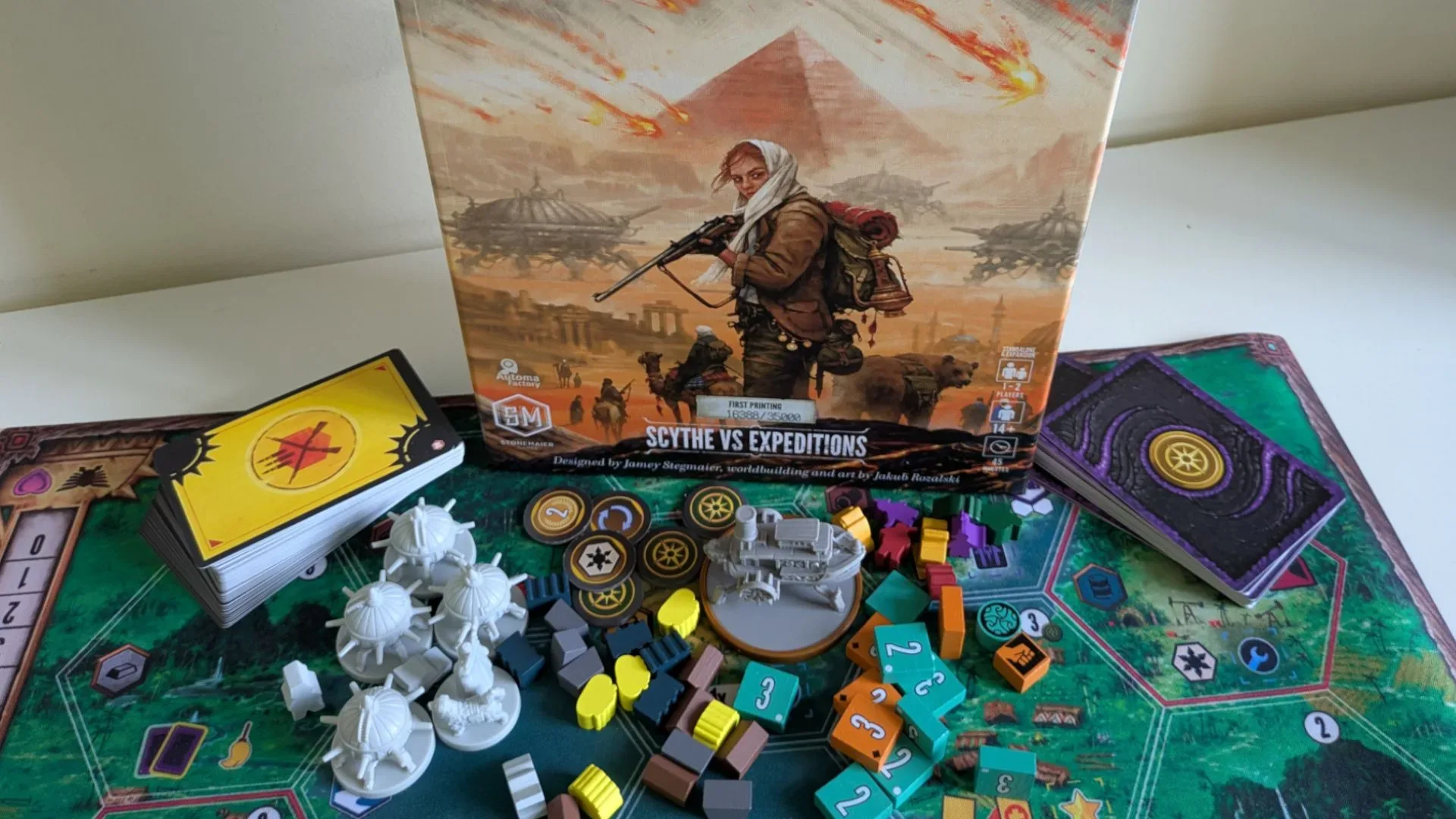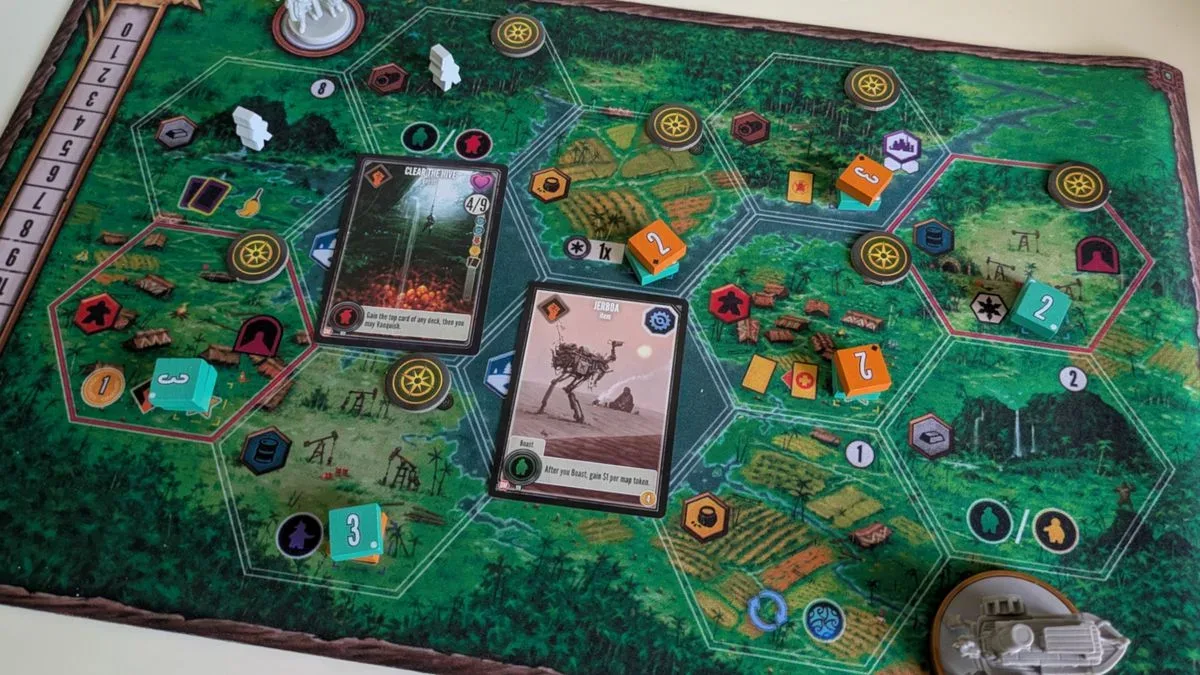
Some board-game crossovers add a familiar character, a branded deck of cards, or perhaps a miniature that looks excellent while spending most of its life guarding the insert. Duel of Meloch has picked a far stranger route. Designed by Jamey Stegmaier and published by Stonemaier Games, it lets two players fight across the same compact map while effectively playing two different games: one participant uses the systems of Scythe, while the other uses those of Expeditions.
That is an audacious sentence even before the rulebooks arrive. Scythe is an engine-building, territory-conscious strategy game of workers, resources, mechs, production, and carefully optimized turns. Expeditions, set in the same alternate-history world, approaches its exploration through a more card-driven structure focused on a single mech and upgrades. Both feature hex maps, mechs, and stars, but their moment-to-moment priorities are distinctly their own. Duel of Meloch does not sand those differences away. It puts them in the same arena and asks them to behave.
Against the odds, the central mechanical idea appears to work. The problem is not that the experiment fails. The problem is that its success creates a daunting question: who is most likely to enjoy an experience that asks them to understand the workings of three games at once?
A shared board with two separate brains
Duel of Meloch is listed for one to two players, ages 14 and up, with a roughly 45-minute play time. Its strategy, exploration, and engine-building labels all fit, although “high complexity” is the most important part of the box’s identity. The duel-specific rules are comparatively approachable. The challenge comes from the fact that the Scythe player and the Expeditions player each need access to the rules of their respective parent game, and those rules are not included in the Duel of Meloch package.
For a newcomer, that is a serious onboarding tax. Learning one substantial strategy game can be a pleasant evening with snacks and a patient teacher. Learning two different systems plus the adjustments that allow them to collide is more like applying for a small, unusually charming bureaucracy. It is especially demanding because players cannot simply learn a shared turn structure and make minor faction-specific decisions. Each side looks at the same map through a different operational lens.
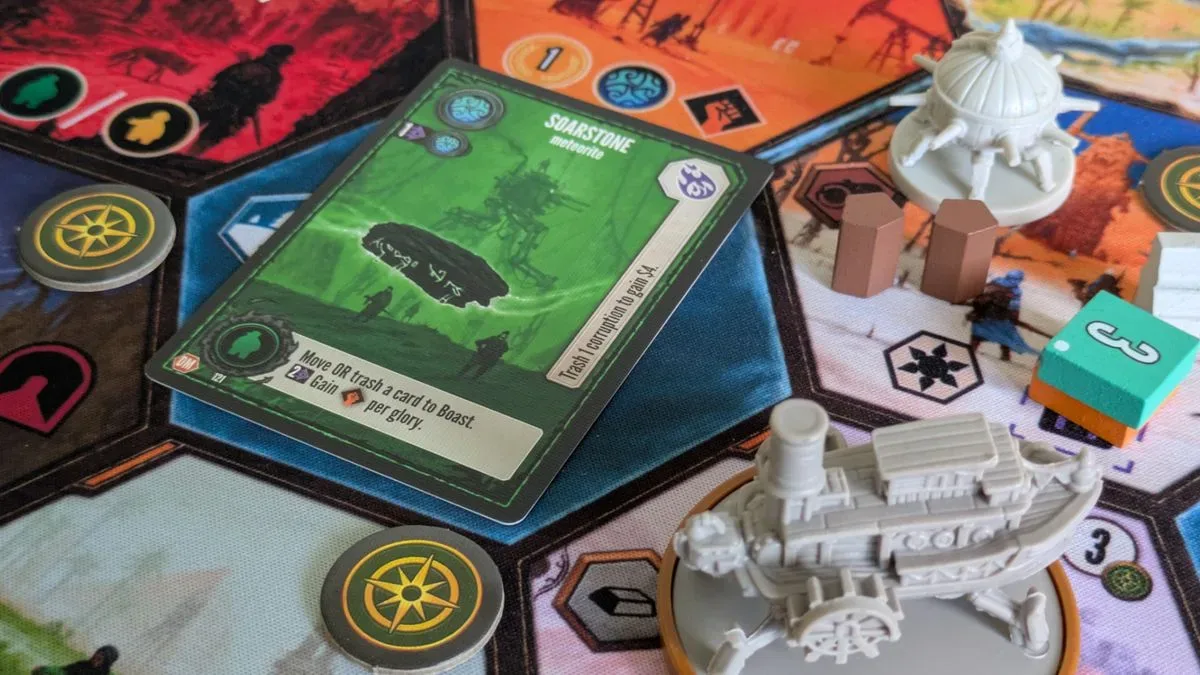
The board handles this with a clever piece of visual engineering. Hexes carry icons relevant to both games, so each player reads the territory according to their own rules. The Scythe side is concerned with such matters as where workers can produce and what benefits a growing mini-empire can extract from a location. The Expeditions side uses the spaces in relation to card play and card refreshes, based on where its mech stands. One map, two rule languages, and just enough common visual grammar to stop the whole thing becoming a cardboard diplomatic incident.
This compatibility was not reportedly the result of a grand plan to fuse the games; their similar iconography instead reflects an aesthetic preference carried across projects, with echoes in the otherwise unrelated Euphoria. Still, the visual overlap turns out to be useful groundwork. The two systems can share physical space without constantly bumping into one another like shopping carts in a tiny supermarket aisle.
The race to four stars creates real stakes
The biggest structural bridge is the triumph track. Both players seek four stars, and the included track presents eight possible spaces with goals tailored to each system. Currency creates one direct comparison: the Scythe player can claim a star at 12 coins, while the Expeditions player needs nine. Other slots ask for objectives that naturally belong to the individual game. A fourth deployed Scythe mech can satisfy one condition, for example, whereas the Expeditions side can take that slot by upgrading its mech three times.
Related coverage includes Duel of Meloch Review: A Clever Scythe and Expeditions Crossover With a Steep Entry Cost.
Those star spaces are exclusive. Once a player has earned one, the rival cannot use it. That adjustment makes the nominally parallel pursuits more competitive than their parent games can be. Watching an opponent edge toward a goal creates a decision: should you accelerate your own plan, attempt to steal the available triumph, or abandon the race before it consumes turns better spent elsewhere?
It is a smart pressure system, but it does not guarantee a constant tug-of-war. If one player has clearly gained momentum toward a particular objective, competing for it can become inefficient. The sensible response may be to pivot to another star rather than conduct a heroic but wasteful chase. In practice, that means Duel of Meloch can still leave each side largely occupied with the core routines of its own game. The mutual track matters, but it may not transform every session into a permanent contest over every checkbox.
Combat is possible, not always advisable
Direct conflict also brings the two designs closer. Combat draws substantially from Scythe’s card-based approach. Players secretly decide how much power to spend, then may add combat-card bonuses, limited by the units involved. The Expeditions player can obtain the relevant cards from particular map icons, and a battle can start when that lone mech enters a hex containing the Scythe player’s workers or mechs.
On the small duel map, these encounters can arise often enough to shape positioning. Yet the conflict is asymmetrical in a very literal way: the Expeditions side has only one unit, while the Scythe player can bring more presence to a fight. That generally gives Scythe an advantage, encouraging the Expeditions player to choose engagements with care. The Expeditions mech can also disrupt Scythe production by occupying the right hex, which makes blocking exposed spaces tempting. But tempting is not the same as safe when the other side can answer with a stronger military footprint.
The result sounds more combative than it may feel. Scythe has always worn the costume of a mech conflict game while rewarding careful economic development at least as strongly as aggression. Duel of Meloch makes proximity harder to avoid, but it does not erase the reasons a player might rather build efficiently than pick a fight. It is a head-to-head game where threat, blocking, and route denial can be as valuable as actually throwing down.
What each parent game gains—and loses
The Scythe half appears especially comfortable in this smaller format. A reduced play area can make the game’s engine-building demands less intimidating, particularly compared with the broad scope of its original board. There is less room for the strategy to sprawl into a full-scale continental planning meeting, while movement and resource choices retain their importance.
Expeditions remains recognizable through its card management, upgrades, and effort to deal with corruption. Its exploratory atmosphere takes a modest hit, however. The original game’s face-down hexes contribute to the sense of travelling into uncertain territory, and that quality is naturally diminished on a tight shared map. The system remains functional and engaging, but the sensation of discovery is not quite the same when the duel requires everything to fit inside a more compact confrontation.
It is worth remembering that these parent games are not necessarily at their best with just two players. Duel of Meloch offers an alternate route for a faster two-player session, and its small maps can also be used for swift Scythe-only or Expeditions-only games by players who own the appropriate original. In a gaming landscape where even major video-game platforms are judged by how well their libraries serve different audiences—see the discussion around the Switch 2’s current character lineup—that flexibility has genuine appeal. A compact table footprint and a shorter session can be a feature rather than a compromise.
The best case is ownership of both games
Duel of Meloch becomes considerably more attractive for players who already own, know, and enjoy both Scythe and Expeditions. It includes a new Scythe faction and a new Expeditions character, designed to stand apart from existing choices, along with miniatures that add visual flair to the established collections. Existing factions and characters from the parent games can also cross into Duel of Meloch, expanding the potential matchups.
That flexibility is particularly useful in the included Tournament of Meloch campaign format. Rather than treating the duel as a one-off novelty, experienced owners can explore combinations while still relying on the underlying rules they already have internalized. In that context, the box feels less like a demanding standalone and more like a generous connector between two games that are already regular visitors to the table.
For someone who owns neither game, or owns only one, the proposition is far less clear. Duel of Meloch technically stands alone, but its knowledge barrier is unusually steep and its hybrid novelty may not outweigh the cost of learning both parent systems. Players in that position may be better served by choosing Scythe or Expeditions first, depending on whether they prefer an expanding engine and territorial economy or card-focused exploration and mech upgrades.
Who should consider Duel of Meloch?
- Recommended for: players familiar with both Scythe and Expeditions who want new factions, a new character, crossover matchups, or a campaign-minded two-player format.
- Also worth considering for: owners of either parent game who specifically want a quicker two-player map for that game and understand that the full crossover asks for more rules knowledge.
- Approach cautiously if: neither parent game is in your collection, because learning two heavyweight systems to access the central idea is a formidable ask.
- Skip if: you prefer strategy games with one unified rules framework. Duel of Meloch’s dual-system premise is its achievement, but also its homework.
Duel of Meloch is a remarkable design precisely because it proves the unlikely can be coherent. Scythe’s production-and-engine puzzle and Expeditions’ card-driven exploration do not merely share a mat; they retain their personalities while pursuing the same prize. For established fans, that makes this a deeply appealing toy box of variants, characters, factions, and matchups. For everyone else, it is an impressive invitation written in three separate rulebooks.