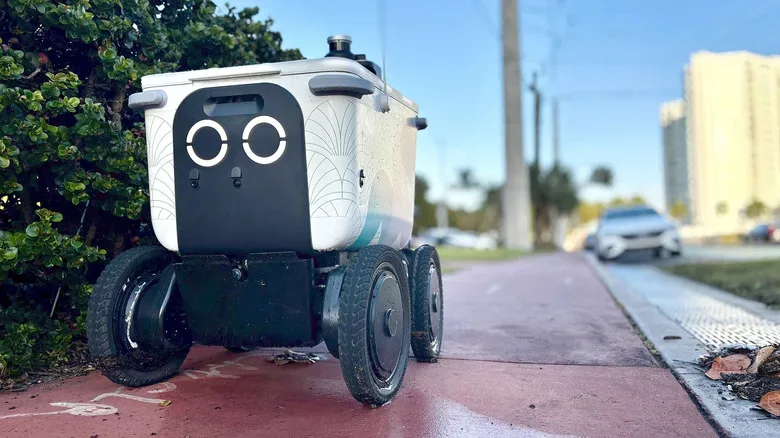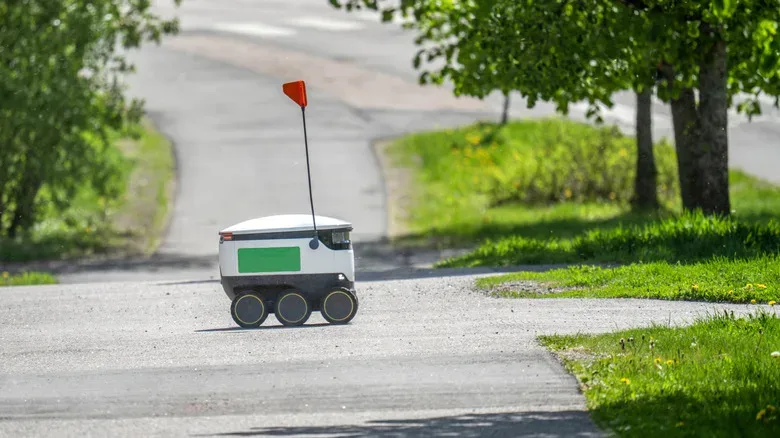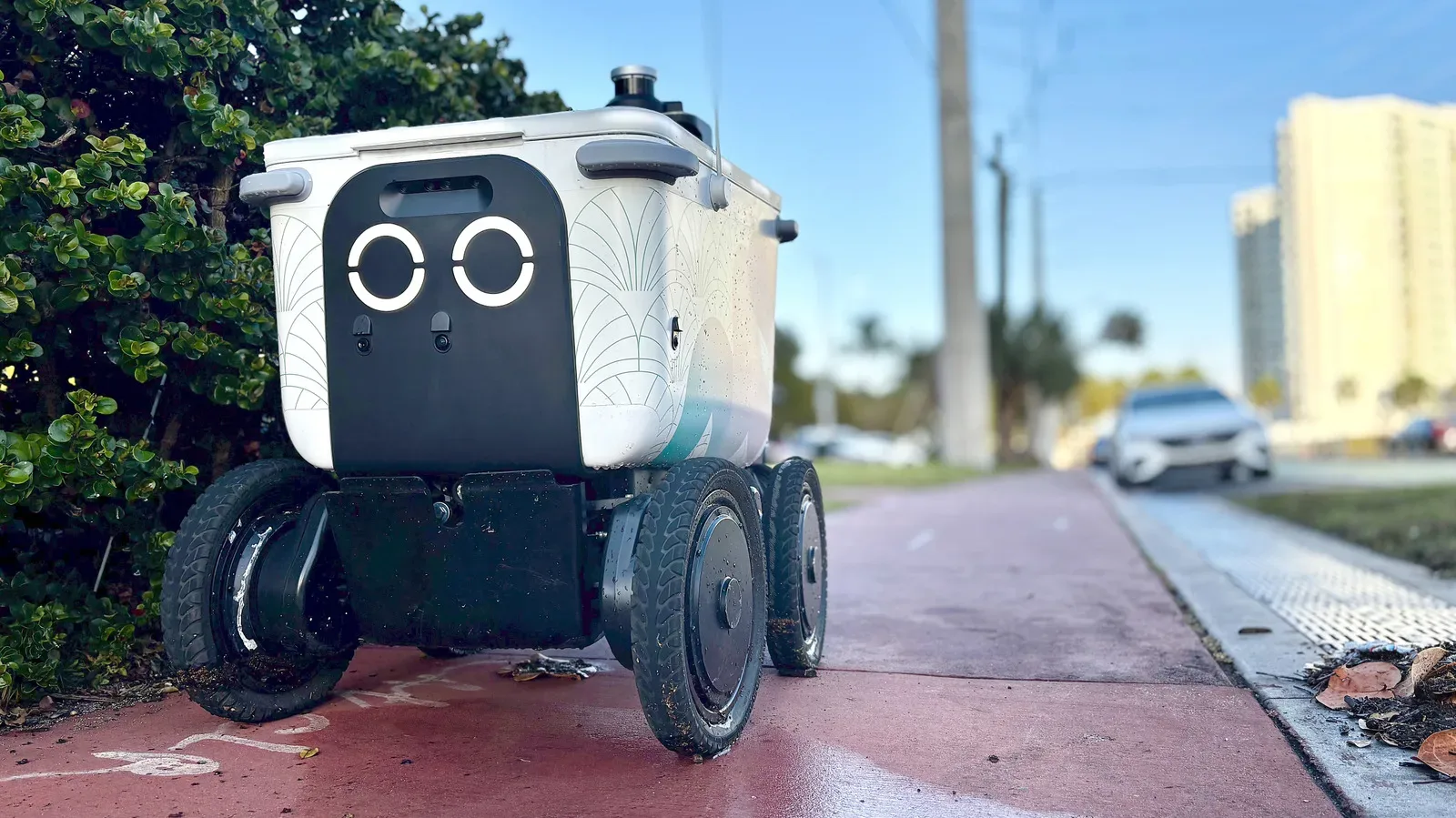
Sidewalk delivery robots have an unusually effective way of making their central problem visible. They are small, mobile, sometimes decorated with friendly faces, and built to occupy the same narrow public routes as people walking to work, using wheelchairs, pushing strollers, cycling near crossings, or navigating crowded outdoor seating. That makes every stall, bad detour and awkward near-miss feel less like a distant software problem and more like a piece of consumer technology that has wandered directly into civic life.
The appeal is easy to understand. A robot can carry a meal or small order over a short distance without needing a human courier for that individual trip. Companies operating in this area include Starship Technologies, Serve Robotics, Coco Robotics, Delivers.AI and DoorDash, which has introduced its own robots. Yet a delivery route is not a tidy warehouse aisle. It is a shifting environment full of cracked paving, temporary construction, pedestrians who do not behave predictably, business queues, patio furniture and intersections with competing rules and risks.
That contrast explains why the conversation should not stop at whether the robots look charming or irritating. The harder question is whether a machine that can navigate a normal route most of the time can do so without transferring the burden of its mistakes to the people sharing the sidewalk.
Autonomous does not mean unsupervised
Many delivery robots now operate autonomously, using cameras, sensors and GPS, while human supervisors intervene only when necessary. Each term describes a different piece of the navigation puzzle. GPS helps establish the robot’s position and planned route. Cameras provide visual information about its surroundings. Sensors can help identify nearby objects or changes in the environment. Together, these systems attempt to turn a public walkway into a route the robot can follow.
But knowing where a robot is and recognizing that something is nearby are not the same as understanding what should happen next. A patched sidewalk, a new work barrier, a crowded café entrance or a person changing direction can create ambiguity. Humans routinely resolve these moments through attention, courtesy, body language and a fast assessment of who has room to move. A robot must detect the issue, classify it, choose a response and execute that response safely. If any part fails, it may stop, take up space or make an inappropriate maneuver.
This is why remote support remains significant even in a largely autonomous model. Human intervention can be a fallback when the system encounters something it cannot confidently resolve. However, that arrangement also highlights a practical limitation: the route is not truly frictionless simply because the vehicle can move itself for much of the trip. It has an escalation path when reality falls outside its expectations.
Coco Robotics previously relied on remote human drivers throughout trips before the industry’s broader shift toward more autonomous operation. The change reflects the desire to reduce the amount of direct human involvement required per delivery. It does not erase the messy conditions of the sidewalk, and the safety question is whether the technology’s edge cases are rare enough—and handled well enough—for shared public space.
Small obstructions can become major accessibility problems
For an able-bodied pedestrian on a wide, empty path, a paused delivery robot may be an annoyance measured in seconds. For someone with limited mobility, a wheelchair user or anyone moving through a constricted route, it may be much more consequential. Sidewalk width is finite. When a robot occupies the usable path, the person expected to yield may have no safe or dignified alternative.
That is why reports of pedestrians having to make way for robots deserve more attention than the usual jokes about a “clanker” blocking the route. Delivery machines are theoretically meant to stop for people, but yielding is not a complete solution if stopping leaves the robot in the only accessible passage. A system can avoid a direct collision while still creating an obstacle.
The issue can also intersect with the Americans with Disabilities Act, commonly shortened to ADA. In this context, the concern is not merely whether a robot bumps into someone. It is whether its presence effectively obstructs accessible travel on a public route. The supplied evidence describes sidewalk-hogging as a potential ADA concern, which is a useful reminder that accessibility should be assessed in terms of real passage and independence—not only collision rates.
Restaurants with outdoor seating and other businesses that spill activity onto sidewalks add another layer. The machine may encounter tables, customers, staff and queues in spaces that were already tight. A navigation model may regard these as obstacles; a person regards them as a social environment where slowing down, asking permission, or choosing another route can be necessary. The robot’s physical footprint may be modest, but it can still impose a cost on everyone else trying to use the space.
Property damage and injuries make the stakes clearer
Navigation failures are not exclusively theoretical. One robot reportedly damaged a bus stop in Chicago after becoming confused by its surroundings. That is a concrete example of the gap between a robot’s planned environment and the city as it actually changes day to day.
There have also been reported cases of bodily harm. In New Jersey, a man suffered a broken shoulder and a head injury after a delivery robot struck his bike. The evidence also notes other incidents of robot-caused harm. The precise circumstances of every event matter, and isolated cases do not by themselves define the performance of an entire industry. Still, they establish the key principle: low-speed, compact delivery machines are not automatically harmless when they operate near pedestrians and bikes.
Analysis should resist two simplistic responses. It would be premature to claim that every sidewalk robot is inherently unsafe from the incidents described here. It would be equally misguided to dismiss harm because the machines are small or because automation has convenience benefits. In a public setting, acceptable performance must account for the people who face the consequences when the system gets confused.
Expansion may magnify unresolved design choices
These questions are becoming more urgent because the sector is expected to grow rather than fade. A Transforma Insights projection puts the global number of automated urban delivery vehicles at 559,000 by 2035, up from 28,000 in 2025. Forecasts are not guarantees, but the scale of that estimate shows why cities, disability advocates, businesses and delivery platforms have reason to address the basics before deployments become much more common.
Current distance limits put a check on the transformation. Present robot models are described as having a range of about two miles, which makes them especially suited to dense urban areas and short trips. That means human delivery workers are not simply removed from the picture: many deliveries will remain outside the practical reach of a sidewalk robot. But even a limited radius can cover highly populated neighborhoods, where pedestrian traffic and constrained infrastructure are already intense.
The labor implications are therefore real even if incomplete. Delivery platforms can see robots as a means to improve overall profitability, particularly as companies such as Uber Eats and DoorDash have faced scrutiny over whether drivers are paid ethically. The important distinction is between a technical capability and a labor outcome. A machine’s ability to carry food a couple of miles does not automatically reveal how platforms will divide work, cost and responsibility. It does show why deployment decisions deserve public attention instead of being framed solely as novelty or convenience.
Rules are inconsistent, while cameras raise a separate question
Regulation appears to be one of the largest gaps. Many places have no limits specific to delivery robots, while more than 20 states treat personal delivery devices as pedestrians. That legal designation is striking because it places a commercial, sensor-equipped machine into a category normally associated with people moving on foot. The designation may give devices a route to operate on sidewalks, but it does not answer how they should behave around people, how much space they may occupy, or who is accountable when something goes wrong.
Some cities are already moving in another direction. Chicago, San Francisco and Toronto have enacted restrictions or outright bans on delivery bots. These measures indicate that local authorities can reach different conclusions depending on local street conditions, density, accessibility priorities and tolerance for an emerging delivery model. A patchwork of policies may be inconvenient for operators, but it also reflects an unavoidable fact: a sidewalk network is local infrastructure, not an abstract testing ground.
Privacy is a distinct concern. Delivery robots use cameras to navigate, and those cameras have drawn scrutiny from regulatory bodies. Navigation cameras are not necessarily equivalent to a system designed for surveillance, but people sharing a walkway may reasonably care about what is captured, how it is handled and what safeguards apply. The relevant policy task is broader than deciding whether robots can drive on the sidewalk. It includes defining responsible behavior for networked, camera-equipped devices operating near homes, businesses and passersby.
This concern sits within a wider debate over consumer and connected technology, where new hardware often reaches the public before expectations around data use become equally clear. For another example of how emerging device claims can require close reading, see the discussion around Meta’s Project Phoenix.
What better deployment would need to prioritize
The evidence points to a straightforward hierarchy. The first objective cannot be faster delivery or reduced operating costs. It has to be safe, accessible use of public space. That means robots need to handle broken surfaces and temporary changes without becoming obstacles; yield in ways that leave genuine room for people; and avoid creating new hazards at crossings, patios and crowded commercial areas.
- Accessibility first: A stopped robot should not turn the only usable section of sidewalk into a dead end.
- Clear accountability: Operators need identifiable responsibility when a machine stalls, damages property or injures someone.
- Local rules: Cities need the ability to set restrictions appropriate to their own streets and sidewalks.
- Privacy safeguards: Camera-based navigation should receive scrutiny proportionate to its presence in shared spaces.
- Honest autonomy claims: Human supervisory involvement should be understood as part of the operating model, not treated as irrelevant background detail.
Delivery robots may prove useful for some short urban orders, and their continued presence is likely. But “likely” is not the same as “ready for every sidewalk.” The technology’s future will be determined less by whether it can complete an easy route than by how responsibly it handles the unpredictable routes—and the people—it cannot treat as predictable.