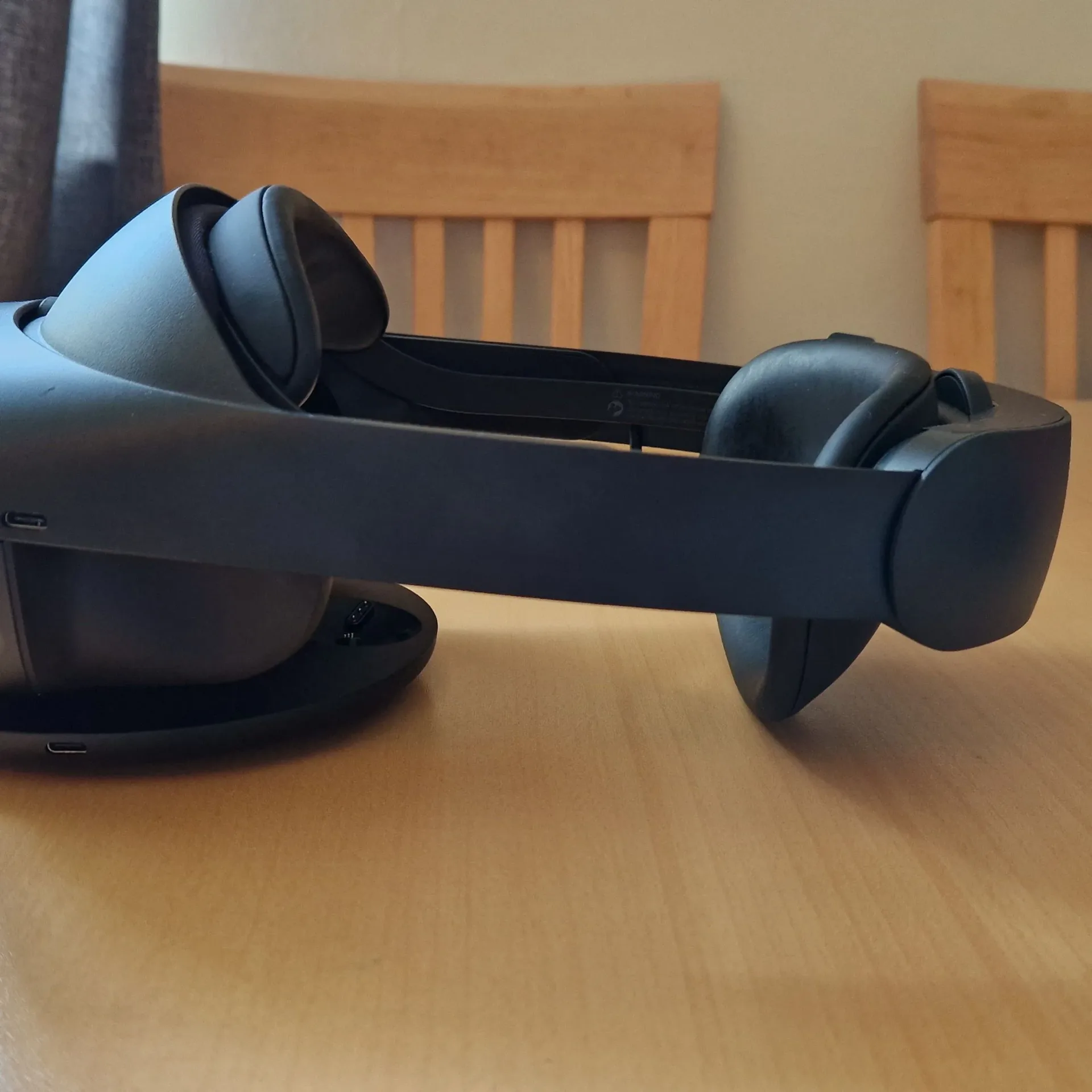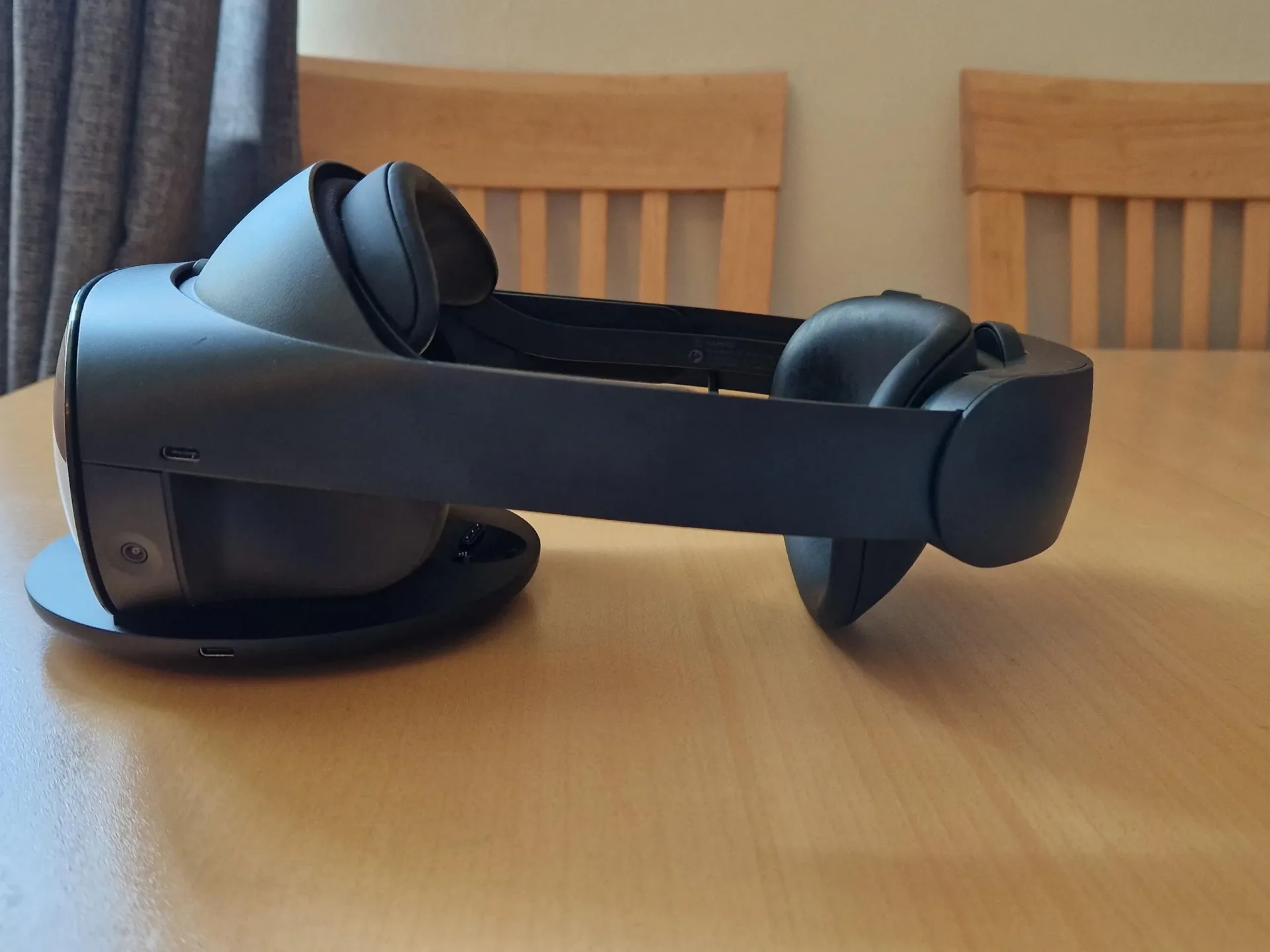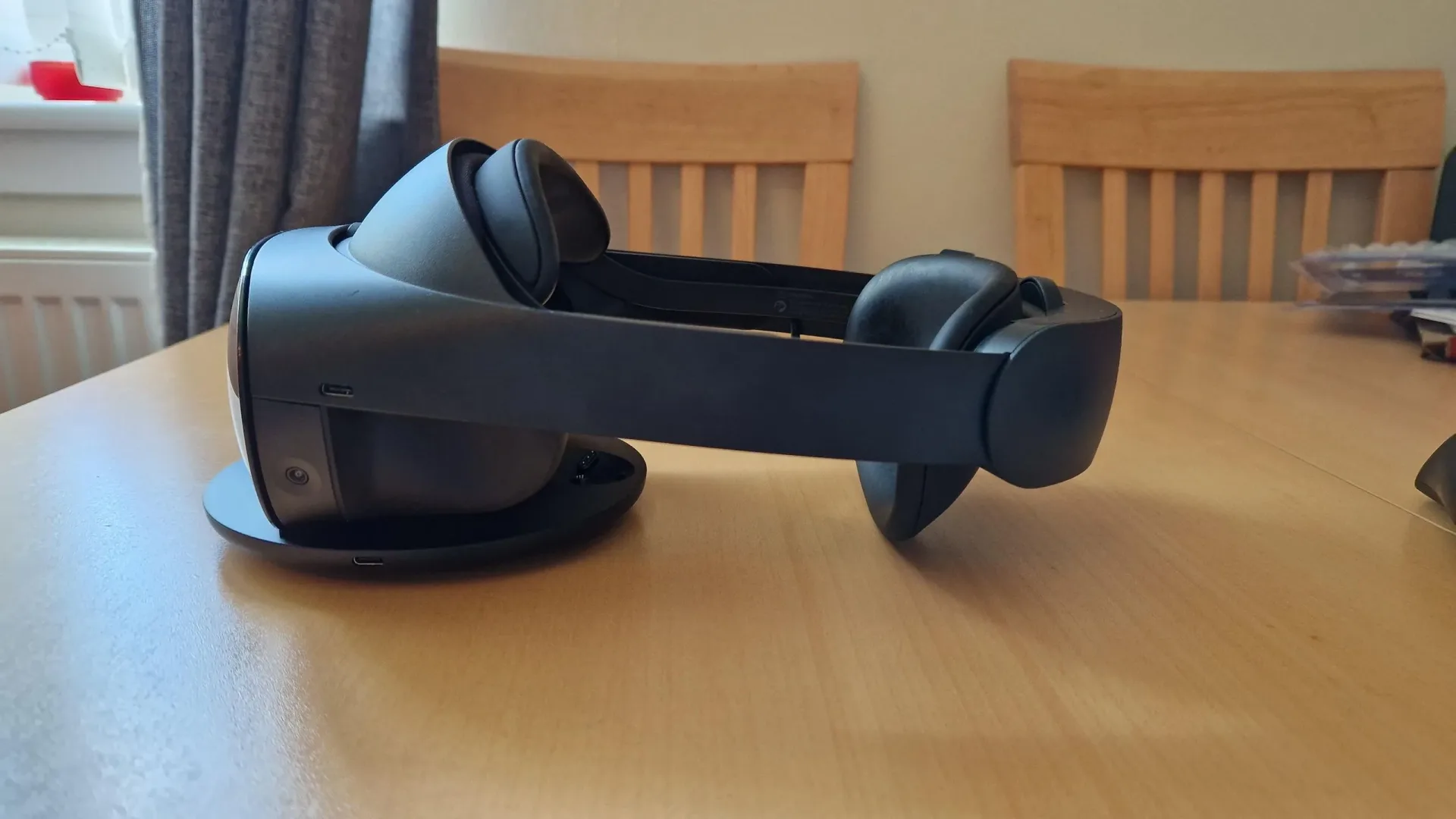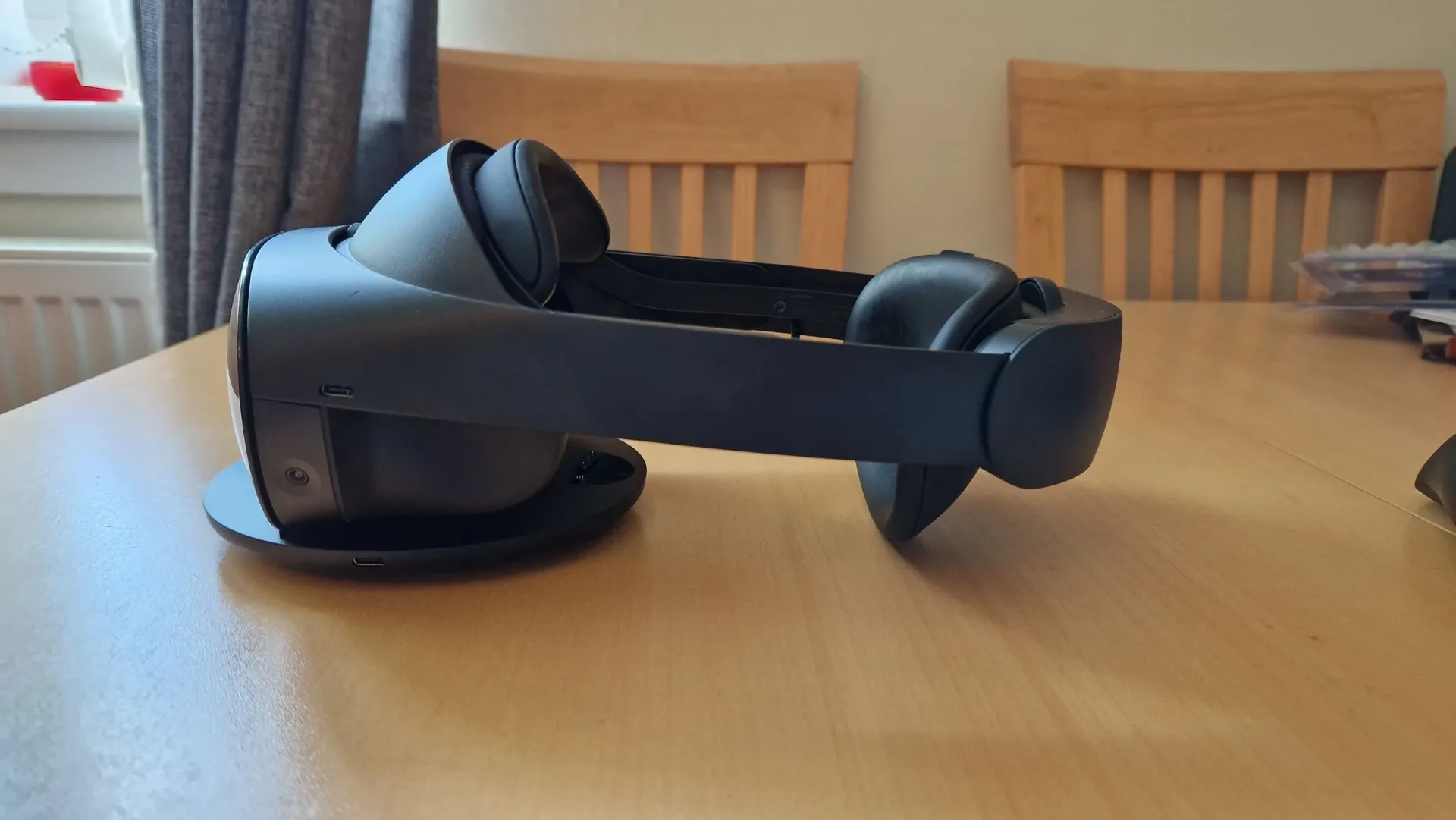
Meta’s next device may be trying to solve a very different problem from Valve’s newly launched Steam Frame. Images apparently discovered within an updated HorizonOS prescription-lens application depict an unannounced product referred to as Project Phoenix, with a form that looks notably closer to smart glasses than the familiar silhouette of a dedicated VR gaming headset.
That distinction matters. A product can run the same operating system and retain access to a game library without being designed principally around long, energetic, controller-heavy VR sessions. The leaked material is not an official product reveal, and the imagery alone cannot settle specifications, price, release timing, input support, or even whether Phoenix will be a direct successor to an existing Quest model. But it does provide useful clues about the trade-offs Meta may be considering ahead of its September 23–24 Connect event.
The apparent design includes slim, glasses-like arms and a cable leading from the left arm to what appears likely to be an external power source or computing puck that could be pocketed or belt-clipped. The prescription-lens angle is meaningful, too: the application’s purpose is apparently to show how corrective lenses are fitted into the device. That is an important convenience feature for many headset users, but in this case it also reinforces the sense that wearability and everyday fit may be central to the product’s pitch.
A leak is a clue, not a spec sheet
It is worth putting firm boundaries around what the available material can actually establish. The HorizonOS app visuals indicate that Meta has prepared prescription-lens guidance for a device with this design. They do not confirm the display resolution, battery capacity, processor, tracking system, field of view, controller bundle, software compatibility, name, or launch plan.
That means Project Phoenix should be treated as a reported, unreleased device rather than a finished consumer product. Even the suggestion that Meta could move away from the Quest name remains unconfirmed. An internal or app-facing image can be accurate and still represent a model, accessory configuration, or product category that the public has not yet been told how to understand.
Still, visual design can reveal priorities. A chunky, self-contained headset advertises immersion and onboard capability. A compact, glasses-adjacent device with a tether to an external module signals a different balancing act: reducing weight on the face while moving at least some of the burden away from the eyewear itself. That could be particularly attractive for media, communication, work-oriented mixed-reality tasks, or shorter interactive sessions. None of those uses excludes games, but neither do they automatically make gaming the primary objective.
Why lighter hardware changes the VR equation
“Lightweight” is not simply a comfort buzzword in head-mounted hardware. A headset rests on the face and head, so its mass, shape, balance, and strap arrangement all affect whether it stays stable while the wearer looks around. Moving power or computing hardware into a separate puck could potentially reduce the load carried directly on the face. The apparent cable is therefore more than a cosmetic detail: it suggests a possible effort to make the glasses portion less bulky.
For gaming, however, comfort is only one requirement. Fully immersive VR often asks players to turn quickly, look sharply upward or downward, lean, reach, and move their head repeatedly. A glasses-style fit may be appealing for casual use, but it raises practical questions when applied to active games. How securely does the device stay positioned? Is the cable managed in a way that does not distract or snag? Does the form factor remain comfortable over an extended play period? The leaked images do not answer any of those questions.
Related coverage includes Meta's Project Phoenix Leak Points to Lighter Smart-Glasses-Style VR as Steam Frame Launches.
There is also the question of field of view, often shortened to FOV. This describes how much of a virtual scene is visible to the wearer at one time. In plain terms, it is the size of the visual window into the digital world. A wider field of view can make an experience feel less like looking through a constrained opening, while a smaller one may be perfectly suitable for some applications but feel less accommodating in games built around environmental awareness and immersion.
The visible lenses in the apparent Phoenix imagery look small, though design photos cannot reliably reveal the eventual usable field of view. Lens geometry, display placement, and optical design all matter. It would be premature to declare the device unsuitable for gaming on that basis alone. The more defensible reading is that the imagery raises a question that Meta will need to answer: whether this hardware is intended for immersive games first, or whether immersion is one use among many.
Controller-free interaction could be the biggest gameplay question
No new controllers appear in the reported images. Separately, the Connect schedule includes a session from Meta software engineering manager Dongyi Li called A practical guide to controller-free interaction. The title does not confirm that Project Phoenix will ship without controllers, yet it fits a direction Meta has explored since Meta Quest Pro: making hand-based interaction more important.
Controller-free interaction generally means using tracked hands and gestures rather than physical handheld controllers for navigating interfaces and performing actions. It can be intuitive for simple tasks. Selecting a panel, pinching to activate an option, or manipulating virtual objects with one’s own hands has an immediate appeal, particularly when the user is not trying to learn a traditional game control scheme.
Games can demand more from input hardware. Physical controllers provide buttons, triggers, sticks, and—crucially—consistent touch points. That consistency lets a player make fast, repeatable actions without needing to see their own hands. It also gives a degree of tactile feedback: fingers can find a trigger or button by feel, and the controller’s shape acts as a reliable reference in space.
Hand tracking may be useful, even excellent, for particular game types and social or menu interactions. But it does not automatically replace every controller function. A game that depends on rapid movement, multiple simultaneous inputs, precision aiming, or frequent button combinations can benefit enormously from dedicated controls. If Phoenix emphasizes controller-free use, the key question is not whether it can access games, but which kinds of games feel natural and complete on the hardware.
This is where the device’s positioning becomes more consequential than its branding. If controllers are optional accessories, Meta could preserve a path to more traditional VR play. If the product is built chiefly around hands, lightweight wearability, and a pocketed module, it may signal a device intended to broaden use beyond the enthusiast VR gaming audience rather than replace a conventional gaming headset outright.
Steam Frame and Phoenix may be chasing different buyers
Valve’s Steam Frame enters the conversation with a reported $1,059 price, a figure that immediately frames it as a costly piece of gaming hardware. A device at that level does not need to defeat every cheaper headset in every category to have a purpose. It needs to persuade an audience that its specific gaming proposition is worth the outlay.
Project Phoenix, meanwhile, cannot yet be judged on price or final capabilities because neither has been established publicly in the available evidence. But the apparent glasses-like construction suggests a potential split in priorities rather than an obvious head-to-head collision. If Meta is building a wearable that makes HorizonOS more convenient and approachable for broader day-to-day use, its most direct competition may not be a premium gaming-first device at all.
That would leave room for both approaches, albeit with very different compromises. Steam Frame’s $1,059 cost is a substantial hurdle for consumers comparing it with more affordable Quest hardware. Yet a lower-cost headset and a premium gaming machine are not necessarily interchangeable when they emphasize different kinds of interaction, immersion, comfort, or software use. The same dynamic is playing out across the wider industry as platform holders test different ways to put games and entertainment in front of users; Apple, for example, has continued to reshape the service side of games through broader plan bundles, as seen when Apple folded TV and Arcade into paid iCloud+ plans.
For Valve, the more immediate challenge may therefore be the basic one attached to a four-figure price: identifying the buyers who value its proposition enough to pay for it. For Meta, the challenge is clarity. A glasses-style product may be compelling, but prospective customers will want to know whether it is a gaming headset, a smart wearable with gaming access, or a new category that sits between the two.
Meta’s broader signals point to a transition, not a confirmed exit
The Phoenix discussion arrives amid a complicated year for Meta’s VR and game-development efforts. The company has closed studios and cut jobs connected to gaming and headset production in 2026, while Quest headset prices have increased and Reality Labs has faced lower profits. At the same time, Meta’s Ray-Ban smart glasses have appeared to find considerable traction, giving the company a clear reason to pay attention to lighter wearable products.
Those developments make a smart-glasses-adjacent design easier to interpret, but they should not be overstated as proof that Meta is abandoning VR games. Meta CTO Andrew “Boz” Bosworth has said there are no plans to leave the sector. A company can reduce or reorganize parts of its game operation while continuing to support an operating system, store, apps, and games across several devices.
The more cautious interpretation is that Meta may be recalibrating. Rather than pursuing the mainstream gaming market through one familiar style of standalone headset, it could be testing hardware that emphasizes wearability and controller-free interaction. That would be a strategic shift in focus, not necessarily a departure from games.
What to watch at Meta Connect
Connect should bring the first opportunity to separate visual inference from confirmed details. If Project Phoenix appears, the most important information will be more practical than promotional:
- Product identity: Is it a Quest successor, a separate wearable line, or something positioned between smart glasses and headsets?
- Input: Are dedicated controllers supported, bundled, optional, or absent?
- Gaming emphasis: Does Meta demonstrate demanding immersive games, or focus on apps, media, social use, and lightweight interaction?
- Optics and fit: What does Meta say about field of view, prescription-lens support, and stability during movement?
- The external module: Is the apparent puck a battery, a compute unit, or both, and what does the cable mean for everyday use?
- Compatibility: Which existing HorizonOS apps and games will work as intended, and are there limits tied to controllers or hardware design?
Until then, the leak points to possibility rather than certainty. Project Phoenix may still run HorizonOS and connect users to the same ecosystem as other Quest hardware. But the apparent form factor makes one thing clear: access to VR games and a product designed around VR gaming are not identical promises. If Meta is moving toward a lighter, more glasses-like wearable, Valve’s Steam Frame may have less reason to fear a direct gaming showdown than its price tag does.