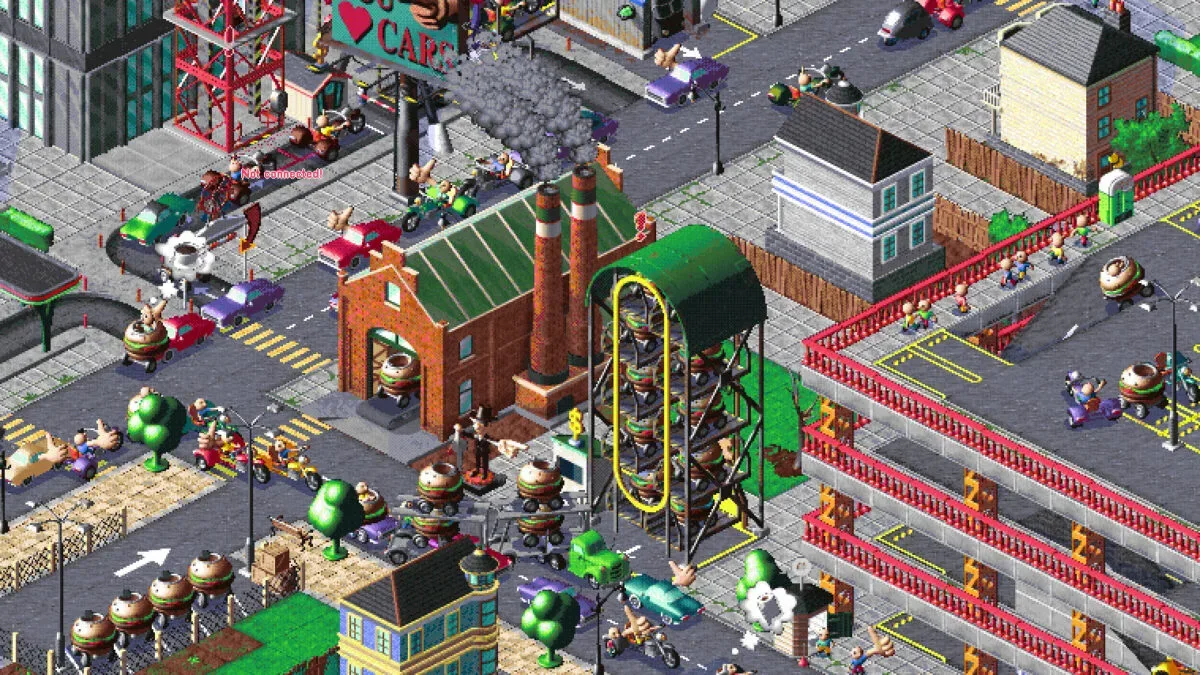
Car Park Capital begins with a deceptively narrow business proposition: make money from parking spaces. Its joke—and its central design idea—is that no parking lot exists in isolation. Expanding that lot eventually means reshaping the city around it, then reshaping the people who live there, travel through it and object to what it becomes.
Developed by Dutch studio Hilkojj Interactive and picked up by MicroProse, the early-access management game takes the clean, readable language of the classic tycoon simulator and points it toward an unusually ugly objective. Players place markings and signs, set prices and pursue a bigger parking operation. But growth is not confined to adding another level to a garage or optimizing a queue at the gate. The game turns the supposedly mundane question of where cars sit still into a chain of increasingly severe commercial and civic choices.
That makes it a simulator about parking, certainly, but also a satire about the systems that can make parking feel inevitable. Car Park Capital asks the player not simply to meet existing demand but to manufacture more of it—and to benefit as alternatives become weaker.
A tutorial with a deliberately wrong destination
The tutorial reportedly opens on the entrance to a busy theme park, a setup that initially suggests an amusement-park builder. Instead of putting the player in charge of rides, attractions or guests’ fun, it narrows the role to the paved space outside. The first tasks involve parking fundamentals: changing fees, laying down the yellow lines that organize bays and adding signage.
For more context, explore Klara and the Sun Review: Jenna Ortega Can’t Power Taika Waititi’s Uneven Android Drama.
Then comes the escalation. The tutorial introduces the sabotage of public transit as a way to improve parking business. That is the point at which the game makes its argument in mechanical rather than purely verbal form. Public transport is not a neutral backdrop. In Car Park Capital’s logic, it is competition. Making it worse can send more customers toward the player’s lots.
Management simulation is a genre built around interacting systems: a choice in one part of a virtual operation changes outcomes elsewhere. A price can affect demand; a building can require roads; a new service can create an expense as well as revenue. Car Park Capital applies that familiar framework to an intentionally uncomfortable dependency. It treats the convenience of the private car as both a market to exploit and a condition the player can help create.
The humor comes from the bluntness. Most business games dress expansion in words such as efficiency, satisfaction and growth. Here, those impulses are pushed until their social cost can no longer stay off-screen.
From a few spaces to a built-in demand machine
Campaigns begin with a small, appealing parking lot in a dense city. Organic expansion is difficult because land is already occupied. The path forward is not presented as a miraculous empty plot appearing at the edge of town. It involves removing apartment buildings and homes to claim more square footage.
Those displaced residents need housing, and the game lets the player construct suburban sprawl. The satirical loop is especially clear here. Suburban homes are placed farther from the dense city, creating a greater need to drive. More driving means more cars; more cars mean more reason for parking spaces. Rather than responding to transport demand, the player is encouraged to build the circumstances that produce it.
This is a useful distinction for understanding the game’s targets. Induced demand, in plain terms, is the idea that adding capacity can encourage more use of that capacity. Car Park Capital’s version is deliberately cartoonishly comprehensive: add parking, create car-dependent homes, produce cars, and then build still more parking. The game is not attempting a subtle depiction of benign urban planning. It is depicting an accelerator, one whose success depends on taking choices away from everybody else.
The player’s business broadens accordingly. Cars need fuel, so the operation can move into oil drilling. Property acquisition, desirability monitoring, superstores and drive-throughs enter the picture as well. A ferris wheel for cars rather than people takes the premise into absurdist territory, but it also preserves the same joke: even leisure can be rebuilt around the vehicle and the revenue stream attached to it.
It is a pointed answer to the usual tycoon-game fantasy of specialization. Someone arriving for elaborate parking-garage design may instead find a game asking them to be a landlord, developer, industrialist, retailer and energy magnate at once. The parking space is not the end product. It is the organizing principle for a private empire.
When satire turns coercive
The available tools grow more extreme as the business expands. The game includes evictions, damage to local infrastructure, privatized toilets and a personal police force used against protesters. It can also involve hiring fighters in preparation for confrontation. These details make clear that Car Park Capital is not merely poking fun at ugly architecture or overpriced lots. Its satire is about power: who gets to set the terms of a city, who bears the costs of expansion and what happens when opposition is treated as an obstacle rather than a public response.
That is why the game’s pitch lands differently from a conventional city builder. City builders often ask players to balance residents’ needs against budgets and growth. Car Park Capital appears to invert that relationship. Residents, transit, local amenities and dissent can become variables to suppress if doing so strengthens the parking enterprise.
Satire in this context does not mean that every action is harmless because it is exaggerated. It means exaggeration is being used to expose a pattern. The game piles property development, petroleum extraction, big-box commerce, car manufacture, infrastructure decay and private enforcement into the same economic machine. Each step is more severe than the last, but each is framed as a practical answer to a previous business problem. The comedy lies in how frictionlessly the terrible solution presents itself.
Car Park Capital’s sharpest idea is that a parking lot is never just a parking lot when the whole city can be redesigned to fill it.
That framing also gives the player a strange role in the story. They are not a distant mayor attempting to keep competing interests in equilibrium. They are an entrepreneur whose incentives become ever more aligned with scarcity, displacement and dependency. In a traditional optimization game, mastery is satisfying because the system begins to run smoothly. Here, smooth operation may be the most alarming outcome.
The limits of an unstoppable parking empire
The game’s dark loop is described as amusing and absorbing, but its power curve may be a potential issue for players who want a long-lasting strategy challenge. Once the operation becomes effectively indestructible, the satirical meaning remains intact: entrenched private power is difficult to dislodge. Yet the strategic tension can diminish when there is no credible threat to the player’s position.
That is an important distinction between a strong theme and an endlessly compelling simulation. A simulation normally lives or dies on meaningful trade-offs, changing constraints and the possibility that a successful plan can fail under new conditions. If Car Park Capital reaches a state where its empire cannot be meaningfully challenged, then the player may be left with a very effective metaphor but fewer difficult decisions.
Early access matters here. The label generally means a game is released while still in active development rather than treated as a finished version. In this case, the reported default city scenario is accompanied by a Florida Keys setting, offering another place to push the game’s agenda of expansion and damage. But the currently described material should not be mistaken for a promise of what every future build will contain. For interested players, the practical takeaway is to approach it as an evolving satirical management game, not as a settled, final-scale tycoon package.
There is still a compelling contrast at the heart of the premise. Parking design is usually hidden in plain sight: painted lines, gates, signs, pricing boards and vast paved surfaces are treated as background infrastructure. Car Park Capital brings that background to the foreground, then refuses to let it stay innocent. Every new space becomes an invitation to think about the homes removed, the trips made harder without transit and the commercial ecosystem built to make driving unavoidable.
A city builder where the villainy is the feature
The game’s closest conceptual relatives are not necessarily other parking games, but management games that use systemic play to make an argument. Its visual and structural comparison to a classic tycoon game is part of the gag: the colorful, orderly language of construction and profit is used to conduct a campaign of civic deterioration. Players are invited to enjoy the clarity of a well-connected system while recognizing that the system is horrifying.
That tension may be Car Park Capital’s strongest feature. It does not demand that the player accept a lecture before touching a tool. It lets the player act, rewards the action and then keeps widening the view until the reward itself looks grotesque. A parking fee becomes land acquisition; land acquisition becomes displacement; displacement becomes sprawl; sprawl becomes car dependence; car dependence becomes a rationale for even more parking.
For a wider look at the same premise, Car Park Capital’s city-building nightmare similarly underscores how far the game takes its parking-lot logic.
Whether the present balance can sustain the marathon sessions associated with the best simulation games is an open question, particularly while the game remains in early access. But as a concept, it is unusually direct. Car Park Capital makes the player the beneficiary of a city becoming less livable, and makes every successful business decision another punchline with asphalt under it.