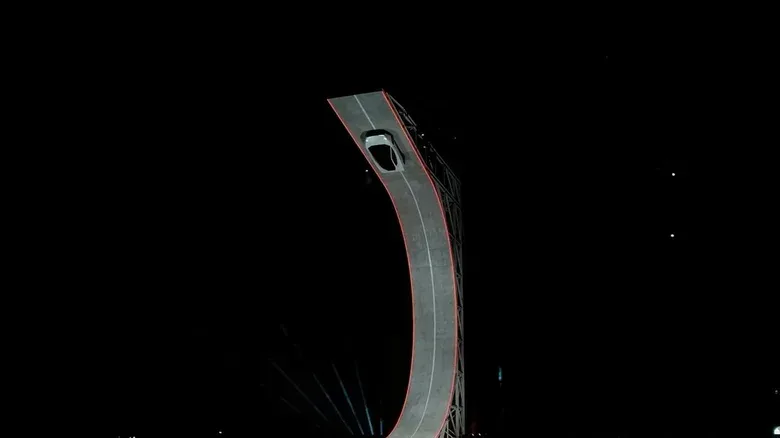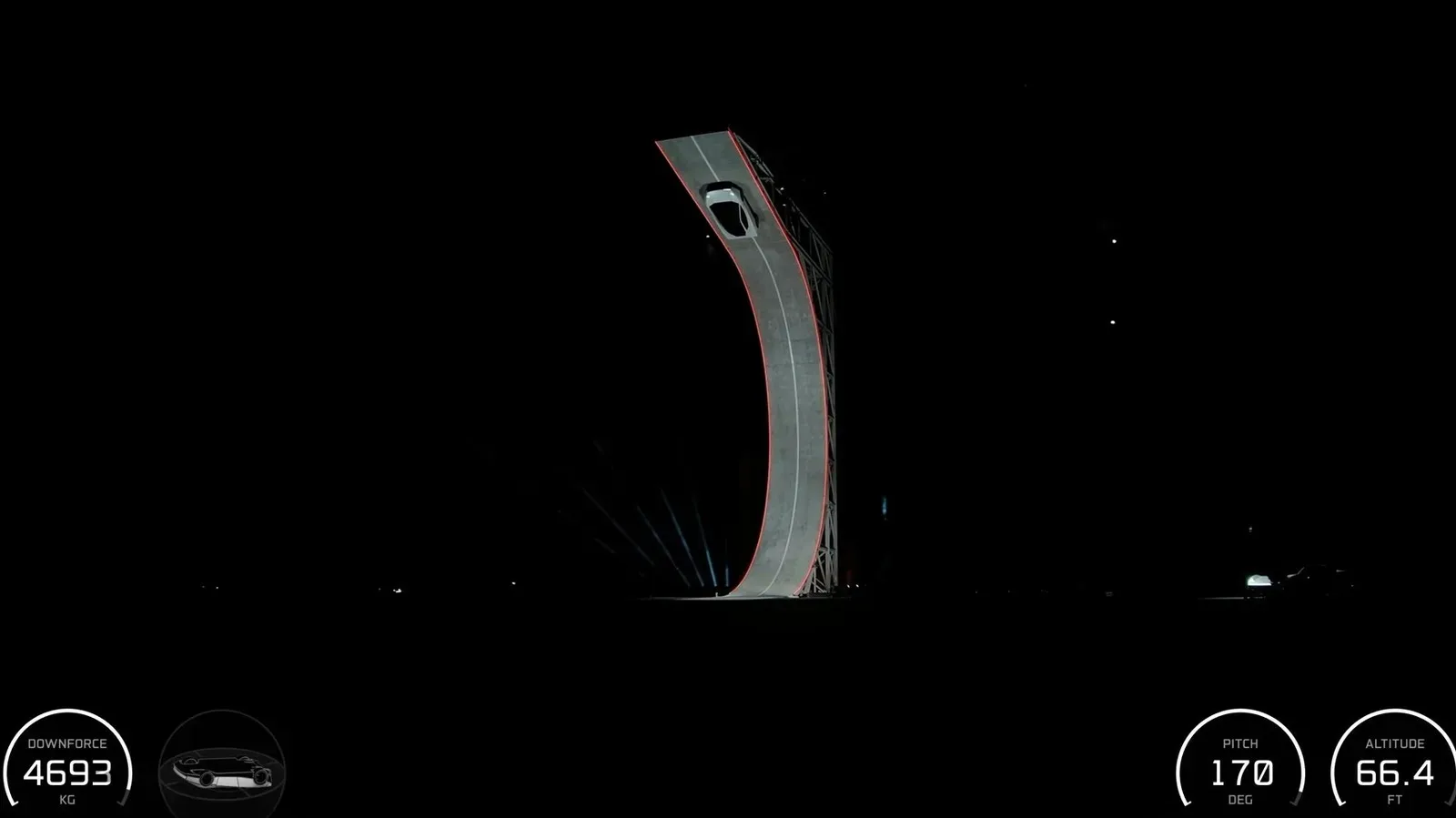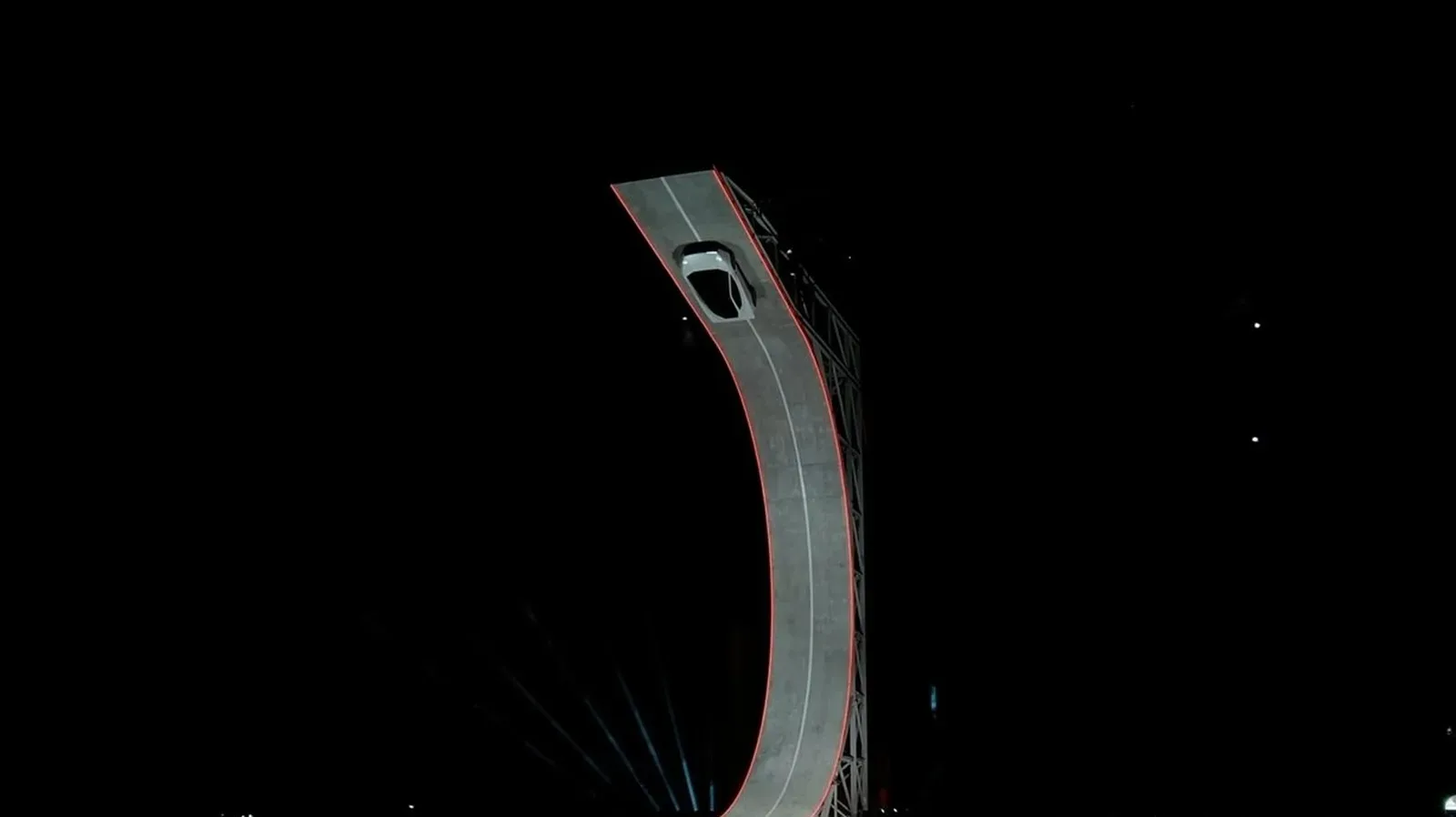
Tesla’s next-generation Roadster arrived with a demonstration designed to make gravity look negotiable. The car drove up a C-shaped ramp, paused on the vertical section in a position that appeared upside down, then launched away, rotated upright and landed. Tesla attributes that dramatic behavior to a multi-mode fan and ground-sealing arrangement it calls a downforce generator.
It is a striking claim, and the underlying concept is real: use powered fans to remove air from beneath a car, reduce the pressure under its floor and create suction that presses the vehicle toward the surface. Tesla says its system works with a retractable rear wing and can provide sufficient downforce to hold the Roadster upside down at any speed.
But the important context is that fan-generated downforce is not new. It has appeared in radically different forms across racing history, from a famously boxy Can-Am prototype in 1970 to a one-race Formula 1 winner in 1978. More recently, McMurtry has demonstrated an electric car clinging upside down to a rotating platform. The Roadster’s reveal is therefore less the birth of an idea than a high-profile return of an unusually direct approach to aerodynamic grip.
What downforce means — and why fans change the equation
Downforce is the force pushing a vehicle into the road. More downforce can give tyres more grip for cornering, braking and acceleration. Conventional performance cars usually generate it through the bodywork moving through air: wings, splitters and the shaped underside of the car direct airflow to create pressure differences.
For more context, explore Joe Budden Criticizes Elliott Wilson as DJ Vlad Partnership Fallout Draws More Attention.
That traditional method depends heavily on speed. At low speeds, a wing has relatively little air moving over it, so its contribution is limited. A fan system takes a different route. Rather than waiting for the car’s motion to build the aerodynamic effect, fans actively pull air from the space under the vehicle. If that underside is sufficiently sealed from surrounding air, the resulting low-pressure area can pull the car toward the ground even when it is stationary.
This is the key distinction behind the upside-down demonstrations. The point is not merely that the car has a rear wing or a sleek body. It is that powered airflow can create meaningful suction before the vehicle has gathered speed. Tesla says the Roadster’s fans and ground sealing system can generate up to 2g of downforce. In this usage, g is a measurement expressed relative to Earth’s gravity; it describes the magnitude of the force, not a claim that the vehicle itself is accelerating at that rate.
A system capable of creating downforce at a standstill has obvious visual appeal, but it also has performance significance. It potentially offers grip in the slowest portions of a circuit, where ordinary aerodynamic aids are at their least effective. That said, Tesla’s figures and description are company claims, and the source material does not provide independent performance testing of the Roadster system.
The Chaparral 2J: a 1970 prototype built around suction
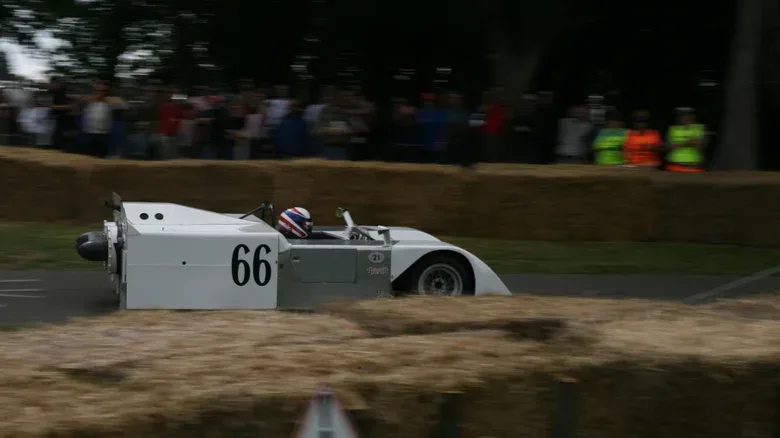
One of the clearest predecessors is the Chaparral 2J, entered in the Can-Am Championship by American racing drivers Jim Hall and Hap Sharp in 1970. The prototype’s blunt, squared-off appearance earned it a reputation for looking more like a box on wheels than a traditional racing car, but its underbody concept was anything but ordinary.
The 2J used a modified 7.6-liter Chevrolet V8 for propulsion. Its suction system, meanwhile, was built around two fans adapted from a military tank engine. Transparent polycarbonate sheets formed skirts around the lower edges of the car, creating a more enclosed zone beneath it. The fans pulled air from that space, producing the low-pressure effect that pressed the car toward the track.
The reported suction force was between 1.25g and 1.5g. Put beside Tesla’s stated maximum of 2g, the comparison makes the family resemblance easy to see: both approaches use powered extraction underneath the car and depend on managing the gap between the car and the surface. The details may differ, but the central engineering objective is shared.
The story behind the 2J also shows that this was not a passing gimmick. Its suction technology began as Chevrolet’s Suspension Test Vehicle project before Hall recruited developer Don Gates to his team. Decades before modern electric hypercar demonstrations, engineers were already exploring whether fans and skirts could deliver aerodynamic loading in a more immediate, controllable way than wings alone.
Why the skirts matter
A fan cannot maintain low pressure under a car efficiently if air constantly rushes in through large gaps at the edges. That is why the Chaparral used polycarbonate skirts. They helped define the volume from which the fans extracted air, making the suction system more effective.
Tesla’s description of a ground-sealing system points to the same practical challenge. “Ground effect” in this context is not magic adhesion. It is a pressure-management problem. The closer a system comes to controlling airflow beneath the car, the more effectively it can create a pressure difference. Surface conditions, clearances and how the vehicle handles gaps are therefore central to any real-world fan-downforce design, even if the headline moment is an upside-down pause on a purpose-built ramp.
Brabham’s BT46 and the Formula 1 fan-car episode
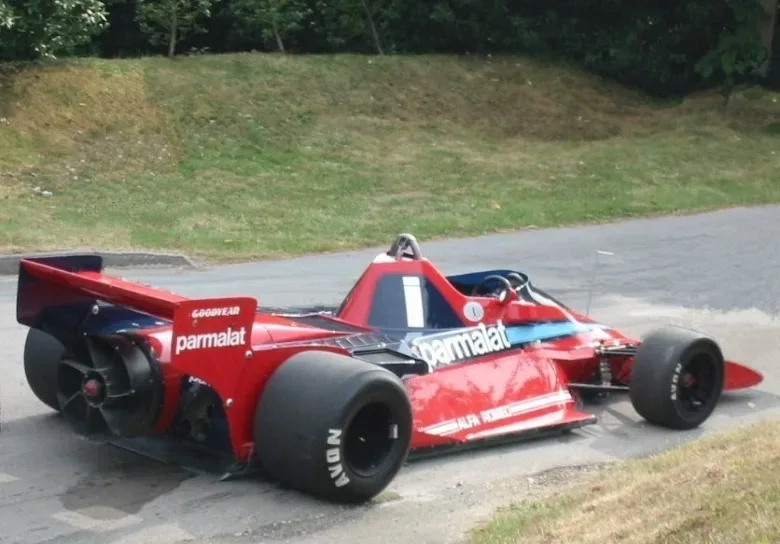
The next famous chapter came in Formula 1. Gordon Murray designed the Brabham BT46 for the 1978 season, and its fan-equipped variant became widely known as the “Fan Car.” The car’s designers said the large rear-mounted fan was chiefly for cooling in order to meet Formula 1 regulations. Yet the design also drew on ideas associated with the Chaparral 2J and the Tyrrell 008, another Formula 1 car whose fan concept did not ultimately succeed.
The BT46 used a series of clutches connecting to a single large fan at the rear. Like the 2J, it employed skirts that covered the gaps between the car’s underside and the circuit. The fan extracted air beneath the car and produced suction. In the BT46’s case, the suction effect increased as the vehicle went faster.
Its competitive record is remarkably concise: the BT46 raced only once, at the 1978 Swedish Grand Prix, and won. That result is part of why fan cars have remained a fixture of motorsport lore. The design did not create a long racing era, but it made its point immediately: actively controlling the air beneath a car could translate into a meaningful advantage.
The Brabham and Chaparral examples also explain why Tesla’s presentation has drawn so much interest beyond a single stunt. A fan-assisted vehicle is visually memorable because it can appear to ignore the usual relationship between speed and grip. But its deeper significance is that it revisits one of racing engineering’s most distinctive attempts to make downforce available on demand.
McMurtry’s Spéirling is the closest current comparison
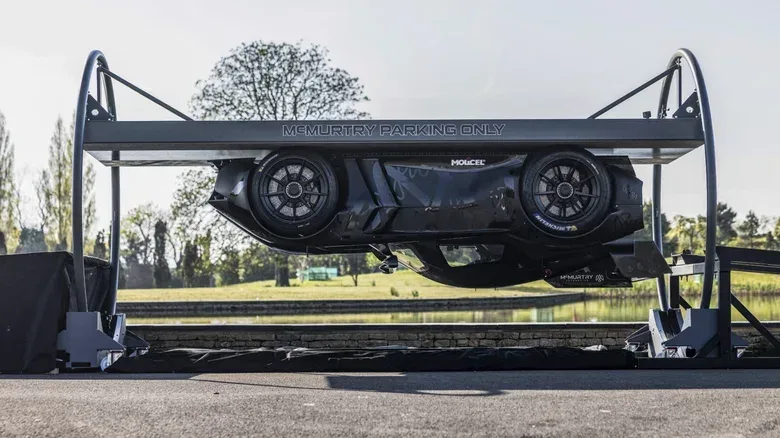
If the Chaparral and Brabham provide the historical lineage, McMurtry’s Spéirling is the most direct modern comparison in the supplied record. McMurtry Automotive unveiled the electric sports car in 2025 and demonstrated it hanging upside down from a rotating platform at its English headquarters without support.
Its system, called Downforce-on-Demand, uses two fans to extract air from beneath the car. McMurtry has framed the result in much the same practical terms as Tesla: the Spéirling can generate enough downforce to adhere to a surface at any speed, including when stopped. The company says this contributes to cornering capability exceeding 3g.
After Tesla showed the Roadster, McMurtry responded on social media with a playful welcome message and a video of the Spéirling inverted. The exchange captures the unusual state of this niche technology. Tesla may be bringing fan downforce to a far broader public conversation, but McMurtry already has a production-oriented electric sports car centered on the same fundamental principle.
McMurtry revealed the final production version of the Spéirling Pure in July 2026. The company plans to make 100 vehicles, with pricing starting at $132,300, and expects the first customer deliveries before the end of the year. For readers looking for a concise rundown of the Roadster comparison and its motorsport ancestry, this overview of Tesla’s fan-downforce roots covers the key lineage.
What Tesla has said about the Roadster
Tesla says the Roadster’s fan system and retractable rear wing provide the required downforce, while the demonstrated Thrust version adds acceleration thrusters. Elon Musk has said Roadster production is planned for 2028, and reservations are open.
- The base Roadster reservation costs $50,000.
- The Thrust trim, described as including the suction system and acceleration thrusters, requires a $250,000 reservation.
- Tesla says the fan-and-seal setup can produce up to 2g of downforce.
Those details underscore that the demonstration is tied to a particular ambitious configuration rather than a generic claim about every performance EV. They also make it important to separate the engineering idea from the eventual production reality. Tesla has described its planned technology and schedule; the supplied information does not establish independent verification of final specifications, on-road behavior or production delivery timing.
The practical takeaway: old aerodynamic logic, newly visible
The Roadster stunt makes an obscure area of race-car engineering unusually easy to understand. A car upside down on a vertical surface is an exaggerated illustration of the same objective that matters in a corner: maximize the tyre load available without waiting for high speed. Fans make that possible by actively shaping the pressure beneath the vehicle.
There is also a reason this idea has persisted through the Chaparral 2J, the Brabham BT46 and now the Spéirling and Tesla Roadster. Conventional aerodynamics can be extraordinarily effective, but it follows the vehicle’s speed. Fan systems promise an additional tool: downforce that can arrive early, including from a standstill, so long as the airflow beneath the vehicle can be controlled.
Tesla’s Roadster did not invent the fan car. What it has done is put a long-running, specialist motorsport concept in front of an enormous audience with a demonstration built for the age of viral video. The historic examples matter because they show the trick is rooted in serious engineering. The modern examples matter because they show it is no longer just a chapter from 1970s racing history.