A Level 2 home charger is one of those upgrades that can sound mandatory the moment an electric vehicle arrives in the driveway. In practice, it is not an automatic purchase. For some owners, a standard 120-volt outlet can restore the energy used in a normal day while the car sits overnight. For others—especially drivers with large batteries, long daily routes or little time between drives—a 240-volt Level 2 setup changes home charging from a slow background task into a dependable daily routine.
The useful question is not, “What is the fastest charger I can buy?” It is, “Can my current setup put back the energy I regularly use before I need the car again?” Answering that means looking at four connected limits: the battery’s capacity, the vehicle’s maximum AC charging rate, daily energy consumption and the electrical service available at home.
That approach also prevents two common mistakes: paying for charging hardware the vehicle cannot use at full speed, or assuming a normal wall outlet will be sufficient because it technically works. The latter can be perfectly reasonable for the right vehicle and driving pattern. It can be wildly impractical for another.
Start with the energy you use, not a full-battery fantasy
An EV does not need to be brought from empty to 100 percent every night. What matters for day-to-day planning is the portion of the battery used since the previous charge and the time available to replace it. A driver who uses a modest fraction of the pack each day has a very different charging requirement from somebody regularly consuming a large share of a long-range vehicle’s capacity.
Battery size is expressed in kilowatt-hours (kWh), a measure of stored energy. Charging output is expressed in kilowatts (kW), a measure of power delivered over time. The distinction is central: a larger kWh figure means more energy to replenish, while a larger kW figure means that replenishment can happen faster.
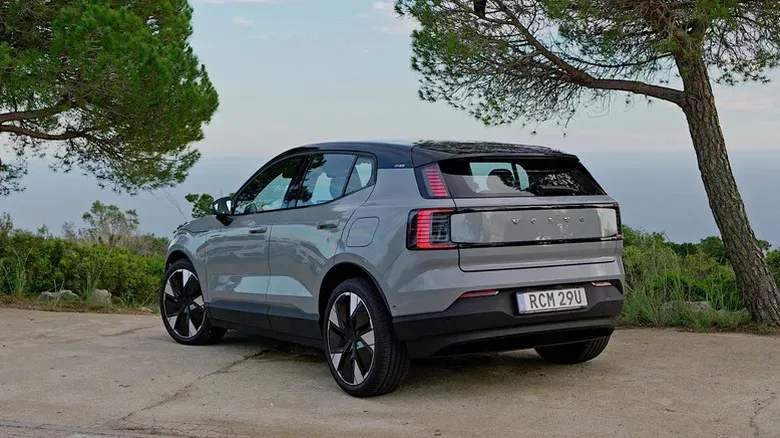
The range of battery capacities among electrified vehicles is substantial. A Fiat 500e has a 38 kWh battery, while a Tesla Model 3 is cited with a 79 kWh pack and a Volvo EX30 with 69 kWh. At the other end, the GMC Sierra EV is listed with a 155 kWh battery. Plug-in hybrids are a separate, often less demanding home-charging case: the Toyota Prius Prime has a 14 kWh battery and the Toyota RAV4 Prime an 18 kWh battery.
Those numbers explain why a one-size-fits-all charging recommendation falls apart quickly. Replenishing the same percentage of a 14 kWh plug-in hybrid battery requires far less energy than replenishing the same percentage of a 155 kWh pickup battery.
A simple daily-use check
One practical benchmark is whether daily driving uses more or less than roughly 15 kWh, described here as around 50 miles of range. If use stays below that level and the vehicle can sit plugged in overnight, a regular outlet may be enough. The setup is not fast, but it can be sufficient.
Now compare that with a more demanding example. Using 40 percent of a 79 kWh Tesla Model 3 battery means replacing about 32 kWh—described as roughly 100 miles of use. On a conventional household connection, that takes about 18 hours. A driver doing that repeatedly will fall behind on overnight replenishment and eventually have to depend more on public charging. That is the kind of schedule for which Level 2 charging is designed to solve a real problem.
Analysis: daily energy use is more informative than odometer miles alone because it directly describes what must go back into the battery. Battery capacity then tells an owner how much reserve they have when charging is slow or a night of charging is missed. A large pack provides more reserve, but it also makes a full recharge through a regular outlet take much longer.
What a standard outlet can—and cannot—do
In the United States and Canada, a standard 15-amp, 120-volt AC outlet can supply up to about 1.8 kW. With a portable adapter or standard outlet charging arrangement, the stated rough full-charge times are under 10 hours for the plug-in hybrid example, about 21 hours for a 38 kWh Fiat 500e, about 43 hours for a 79 kWh Tesla Model 3 and about 86 hours for a 155 kWh GMC Sierra EV.
Those full-charge figures are not necessarily a verdict against household charging. A Prius Prime or RAV4 Prime owner who consumes only part of a relatively small battery may find the ordinary outlet entirely adequate. A small EV driven lightly may fit the same pattern. The outlet can quietly recover the day’s use while the vehicle is parked overnight.
But the numbers do establish the boundary. Standard household charging is best thought of as a low-power, long-duration option. It is useful when the car has enough idle time and does not need much energy added each day. It becomes less suitable when a vehicle is used intensively, has a large battery or must be ready again after a short turnaround.
It is also worth separating “can charge” from “is a good fit.” Being able to connect an EV to a regular outlet does not guarantee that the household circuit, wiring condition and daily schedule make it the best long-term arrangement. Electrical work and circuit suitability should be assessed by a qualified electrician.
Level 2 means 240 volts—not DC fast charging
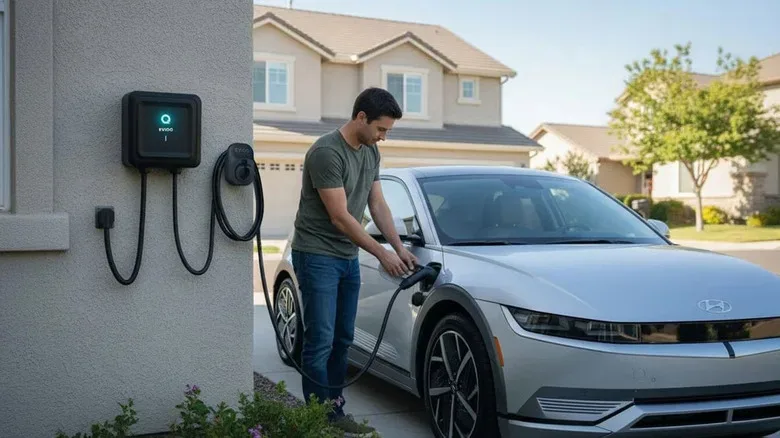
A Level 2 charger uses alternating current, or AC, and generally connects to a 240-volt circuit rather than the 120-volt circuit used by a standard outlet. Residential Level 2 equipment can deliver roughly 3.3 kW to 11.5 kW, depending on the installation and available electrical capacity.
It should not be confused with a DC fast charger. With AC charging, the vehicle converts the incoming alternating current to direct current for its battery after it is connected through a J1772 or Tesla NACS connector. A Level 2 unit is therefore a faster home or commercial AC solution, not the same category of high-speed direct-current equipment used for rapid stops away from home.
For buyers comparing power ratings, these examples provide a useful ladder:
- 120-volt household charging: up to about 1.8 kW from a standard 15-amp outlet.
- 16-amp, 240-volt Level 2: about 3.5 kW, roughly double the standard-outlet rate.
- 32-amp, 240-volt Level 2: about 7.4 kW, roughly four times the 120-volt example.
- 48-amp Level 2: up to about 11.5 kW, assuming both the home installation and vehicle support it.
At 7.4 kW, the cited estimate for a full Tesla Model 3 charge is about 11 hours, while a 155 kWh GMC Sierra EV battery could take roughly 22 hours. Compared with 43 hours and 86 hours respectively from the 1.8 kW household example, the convenience gain is easy to see.
The car’s onboard AC limit is a hard ceiling
More charger output is not automatically more speed. The vehicle’s maximum AC charging capability sets the effective ceiling. That is why buyers should check the vehicle specification before choosing a unit.
Examples vary considerably. The Toyota Prius Prime supports up to 3.5 kW AC charging, while the RAV4 Prime can reach 7 kW. The Nissan Ariya, MG4 and Kia e-Nero are listed at 7.4 kW. Tesla Model 3 and Model Y vehicles are among models cited with support up to 11 kW.
If an EV tops out at 7.4 kW, an 11.5 kW charger does not make that particular car charge at 11.5 kW. The equipment may still be a choice someone makes for other reasons, but it will not override the vehicle’s onboard limit. Conversely, choosing an undersized charger can leave available vehicle capability unused.
Practical implication: match the charger to the lower of two relevant limits—the car’s supported AC rate and what the home can safely provide. This is a more useful shopping rule than treating the highest amperage on a product listing as a universal advantage. It mirrors the kind of constraint-based buying decision that also matters in home entertainment gear, including the trade-offs covered in this look at wired versus wireless gaming speakers.
Why Level 2 can be a safety and management upgrade too
Speed is the headline benefit, but dedicated Level 2 hardware can bring protections and monitoring that basic household charging setups may not offer to the same degree. Features mentioned for dedicated units include grounding or pen-fault protection, DC leakage protection and energy-use monitoring. Some units can help track overall consumption so owners can keep a closer eye on how charging fits within household circuit capacity.
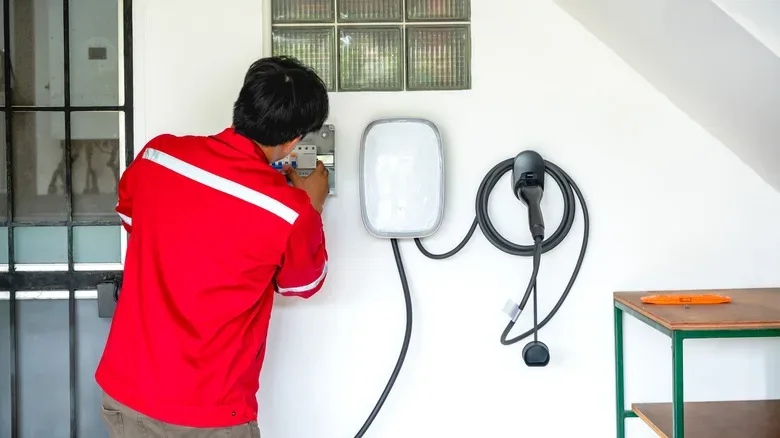
That is particularly relevant where wiring is older, questionable or shared with other significant loads. It is not a reason to self-diagnose an electrical system. Rather, it is a reason to make electrical verification part of the project instead of treating the charger as an appliance that can be selected in isolation.
Features such as energy monitoring and cord management may also affect value, even though they do not change the vehicle’s maximum charging rate. A less expensive unit may omit them; a higher-priced one may include them. Buyers should separate those convenience and management features from the basic question of how many kW the vehicle can accept.
Installation may be the real budget variable
Single-vehicle 240-volt Level 2 chargers are estimated at roughly $250 to $700, varying by amperage and added features. The unit price, however, is not the entire project cost. Installation can range from hundreds to thousands of dollars depending on complexity.
The home’s main electrical service is a major part of that complexity. Many newer homes with 200-amp mains can accommodate high-output Level 2 charging. Homes with 100-amp mains or less may require an upgrade to 200 amps, which can be a considerable expense. Only a qualified electrician can determine whether an upgrade is needed for a specific house and proposed charger.
There may be a simpler route in some cases. A home that already has a suitable oven-range or RV power connection may be able to use a compatible plug-in Level 2 charger without electrical modifications. Compatibility and wiring still need professional confirmation; the existence of a receptacle alone is not proof that it is suitable for a particular EV charging load.
A decision path that avoids overbuying
- Identify the vehicle’s battery capacity. A 14 kWh plug-in hybrid and a 155 kWh pickup create radically different replenishment needs.
- Estimate typical daily energy use. Under roughly 15 kWh per day, with an overnight window, is the strongest case for staying with a regular outlet.
- Check the vehicle’s maximum AC rate. This is the speed the car can actually accept from a Level 2 setup.
- Compare the charging window with the required energy. If ordinary household charging cannot consistently restore what daily driving consumes, Level 2 becomes the practical option.
- Have the electrical service and wiring reviewed. Determine whether the desired circuit is safe and feasible before treating the charger price as the whole budget.
- Choose output intentionally. A 3.5 kW, 7.4 kW or up-to-11.5 kW option should fit the car, the household and the driver’s schedule.
For most plug-in hybrid owners, a standard outlet may remain the sensible financial choice. The same can apply to owners of small EVs or people who use less than about 50 miles of range per day. For larger-battery EVs, heavier daily driving or schedules that demand reliable overnight recovery, a Level 2 charger can be less of a luxury than a way to make the vehicle’s everyday use line up with the reality of its charging time.
Shop the products
Check current price, model and availability at the retailer.