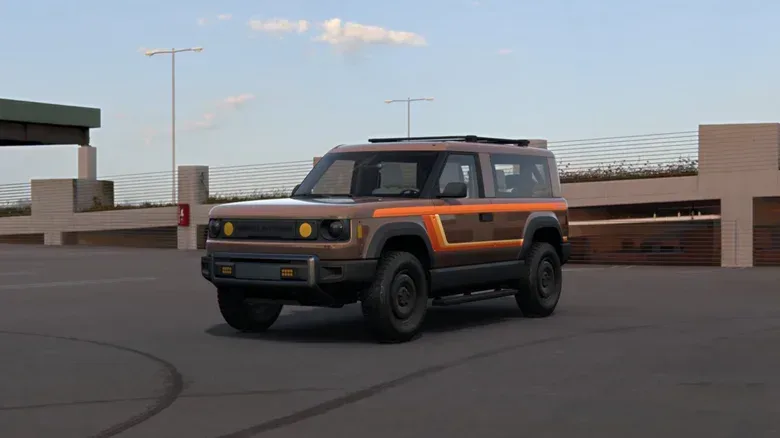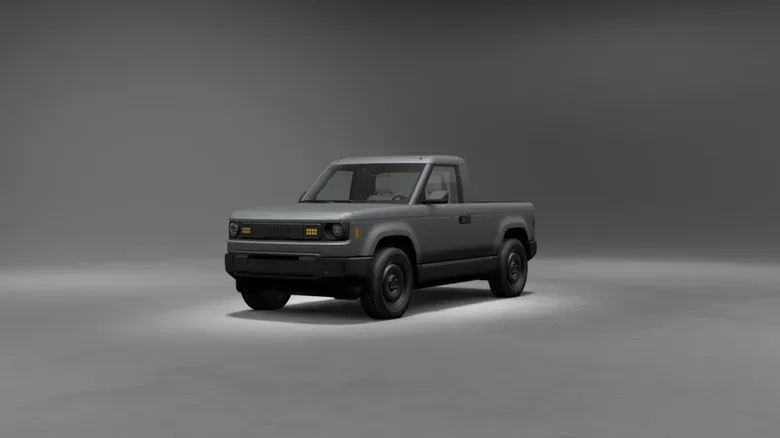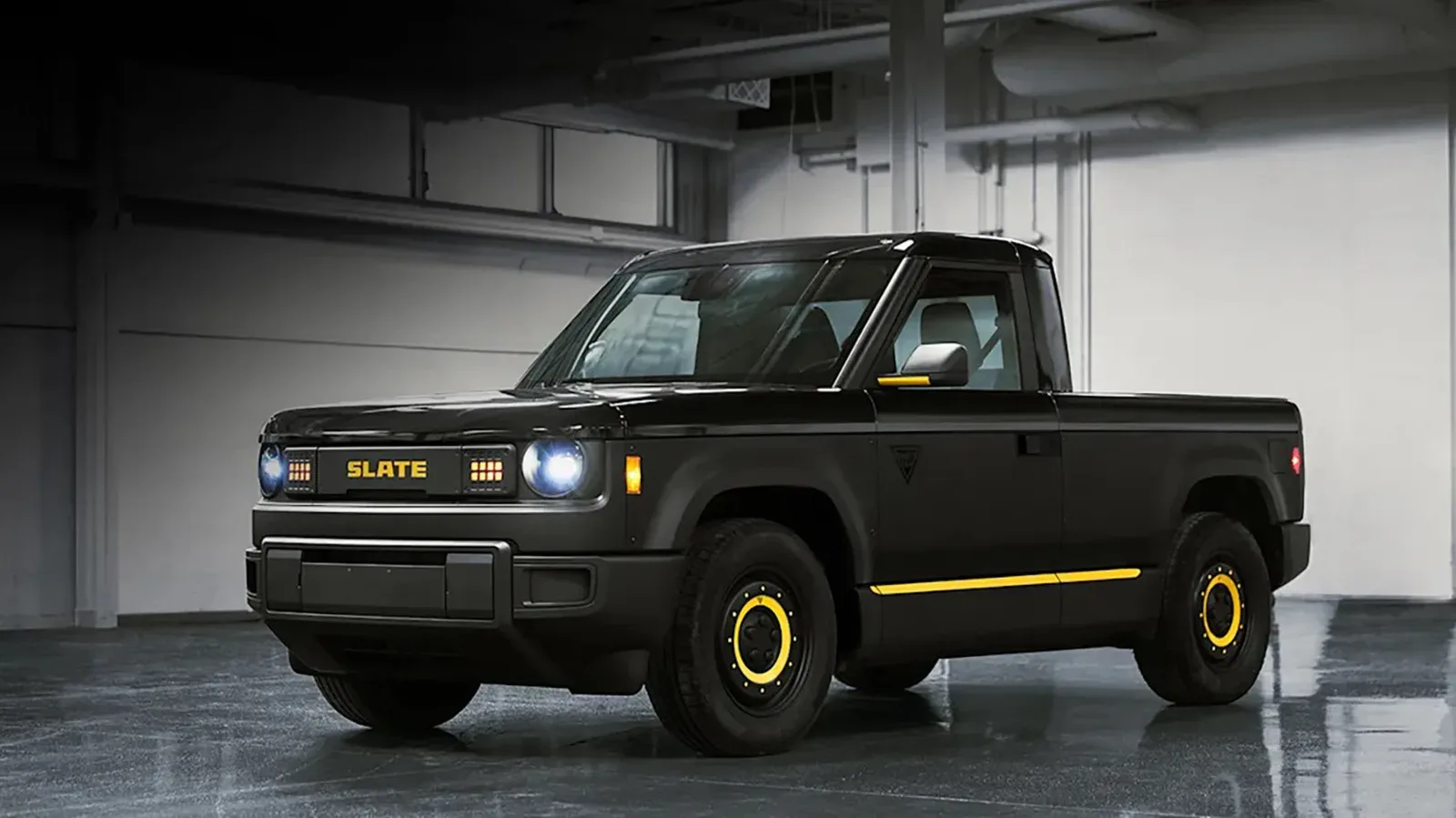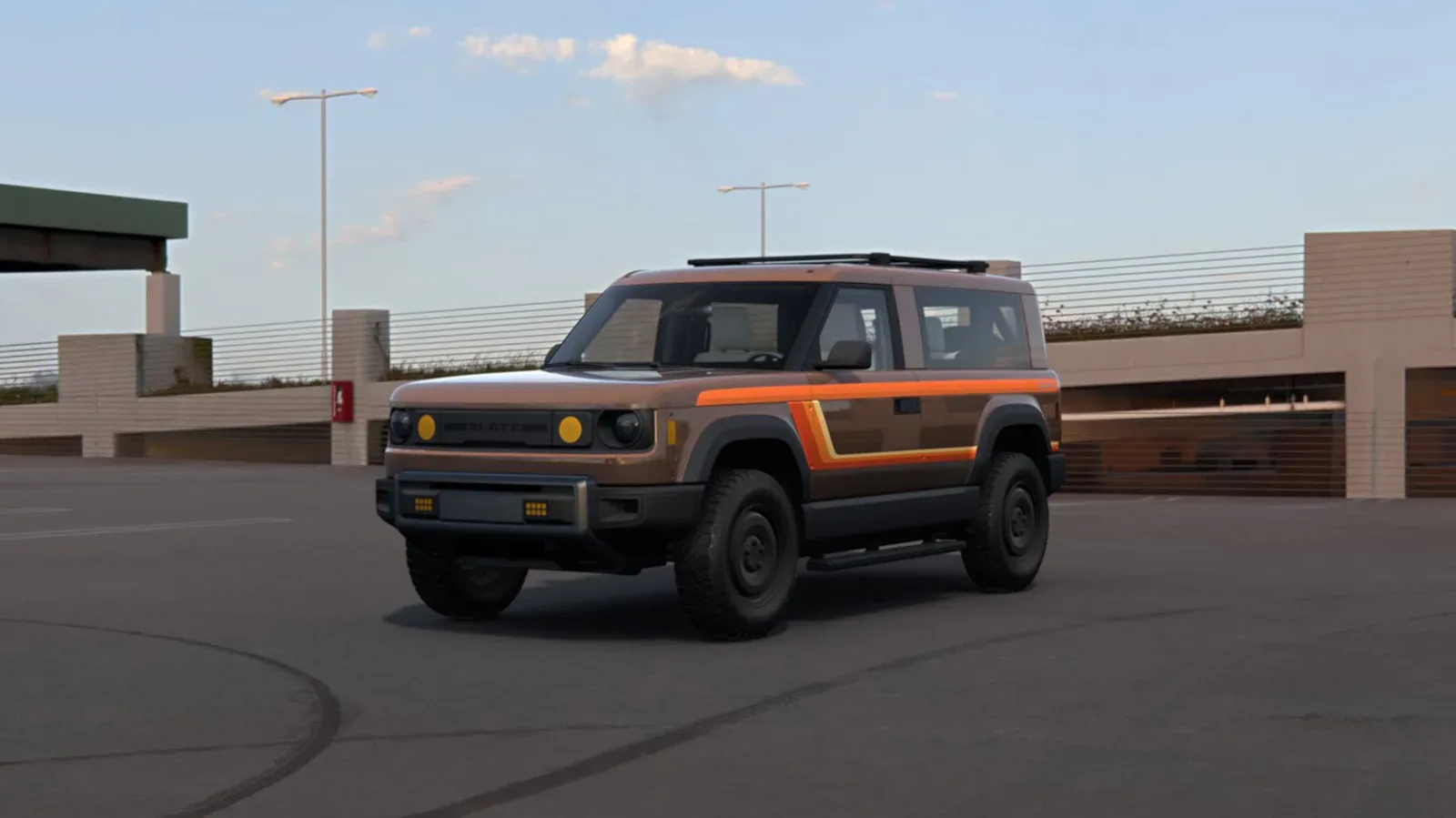
The Slate Truck’s central pitch is unusually straightforward: start with an extremely plain electric pickup, then decide how much vehicle you actually want to build around it. The factory truck is a two-seat model in slate gray, but the accessory catalogue contains more than 200 add-ons. It can be turned into a five-seat SUV in fastback or squareback form, or configured with a more open-air, Jeep-like direction.
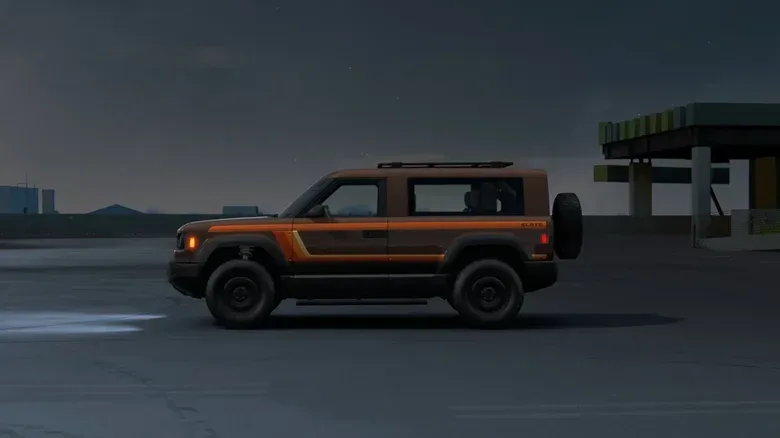
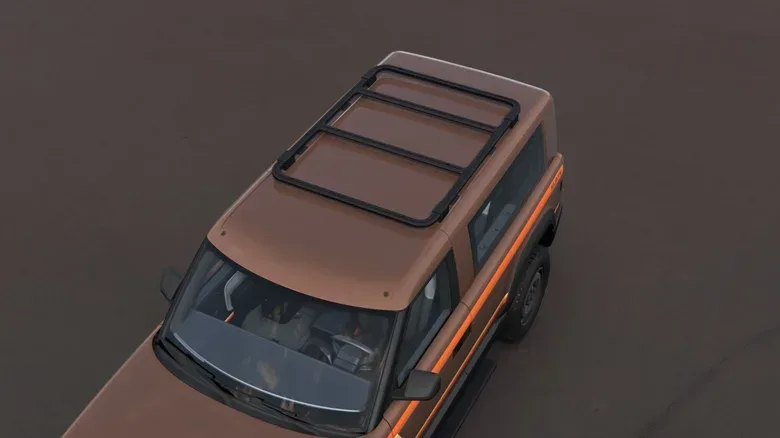
That makes it unusually fertile ground for a theme build. For a retro-minded configuration, the strongest route is a truck that borrows the broad visual language of a 1970s utility 4x4 without pretending to be a literal recreation of any one classic vehicle. Think squared bodywork, copper paint, chunky tires, simple auxiliary lamps and a roof rack—not an exact historical replica. The result is an electric vehicle that looks deliberately analog while retaining a few carefully selected modern conveniences.
There is one substantial asterisk: modularity does not automatically equal cheap personalization. Slate lists the basic pickup at $24,950, before taxes and fees. A fully themed squareback SUV concept, once its major accessories and destination charge are counted, lands at $37,918 before several accessories with prices still to be announced. The lift kit, Bluetooth steering-wheel controls, tablet mount, certain interior accents and console armrest are among the variables that can push the final figure higher.
Start with the squareback, not the pickup
The squareback SUV conversion is the appropriate foundation for this kind of build. It raises the starting point to $29,950, but adds the squared-off shell, a roll cage, extra airbags and a three-person bench seat. In practical terms, it turns the basic two-seat pickup into a five-seat vehicle and brings a more useful cargo shape.
The squareback also makes aesthetic sense. A fastback’s sloping roofline may suit a more contemporary or street-focused build, but the tall, blunt profile better supports a 1970s-inspired design. Slate’s squareback costs $2,000 less than the fastback alternative as well, which leaves a little more room in the budget for equipment that changes both the appearance and day-to-day usefulness of the truck.
What “modular” means here: rather than choosing one heavily equipped trim package up front, buyers can begin with a minimal vehicle and layer on body conversions, interior pieces, utility gear and cosmetic accessories. That can be helpful for spreading decisions over time. It also makes disciplined planning important, because many individually modest upgrades can become a very large total.
The visual recipe: copper, stripes and simple details
The most important exterior choice is the $670 Michigan Copper full wrap. Since every Slate begins in a muted gray, a wrap is doing a great deal of work in establishing the truck’s identity. Copper is the appropriate base for a late-1970s-flavored look, especially when paired with slab-sided bodywork and black utility accessories.
Next come the $320 Throwback body decal and $190 Creamsicle shoulder decals. Together, these introduce the horizontal stripe treatment that makes the concept read as intentionally retro rather than simply orange. The stripe has a faintly Atari-like quality, an amusing connection for anyone who enjoys old-school design across categories. Customization remains a recurring attraction in modern hardware culture, whether it is a vehicle assembled through accessories or technical projects such as this PS5 Linux loader update; the appeal is being able to make a product feel specifically yours.
Restraint matters with the accents. Slate offers mirror and rocker details, but adding every available decorative piece risks turning a coherent stripe package into visual clutter, particularly if shades do not precisely match. The stronger choice is to let the copper wrap and two main decal sets do the heavy lifting.
Small “Dots” plates for the front lamps, taillights and grille complete the face for less than $160 total. These parts will not redefine the vehicle on their own, but they help carry the graphic theme across the surfaces that remain visible even when the truck is parked head-on or from behind.
Build the utility-truck silhouette carefully
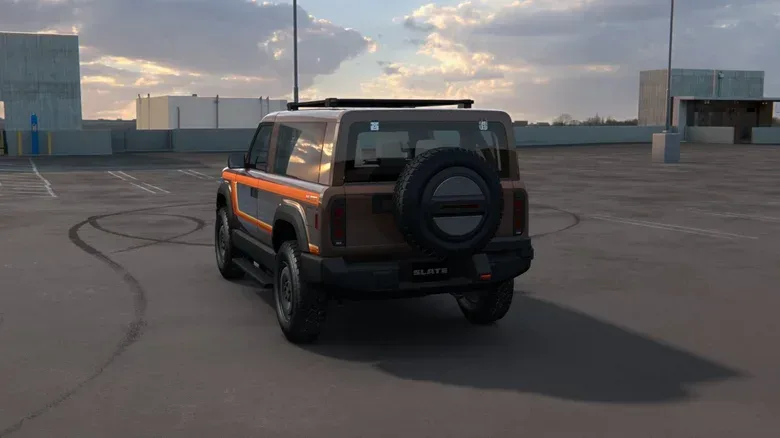
Several accessories create the boxy 4x4 profile: a $500 upgraded front bumper, $600 rear bumper, $300 fog lights, $150 fender flares, $550 spare-tire carrier and $350 running boards. There is a practical logic beneath the style. The running boards become especially sensible if a lift kit is fitted, while the spare-tire carrier and bumpers reinforce the truck’s utility-oriented stance.
Slate’s lift kit does not yet have a listed price, but it is expected to raise the truck by roughly two inches. That is enough to alter the proportions without transforming the Slate into an extreme off-road machine. Pairing it with $1,100 all-terrain tires mounted on 17-inch wheels is more consistent with the theme than choosing Slate’s available 20-inch wheels.
The wheel-size decision deserves a brief explanation. A 17-inch wheel generally leaves more visible tire sidewall than a 20-inch wheel when fitted to a vehicle of this sort. In this configuration, that supports the chunkier old-school look. The supplied information also identifies softer ride quality as an advantage of the 17s. The larger wheels may be appealing for a more contemporary visual treatment, but they pull this build away from its period-inspired objective.
None of those accessories should be mistaken for a promise of serious trail performance. The Slate Truck is rear-wheel drive. Its proposed job is better understood as handling dirt roads and snowy driveways than tackling steep trails, deep mud or remote overlanding routes. This is an important distinction because fender flares, all-terrain tires and fog lamps can signal greater capability than a vehicle’s drivetrain actually supports.
Roof-rack appeal meets range reality
A $650 squareback roof rack, mounted through Slate’s $125 T-rail, is arguably the piece that completes the silhouette. Beyond aesthetics, the rail can accept carriers for bicycles, kayaks, skis and paddleboards, and Slate also offers a roof basket. In other words, the rack makes sense for gear that might genuinely be used, rather than existing only for a vintage-adventure pose.
But this is also where a practical limitation needs to remain visible. Slate estimates 205 miles of range for the base pickup. The heavier squareback conversion is likely to reduce that figure, though no exact range estimate for this build is provided. Extra gear carried on the roof would logically make the long-distance camping fantasy less comfortable still, but no specific range impact has been stated.
The sensible use case is therefore local or regional recreation: a bicycle trip, a short paddle excursion, skiing within a manageable charging plan, or an overnight outing that does not require driving far beyond charging infrastructure. The truck can look ready for a wilderness expedition without being the ideal tool for one.
Keep the cabin functional, but do not erase the concept
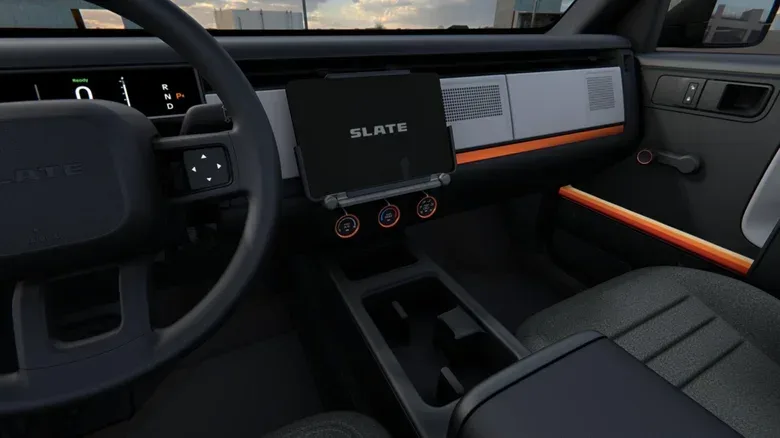
Inside, the theme works best in small doses. The $50 Throwback interior decal and unpriced Magma lower-dash and climate-knob accents carry the exterior color story into the cabin. Retaining the stock dark interior prevents the design from becoming overwhelming.
Some additions are simply quality-of-life purchases. Door armrests in Slate Black cost $50, while the console armrest remains unpriced. A $250 center console, $50 door-cubby organizers and front-and-rear all-weather floor liners totaling $135 are all useful additions for a vehicle expected to carry passengers and outdoor equipment. These are the kinds of accessories that can be easier to justify than decorative changes because they address storage, comfort and cleanup directly.
One omission cannot currently be solved through the catalogue: power windows. Slate previously showed power windows but later removed them, while indicating they may return eventually. Manual windows happen to fit the old-school story, but the decision is Slate’s, not merely a charming retro flourish. Potential buyers should judge the omission as a real convenience trade-off rather than write it off as nostalgia.
Technology is optional, not absent
The base Slate has no built-in display or stereo. The intended workaround is a phone serving both navigation and entertainment duties. For buyers who expect music or podcasts during routine driving, the bare configuration will likely feel incomplete.
A reasonable middle ground is Slate’s $250 center speaker plus $150 pair of front left and right speakers, bringing the audio upgrade to $400. This does not overturn the truck’s minimalist premise; it fills a basic everyday need. Bluetooth steering-wheel controls, still priced as TBD, would add safer access to calls and track changes by allowing those actions without removing hands from the wheel.
A tablet mount, also unpriced, can sit alongside the standard phone mount. It is not confirmed whether the mount can hold a portable CarPlay or Android Auto display, so buyers should not treat that as guaranteed compatibility. Still, the distinction is useful: CarPlay and Android Auto are smartphone-integrated interfaces commonly used for navigation, calling and media, while a simple tablet mount is only a physical attachment point. Hardware support and software compatibility would remain separate questions.
The $40 Five Switch upgrade is another small but meaningful piece. It supplies a physical row of light switches and is required for the fog lights. This is an example of a dependency buyers should catch early in configuration: the apparent price of one upgrade may not be the whole price if another required component must be selected alongside it.
For charging at home, Slate offers a $479 home charger and says it can fully charge the truck in five to eight hours. The truck uses Tesla’s plug design, and Slate has said adapters for older public chargers will be sold. Charging access should be evaluated before a buyer gets carried away with wheels, wraps or roof gear, since it determines how conveniently the EV fits daily life.
The price of a highly specific truck
Adding the listed priced accessories for this concept brings the accessory subtotal to about $6,518, while several items remain unpriced. Starting with the $29,950 squareback SUV and including the $1,450 destination fee produces the stated $37,918 figure. The unpriced lift kit alone could materially move the total; with the other pending-price pieces, the accessory tab could approach $8,000.
That does not mean the modular approach has failed. It reveals its honest trade-off. Someone who genuinely wants the squareback conversion, roof rack, all-terrain wheels, better storage, speakers and a distinctive visual identity can choose every piece deliberately. Someone whose priority is low entry cost can leave the vehicle close to its original form and stay under $25,000 before taxes and fees.
The real caution is against confusing a low base price with a low finished price. Before ordering, it is worth separating accessories into three lists: needs for safety or daily use, equipment required by another chosen upgrade, and purely visual wants. On this 1970s-inspired Slate, the essential personality comes from the squareback body, copper wrap, stripe package, 17-inch all-terrain wheel setup and roof rack. Everything after that should earn its place through a concrete benefit—or a very convincing case that it makes the truck more enjoyable to own.