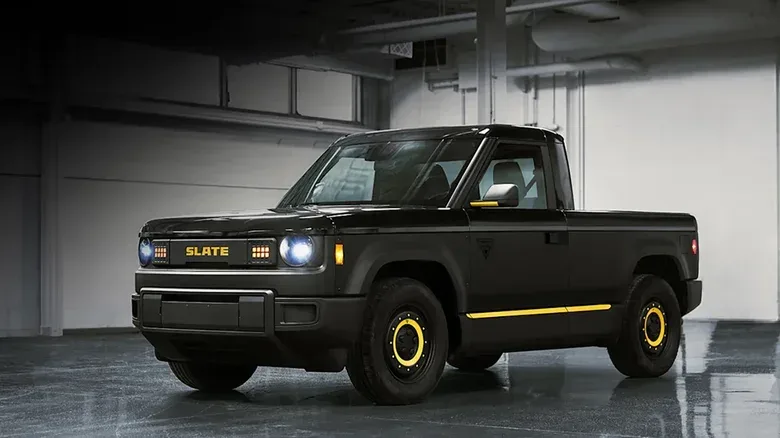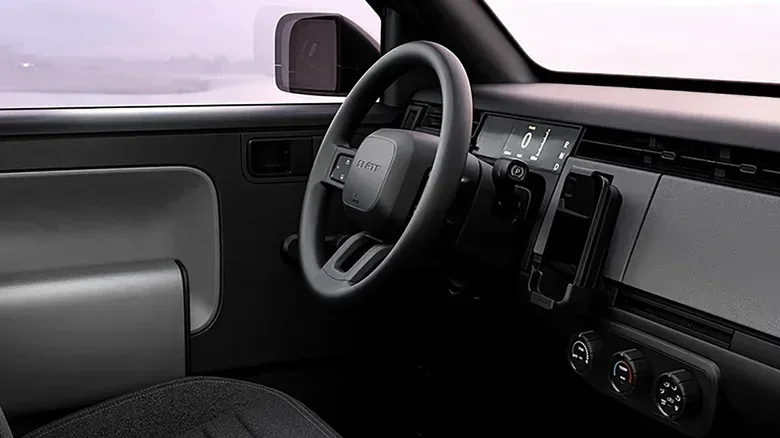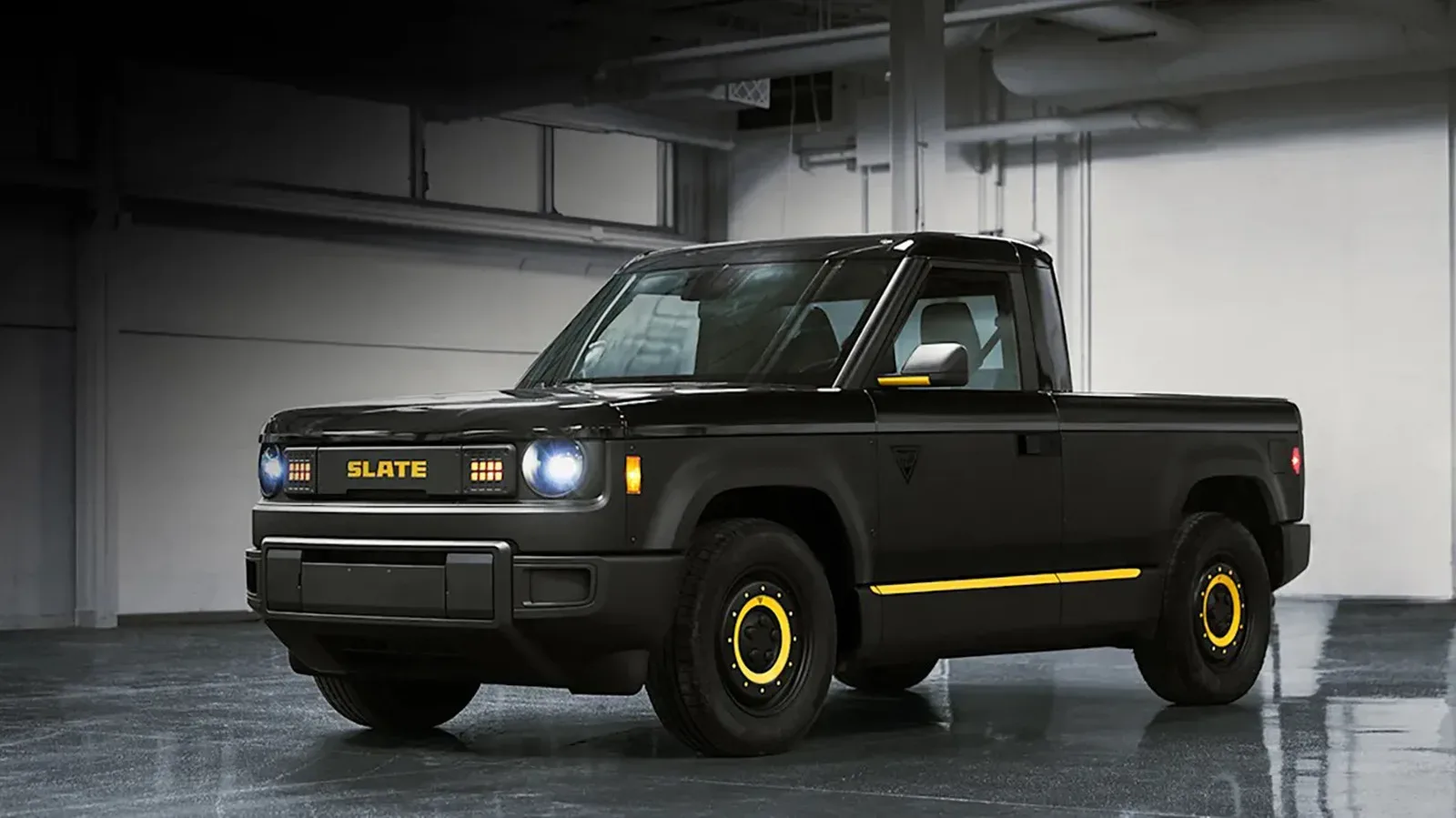
Slate Auto’s electric truck is making an unusually aggressive bet on less. The base vehicle omits the sort of equipment many drivers now treat as standard: built-in infotainment, a radio, speakers, power windows and even paint, with vinyl positioned as the alternative. It also forgoes built-in cellular connectivity.
That does not mean the truck is permanently frozen at the software version it leaves with. Slate’s answer to the update problem is a phone-assisted process: the Slate app downloads an available update to the owner’s phone, the phone connects to the truck through the USB port on the dashboard, and the vehicle takes it from there.
It is a small technical detail, but it neatly explains the larger philosophy behind the vehicle. Slate is not trying to make a pickup that behaves like a rolling tablet. It is trying to hold down its entry price by removing equipment it considers unrelated to driving and safety, while retaining a way to correct bugs and make limited improvements after delivery.
What “over-the-air” means in this case
Over-the-air, commonly shortened to OTA, generally refers to a device receiving software wirelessly through a cellular or Wi-Fi connection. In a connected vehicle, that can let the manufacturer send software directly to the car without the owner plugging in a separate device or visiting for an update.
Slate’s truck takes a different route. The update initially reaches the phone through the Slate app. The owner then plugs that phone into the truck’s dash-mounted USB port for the first transfer. Slate says that connected transfer takes about a minute, provided the phone has a connection for the download portion. The truck can then complete the installation itself, a step that can take roughly 45 minutes.
So the truck is not using the phone as a permanent built-in modem. Instead, the phone is a delivery bridge between the update download and the vehicle. The distinction matters. The owner needs the app and a USB connection to begin the process, but does not need to sit in the truck with the phone connected for the entire stated installation time.
In practical terms, the workflow is straightforward:
- An update becomes available in the Slate app.
- The app downloads the update file to the owner’s phone.
- The owner connects the phone to the truck through the dashboard USB port.
- The initial transfer takes about a minute.
- The truck installs the update on its own, with installation taking around 45 minutes.
The process has a deliberately hands-on first step. That may sound old-fashioned beside cars that continuously communicate through their own cellular connections, but it is consistent with a vehicle that leaves out that hardware in the first place. It also gives an owner a clear moment of participation: no phone connection, no initial update transfer.
Expect maintenance, not a surprise feature parade
Slate says its updates are intended for bug fixes and smaller improvements. Buyers should not treat the USB-based system as a promise that the truck will eventually acquire major new capabilities after purchase. That is an important expectation to set, particularly at a time when software updates are often marketed as a way for products to change substantially over time.
Bug fixes are corrections for problems in software behavior. Small improvements can include refinements rather than an entirely new vehicle function. The supplied details do not identify particular fixes or changes, so it would be premature to assume what an individual update will contain. What is clear is the intended scope: keeping the truck maintained, rather than delivering headline-grabbing transformations.
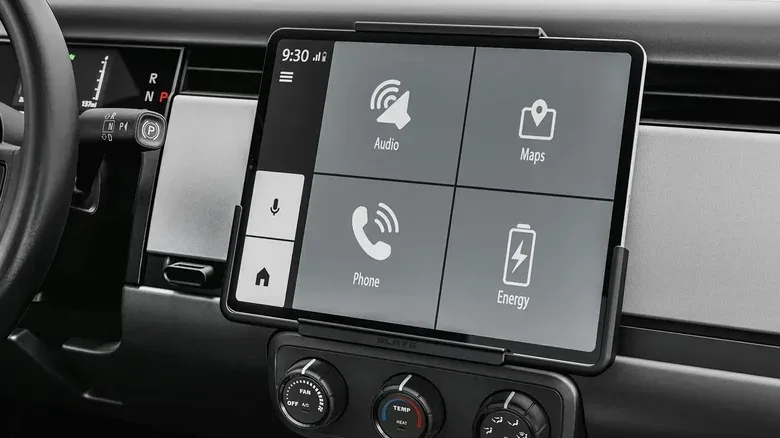
That narrower approach fits the truck’s sparse dashboard concept. A conventional infotainment system typically centralizes media, navigation and vehicle controls on an integrated display. Slate’s base truck does not include one. Its app instead handles functions such as showing range, helping locate chargers and sending directions to Google Maps, Apple Maps or Waze.
Owners who use the phone for those jobs will already be treating it as an important companion device. That makes an app-to-USB update path less out of character than it would be in a luxury vehicle built around always-on connectivity. For anyone who has had to learn the quirks of a gadget-controlled interface—such as the options hidden behind the star button on a Roku remote—the broader lesson is familiar: the hardware may be simple, but the companion software and its workflow still matter.
Minimalism has a price target—and optional extras
The missing tech is not presented as an accidental omission. Slate’s strategy is to reach a sub-$25,000 starting price by cutting elements it does not classify as driving- or safety-related. The base configuration’s lack of paint, power windows, radio and speakers makes the extent of that calculation unusually visible.
But bare-bones does not mean there is no route back toward familiar convenience features. Slate offers optional equipment including speakers and an iPad mount, the latter intended to make the setup feel more like a traditional infotainment arrangement. There is also a kit that converts the vehicle into a five-seat SUV, along with a telematics module that enables unlocking the doors through the app.
Telematics is the term for systems that exchange vehicle-related information and support remote functions. In this case, the stated use is app-based door unlocking. It is notably an option rather than a foundational part of every truck, which reinforces Slate’s split between a simple base product and add-ons for customers who want more connected functionality.
That modular setup creates an obvious decision for prospective buyers. A low entry price may be attractive, but each missing comfort or capability that matters to a particular owner can become an additional purchase. Slate says a fully equipped version of the modular truck can exceed $45,000. The difference between the sub-$25,000 starting point and that higher possible total is therefore central to understanding the vehicle: the entry model and an extensively accessorized one may serve very different expectations.
For some drivers, that may be a benefit rather than a drawback. Someone who wants a basic utility vehicle may prefer not to pay up front for speakers, a large integrated screen, remote door controls or passenger capacity they do not need. Someone who wants the conveniences of a more conventional, connected vehicle will need to consider both which additions are required and how much they change the final cost.
The truck’s stated numbers point to local utility
Slate lists an estimated range of 205 miles, a maximum payload of 1,550 pounds and a tow rating of 2,000 pounds. Those figures describe the truck’s intended lane more clearly than the pickup shape alone might. The vehicle is positioned for errands and shorter hauling work rather than long-distance travel, and it is not presented as a direct match for other electric trucks designed around different goals.
Range is the estimated distance an electric vehicle can travel before it needs charging. A 205-mile estimate can help frame routine use, but it is not a guarantee of how far every trip will go. Payload is the weight carried in the vehicle, while a tow rating is the stated limit for a trailer the vehicle can pull. The supplied numbers are useful for owners considering light utility tasks, but they should not be read as a blanket answer for every cargo or towing scenario.
The phone app is part of that day-to-day picture. Beyond updates, it displays range, assists with finding chargers and can pass routing information to whichever of Google Maps, Apple Maps or Waze the driver prefers. Rather than attempting to replace familiar phone navigation ecosystems with a proprietary screen, Slate’s setup relies on the device many drivers already carry.
There is a trade-off. The phone becomes more important to the ownership experience than it would be in a truck with fully integrated navigation and connectivity. That is not necessarily a flaw; it is the explicit design choice. But it means buyers should evaluate the app workflow as seriously as they evaluate the physical absence of a radio or built-in display.
A privacy argument built around less constant connection
A vehicle without built-in cellular may appeal to people uncomfortable with the idea of a car continually reporting back through an always-present data connection. Slate says it will not sell app data and that it gathers only what it needs for diagnostics, service and update status.
The claim is meaningful because the Slate app still has practical responsibilities. It is used for the update process and for vehicle-related information such as range and charger searches. The company’s stated policy does not mean no data is involved; rather, its position is that collection is limited to the needs identified for diagnostics, service and update status, and that app data will not be sold.
For buyers, the appeal is less about eliminating software altogether and more about limiting how deeply it is embedded into the vehicle. The truck still has software that can be maintained. It still has an app. It can still support an optional telematics module. Yet the standard vehicle avoids the built-in cellular connection that enables a more continuously networked approach.
Why the update method is the clearest expression of Slate’s idea
Slate’s USB update procedure is not merely a workaround for a missing feature. It is a concise example of the company’s larger wager: remove recurring hardware complexity from the base truck, lean on an owner’s existing phone where appropriate, and sell optional capability to people who want it.
For the right buyer, that can look refreshingly focused. The truck still receives maintenance updates, still provides range and charger help through an app, and still has stated utility credentials for short-run hauling and errands. For another buyer, the lack of built-in entertainment, cellular connectivity, power windows and other equipment may be a deal-breaker before the update process even enters the conversation.
Whether that audience is large enough remains unresolved. What Slate has made clear is that software support does not automatically require a vehicle to be a permanently connected entertainment hub. In this truck, a phone, a USB cable and a brief initial transfer are the bridge between minimal hardware and software that can still be kept current.