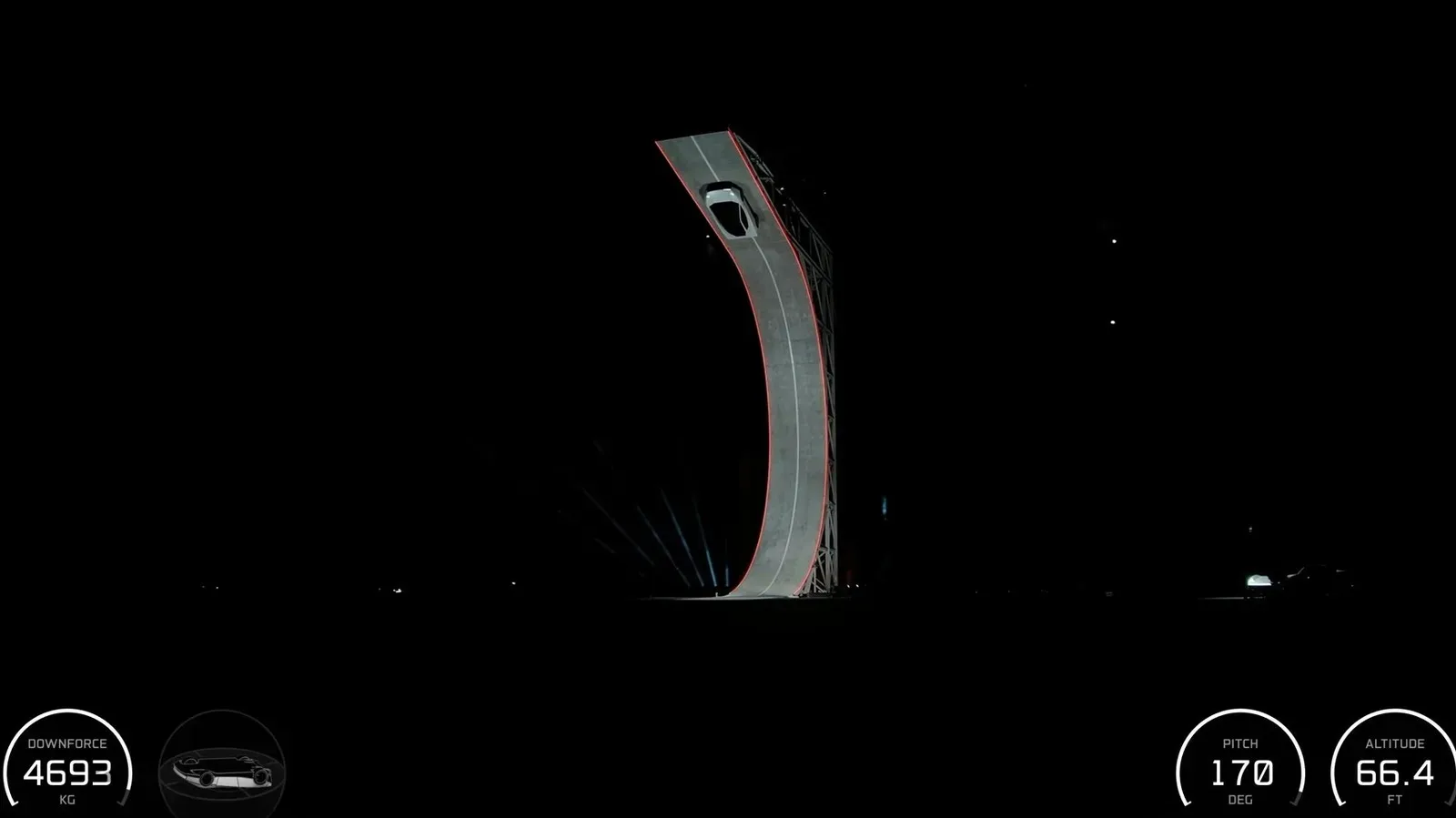
Tesla’s next-generation Roadster did not make its entrance like a conventional performance car. At its launch event, the vehicle was used for a string of stunts that placed it somewhere between an EV demonstration, a practical-effects showcase and a level designed by someone who has spent too much time trying to break a racing game’s physics engine.
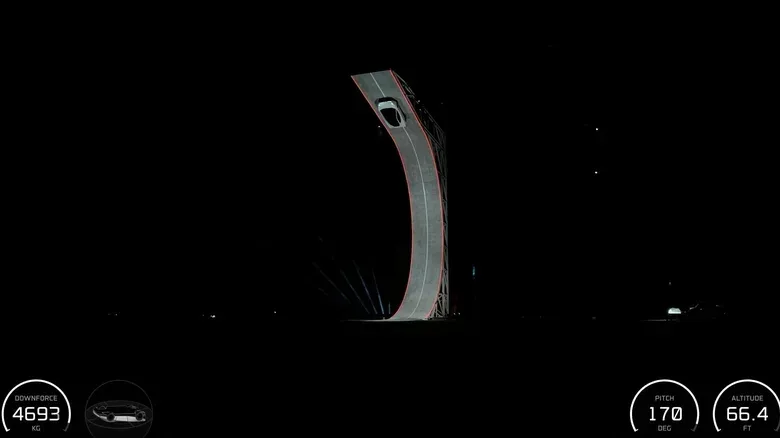
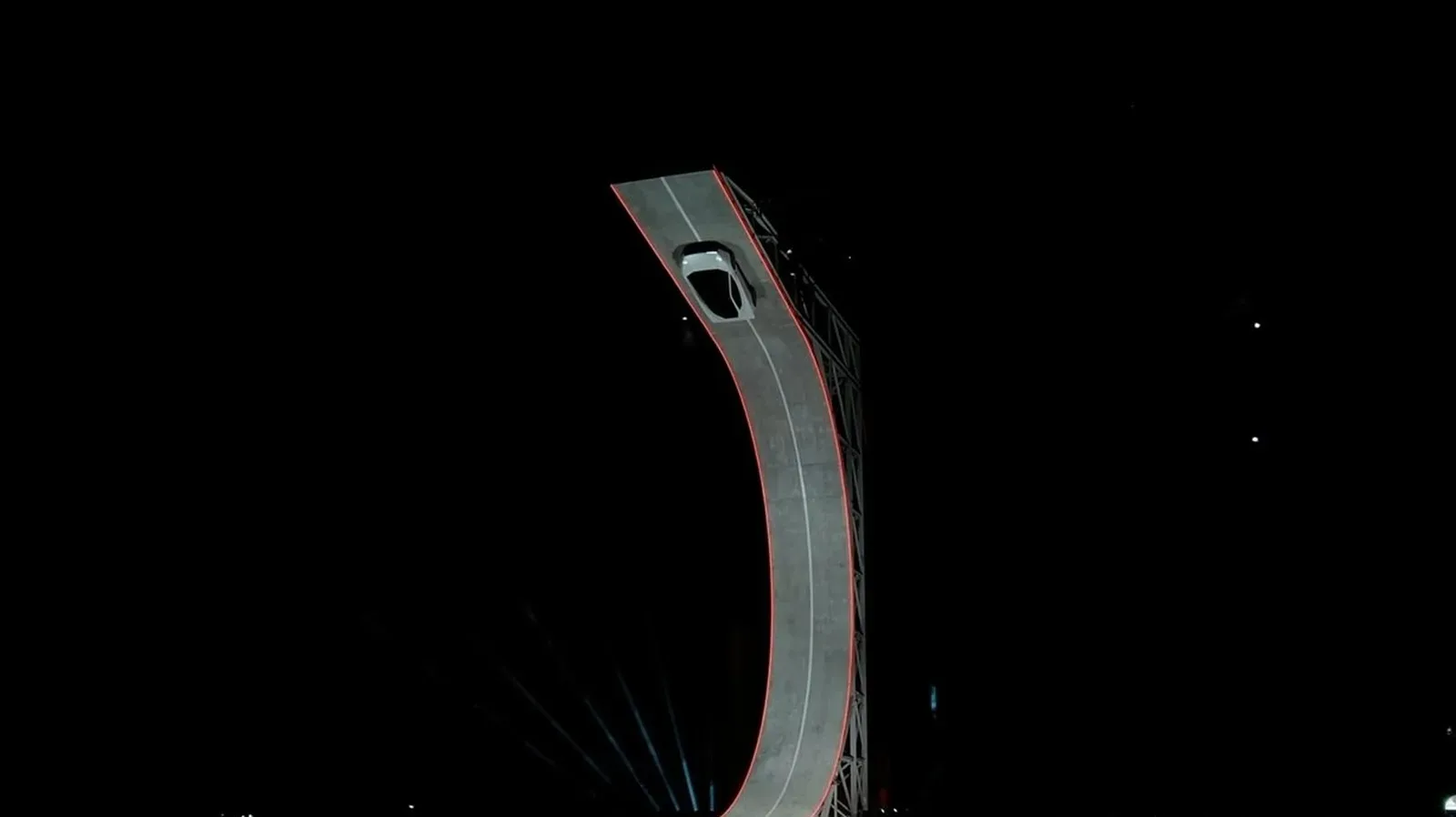
The headline act began on a C-shaped ramp. The Roadster drove upward, then stopped at the top with the car perpendicular to the ground and hanging upside-down. It performed that climb twice. On the second run, it left the ramp, rolled over and descended safely in a hover.
Tesla attributed that controlled descent to cold-gas thrusters using technology borrowed from SpaceX. Later demonstrations had the Roadster jump over several Tesla vehicles parked side by side. Near the end of the presentation, it made another dramatic move from a stationary position: jumping upward, rotating in the air and hovering back down.
It is an unusually theatrical way to frame a vehicle reservation program. But the particulars matter, because the display blended several separate capabilities into one escalating show: adhesion on the ramp, acceleration for the jump, rotation in midair and controlled hovering during descent.
What the Roadster actually showed
The upside-down ramp segment depends on a different idea from the Roadster’s hovering descent. Tesla described the suction-equipped version as the one that enabled the vehicle to remain inverted on the ramp. That feature should not be confused with the accelerator thrusters named in the same reservation tier, or with the hovering Roadster, which is a separate and more limited-access version.
In simple terms, suction is the element presented as holding the car to the ramp. Cold-gas thrusters are the element Tesla connected to the controlled aerial maneuver. A cold-gas thruster is a propulsion system that expels stored gas to generate force; in this case, Tesla said the relevant technology was borrowed from SpaceX. The supplied details do not specify the gas, thrust levels, controls, range of movement or how the system is configured on the Roadster, so those are important unknowns rather than blanks to fill with assumption.
That distinction matters because launch-event footage can make multiple systems look like one magical “car can do anything” button. The ramp stunt, vehicle-clearing jump and hover are spectacular precisely because they are visually legible. They are less useful as a full explanation of how each system operates, what circumstances it requires or what a customer vehicle would be expected to do outside a prepared demonstration.
Still, as a piece of visual communication, Tesla’s approach is hard to misunderstand. The Roadster was shown doing things audiences do not associate with normal road cars: driving onto a curved structure, remaining upside-down, launching over a row of vehicles and lowering itself after a flip. This was not subtle product messaging. It was an attempt to make the next-generation Roadster feel like an unlocked endgame vehicle.
Related coverage includes Tesla Roadster Stunt Event Shows Upside-Down Driving, Jumps and Hovering.
A reveal structured like a stunt sequence
The order of events gave the presentation a clear progression. First came the verticality of the C-shaped ramp. Then came the confirmation that the Roadster could repeat the climb. Its exit from the ramp added a roll and controlled descent. The parked-car jump shifted the emphasis to distance and clearance. Finally, the stationary jump and flip condensed the event’s central promise into one maneuver: lift, rotation and hover.
That sequence is relevant beyond the spectacle. A car launch can usually lean on styling, specifications, interior features or a conventional track run. This one chose spectacle as the main language. Each stunt became a concise demonstration of a claimed function rather than a long technical briefing.
For an audience used to game trailers, it is a familiar rhythm: introduce the arena, show the mobility mechanic, escalate with a bigger obstacle, then end on the move people will replay. The comparison is about presentation, not a claim that the Roadster operates like a game. The real-world requirements, safety constraints and engineering details remain far more consequential than any show-floor highlight reel. But the visual grammar is unmistakable.
That overlap between performance and presentation is why the event may resonate outside ordinary car coverage. Joking Joystick recently covered a music video built around a retro game-show remix; Tesla’s Roadster presentation similarly treated its subject as something to be staged, watched and reacted to, not merely described on a spec sheet.
The reservation terms separate the spectacle into tiers
Tesla says the next-generation Roadster is available for reservation, though the route into ownership changes substantially depending on which version a buyer wants.
- Base vehicle: a $5,000 reservation payment is required now, followed by an additional $45,000 within 10 days.
- Suction and accelerator-thruster version: reservation costs $250,000.
- Jump-and-hover version: reservation is invite-only and available only to select customers.
The terms make clear that the event’s biggest moments do not all sit in the same customer category. The base-vehicle reservation requires the initial $5,000 plus the stated additional $45,000 payment within 10 days. The version associated with upside-down ramp adhesion and accelerator thrusters calls for a dramatically higher $250,000 reservation. And the model presented as capable of jumping and hovering is not simply an item that any interested buyer can reserve; Tesla says access is invitation-only.
This is the practical split behind the viral-ready footage. Someone watching the Roadster hang upside-down or descend from a flip should not assume every reservation corresponds to every feature shown onstage. The supplied reservation information specifically ties the suction and accelerator-thruster version to the $250,000 option, while the jump-and-hover version is reserved for selected invitees.
Why the technical language deserves care
“Thruster” is a powerful word because it immediately suggests spacecraft motion. Tesla explicitly linked the Roadster’s cold-gas thruster technology to SpaceX, which makes the association intentional. Yet that does not provide a full technical specification. The demonstration establishes what Tesla showed: a Roadster that hovered down after a rollover and later after a stationary jump and flip. It does not, from the available information, establish performance limits, routine operating conditions, approval status, user controls or any broader use case.
Likewise, the ramp sequence demonstrates a staged inverted hold using the suction-equipped version. It does not answer how the system works in detail, how long it can be used, what surface it needs, or whether there are conditions where it cannot operate. Those are not minor footnotes. They define the gap between an attention-grabbing demonstration and a complete picture of a product’s capabilities.
That is not a knock on the stunt. A launch event is allowed to be a show. But separating what was visibly demonstrated from what remains unspecified is the most useful way to read it. Tesla put the Roadster through a series of remarkable maneuvers and gave broad labels to the technology involved. The reservation tiers then provided a second, equally important piece of information: the extreme configurations shown are not described as a universal package for every buyer.
What the footage is selling, beyond speed
Performance cars are often sold on acceleration, top speed, handling or lap-time language. None of those metrics are needed to understand the intended message here. Tesla instead made a case for the Roadster as a machine with unusual motion itself: it can cling, launch, rotate and control its return to the ground.
That approach gives the Roadster a different identity from a car that is merely quick in a straight line. It turns the vehicle into the subject of a stunt show, with the technology presented as the means to transform its movement. The C-shaped ramp is not just a prop; it creates the image of a car ignoring the orientation drivers normally take for granted. The jump over parked vehicles is not just a clearance test; it turns a roadway-scale obstacle into a set piece. The final flip works as a closing flourish because it combines the show’s core vocabulary in a single beat.
The strongest takeaway is therefore not that every Roadster reservation buys access to a hovering vehicle. It does not. Rather, Tesla used the Roadster event to demonstrate a hierarchy of increasingly unusual configurations, with availability ranging from the base reservation process to a costly suction-and-thruster option and, at the far end, an invite-only jump-and-hover version.
For now, the known facts are the stunts Tesla displayed and the reservation structure it outlined. The Roadster climbed the C-shaped ramp twice, hung upside-down, exited with a roll and hover, jumped over parked Tesla vehicles, then performed a stationary jump, aerial flip and controlled descent. The engineering detail behind those scenes remains limited in the information available, but the intended impression is crystal clear: Tesla wants this Roadster to look less like a conventional car reveal and more like a boss-level mobility demo.