There is a comfortable rhythm to the modern survivor-like: begin fragile, gather experience, choose upgrades, and eventually become the terrifying weather system that erases an entire screen of monsters. Blood Dungeon, from developer Messhof, recognizes that rhythm but declines to let players settle into it. Its central twist is not a radically different progression structure. It is the decision to make movement matter all the way through the chaos.
The result is a game that shares the broad outline made famous by Vampire Survivors—defeat enemies, collect blood, improve weapons, add new armaments, and select randomized passive effects—while feeling considerably more physical. Blood Dungeon is less interested in letting a powerful build carry the player from a safe corner of the map. It asks for route choices, platforming awareness, and recovery under pressure. That makes its best moments notably active, even if its uneven upgrade hierarchy and opaque unlock conditions occasionally turn a smart run into a frustrating roulette spin.
Movement is not an afterthought
Before upgrades start filling the screen with projectiles, Blood Dungeon already behaves like a capable platformer. Its nine characters mostly operate along similar lines, although two stand apart more distinctly. They can jump freely, scale walls and ceilings, move across fences, and swim. Those abilities are not decorative flourishes pasted onto a horde-survival formula. They shape how players navigate danger.
That matters because the genre’s standard appeal often lies in positioning without necessarily demanding a lot of precise movement. A player makes build decisions, steers away from crowds, and waits for an escalating arsenal to do its work. Blood Dungeon preserves the satisfaction of accumulating offensive nonsense, but it gives the player a more direct relationship with survival. Walls can be climbed; space can be reclaimed; a bad situation may be escaped with platforming rather than simply endured.
In quieter circumstances, the underlying traversal could plausibly support a more conventional platform game. Blood Dungeon is rarely quiet, of course. Hundreds of enemies can occupy the screen, turning the environment into an obstacle course where the obstacles are also trying to eat the obstacle course. Still, the controls and movement options establish an identity the game can call its own. The player is not merely piloting a build. They are constantly piloting a character through a dangerous space.
That distinction makes Blood Dungeon a useful companion piece to discussions about why familiar game structures can still feel fresh. The loop may be recognizable, but the emphasis changes the experience. Like the social negotiations described in the unwritten rules of couch multiplayer, the important part is not only what rules exist, but what those rules demand of everyone involved. Here, the demand is attention. The controller is not something Blood Dungeon encourages players to put down.
A familiar upgrade loop with a narrow power corridor
Blood collected from defeated enemies fuels the escalation. Leveling opens weapon improvements, new weapons, and a menu of passive upgrades selected from a random assortment. On the surface, this is the expected survivor-like engine, and Blood Dungeon handles much of it well. Plenty of options offer clear value and invite immediate selection. A good run still has the wonderful sensation of a plan clicking into place while hostile bodies pile up around it.
The complication is that the choices do not always appear equally viable. Some upgrades can feel inconsequential, while several can become difficult to ignore. Two stand out especially strongly: the basketball, which releases a swarm of bouncing orange balls across the environment, and an upgrade that doubles everything. Their usefulness can become so pronounced that rerolling for them feels tempting, even necessary, particularly ahead of final bosses.
That is where Blood Dungeon’s commitment to randomness becomes less thrilling. Randomized choices are supposed to create improvisation: take what the run offers, make it work, and discover surprising combinations. But when a handful of options repeatedly seem mandatory, a reroll is no longer an exciting gamble. It is an attempt to meet the game’s assumed baseline. The basketball is memorable and visually easy to read amid the mess, but it should feel like one exciting option among many rather than a piece of emergency equipment.
Balancing a pile of weapons that all need to be distinct yet comparably worthwhile is a famously difficult job. Different tools should produce different play patterns; otherwise, a wide arsenal becomes cosmetic. At the same time, the game benefits when varied tools can credibly lead to victory. Blood Dungeon’s strongest concept—skilled movement amidst procedurally shaped havoc—would have more room to shine if more builds carried a similar sense of possibility.
Difficulty produces pressure, not always domination
Each level is completed by defeating three bosses. Blood Dungeon is surprisingly tough on that path. This difficulty cuts in two directions. The downside is that even a successful run may not deliver the overwhelming late-game supremacy players associate with the genre. It does not always become the kind of gleeful spectacle where the character has evolved into a small natural disaster and the enemy crowd has become pure decoration.
The upside is much more interesting: the game’s challenge keeps platforming relevant. A clean climb, an escape along a wall, or a well-timed change in route can save a run in ways that a lucky upgrade roll cannot. The player’s dexterity remains important after the build starts accumulating power. Blood Dungeon therefore has a more intense relationship with danger than games built around passive screen clearing.
There is a tension in that design. A bullet-heaven game should absolutely provide moments of absurd strength; the genre’s pleasure partly comes from watching a weak beginning turn into unmanageable excess. Yet Blood Dungeon argues that power does not have to mean disengagement. The most satisfying version of its formula would preserve its high-alert platforming while making a wider range of weapon combinations feel capable of meeting the bosses on their own terms.
Bones promise permanence, then leave questions
Runs award bones, a currency spent on permanent character upgrades. This meta-progression gives repeated attempts a useful purpose beyond practice. Investing in preferred character attributes offers a clear reason to return after a loss, and it reinforces the sense that effort is accumulating even when a run ends early.
But the system can run out of runway sooner than expected. Available upgrades may be exhausted while additional ones remain locked behind conditions that are not clearly communicated. The consequence is a growing reserve of bones that cannot be spent, paired with uncertainty over what action will actually open the next set of purchases.
For a game centered on repetition and incremental improvement, clarity is part of the reward. Unlock mysteries can be satisfying when the game signals the goal well enough for players to form a theory and pursue it. When requirements feel hidden or arbitrary, the currency ceases to represent momentum. It becomes a reminder that progression exists somewhere behind a curtain. The collector’s urge to keep building a meaningful pile is real, but as The Collector’s Five Stages of Buying One Small Thing makes clear, acquiring more of something is only satisfying when it has a place and purpose. Blood Dungeon’s unused bones need a clearer destination.
Committed to being gross
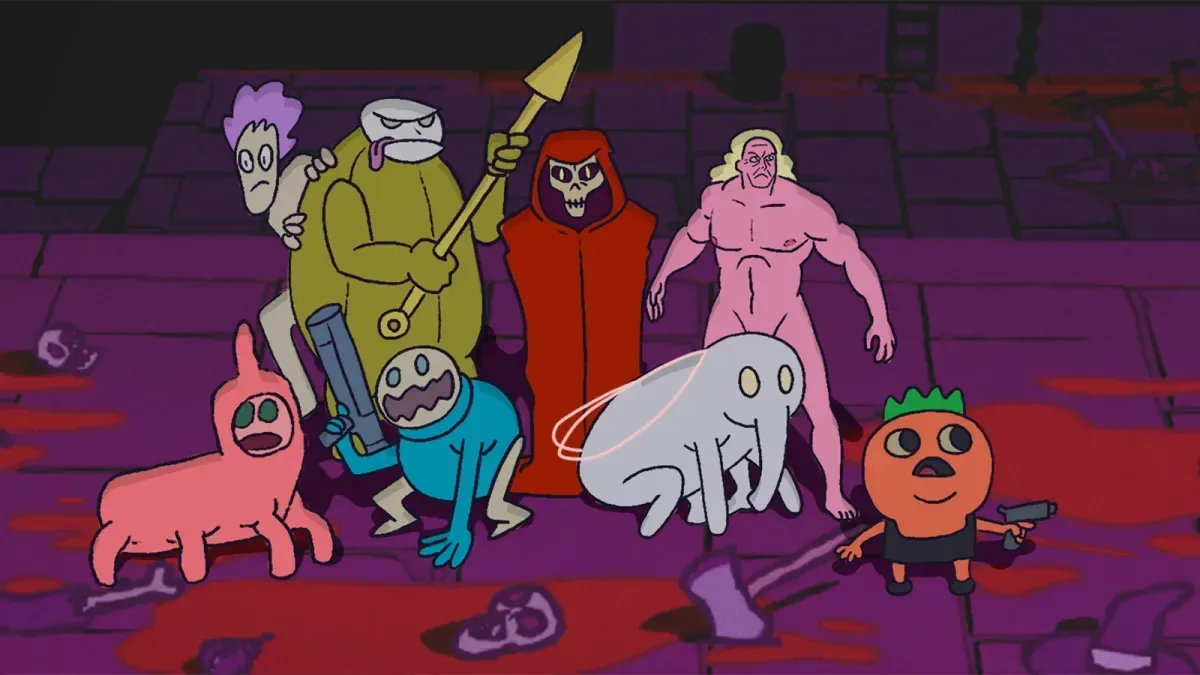
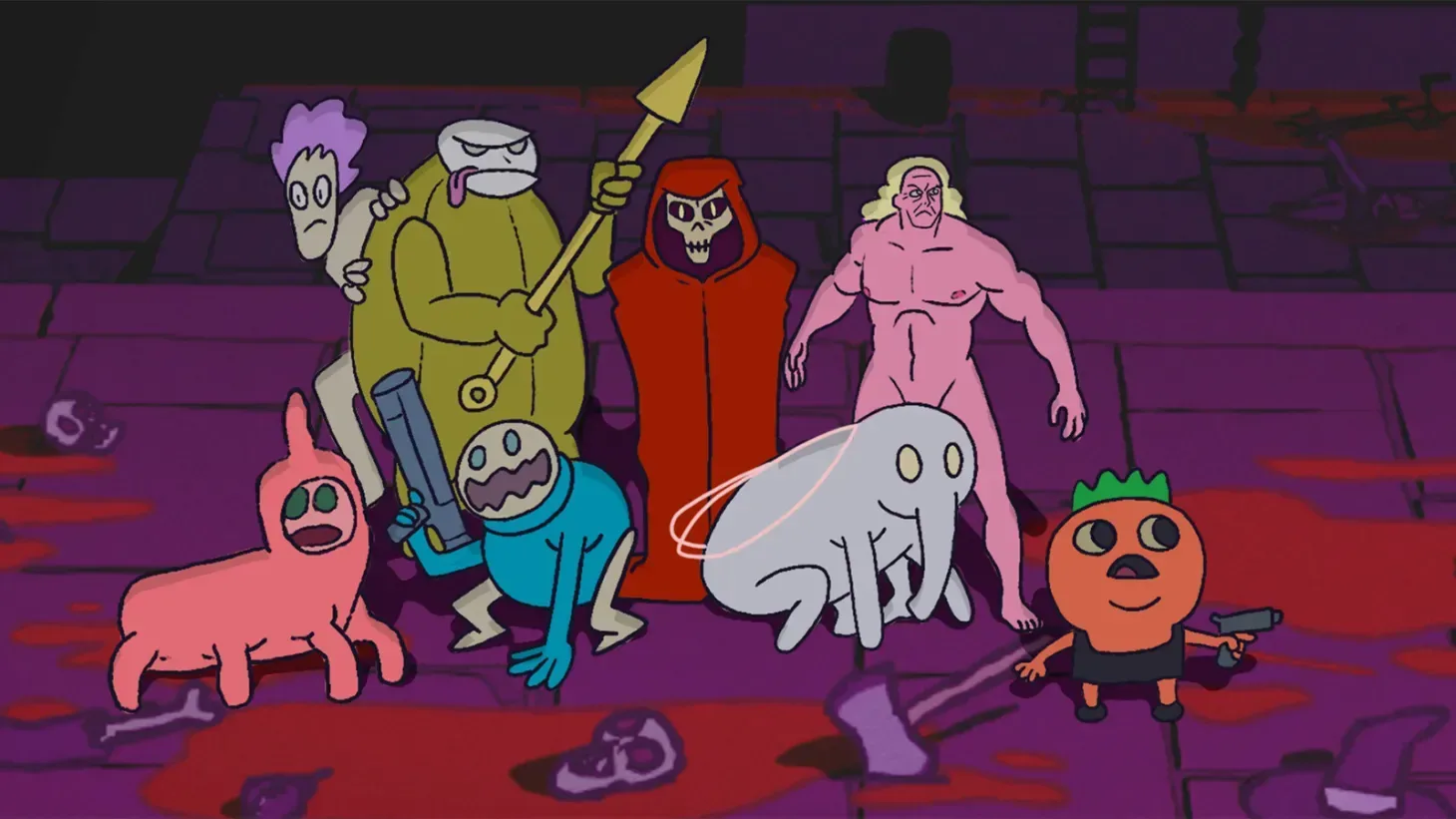
Its other major differentiator is aesthetic. Blood Dungeon deliberately embraces ugliness. The characters are grotesque on purpose, the overall presentation leans into an unpleasant texture, and the result is not likely to meet every player halfway. This is not accidental roughness mistaken for style. It is a coherent choice, and it suits the game’s dirty, frantic tone.
That coherence does not make it universally appealing. One especially practical upgrade is a fart cloud that periodically releases poison, and its repeated sound effect may be enough to make some players hesitate before picking an otherwise useful tool. It is a tiny but revealing example of Blood Dungeon’s priorities: the game is willing to be obnoxious if obnoxious is the flavor it wants.
For players who enjoy gleefully ugly games, that commitment gives Blood Dungeon personality in a crowded genre. For players who do not, the same commitment can be a genuine barrier. Either reaction is fair. The key point is that it is recognizable at a glance and tonally consistent, not anonymous fantasy sludge with an interchangeable pile of upgrades.
An active spin on the survivor-like formula
Blood Dungeon succeeds most clearly when the swarm gets dense and the player survives through movement rather than hoping the next level-up window delivers the correct answer. Its platforming foundation gives it a liveliness that many comparable games intentionally abandon in favor of automated devastation. It wants chaos, certainly, but it wants the player to keep participating in that chaos.
The lopsided strength of certain upgrades, the disappointing consequences of missing them, and the vague conditions surrounding some permanent progression systems stop the game from fully realizing that promise. Even so, Messhof’s approach is distinct. Blood Dungeon takes a familiar structure and adds a demand that cannot be optimized away: keep moving, keep climbing, and keep making the escape yourself. For a genre that can sometimes turn the player into an audience member for their own build, that is a meaningful and refreshing complication.