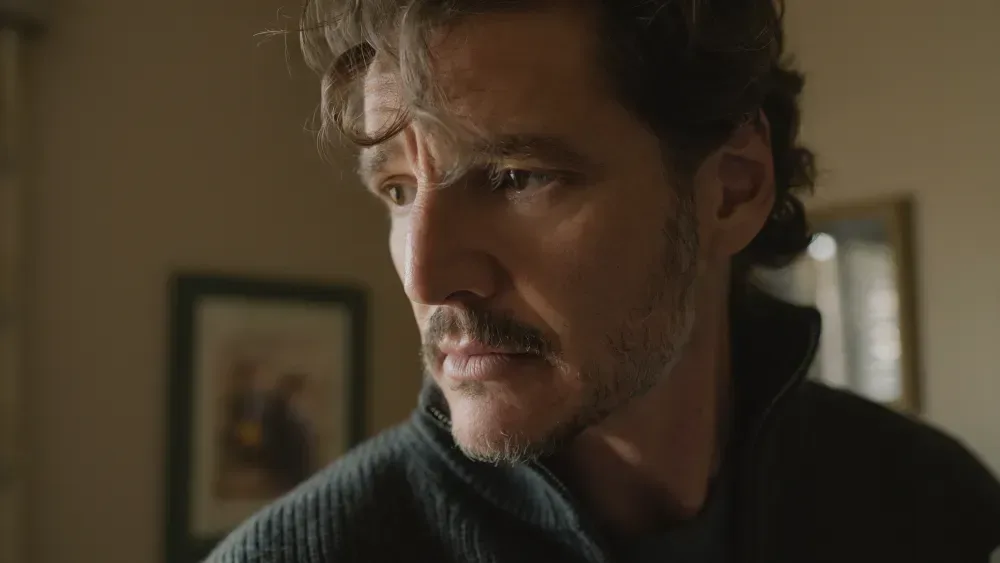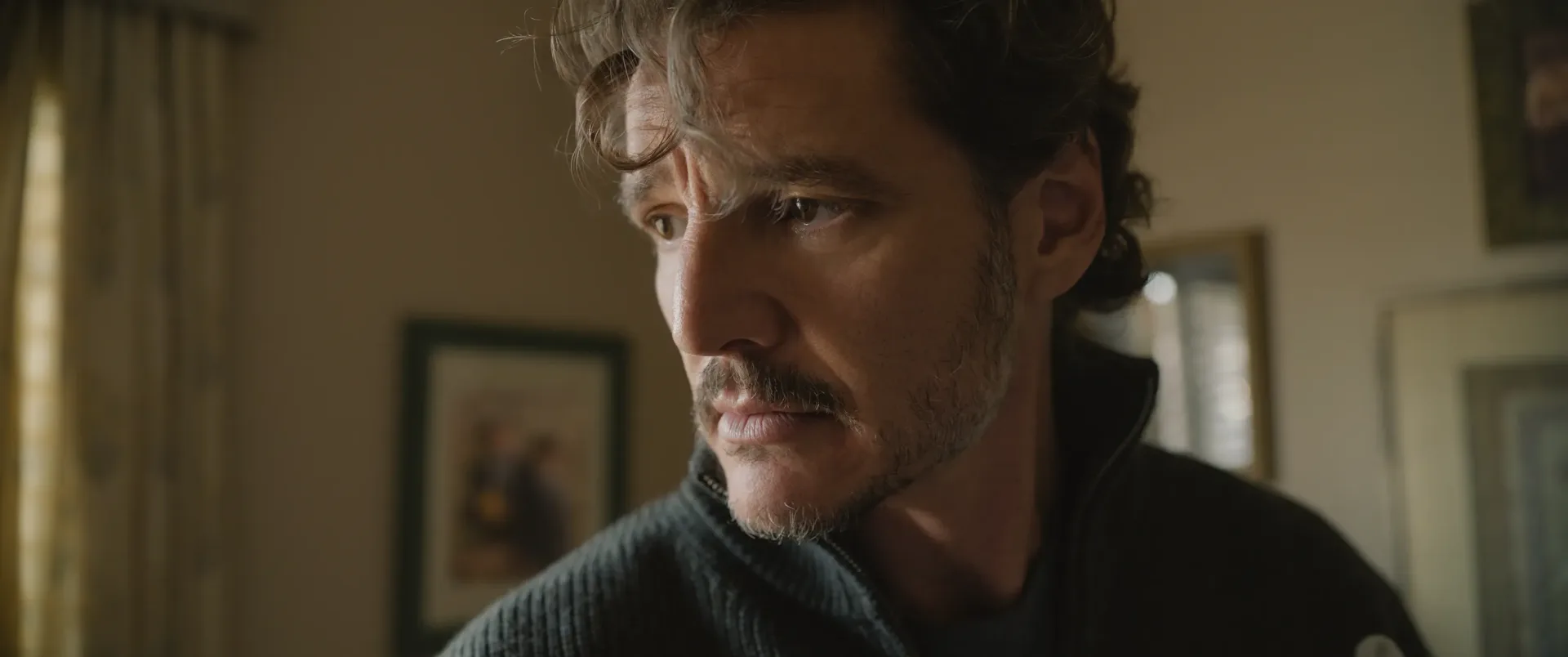
Behemoth! is built around an unusually persuasive premise for a film about elite musicians: Pedro Pascal’s Alex Serian looks as though he actually belongs with a cello in his hands. That detail matters. Tony Gilroy’s 124-minute drama places Alex inside professional orchestras, high-pressure soundtrack sessions and a tangled private life, asking the audience to accept him not merely as a troubled man who happens to own an instrument, but as a player whose technique has shaped every part of his identity.
Pascal learned the cello for the role, and the commitment is visible in the practical mechanics of performance: bow movement, vibrato and posture. In a genre where fake instrumental playing can turn a supposedly serious scene into accidental pantomime, that work gives Behemoth! a valuable baseline of credibility. Alex’s talent does not need to be explained away by editing or narrative insistence. The film can let the body language do the selling.
That foundation supports a story with several competing currents. Alex is a renowned cellist with experience in major orchestras, including Chicago, but he is now also making a living through recording sessions for movie scores. He is glamorous, capable and outwardly unruffled, yet his relationships, family history and sense of direction are all in much worse condition than his composed exterior suggests. The result is part music-industry drama, part midlife-crisis portrait and part romantic mystery.
A movie about the work behind movie music
The most distinctive setting in Behemoth! is not a concert hall but the soundtrack-recording studio. Alex’s work reflects a career path the film treats as artistically demanding rather than secondary: a player can move between prestige orchestral work and sessions assembled to record scores for film. The latter comes with its own exacting expectations, and Gilroy makes room for the work’s specialized vocabulary.
Early scenes combine conventional musical directions with studio shorthand. Pianissimo, for instance, means playing very softly. “New ink” refers to newly supplied or revised written music. Those small pieces of language establish a workplace in which timing, precision and rapid adjustment are central. The conductors running the sessions are depicted as unforgiving perfectionists, including a volatile figure played by Thomas Kretschmann.
That attention gives the film a productive tension. Classical music can seem, from a distance, formal and sealed off; soundtrack work can be mistaken for a more casual commercial cousin. Behemoth! instead presents both as environments where elite ability is judged in real time. Alex is not simply playing beautiful passages in isolation. He is part of a group operation with technical demands, hierarchy and pressure.
Gilroy then turns that setting into a formal game. The audience hears an orchestra record a cue for another film, only for the piece to become the score of Behemoth! itself. It is a self-aware move: the music is both an object being made inside the story and the device shaping the viewer’s response to that story. The film’s music is credited to the Behemoth! Collective, with nine composers involved, including James Newton Howard and Alan Silvestri.
In practical terms, the trick foregrounds a truth that movies normally hide. A tense sequence has tense music under it, but here the picture has already shown musicians creating that kind of tension as paid labor. The suspense machinery is briefly exposed without stopping the film from using it. It is a playful idea, even if its larger meaning is not always clear.
Alex Serian is talented, charming and running out of road
Alex’s professional assurance contrasts sharply with the mess surrounding him. He is introduced trying to extricate himself from a relationship with Carol, played by Olivia Wilde. Carol is the wife of a wealthy Chicago orchestra patron, turning what might have been a private mistake into a potentially disruptive entanglement with the financial ecosystem around the orchestra.
Pascal plays Alex with an intriguing restraint. His character drinks, drifts from city to city and moves from one relationship to another, but he rarely appears openly rattled. He is the still center while other people react with greater volatility. That calmness works with the film’s conception of Alex as a virtuoso accustomed to control: technical mastery and cultivated poise have become both his professional asset and a method of avoidance.
The script establishes that his gifts were recognized early. Alex was a child prodigy from a prominent musical family, and the film includes an archival-style glimpse of him playing Bach on The Tonight Show at age six. The pedigree helps explain his extraordinary facility, but it is not treated as uncomplicated good fortune. His family background is also a source of lasting damage, slowly brought into view through conversations with his brother.
Will Arnett plays that brother, a talented but rumpled podcast host. Their exchanges begin to outline the family history without immediately turning the film into a straightforward explanatory drama. This is one of the movie’s persistent choices: it withholds, circles and jumps. The approach can make emotional information feel discovered rather than delivered, though it also places a burden on the audience to keep track of exactly when events occurred.
Nadia, Viviana and a deliberately broken timeline
Alex’s past includes Nadia, an acclaimed violinist played by Eva Victor. He meets her in Dallas, where the two begin a relationship. A fraught phone call involving a billionaire who wants to marry Nadia follows, Nadia lashes out at Alex, and tragedy soon enters the story. The film does not always make the chronology transparent. Scenes arrive in an elliptical, cut-and-paste pattern, while the cast’s appearance stays largely constant across different periods.
Elliptical storytelling means leaving gaps between scenes or withholding links that a conventional narrative would make explicit. Used well, it can create uncertainty that mirrors a character’s fractured memory or a mystery’s gradual unfolding. In Behemoth!, it contributes to the movie’s restless, slightly mischievous texture. Yet it can also obscure basic temporal stakes: viewers may need a moment to determine whether a development follows directly from the last scene or belongs to another stage of Alex’s life.
After the breakup in Chicago, Alex returns to Los Angeles, where he grew up and can find further session work. There, he becomes absorbed by online compositions from Viviana, a 15-year-old local figure played by Alexa Swinton. Viviana makes original avant-pop music, a label suggesting pop-oriented work that experiments beyond familiar commercial formulas. Her sound represents a different musical sphere from Alex’s orchestral discipline, even as his attention to her proves personal rather than merely aesthetic.
Viviana is Nadia’s daughter. Alex feels an unexplained pull toward her music and, eventually, seeks answers. The movie’s suspense finally sharpens when he poses as a caterer’s assistant to enter Nadia’s stone mansion, locate what he needs and escape. It is a genre turn that lets Gilroy stage a clean, physical sequence after a film largely driven by behavior, conversation and musical labor.
Gilroy’s smaller-scale experiment after larger worlds
Behemoth! is Gilroy’s fourth feature as director and his first since The Bourne Legacy in 2012. He also created and served as showrunner on Andor. That background helps make the new film’s interest in systems feel unsurprising. Whether Alex is navigating patrons, recording-session authority, romantic obligations or the legacy of a musical family, he is rarely free of an institution’s influence.
But the new film is not presented as a large conspiracy thriller. Its pleasures are more miniature and mischievous: insider terminology, the transition from diegetic performance to soundtrack, and a protagonist whose refinement does not prevent him from behaving badly. A scherzo is traditionally a lively, playful musical movement, and that is a useful frame for a movie that moves quickly between serious artistic stakes, relationship damage and wry formal games.
The title remains an awkward fit. It is also the name of a film for which Alex is helping record music, giving the exclamation point and the word an in-story rationale. Still, a title invoking something gigantic sits oddly atop a contained drama about one cellist’s stalled emotional development. The mismatch is memorable, if not necessarily elegant.
Why the cello training is more than a neat casting fact
The most important achievement described here may be the least flashy: the performance scenes make Alex credible before the screenplay asks the audience to invest in his turmoil. A cellist’s physical technique is not decorative. The left hand controls pitch on the fingerboard; the right hand’s bowing shapes attack, volume and tone; vibrato is the subtle oscillation that can enrich or intensify a sustained note. When an actor’s movement is convincingly coordinated, the character’s expertise registers instantly.
That credibility has narrative consequences. Alex can be selfish, passive and emotionally opaque, but the film does not make his artistry vague. The audience understands why he keeps finding work and why other characters respond to him as a serious musician. His virtuosity is concrete, not an accolade pasted onto the script.
For a story set partly in a film-score ecosystem, that precision also creates an appealing irony. The protagonist helps manufacture the emotional signals that tell audiences when to feel fear, romance or regret. Yet he has difficulty confronting those same feelings in his own life. Behemoth! does not always make its timeline easy to parse, and Alex’s reserve may leave viewers wanting a deeper view into his pain. But its musical world, from rehearsals to recording sessions, appears to be the place where the film is most sure-footed.
The picture screened as a New York Film Festival Centerpiece on October 1, 2026. It is a Searchlight Pictures release produced by Tony Gilroy, Sanne Wohlenberg and John Gilroy, with Damián García as cinematographer and John Gilroy as editor. For more on the business forces reshaping major screen entertainment companies, see the planned use of the Skydance name in the Paramount-Warner Bros. combination.