Amazon Prime can be handy when a last-minute cable, controller accessory, game storage solution or gift needs to arrive quickly. But a membership is harder to justify when it quietly renews at the standard $14.99 monthly rate and the benefits go mostly unused. The practical question is not simply whether Prime is useful; it is whether you qualify for a version of it that better matches what you actually spend and how you shop.
Several legitimate routes can reduce the cost, and a few can make it free. They are not interchangeable. Some are introductory offers, some depend on age, enrollment or income eligibility, and some are benefits attached to an employer, phone plan, card or household arrangement. The important part is to check the conditions before changing an existing plan: a seemingly routine switch can remove a benefit that is no longer offered to new customers.
Start by separating a trial from an ongoing price
The ordinary 30-day Prime trial is the most straightforward no-cost option for eligible customers. During that window, Prime benefits include fast shipping, certain exclusive shopping discounts, enhanced Alexa access and Prime Video. It can make sense for a defined period of shopping, such as a sale event or holiday orders, when one month of access has a clear purpose.
A trial is not the same as a free membership. A payment method is required, and the plan rolls into a paid membership unless it is cancelled before renewal. Put the renewal date somewhere you will see it and decide ahead of time whether you will keep it. Amazon does not state a fixed cooldown that guarantees a former subscriber will qualify for another trial, so nobody should plan an annual shopping routine around repeatedly receiving one.
For more context, explore How to Tell Whether a USB-C Cable Is Actually Waterproof—and What IP67 and IP68 Mean.
That distinction matters because a subscription can feel inexpensive in isolation while becoming a poor fit over a year. If you mainly use Prime for one predictable burst of purchases, a trial may be enough. If you regularly use shipping, video and shopping benefits across the year, an eligibility-based plan or a household share may be the more durable answer.
Prime for Young Adults offers the longest introductory window
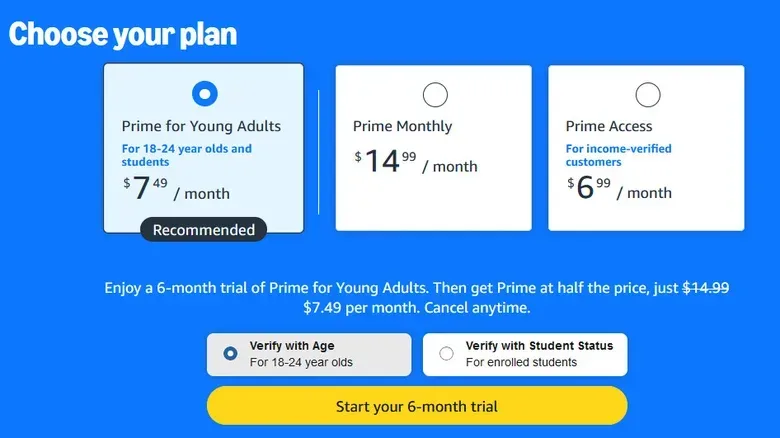
Prime for Young Adults provides eligible new members with six months at no charge. Eligibility includes adults aged 18 through 24 and higher-education students of any age, with proof of age or school enrollment required. After the free period, the listed choices are $7.49 per month or $69 per year.
For someone who qualifies and expects to continue using the service, the annual option is worth comparing with the monthly alternative. Twelve monthly payments at $7.49 would total $89.88, while the annual plan is listed at $69. That comparison only matters if you expect to remain eligible and want Prime after the introductory period; the larger point is that the plan gives qualified users a lower ongoing path than the standard monthly price.
Related coverage includes How to Get Amazon Prime Free or for Less.
There is a key sharing limit: free-trial members and Prime for Young Adults members cannot share Prime benefits through Amazon Family. That can alter the math for a household. One person may be better off using their own eligible young-adult membership, while two adults at the same address may instead find that a standard paying membership with permitted sharing better suits their setup.
Prime Access is the lower-price option tied to eligibility
Prime Access is listed at $6.99 per month after a 30-day free trial for eligible new members. It is available to people receiving qualifying government assistance or meeting Amazon’s income requirements; SNAP and Medicaid recipients are included among the eligible groups described. It includes the same perks as a standard Prime membership.
The phrase “same perks” is significant. This is not merely a shipping-only discount. It is a lower-cost membership tier for people who meet the qualification rules, so it can be a more useful long-term option than timing a temporary trial. Current Prime members may be able to move to the discounted membership, but eligibility should be checked before making assumptions about the transition.
In practical terms, this is the option to investigate before cancelling outright if the full price is the obstacle. Keep any required eligibility information ready, read the current terms carefully and confirm that the membership status changes as expected. As with every subscription, verify the amount and renewal timing shown at checkout or in account settings rather than relying on an older email or remembered price.
Amazon Family can prevent duplicate memberships—but has a privacy cost
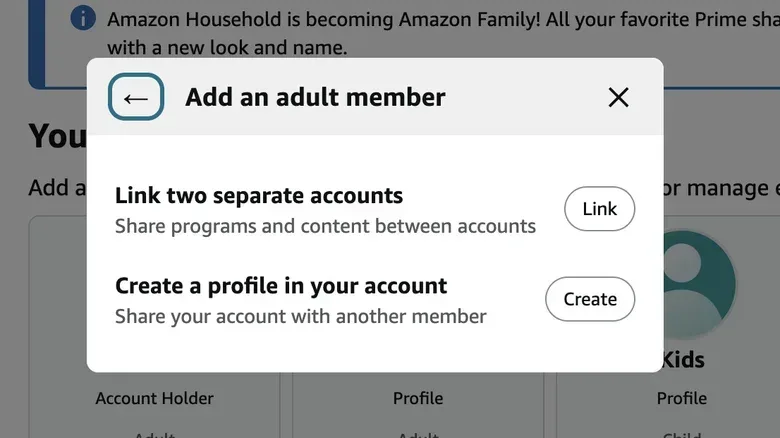
Two people who live at the same primary address may not need two Prime subscriptions. Through Amazon Family, the paying member can share selected benefits with another adult in the household. Those benefits include fast shipping, exclusive shopping deals and ad-supported Prime Video, while each person keeps a separate Amazon account. That means the second adult can place orders without borrowing the organizer’s login.
Separate accounts should not be mistaken for completely separate finances. Amazon requires the family organizer to share a payment method that the other adult can use for purchases. Before accepting or sending an invitation, both people should review settings related to payment methods, digital content and order-history sharing. The saving is real only if everyone involved is comfortable with the arrangement.
Address rules are also central. Amazon ended the Prime Invitee program in October 2025. That older program had allowed members to share free shipping with people outside their household; friends who live elsewhere can no longer receive that benefit through it. Amazon Family is not a workaround for sharing Prime across separate homes.
This makes household sharing a useful but narrow tool. It is best for adults genuinely living at the same primary address, not for a loose group of friends trying to split an account. In addition to the address requirement, remember that trial and Prime for Young Adults memberships are excluded from sharing benefits through Amazon Family.
Check benefits already attached to your work or service plan
One of the easiest savings steps is also the one people can miss: review benefits you may already have. Eligible Amazon employees in the United States can receive Prime without paying separately. Whole Foods has said its hourly workers will receive the same benefit beginning January 1, 2027. For workers who qualify, paying for a personal Prime plan on top of that would be unnecessary.
Phone-plan bundles need extra care because they can be grandfathered. Metro by T-Mobile began including Prime on select plans in 2018, but stopped making the perk available to new customers on September 17, 2026. Eligible customers who already have it can continue to keep it. The implication is simple: do not change carrier service or migrate to a different plan without first confirming what happens to the Prime benefit. An apparently better mobile deal may have a subscription cost hidden in the trade.
These examples point to a broader subscription-management habit. Before subscribing directly, inspect workplace benefit portals and the details of existing service plans. Then, before altering those plans, list the attached benefits that could disappear. A bundle is not automatically valuable, but it should be counted when comparing your real out-of-pocket cost.
A legacy card credit still helps some cardholders, but it is not a new sign-up strategy
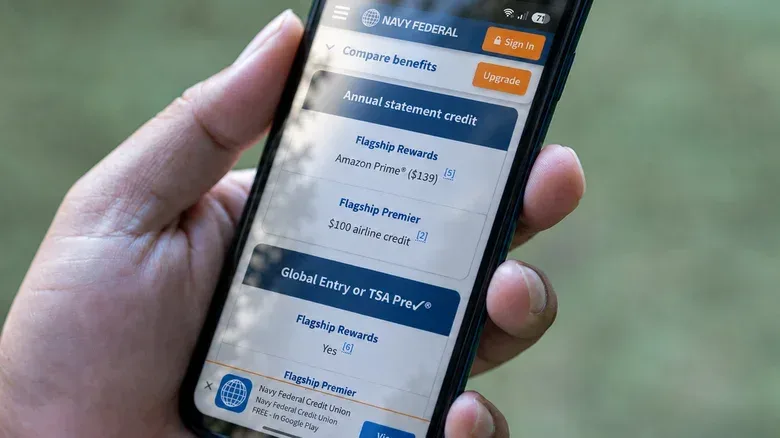
Existing Navy Federal Visa Signature Flagship Rewards cardholders can receive a $139 statement credit toward an annual Prime membership when that membership is paid with the card. New applicants cannot get this version of the card benefit: it has been replaced by the Flagship Premier card, which offers a $100 airline credit instead.
That distinction matters because a card perk should be evaluated based on the product you actually hold, not an older benefit list found online. The Flagship Rewards card’s annual fee rose from $49 to $95 on November 2, 2026. If the Prime statement credit is the only other card benefit you value, the net annual savings works out to $44. Navy Federal says the statement credit can take six to eight weeks to appear.
This is an example of why “free Prime through a card” can be misleading shorthand. For eligible existing holders, the credit can be valuable. For someone choosing a card solely to pay for Prime, the benefit is no longer open in that form, and any annual fee changes the calculation. A statement credit is money back after a qualifying charge; it is not necessarily an instant price reduction at the time of purchase.
Rewards and cash back can offset the cost, not erase it automatically
Microsoft Rewards points can be redeemed for gift cards, including Amazon gift cards that can be applied toward Prime. This is a flexible way to reduce the amount paid, particularly for people already earning points through the program. But it is best understood as an offset: the effective value depends on how many points you earn and choose to redeem, not a guaranteed no-cost subscription.
The Amazon Prime Visa offers 5% back on Amazon purchases for Prime members. Frequent Amazon shoppers may be able to use that return to help cover the membership cost over time. The relevant calculation is personal: estimate your normal Amazon spend, apply the 5% figure and compare the result with the membership cost. Do not add purchases just to chase cash back; spending extra to earn rewards defeats the purpose of trying to save.
Low-income customers who qualify for Spectrum’s Internet Assist plan can receive Amazon Prime at no additional cost. As with Prime Access, qualification is the deciding factor, so it is sensible to confirm current plan eligibility and the precise terms before treating it as part of a household budget.
A simple order for choosing the least expensive legitimate option
- Look for an existing included benefit first. Check employer benefits, your current mobile plan and qualifying internet service. Preserve grandfathered perks before making account changes.
- Check eligibility-based Prime plans. Prime for Young Adults and Prime Access have clearer long-term price advantages for people who qualify than a one-off trial.
- Consider Amazon Family only for an actual shared household. Review payment and privacy implications before accepting the invitation.
- Use a standard trial for a short, defined need. Set a reminder before it converts into a paid membership.
- Treat rewards and card benefits as supporting math. They can reduce the practical cost, but should not cause unneeded spending or a card application that no longer delivers the advertised Prime credit.
Prime can be a useful convenience, but convenience is not a requirement to pay the headline rate. The best saving method is the one you are genuinely eligible to use, understand fully and can maintain without giving up a more valuable existing benefit. That is a better approach than chasing an offer that only looks free for a month.
Shop the products
Check current price, model and availability at the retailer.