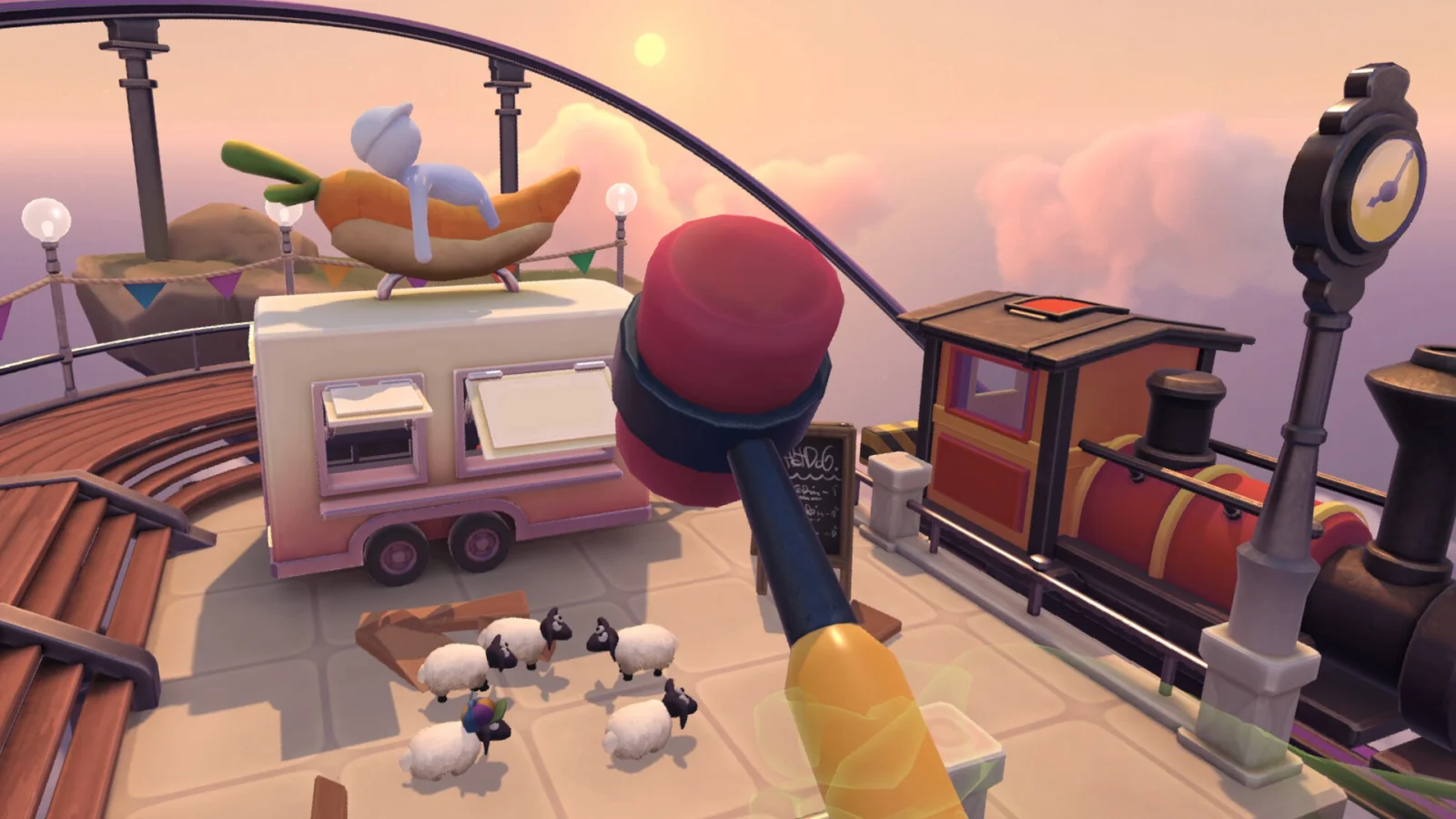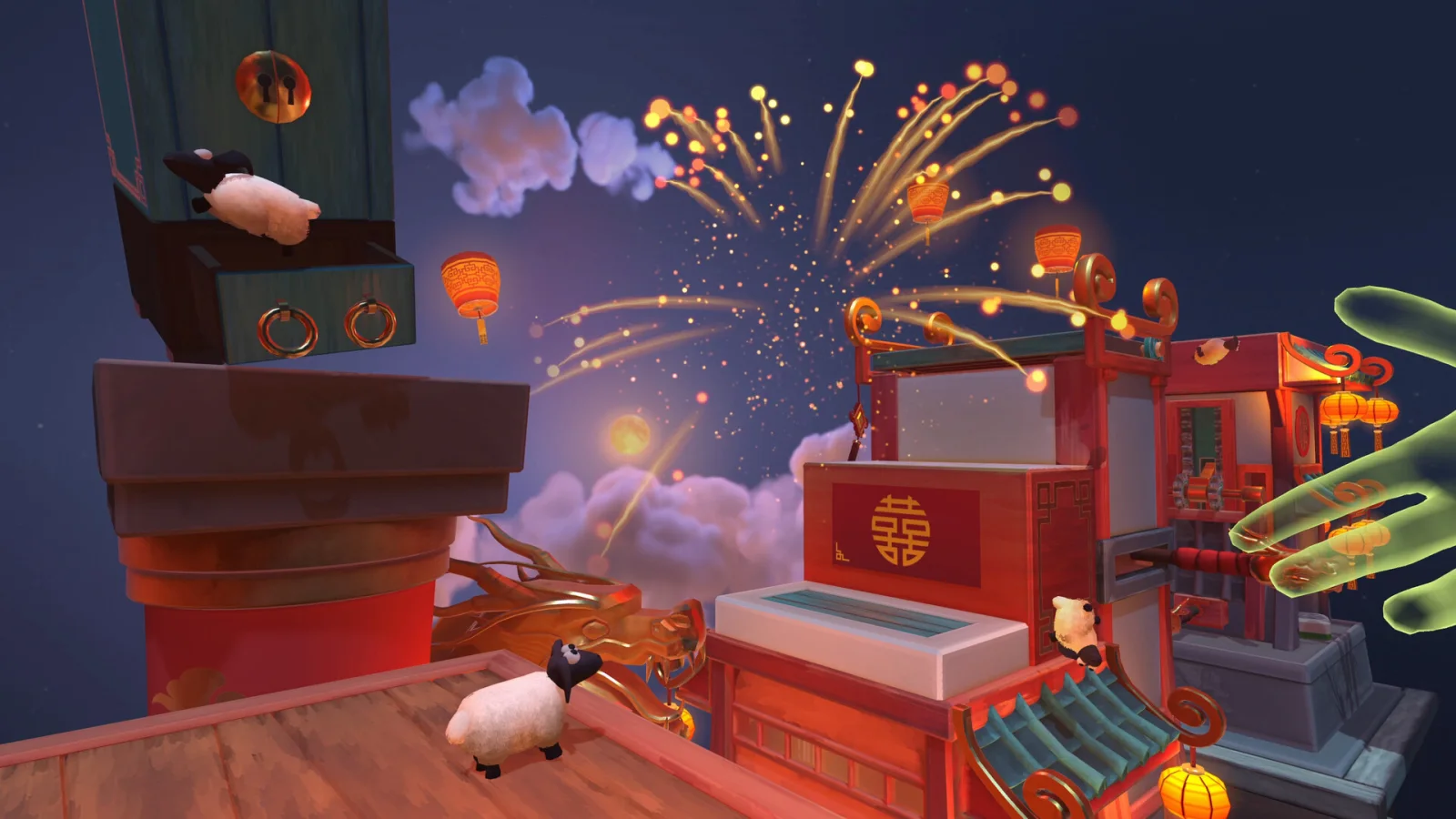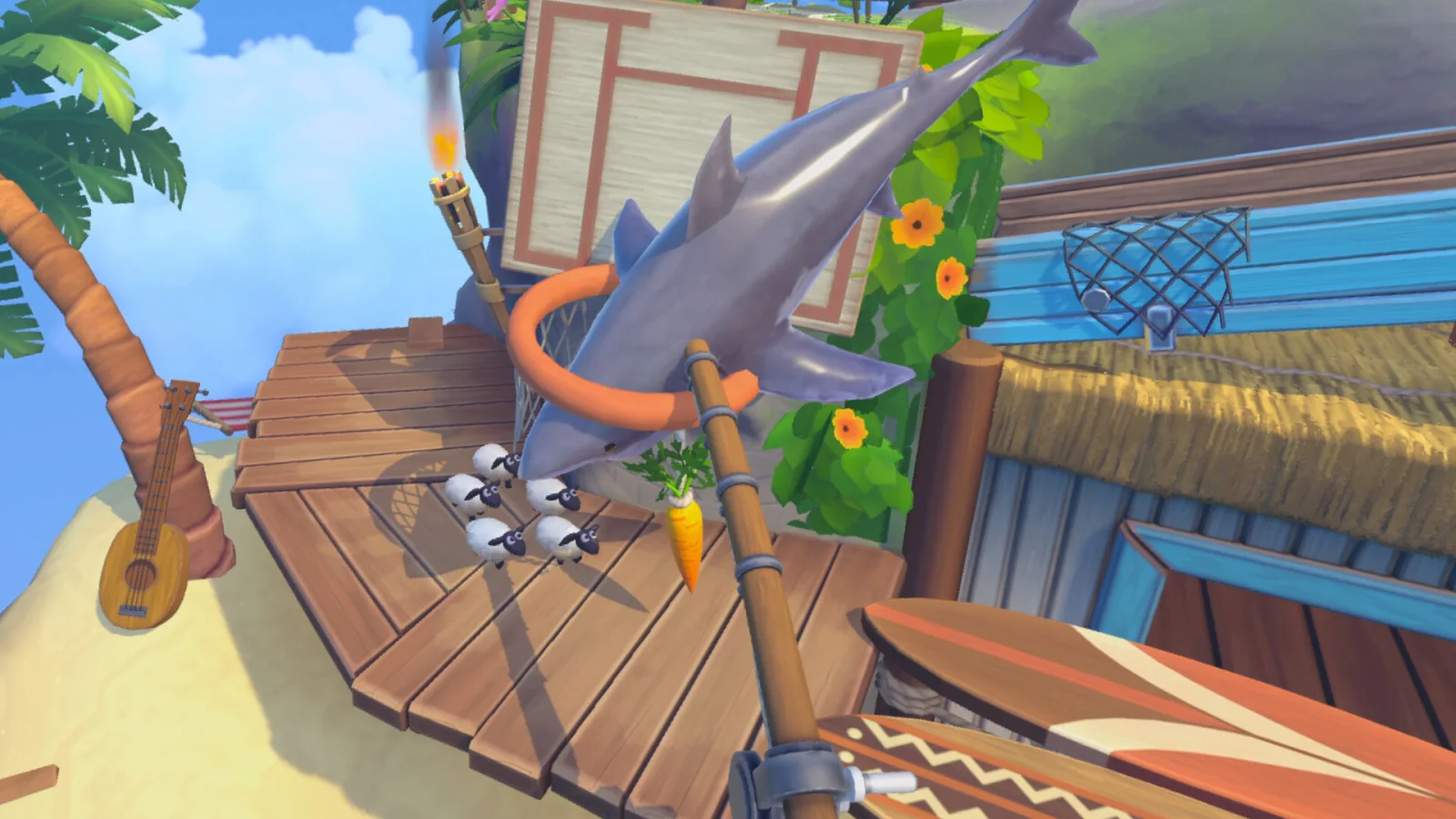
Tiny Flock is developed and published by No Brakes Games, and released on September 29, 2026. Its Steam listing categorizes it as adventure, casual, indie, and simulation, while describing a VR-focused physics puzzle built around a modest but unusually tangible objective: get a small flock of sheep to pasture.
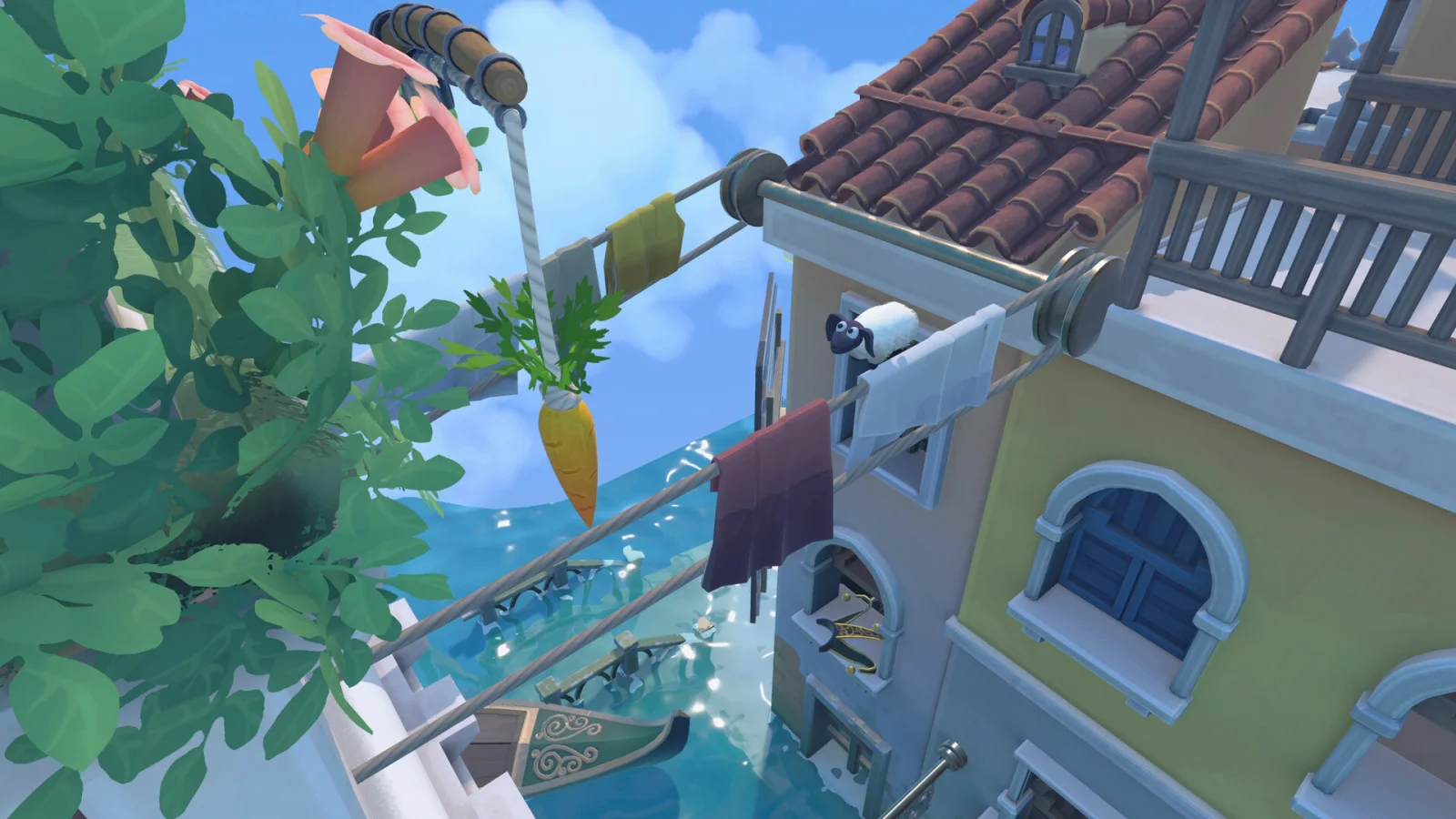
The developer-described route to that goal is environmental manipulation. Rather than identifying a single prescribed path through each scene, the Steam listing presents players with three-dimensional dioramas full of objects and mechanisms that can be used to create safe passage. It specifically names building paths and bridges, stacking and throwing objects, pulling ropes and levers, and smashing objects. The central promise is not merely that a player can move through miniature spaces, but that they can reshape those spaces to make them traversable for the sheep.
This is a design feature based on the Steam-listed description. It separates the listed structure of Tiny Flock from questions the description does not answer, including the practical feel of object handling, the rules that govern sheep movement, the range of viable solutions in individual stages, and the way the game handles failed experiments.
A route-making puzzle with a flock at the center
The Steam listing frames sheep guidance as the purpose behind its physical interactions. The flock must reach an inviting pasture, while the surrounding environment supplies the materials and obstacles that determine whether a route exists. A bridge, stack, moved prop, lever-operated mechanism, or smashed obstruction could all change the landscape between the sheep and their destination.
That setup gives the listed interaction verbs a common direction. Throwing an object is not presented simply as a playful physics action; it is part of a broader attempt to alter a route. Pulling a rope or lever may adjust the relationship between parts of a diorama. Building or stacking can potentially turn loose environmental objects into a crossing or climbable formation. The developer also says that where the player leads, the sheep will follow, linking route construction to herding rather than treating the flock as decorative scenery.
The exact form of that guidance is not described. The listing does not explain whether sheep follow a direct player position, navigate an available path independently, move as a tightly grouped unit, or react differently to hazards and changes in terrain. Nor does it establish whether a player is expected to fully prepare a route before moving the flock or can revise the environment while the sheep are in motion. Those details would have a major effect on the pace of a puzzle, but the broad design premise is clear: create a safer way forward, then guide the animals along it.
It is a pleasingly focused concept because it gives physical experimentation a responsibility beyond simply reaching an exit. The player is trying to make a space usable for several small followers. If the game’s stated systems communicate route safety clearly, that could make a successful construction feel less like solving an abstract lock and more like caring for a flock through an awkward little world.
Twenty-one hand-crafted miniature worlds
The Steam listing describes 21 hand-crafted diorama levels. It calls each one a three-dimensional diorama world and presents the environment as fully interactive. That establishes an authored collection of contained puzzle spaces rather than a claim about procedural generation or an endlessly changing sandbox.
Dioramas suit the stated route-building idea particularly well. A bounded scene can put the destination, elevation changes, obstacles, loose objects, and mechanisms within a comprehensible shared space. In principle, that lets a player look over a problem before deciding whether a gap calls for a bridge, whether a raised area can be reached by stacking, or whether a lever can alter the scene more efficiently than brute-force construction.
This potential advantage depends on level readability, which is not demonstrated by a feature list alone. The important design question is whether the useful parts of a scene stand out without making every answer obvious. A physics puzzle can invite experimentation when players understand the possible relationships between objects, even if they do not know the best arrangement immediately. If a diorama makes its elevations, movable items, and active mechanisms legible, it could support satisfying trial and error. If those relationships are unclear, the same openness could become difficult to interpret.
The miniature format also gives everyday environmental props a useful conceptual role. A loose item might become support for a crossing. A rope or lever might transform the layout. Objects that can be smashed, as the Steam description states, may open space or remove an obstruction. Tiny Flock’s premise asks the player to regard the scenery as potential route material, not simply as a background around a puzzle.
No Brakes Games makes a broad claim that players can interact with anything they can see. That communicates the intended breadth of the interactive world, but it does not identify the behavior of every object or establish that every interaction produces a useful puzzle result. The grounded conclusion is that the listed design emphasizes environmental objects and mechanisms as the main tools for getting sheep through each scene.
What “no set solution” could mean
The developer says Tiny Flock has no set solution, an important phrase for a puzzle game based on physics and manipulation. It suggests that a level is intended to accommodate more than one route-making approach, but the Steam listing does not define the precise model behind that flexibility.
Alternative solutions can take several forms. A level might contain multiple deliberately designed answers. It might accept improvised structures because physical objects can be positioned in varied ways. Or it might allow players to use the same tools in different sequences. Tiny Flock’s listed actions provide a foundation for all three possibilities, but no individual level examples are supplied that would show how broadly those possibilities are implemented.
Consider the conceptual difference between making a stable bridge, assembling a stack, shifting an obstruction, activating a mechanism, and smashing an object to clear room. Each represents a distinct way of thinking about a blocked route. If several options genuinely work within a given diorama, a player could approach the same destination through construction, rearrangement, or destruction. The developer’s language about both carefully engineering a structure and chaotically blowing a path through a level points toward that contrast in attitude.
The key implementation question is whether alternatives are meaningful rather than merely incidental. Puzzle openness is strongest when players can see what a change accomplished and understand why one approach might be more suitable for a particular layout. A carefully built arrangement could potentially favor dependable passage, while an aggressive shortcut could potentially make a faster but less orderly change to the environment. Those are analytical possibilities, not established level-by-level trade-offs.
The listed count of 21 hand-crafted levels should also not be treated as evidence of a specific campaign shape. The description does not state an order, difficulty curve, unlock structure, or theme progression. What it does support is a finite set of authored dioramas sharing a common vocabulary: sheep, routes, interactive surroundings, and physics-led experimentation.
Physics as the proposed problem-solving language
Tiny Flock is described as a physics-based puzzle game, and No Brakes Games says it uses a custom physics setup intended to create a tactile experience. The interactions named on the Steam page make physical behavior central to the developer-described design. Objects are meant to be stacked, thrown, pulled, repositioned, used to make bridges, or smashed; these are actions whose puzzle value depends on cause and effect in the environment.
That gives the concept an appealing tension between planning and improvisation. A player may want to make a deliberate structure that supports the flock, but the same space may encourage trying an unconventional arrangement or removing part of an obstacle. The sheep-focused objective offers a consistent reason to test such changes: do they create a route that the flock can safely use?
Several practical matters remain open. The listing does not describe placement aids, object limits, reset options, checkpoints, undo tools, or how altered objects are restored after an unsuccessful attempt. It would be inappropriate to infer that any of those systems are present or absent. They are relevant questions because a game built around movable objects and changed terrain needs some way for players to continue experimenting after an arrangement does not work.
Similarly, the custom physics claim does not establish how constrained or emergent a particular puzzle will be. Some route-building games use physical systems to permit a narrow set of intended solutions; others let unusual constructions become viable. Tiny Flock’s Steam description supports the ambition of tactile environmental problem solving, while leaving its practical range to the individual levels.
VR interaction is integral to the premise
No Brakes Games describes Tiny Flock as built exclusively for VR. The Steam listing also names full hand-tracking support via Steam Link and pass-through support. These are stated features of the interaction model, though the available description does not specify how either feature is used in a particular level or puzzle situation.
Hand tracking has an immediate thematic connection to the actions Tiny Flock describes. Picking up an object, placing it into a structure, pulling a rope, working a lever, or throwing a prop all fit the fantasy of reaching into a miniature world and rearranging it for the sheep. In conditional design terms, direct hand interaction could make the dioramas feel like physical puzzle boxes rather than distant maps.
Precision is consequently an important question for the finished interaction design. A route may depend on the final position of an object, the stability of a stack, or a mechanism being moved into the right state. The Steam listing does not explain how fine placement is supported, how object collisions are communicated, or how it balances loose physical play with careful construction. Those details will shape whether the developer-described freedom feels expressive, demanding, or both.
Pass-through support should likewise be read only as a listed feature. The supplied description does not identify a particular pass-through presentation, a dedicated puzzle use, or a specific format for it. The supported point is simpler: VR is not an optional wrapper around Tiny Flock’s stated concept, but the intended way players physically engage with its interactive dioramas.
Collectibles, achievements, and a deliberately cozy tone
The Steam listing includes achievements and collectibles, describing them as features for replayability and completion-focused players. It does not state their conditions, where collectibles are placed, or whether finding them requires alternative solutions. They may encourage closer observation or revisiting of completed dioramas, but that remains a possibility rather than a defined system.
The developer also describes a cozy puzzle atmosphere and lists an original cello score. Alongside the tiny flock, miniature worlds, and pasture-bound goal, those details establish a clear intended tone. Tiny Flock is presented as a small-scale physical puzzle about helping wayward sheep through crafted spaces, not as a feature list detached from a setting or mood.
The Steam-listed design is notably cohesive. The flock needs a route; the diorama contains barriers and usable materials; physics-based manipulation is the proposed solution space; and VR is the stated means of reaching into that space. The remaining questions are specific ones: how sheep behavior is communicated, how broad individual solution spaces are, how recovery supports experimentation, and how accurately direct interaction accommodates construction.
For another puzzle-focused design feature, see our Plungeez design feature. Tiny Flock’s listed concept instead centers on creating safe sheep routes by reshaping hand-crafted miniature environments.