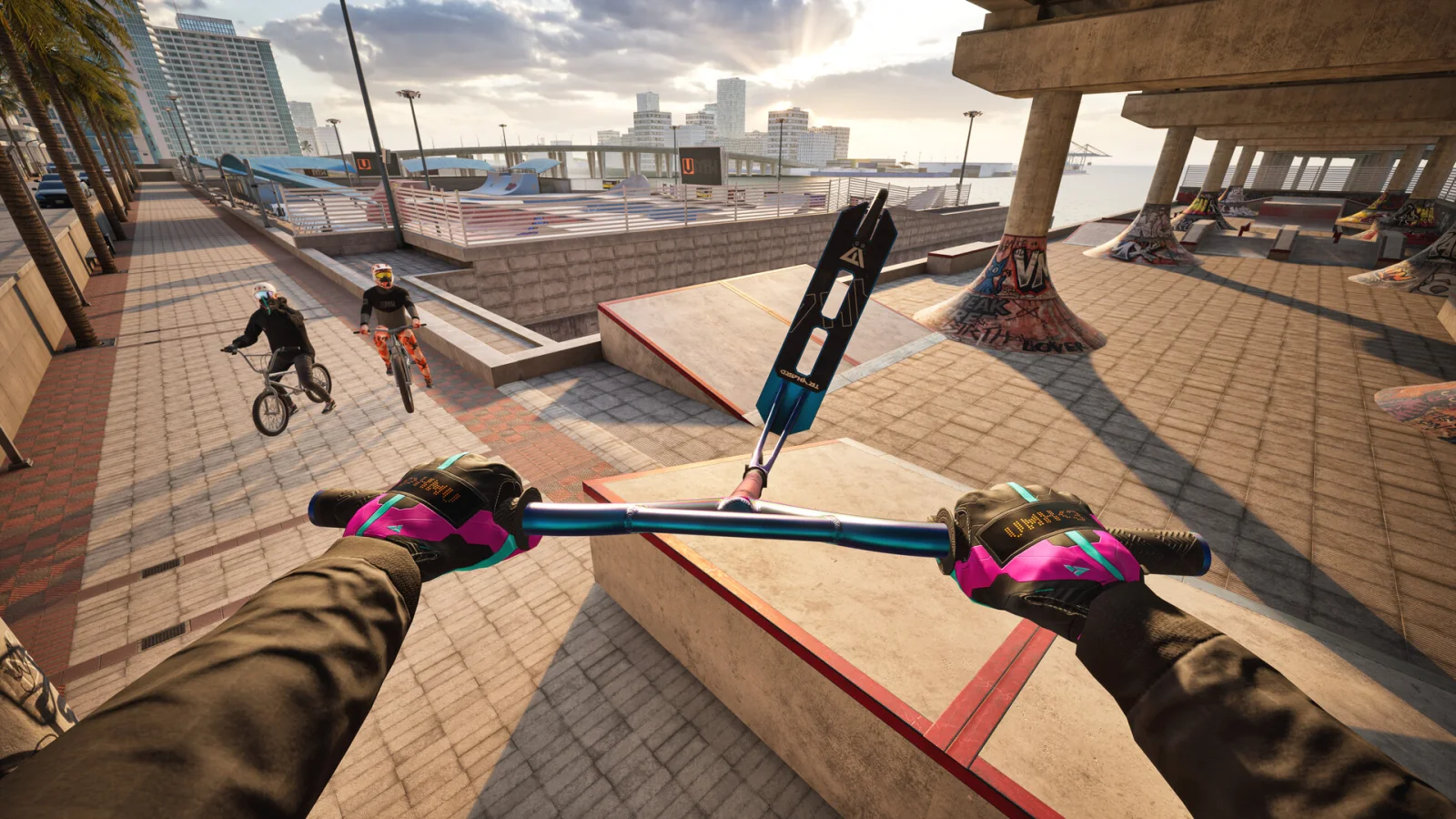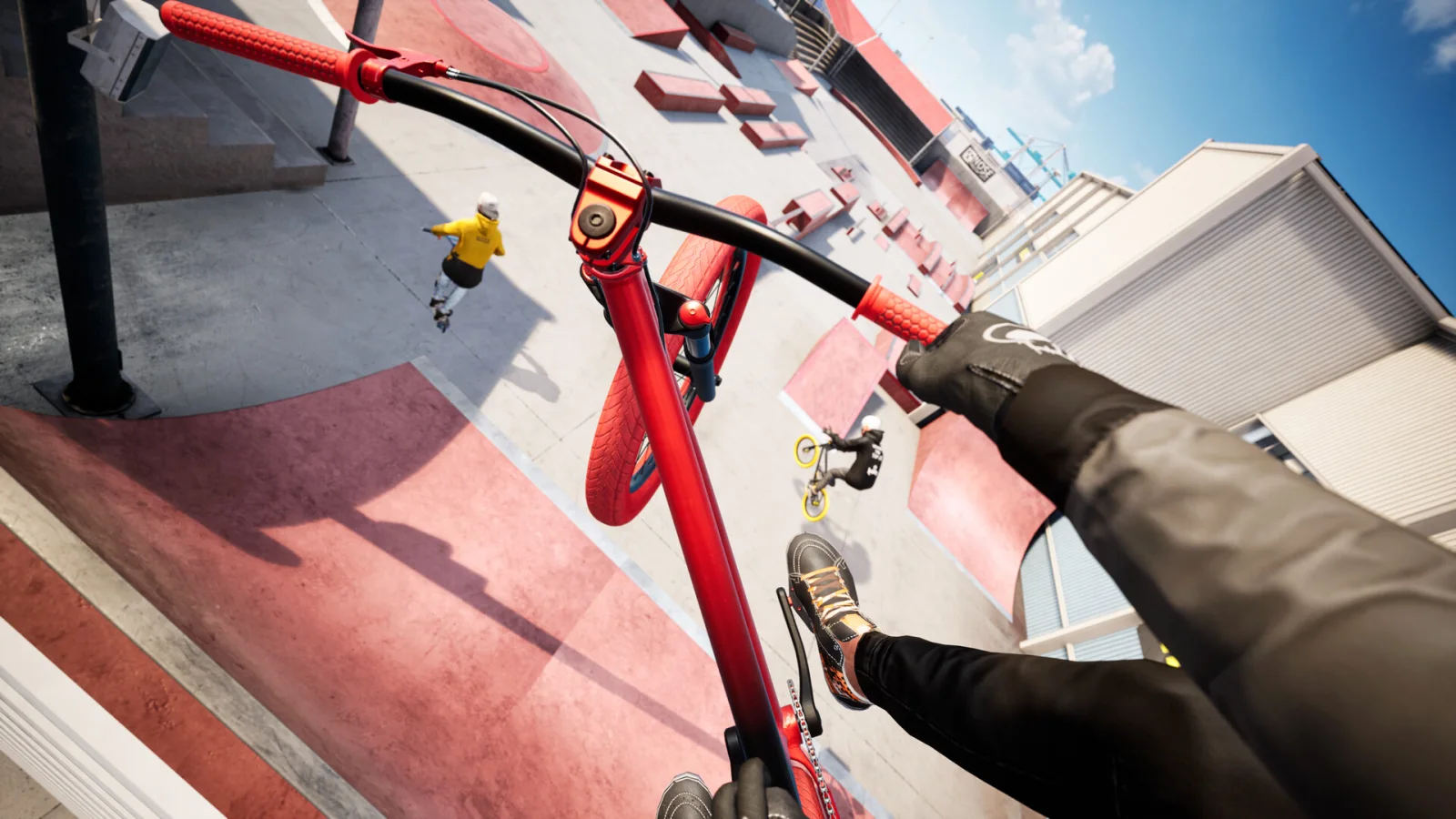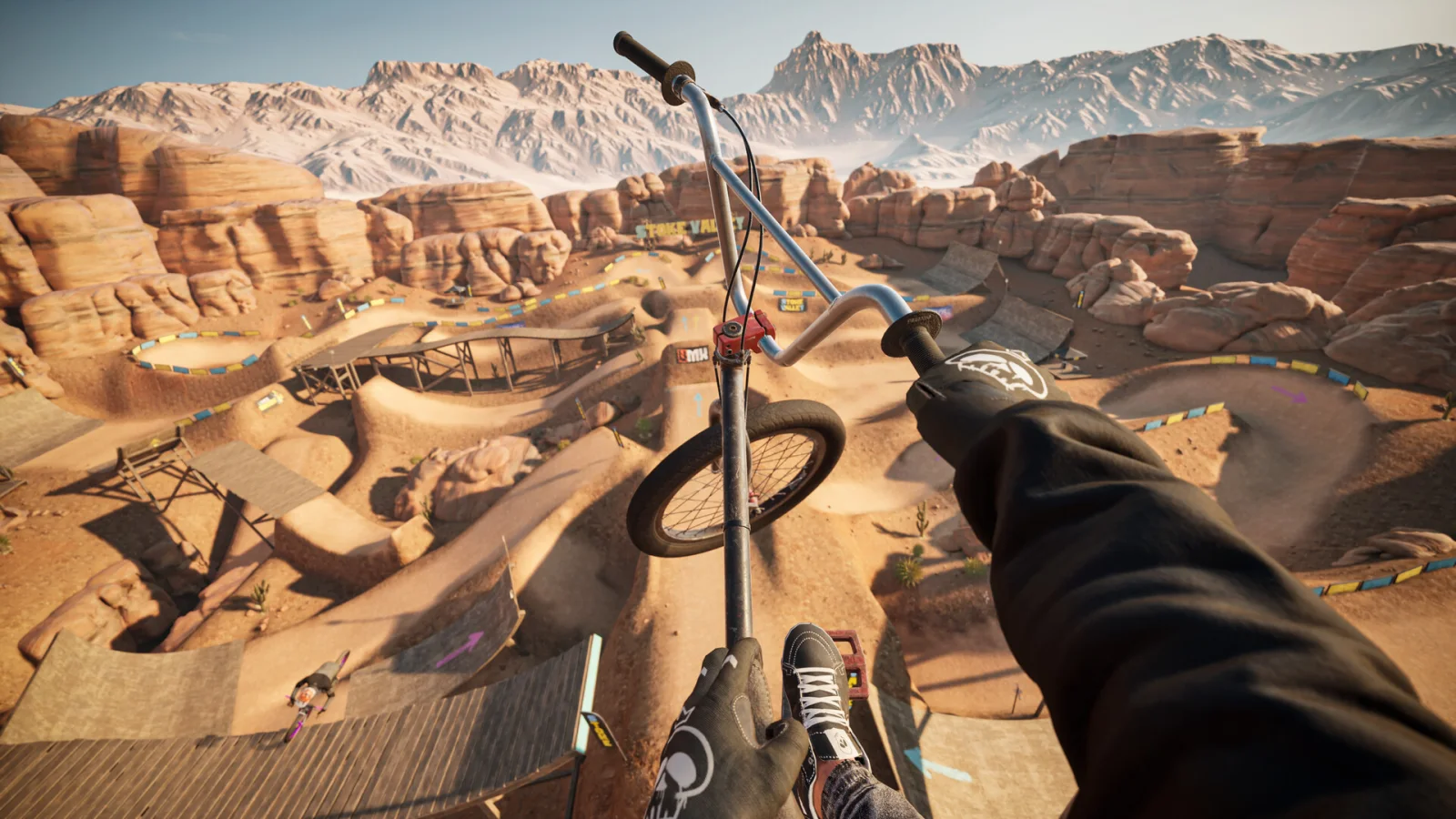
VMX is an announced VR riding game from Break Free Interactive, which is listed as both developer and publisher. Its public description places physical control at the center of the design: players are meant to ride BMX bikes, mountain bikes, and scooters through VR inputs, perform tricks through gestures, choose lines through parks, and work with a custom physics system intended to support precise handling. The same announced package also includes spray-paint customization, points spent on gear and clothing, Comfort Mode options, and multiplayer activities ranging from shared riding to competitive challenges.
This is a factual design feature rather than a hands-on review. The available information establishes what VMX says it is building, not how responsive its controls feel, how its physics behave under pressure, how much content is included, or how reliably its multiplayer and comfort options work in practice. Those distinctions matter especially for a game whose appeal is so closely tied to bodily input. A promising control concept cannot be assessed from a feature list alone; it has to make the connection between movement, feedback, and result understandable to the person wearing the headset.
The announced design puts physical expression ahead of button shorthand
VMX’s clearest stated ambition is to make tricks physical gestures rather than simply a sequence of conventional button commands. That immediately gives the game a potentially distinctive design problem. In a riding game, a trick system needs to communicate at least two things at once: what the player attempted and what the game recognized. With gesture-driven inputs, that relationship may be more immediate than in a traditional control scheme, because the player’s body is part of the expression. It may also be less forgiving if the rules behind recognition are unclear.
The developer describes a custom physics system built for precise, true-to-life handling. That is an announced goal, not verified performance. Still, it suggests that VMX is trying to make line choice, technique, and landing part of the same loop. If the handling model gives players clear ways to understand speed, balance, takeoff, rotation, and landing, then a successful run could become a piece of self-directed problem-solving rather than a matter of selecting a trick from a fixed list. The intended appeal is not merely that a rider can do something spectacular, but that they can find a way to do it.
That possibility creates demanding implementation questions. How will the game distinguish a deliberate trick gesture from an imprecise movement? What information will help a player understand why an attempted landing succeeded or failed? How much can a rider adjust after leaving the ground, and how visible will those adjustments be? The description establishes that players will be able to practice tricks and find their own lines, but it does not establish the depth of the trick vocabulary, the degree of simulation, or the rules used to evaluate technique. Those are the details that will determine whether physical control feels expressive rather than opaque.
Three ride types could create different relationships with the same parks
The announced vehicle selection consists of BMX, mountain bikes, and scooters. The public description says each is built around VMX’s physical VR controls and custom physics. This is a notable scope claim because distinct ride types have the potential to change how a player reads the same space. A feature or obstacle that appears inviting for one ride type could, if the handling meaningfully differs, invite a different approach from another.
That outcome remains conditional. VMX has not publicly detailed the individual characteristics of its BMX bikes, mountain bikes, or scooters, nor has it explained how selections are made, whether each receives unique trick options, or how parks are structured around them. The most productive version of this idea would not simply swap the visual model beneath the player. It would give each choice an understandable identity that affects how a line is planned and practiced. The announced design provides the premise for that variety; hands-on evidence would be needed to show whether it becomes meaningful play variety.
The word “line” is important here. The developer explicitly frames VMX around finding a line and landing it one’s own way. In design terms, a line can turn a park from a backdrop into a decision space. Players may look for a route that links features, manages approach speed, or gives them a suitable setup for a gesture-driven trick. But that is an analytical possibility, not a confirmed map structure. The announcement does not identify any specific parks, obstacle types, objectives, scoring rules, or route systems. It only makes clear that riding spaces and player-selected approaches are core to the pitch.
Customization is announced as both visual authorship and earned progression
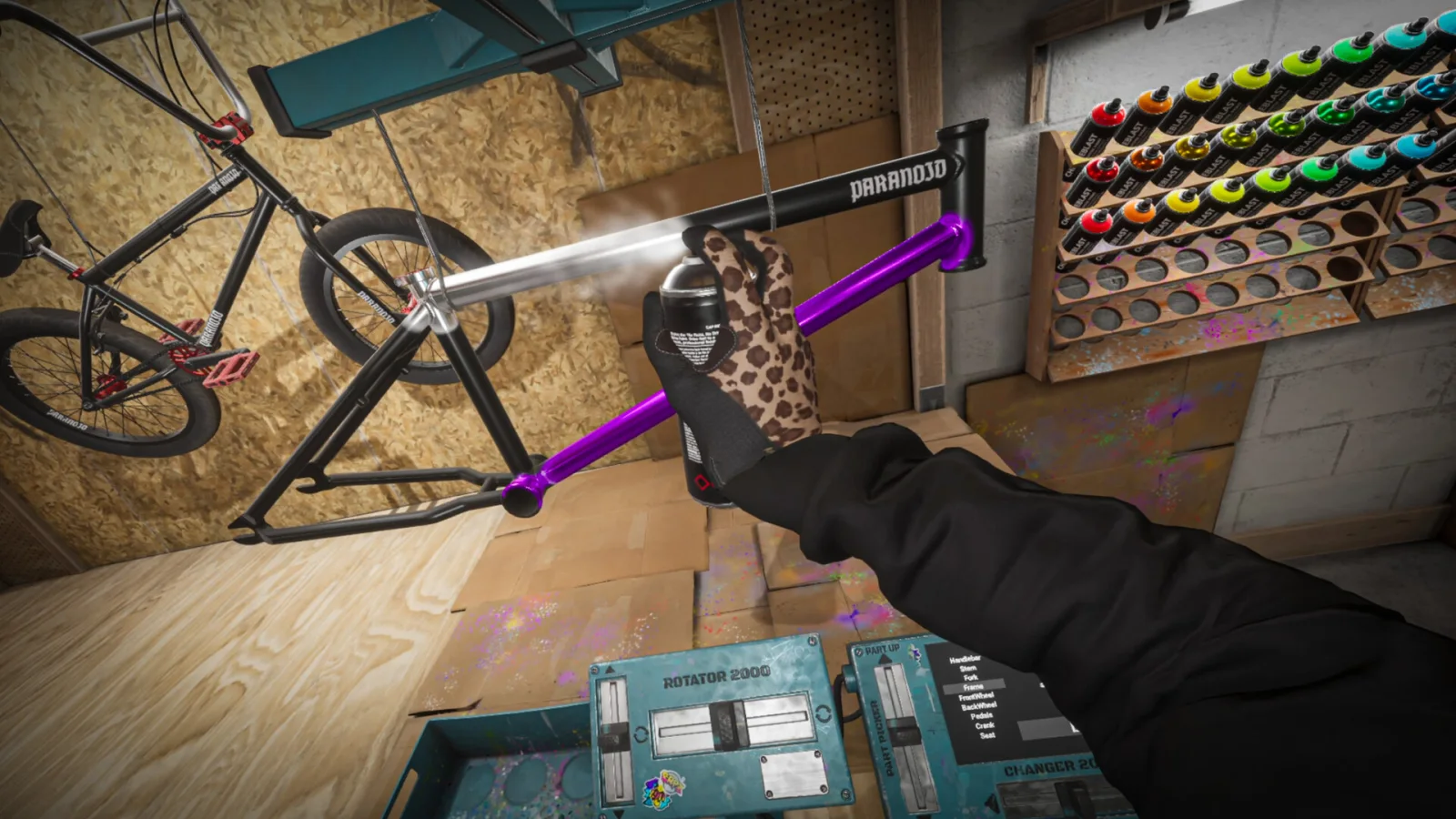
VMX also announces a spray-painting system for personalizing a ride. The description says players can grab a spray can, choose colors, blend them, create gradients, experiment with patterns, and make a custom setup. This is more specific than a simple promise of cosmetic presets: the stated goal is a hands-on painting activity with color blending and patterns.
There is an appealing thematic fit between that system and the game’s physical-control focus. If the riding side asks players to express technique through motion, a painting system could let them express taste through another direct interaction. Yet the quality of such a tool will depend on constraints the current information does not answer. It is unknown how much precision the tool permits, how designs are saved or managed, whether paint applies across all announced ride types, or what boundaries exist around patterns and colors. None of those omissions should be mistaken for missing features; they are simply unannounced details.
The developer also says players earn points while playing and can spend them on a growing collection of gear and clothing. Named examples include helmets, goggles, full-face helmets, snapbacks, and beanies. This establishes an announced earn-and-spend loop plus cosmetic equipment categories. It does not establish point values, unlock conditions, whether gear is purely visual, or the size and update cadence of the collection. The phrase “growing collection” signals an intention for expansion, but not a concrete schedule or quantity.
Design-wise, the best case is that customization gives players a reason to care about their rider and equipment without obscuring the central riding practice. A weaker outcome would be an economy that feels disconnected from the activity it is meant to celebrate. VMX’s public outline is appropriately focused on the promise of expression; it has not supplied enough detail to judge the balance of that progression.
Comfort options need clarity as well as availability
VMX announces a Comfort Mode with additional options intended to reduce motion discomfort while leaving the player in control. This is an important stated consideration for a VR game built around moving through riding environments. However, the announcement does not identify the options included, their trade-offs, or their effects on different activities. It would be inappropriate to claim that the mode solves comfort concerns, or to predict headset performance, from the available information.
What can be said is that the design recognizes a genuine tension: a riding game may want a strong sense of momentum and physical presence, while players can have different tolerances and accessibility needs. A useful comfort suite would ideally make its choices legible, allowing people to understand what an option changes and choose the level of intensity that suits them. Whether VMX achieves that clarity is a question for future direct evaluation, not a conclusion supported by the announcement.
Multiplayer broadens the stated purpose of the parks
The multiplayer pitch is broad. Break Free Interactive says players will be able to ride with friends, explore maps, session favorite spots, practice tricks together, and compete in challenges. This establishes both social and competitive intentions. The description does not specify player counts, matchmaking, communication features, challenge formats, cross-platform support, private sessions, moderation tools, or network performance.
That leaves a central design question: will multiplayer chiefly be a place to share riding spaces, a formal competitive layer, or a flexible mixture of the two? The phrase “session your favorite spots” suggests an interest in informal shared practice, while head-to-head challenges point toward structured comparison. Those modes can complement one another if competition gives practice an understandable target and shared play makes experimentation more inviting. They can also require careful onboarding, particularly where players possess different familiarity with physical gesture controls. The official outline establishes the ambition for a crew-oriented experience, not the shape or quality of its social systems.
For readers interested in how a preview can separate declared systems from evidence about their execution, our design preview of Tower Tactics II takes a similarly cautious approach to announced mechanics.
What is established, and what still needs demonstration
The established picture is substantial but bounded. VMX is from Break Free Interactive and is listed by its official store page with Action, Indie, Racing, Simulation, Sports, and Early Access classifications. Its announced design includes VR riding with BMX bikes, mountain bikes, and scooters; physical gesture-based tricks; a custom physics system; parks and line selection; spray-paint customization; earnable points for gear and clothing; Comfort Mode options; and multiplayer riding, exploration, practice, and competitive challenges. The official listing gives March 26, 2026 as its release date.
The unresolved picture is equally important. There is no hands-on basis here for claims about responsiveness, realism, comfort outcomes, visual quality, content scale, challenge balance, progression pace, multiplayer reliability, or the practical differences among ride types. There is also no published detail in the supplied material about campaign structure, map count, scoring criteria, locomotion settings, control calibration, or post-release plans. These are open questions, not evidence that such elements are absent.
VMX’s announced design is most interesting where it makes physical input, rider technique, and personal style part of one idea. The game proposes that a player can choose a ride, approach a park in their own way, perform a gesture-driven trick, paint a personal setup, and share or contest those spaces with others. That is a coherent direction. Its eventual success will rest on execution that this feature list cannot yet prove: controls must be interpretable, physics must support learning, customization must feel usable, and multiplayer must give the shared ride a dependable purpose. Until those elements can be directly assessed, VMX is best understood as a clearly framed VR riding concept with meaningful questions still attached to every major system.