Pidgeon Pocket is an announced PC design preview, not a scored review. It has not been assessed through hands-on play for this piece, and its balance should not be judged from older pre-release commentary. Developer and publisher Javier Lianes García has indicated that balance changes were planned after that earlier material. What follows therefore separates the game’s stated design from the questions that its finished version will need to answer.
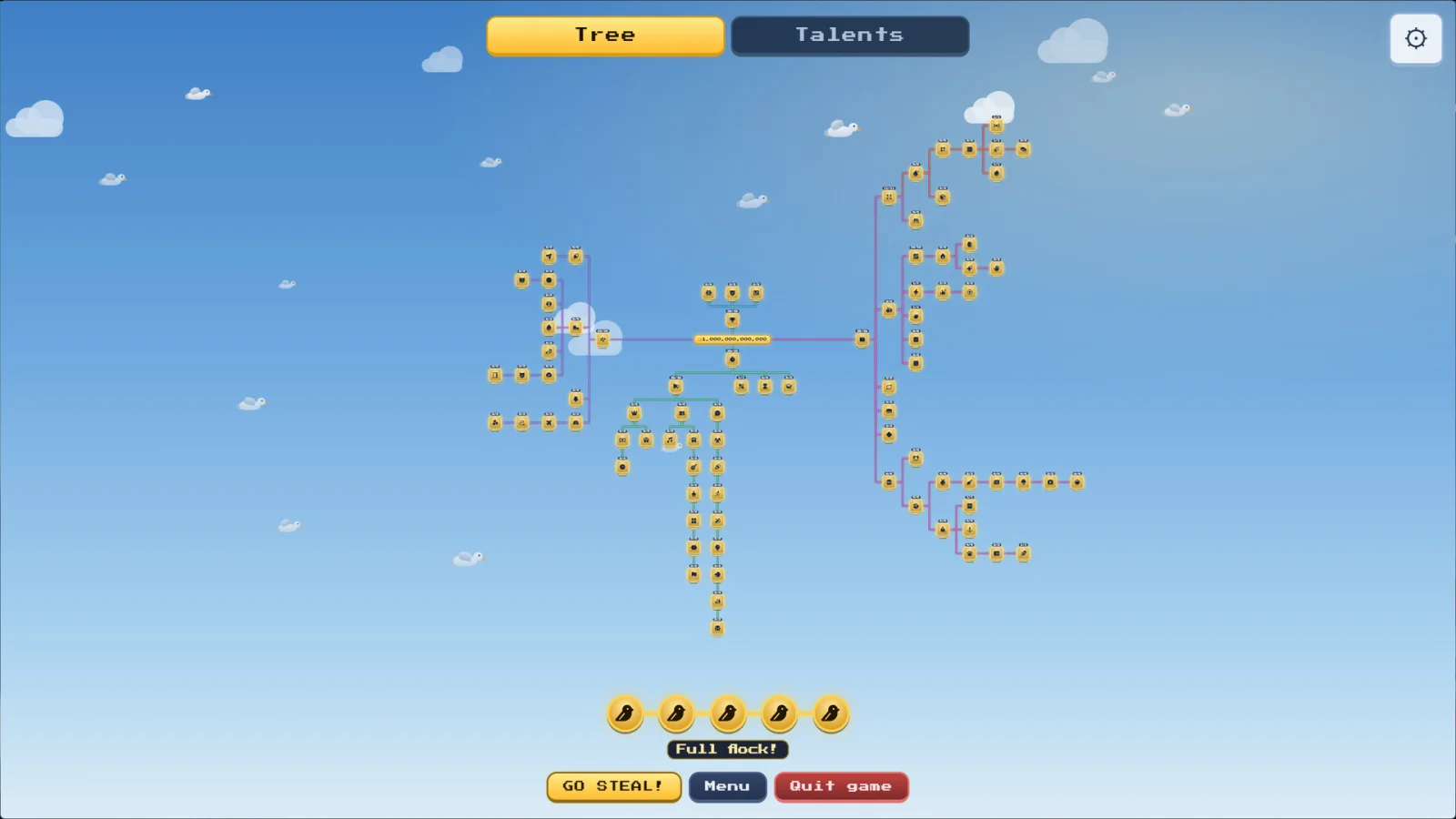
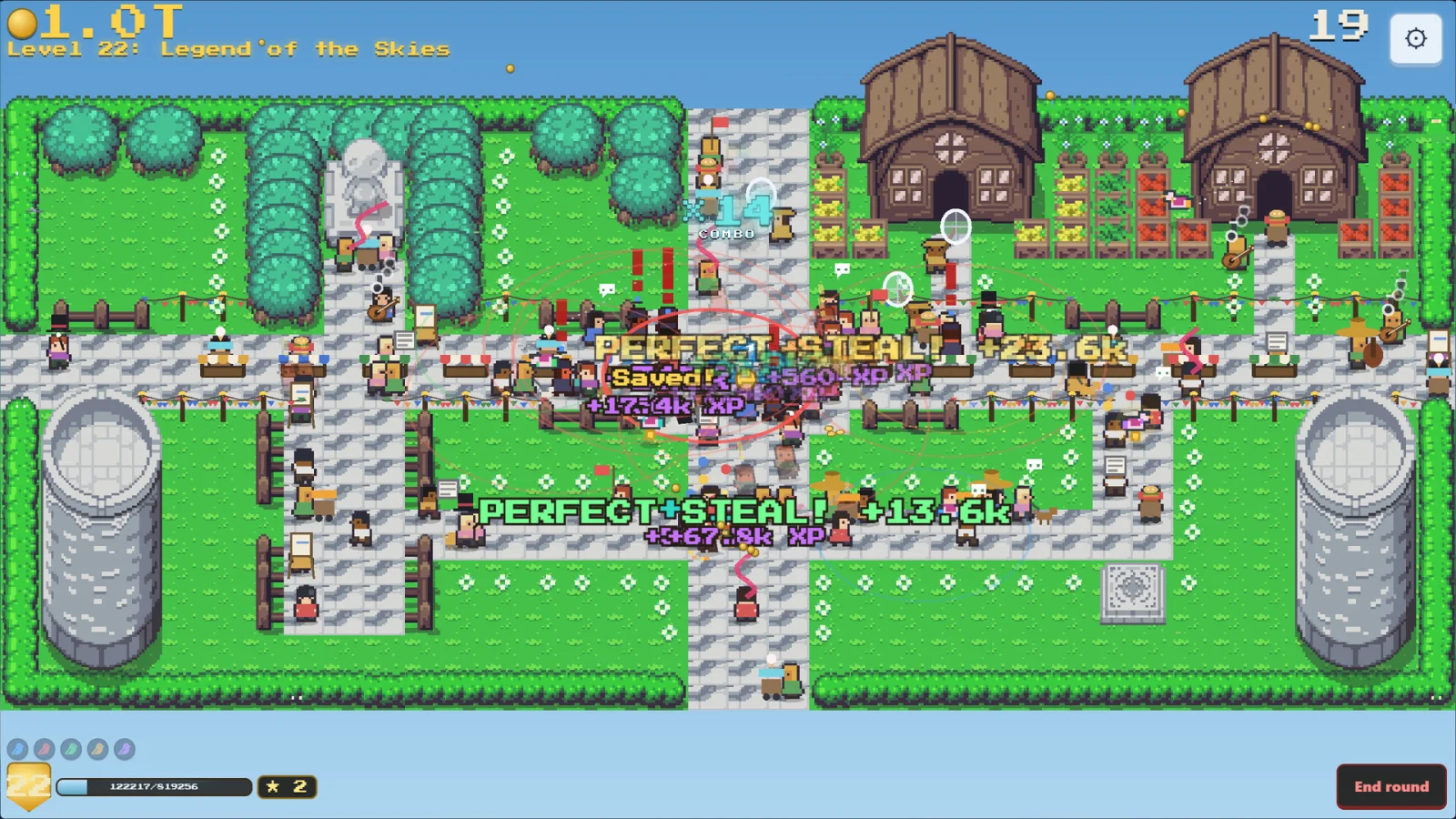
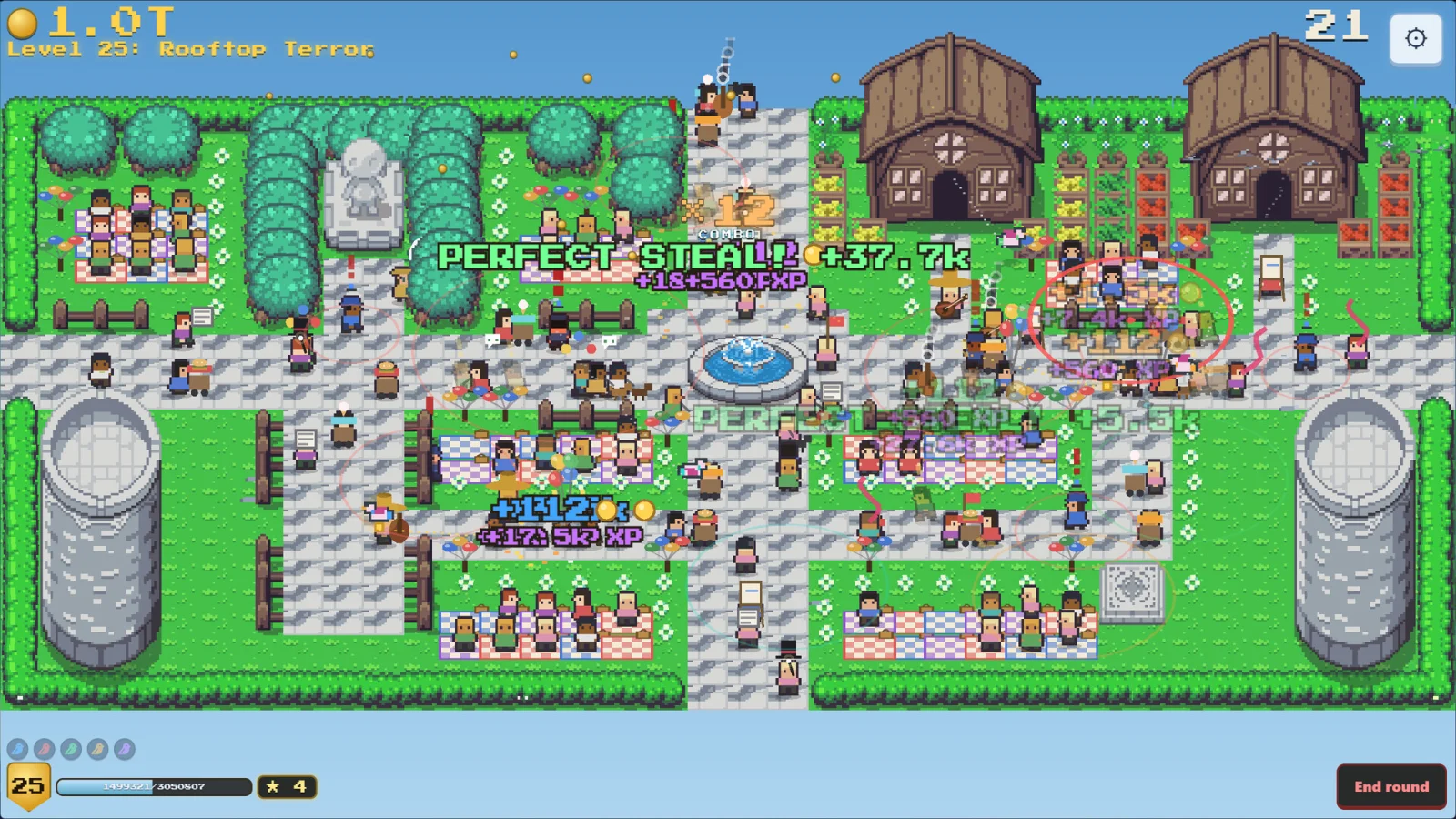
The established pitch is immediately understandable: Pidgeon Pocket is a kawaii incremental pigeon heist in which players aim a flock at coins. From there, the flock can be developed through a branching upgrade tree and through breeding tiers that begin with Street Pigeon and extend to Imperial. Those tiers are described as providing persistent benefits. Law nets are also presented as a threat to heists. The game uses mouse-only controls and officially lists support for 30 languages.
That is a concise set of ingredients, but it points toward a potentially useful tension. Incremental games often live or die on the relationship between simple repeated input and the decisions that gradually reshape its value. A flock aimed at coins is a deliberately direct central image; breeding, upgrades, persistent benefits, and law pressure are the elements that could turn that image from a pleasant loop into a system with texture. The word could matters here. The announced features describe the building blocks, not yet proof of their final pace, depth, readability, or satisfaction.
Established design: a flock, coins, upgrades, and risk
The core stated activity is aiming pigeons at coins. That makes the mouse-only control scheme seem aligned with the premise at a basic level: a pointer is a natural tool for directing a flock across a screen. This is a statement about the apparent fit between the announced input and objective, not a claim about responsiveness, comfort, remapping, or broader accessibility. Mouse-only operation by itself cannot establish whether the game will accommodate different needs or preferences.
The upgrade tree is explicitly described as branching. Branching language is important in an incremental game because it suggests that advancement may involve choosing a direction instead of simply purchasing every available numerical improvement in a fixed order. Yet a visible fork is not automatically a meaningful decision. The eventual tree may create interesting choices only if its routes have trade-offs that matter at the moment players select them. A branch that changes how a flock approaches coins, alters exposure to nets, or reinforces a distinct breeding focus could create an identity for a given run or long-term plan. A branch that is merely an obvious next purchase would still provide progression, but not necessarily choice.
The breeding tiers are the other stated growth structure. Street Pigeon and Imperial give the system a playful social ladder, and the promise of persistent benefits means breeding is positioned as more than a cosmetic label. Persistence can be especially effective in incremental design because it makes repeated effort feel cumulative. It offers a reason for a player to look beyond the immediate next coin and toward the shape of a growing collection or lineage. At the same time, persistent gains need an intelligible relationship to the game’s other pressure. If they become the dominant answer to every problem, temporary decisions may feel secondary. If they are too slight or too opaque, the breeding ladder may lose its sense of occasion. The public outline does not establish where Pidgeon Pocket will land on that spectrum.
Law nets provide the announced counterweight. Their presence is notable because they imply that a heist is not only about accumulating value. A threat that interrupts or complicates the pursuit of coins could prevent the loop from becoming entirely passive in feel, asking the player to pay attention to flock position and risk. But this possibility depends on implementation that has not been confirmed. Law pressure could create lively interruptions, or it could feel disruptive if the player cannot understand why a net appeared, what decisions affected it, and what practical response is available. The key question is not simply whether danger exists; it is whether the game explains danger clearly enough for the player to make a considered choice around it.
The promise of short, readable sessions
The visible nature of the announced loop has potential. Directing a flock at coins offers an immediate action with an immediate target, which may suit short sessions if the results of that action are easy to see. In the best case, a player could open Pidgeon Pocket, identify a worthwhile next goal, guide the birds, make one or two decisions about upgrades or breeding, and leave with a clear sense that something changed. That sort of compact return is valuable for incremental games because it respects the appeal of steady growth without requiring each visit to become a lengthy commitment.
Still, this is conditional design analysis rather than an assertion about the game’s actual session structure. No runtime, timing model, income model, or automation behavior is established by the supplied information. It would be wrong to assume timers, offline gains, idle accumulation, or any other familiar genre convention merely because Pidgeon Pocket is described as incremental. What can be said is narrower: its stated objective is visually concrete, and concrete objectives often give an incremental game a useful foundation for short-form play when the feedback and next decisions are readable.
Readability may become the central challenge as the flock grows. A small group of pigeons moving toward coins is easy to parse in principle. A larger group, multiple upgrade effects, breeding distinctions, and the arrival of nets could make the same screen much busier. The finished game will benefit if a player can quickly distinguish the information needed to act: where the flock is going, what it is gaining, what threat is present, and why a particular upgrade or tier matters. If that information is clean, the kawaii presentation could support the mechanics by making a dense system inviting rather than intimidating. If the visual hierarchy is unclear, the charm could be asked to carry decisions it does not adequately communicate.
This is also where a simple premise can be deceptive in a positive way. A game does not need a huge number of interacting systems to create an engaging incremental rhythm. It needs enough contrast between immediate reward, long-term development, and occasional risk that the player has reasons to evaluate the next action. Pidgeon Pocket’s announced ingredients map onto those roles: coins for immediate reward, a tree and breeding tiers for development, and nets for risk. The encouraging part is the clarity of that outline. The unresolved part is whether the individual systems will genuinely influence one another rather than sit alongside each other as separate progress bars.
Branching upgrades need real consequences
The branching tree is where Pidgeon Pocket has the clearest opportunity to avoid a purely linear climb. A good incremental upgrade choice does not necessarily need to be permanent, punishing, or complex. It simply needs to ask a question that has more than one credible answer. One route might be attractive because it strengthens a player’s current situation; another might offer a slower payoff with a different relationship to risk. The player should be able to understand why either option is tempting.
That principle does not require guessing at the actual contents of Pidgeon Pocket’s tree. No specific upgrade effects, prices, prerequisites, or respec options have been established. It does, however, provide a useful lens for the announced design. If the branches have trade-offs that matter, they may give players a reason to compare plans and feel ownership over a route through the game. If every branch is effectively solved by whichever option produces the largest immediate return, the tree may still function as a delivery mechanism for upgrades, but its branching form will add less strategic value.
Persistent breeding benefits raise a related balancing question. Long-term progression can make a game reassuring: even a modest session contributes to a larger project. But it can also flatten the significance of temporary heist decisions if permanent accumulation answers every obstacle automatically. Conversely, making a temporary situation meaningful should not make lasting advancement feel irrelevant. The interesting version of Pidgeon Pocket would find room for both: a breeding ladder that gives the player durable goals and moment-to-moment law pressure that keeps directing the flock from becoming an entirely routine gesture.
Because prior balance discussion is explicitly outdated, this is not the place to declare the current progression too fast, too slow, too generous, or too demanding. The announced balance changes make that especially inappropriate. Balance will need to be evaluated against the release build or a documented playable build, with attention to how earning, purchases, breeding, and nets actually connect. Until then, the responsible conclusion is that the concept contains several levers worth watching, not that any one of them has already been tuned well or poorly.
Law nets could define the heist identity
The phrase “pigeon heist” gives Pidgeon Pocket a comic identity, while law nets suggest the joke has mechanical consequences. Without a counterpressure, aiming at coins might remain a relaxed collection activity. With a comprehensible threat, it may become a small risk-management exercise: the flock is valuable precisely because it can be put in jeopardy. That is potentially a strong way to distinguish the game’s theme from its incremental framework.
For that distinction to work, law pressure should ideally be legible rather than arbitrary. Players need not know every hidden value, but they should be able to recognize a net as a meaningful event and relate it to choices they can make. Clear feedback can make a setback feel like part of the game’s conversation with the player. Unclear feedback can make the same event feel like an interruption detached from planning. Nothing in the present information confirms how Pidgeon Pocket communicates this pressure, so this remains an implementation goal rather than a claim about the game’s current state.
The relationship between danger and persistence is especially promising on paper. Permanent benefits can encourage confidence and investment in the flock, while a temporary threat can ask players not to become complacent. If those forces are allowed to pull against each other in understandable ways, Pidgeon Pocket may achieve a more active flavor than its cute exterior initially suggests. If they do not, either side could lose definition: nets might become noise, or breeding might become a number that rises without changing decisions.
A restrained preview verdict
Pidgeon Pocket’s announced design has a clean thematic hook and a sensible mechanical outline. Coins provide the immediate target; a branching tree and breed tiers provide longer-term development; persistent benefits promise continuity; and law nets introduce a stated source of heist pressure. Its mouse-only approach appears suited to the basic act of aiming a flock, while the official 30-language listing indicates a broad language offering. Those are established points, not substitutes for evidence about handling, accessibility, balance, or final content.
The game’s real test will be the quality of its relationships. Branches need trade-offs that matter. Persistent breeding needs to complement rather than erase temporary risk. Nets need to be clear enough that pressure feels actionable. And as the flock grows, the screen needs to preserve a readable connection between action and outcome. Those are not complaints about a game already played; they are the questions raised by a promising announced structure.
For readers interested in another announced game whose design can be discussed without pretending that promise is proof, see our Star Conflict: Burrownauts preview. Pidgeon Pocket deserves the same measured approach: its premise is easy to like, but the eventual verdict depends on the playable details that have not yet been established.