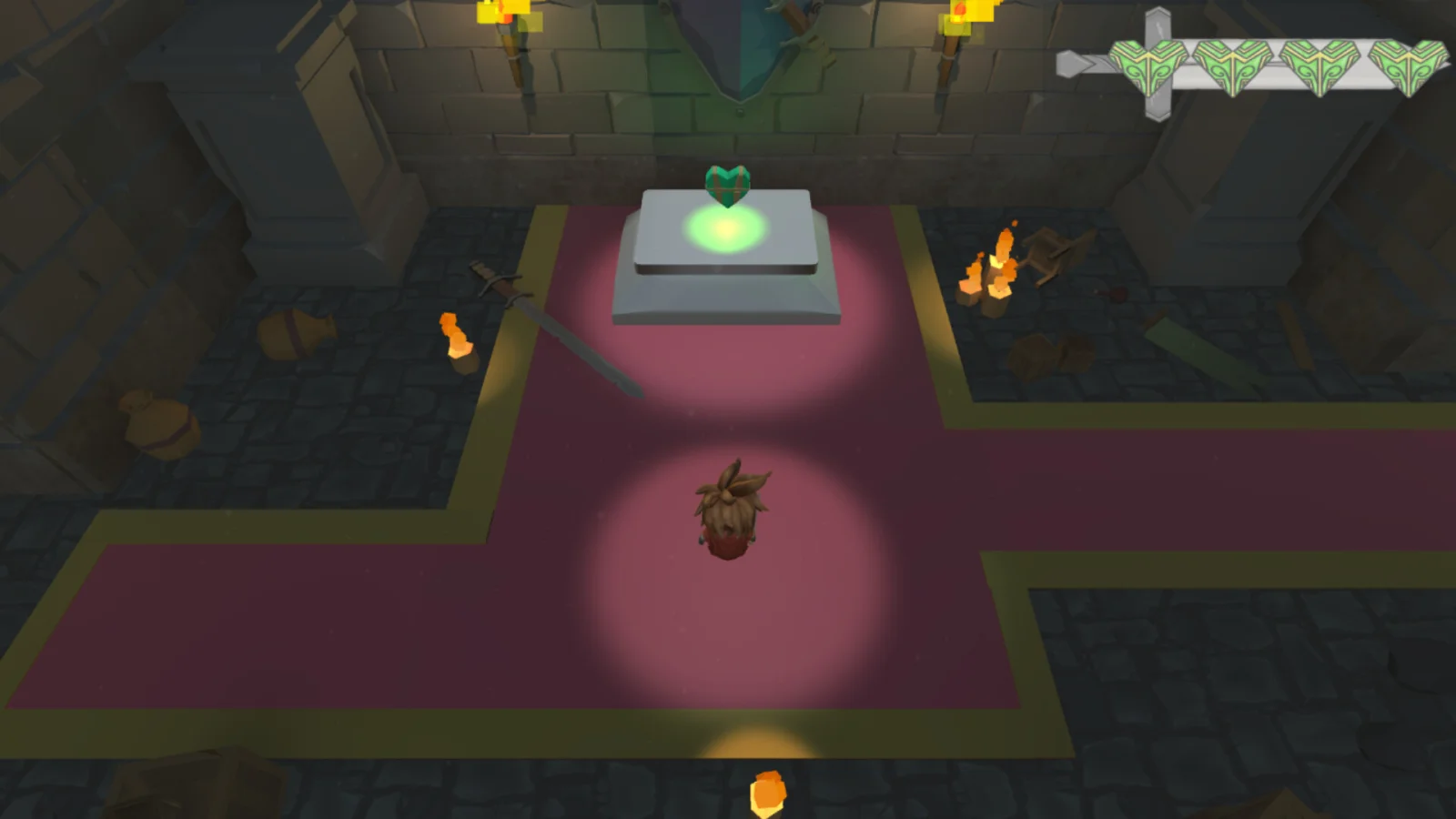
Oops! You’re the Hero! starts from a useful inversion of fantasy obligation: its protagonist is not seeking a crown, a prophecy, or even a noble cause. He is a thief who steals a forgotten artifact, gets marked as the Hero, and must travel to return the thing he took. That is a briskly legible setup with room for comedy, irritation, and a more ordinary person’s view of a world suddenly dragging old legends back into circulation.
The game is an action-adventure for PC set in Othaya, a place described as having moved beyond magic and monsters until both begin returning to threaten everyday people. It frames that resurgence through a reluctant central character rather than a conventional savior. Tut Puff, a companion who is said to talk constantly, accompanies the journey. There are also flying sheep, which is the kind of detail that signals a fantasy game willing to puncture its own gravitas before it hardens into generic chosen-one business.
That premise is enough to make Oops! You’re the Hero! worth watching for players who want a short, story-led fantasy excursion rather than a vast commitment. But the available information supports an assessment of intent, not of execution. The important unanswered questions concern how its humor lands, whether its routes feel genuinely distinct, how its sword encounters play, and whether its central return-the-artifact journey earns an ending. Those are not minor gaps in an action-adventure; they are the work itself.
A hero by administrative error
The strongest idea here is not simply that the protagonist is reluctant. Reluctant heroes are plentiful. It is that his unwanted status appears to grow out of theft: the artifact makes him a target, and the solution is restitution. That creates a potentially grounded motive beneath the magical framing. The objective is easy to understand, while the danger comes from a world in which old threats have reclaimed space.
Othaya’s premise could also give the game a pleasingly off-center tone. A setting that has “moved on” from monsters invites questions about how ordinary people respond when fantasy history becomes current affairs again. The announced story is humorous, so the likely appeal is less in solemn lore than in the friction between an unwilling Hero, a chatty companion, and a population confronted with problems they believed belonged to the past.
Whether that comic angle has range remains unknown. A constantly talking sidekick can be an effective counterweight to a quiet or exasperated lead, especially over a compact adventure. It can just as easily become exhausting if the writing treats constant chatter as a joke in itself. Tut Puff’s presence is a clear tonal promise; the quality, timing, and frequency of that humor are not established.
Players drawn to stories about agency and consequences may notice a familiar neighboring interest in what you leave undone. Oops! You’re the Hero! points in that direction through avoidance routes, though it should not be mistaken for a confirmed consequence-heavy RPG. Its stated format is linear and story rich, and no detail currently demonstrates how broadly choices alter events.
Optional combat is the feature to scrutinize
The clearest gameplay proposition is a path structure that can offer fights or avoidance. Players may explore secrets or confront bosses with a sword, while massive monsters rule their respective biomes. This gives the game a potentially welcoming shape: someone who prefers discovery and evasion may have an alternative to direct conflict, while someone who wants to test the protagonist’s sword can seek confrontations.
On paper, that flexibility suits the premise. A thief pressed into heroism does not need to behave like a fearless warrior at every turn. Avoidance can make narrative sense, not merely serve as an accessibility checkbox. Likewise, choosing to challenge a boss can express a player’s desire to meet the fantasy adventure on its most traditional terms. If the routes are designed with equal care, the contrast could support a pleasantly personal play style within a concise linear journey.
Still, “different paths” is a broad description. It does not establish whether avoidance involves stealth, navigation, dialogue, environmental problem-solving, or simply taking another corridor. Nor does it confirm that boss encounters are optional in every relevant sense, that secrets reward thorough exploration in a meaningful way, or that choosing combat changes the story. The existence of alternatives is promising; their depth is the central unknown.
This distinction matters for buying expectations. A player looking for demanding, technical action should wait for evidence of encounter design, responsiveness, difficulty options, and boss variety. A player hoping for a nonviolent or low-conflict adventure should likewise wait for clarity on what “avoidance” actually asks them to do. The feature list supports both combat and evasion as intended approaches. It does not yet prove that either approach is consistently satisfying.
Small scale may be the right scale
The stated playtime is two to three hours. That should be read as publisher-provided context rather than a measured completion estimate, but it is still useful for understanding the project’s apparent ambition. Oops! You’re the Hero! is positioned as a short journey, not a sprawling fantasy campaign. In a genre that frequently asks for dozens of hours before its final credits, a brief adventure with one clear errand can be a genuine advantage.
A shorter running time could help its jokes, premise, and strange details stay fresh. It may be especially attractive as a one- or two-sitting game for players who want narrative momentum without an overflowing map or a long equipment grind. The prospect of biome-ruling monsters and hidden secrets suggests enough variety to make the trip feel like a journey, while the linear designation sets a sensible expectation that the game is guiding players toward a particular destination.
The corresponding risk is compression. A story about the return of magic and monsters needs enough room for Othaya to feel more than a backdrop, and a choice between fighting and avoiding needs enough room for both options to feel deliberate. Two to three hours can be ideal when a game knows exactly what to foreground. It can also leave a concept feeling like a prologue if character beats, biome identity, or route differences are too lightly sketched.
No reliable basis exists yet to judge pacing, replay value, the significance of secrets, or the final narrative payoff. Players should therefore treat the announced length as an indication of scope, not a guarantee that every route or exploration style receives equal attention.
Who should keep this on the radar?
Oops! You’re the Hero! looks best suited to players who enjoy concise, humorous fantasy stories and do not need every adventure to turn into an enormous open-world obligation. The thief-to-Hero setup has immediate personality, and the combination of exploration, sword-bearing bosses, alternative paths, and absurd fauna makes for a more distinctive pitch than another straight-faced destiny narrative.
It may be less immediately suited to players who need confirmation of deep action systems, elaborate branching narratives, or substantial campaign length before committing. None of those qualities can be inferred from the current outline. The game may ultimately offer them in some form, but an informed expectation should stay close to what is actually described: a linear, story-rich action-adventure with exploration and choices about whether to fight or avoid danger.
There is a sound foundation in the idea of returning a stolen artifact through a world unprepared for its own old monsters. The best-case version of Oops! You’re the Hero! turns that foundation into a nimble comic quest where evasion feels clever, combat feels purposeful, Tut Puff’s chatter has comic precision, and each biome gives its imposing monster a memorable role. The less successful version would rely on that appealing setup without giving its alternatives enough texture. At present, the game’s concept earns interest, while its finished quality remains appropriately unproven.