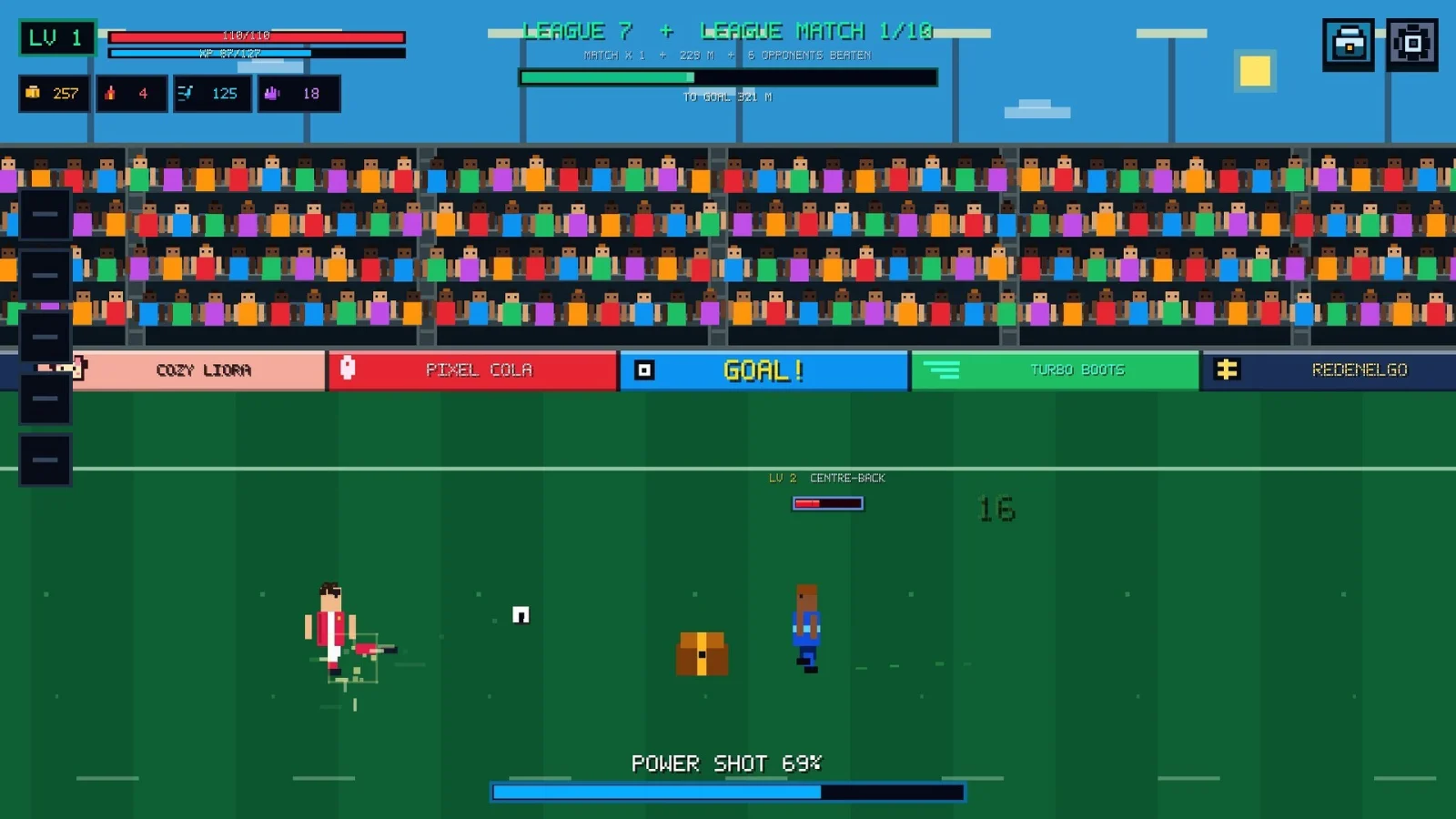
KICKSLAUGHT is a PC Early Access football-themed idle progression game with a notably focused pitch: guide a solo footballer through leagues, overcome goalkeeper encounters, gain experience and equipment, and improve core attributes. It does not present football as a dense simulation of formations, passing lanes, or full-team decision-making. Instead, its stated foundation is a career-shaped advancement loop, where the appeal rests on watching a player become more capable and making the incremental choices that support that rise.
That narrowness is neither automatically a strength nor a failure. Football’s familiar competitive ladder gives progression games an intuitive frame: better gear, stronger statistics, tougher opposition, and another league to climb. Players who want a low-input routine with a sporting wrapper may find that clarity appealing. Players expecting the moment-to-moment authorship of a traditional football game should approach far more cautiously. The key buying question is not whether one likes football in the abstract, but whether equipment-led numerical advancement sounds satisfying as the main form of participation.
A career structure, not a full match simulator
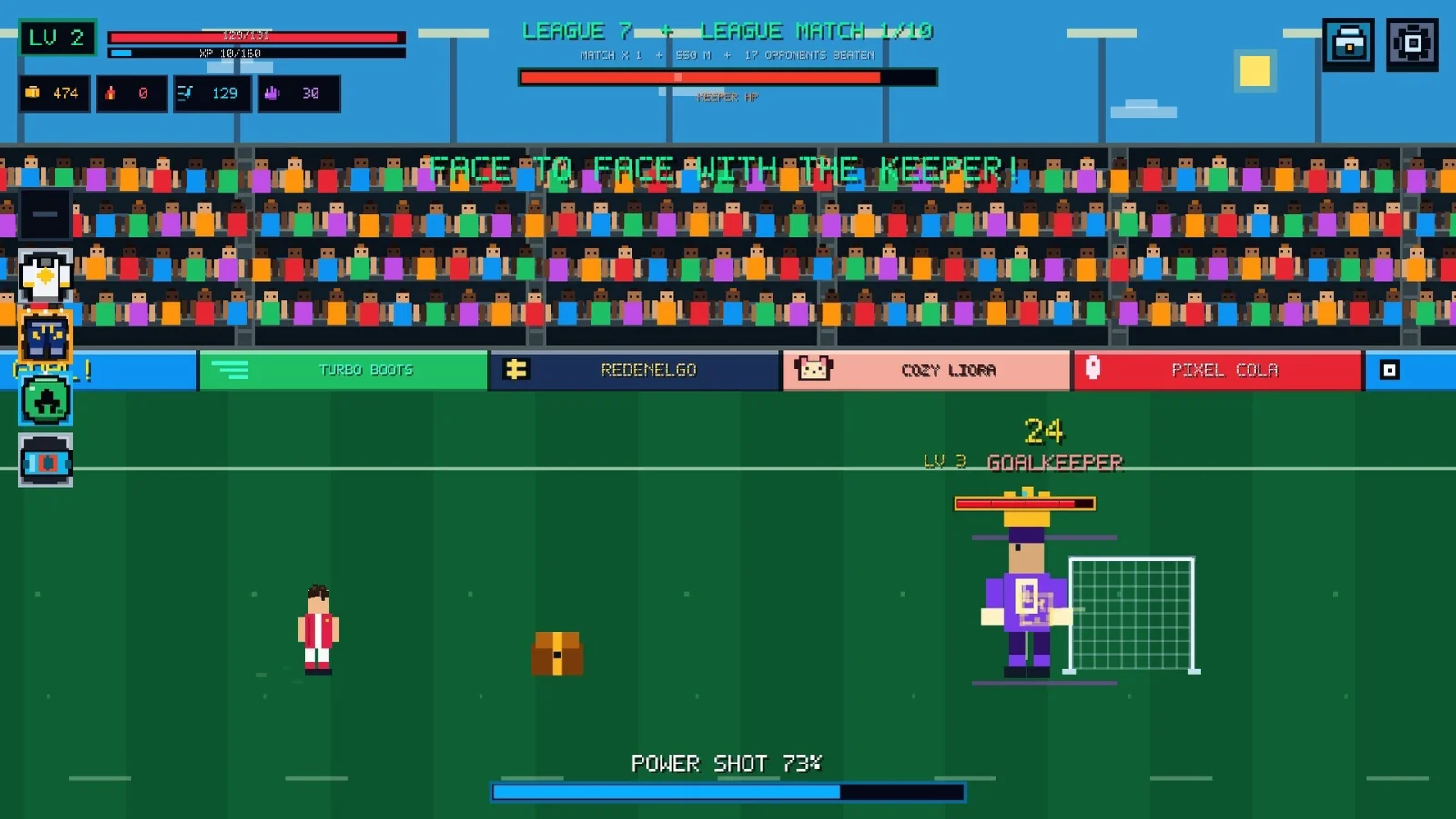
The current premise centers on a lone footballer advancing through leagues and facing goalkeepers. Experience and equipment feed the player’s development, while shot power, shot speed, and defense are listed as upgrade paths. That provides a legible progression triangle: improve the character, use those gains to push ahead, then seek the next improvement. There is also an in-game phone for career information and a neighborhood that offers temporary bonuses, giving the career loop a few contextual spaces beyond the encounters themselves.
These elements suggest an experience designed around checking status, weighing upgrades, and keeping an advancement engine moving. There is value in that kind of structure. Incremental games can make modest decisions feel meaningful when the next threshold is visible and the return on an upgrade is easy to understand. A football career is also a reasonable metaphor for this cadence: a player develops, meets resistance, and attempts to rise through the ranks.
Yet the same structure establishes a clear limit. A game built primarily around stats and equipment needs its choices to create enough texture that progress feels earned rather than merely processed. The listed upgrades point to distinct categories, but their presence alone does not establish how consequential the decisions are, how varied goalkeeper encounters become, or whether different approaches can meaningfully coexist. Those are the questions Early Access needs to answer through the build itself, not through the broad appeal of the premise.
Equipment is positioned as the practical decision layer
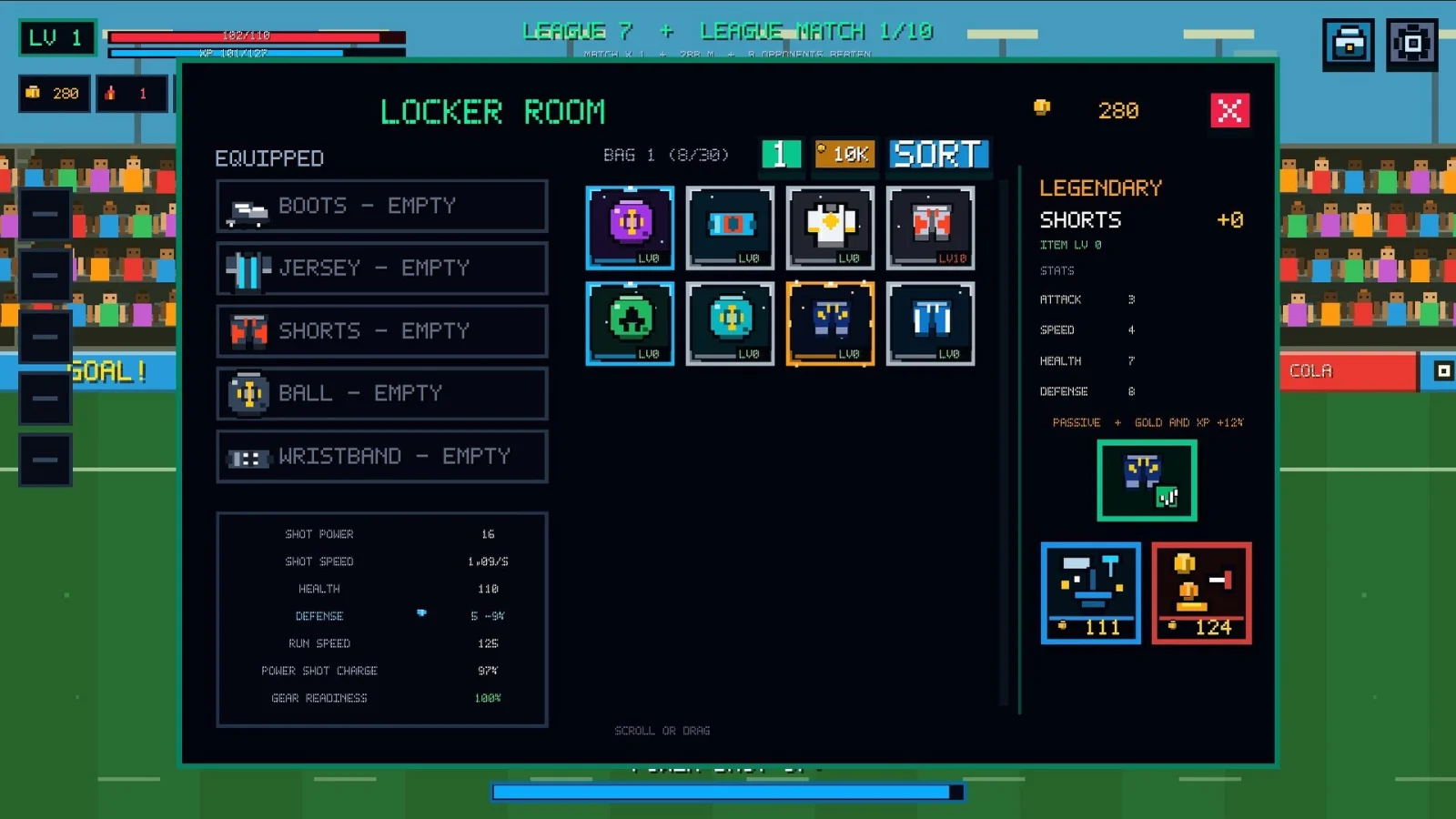
Gear is central to KICKSLAUGHT’s stated identity. Equipment is earned, and a dated outside preview described dedicated slots for a jersey, shorts, boots, wristband, and ball. It also characterized equipment management as much of the available interaction. If that remains representative of the present build, the gear screen is not a side activity; it is where players are likely to express preference, optimize a build, and decide whether the next league push is worthwhile.
That can be a smart fit for a lighter-touch football game. Rather than demand constant physical input, KICKSLAUGHT can make preparation the main event. A player who enjoys comparing drops and refining attributes may appreciate a loop that treats football progression as a compact management exercise. A player who wants to directly determine the outcome through shots, positioning, or tactical adjustments may regard the same approach as too distant from the sport’s active drama.
There is an important distinction here between simplicity and thinness. Simple systems can sustain a game when they create sharp trade-offs: power versus speed, immediate gains versus longer-term upgrades, or specialized equipment versus broadly useful options. Thin systems merely ask the player to select the largest number. KICKSLAUGHT’s official feature outline confirms the categories of progression, but not the depth of their interactions. Until that is clearer, prospective players should treat the game as a modest idle project rather than assume a deep buildcraft game is already in place.
What one early look suggests
A single independent preview from September 15 described the loop as predominantly automatic, with gear management carrying much of the interaction. It reported seven leagues of ten matches, pauses during upgrades, shallow tactical choice, repetitive progression, and a music track that looped too often. These observations are useful but limited: they are a brief, dated account from one player, not a universal verdict on the build. They do, however, underline the most relevant evaluation criteria for interested players: how much agency the encounters provide, whether equipment decisions alter the feel of advancement, and whether the game’s presentation can support repeated sessions.
Early Access asks for present-tense judgment
KICKSLAUGHT has outlined plans for more enemies, goalkeepers, leagues, equipment, and team-transfer options. Those additions could broaden the career fantasy substantially. More opposing types may make advancement less uniform; more gear could produce richer collection and comparison; transfers could provide a welcome sense of changing professional circumstances. But these are full-release plans, not confirmed present features. They should not be counted as current reasons to buy.
This is particularly important for a progression-focused game. Content additions matter, but the underlying loop must already justify repetition. If future leagues simply extend an unconvincing routine, quantity alone will not solve the design question. Conversely, if the existing equipment and upgrades produce satisfying choices, additional opponents and destinations could build naturally on a stable core. The more sensible Early Access standard is therefore modest: assess what is playable now, then view the roadmap as potential upside rather than a guarantee.
Release timing also deserves restraint. KICKSLAUGHT is available in PC Early Access, but a final-release date should not be inferred from projected development windows or conflicting date information. Anyone who prefers a complete feature set, a settled content scope, and a clearer sense of long-term depth has a straightforward reason to wait. That is not a judgment that the current approach cannot work; it is a recognition that an incremental game’s staying power is difficult to establish from plans alone.
Who should step onto this pitch
KICKSLAUGHT appears best suited to players looking for a football-flavored numbers game: people comfortable with automatic or low-input advancement, motivated by unlocking equipment, and happy to approach leagues as milestones in a solo career. The phone and neighborhood systems may add useful routine and flavor for players who enjoy a game that is revisited in short, structured bursts rather than mastered through constant mechanical intensity.
It is a weaker fit for football fans seeking direct control over the action or a strategic team-management layer. The official concept is explicitly about one footballer, upgrades, and goalkeeper obstacles; it should be judged within that remit, not penalized for declining to be an entirely different kind of sports game. Still, a sports theme naturally raises expectations of agency, tension, and variety. The design will need to make its own kind of agency persuasive.
Players who routinely enjoy compact progression games may also want to compare its appeal with other works in the site’s review catalog, such as Oops! You’re the Hero!, another game assessed through the gap between a promising framework and the substance currently available. The comparison is not mechanical; it is a reminder that an unfinished game merits attention for its playable foundations, not merely its intended destination.
An unscored work in progress
KICKSLAUGHT has a coherent core concept. Solo league advancement, goalkeeper encounters, equipment collection, stat improvement, career information, and temporary neighborhood bonuses all point in the same direction: a football career reduced to a digestible idle-progression loop. That coherence is its clearest asset. It knows it is asking players to develop a single athlete over time rather than command a full match from every angle.
Its unresolved issue is whether that focus can turn repetition into satisfaction. The available feature set supports a clean progression fantasy, but it does not yet establish the variety, choice density, or encounter texture needed to recommend the game broadly. For the right audience, the low-input format may be exactly the attraction. For anyone who needs football to feel actively played rather than primarily advanced through, waiting for clearer evidence of depth is the prudent call.