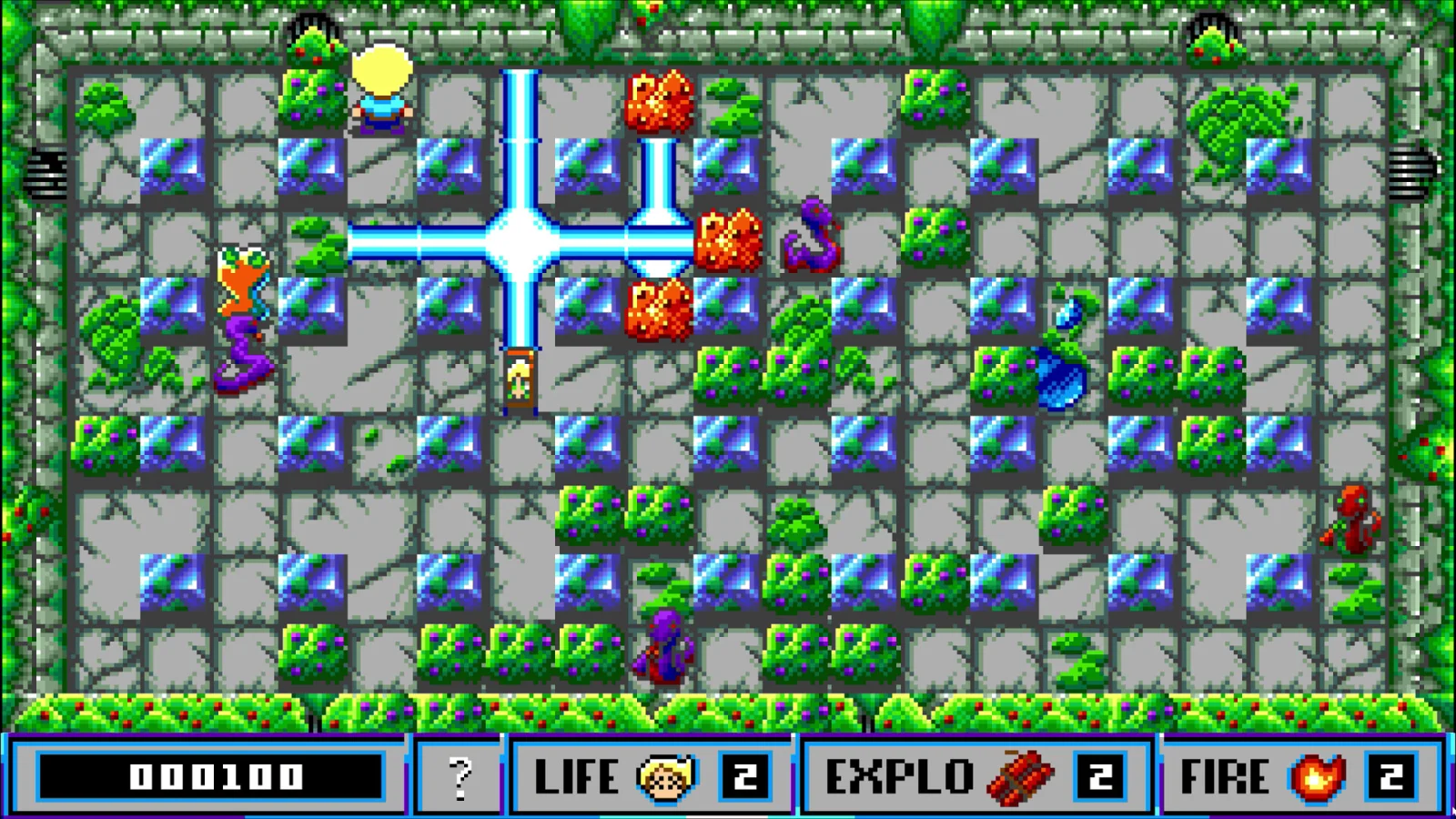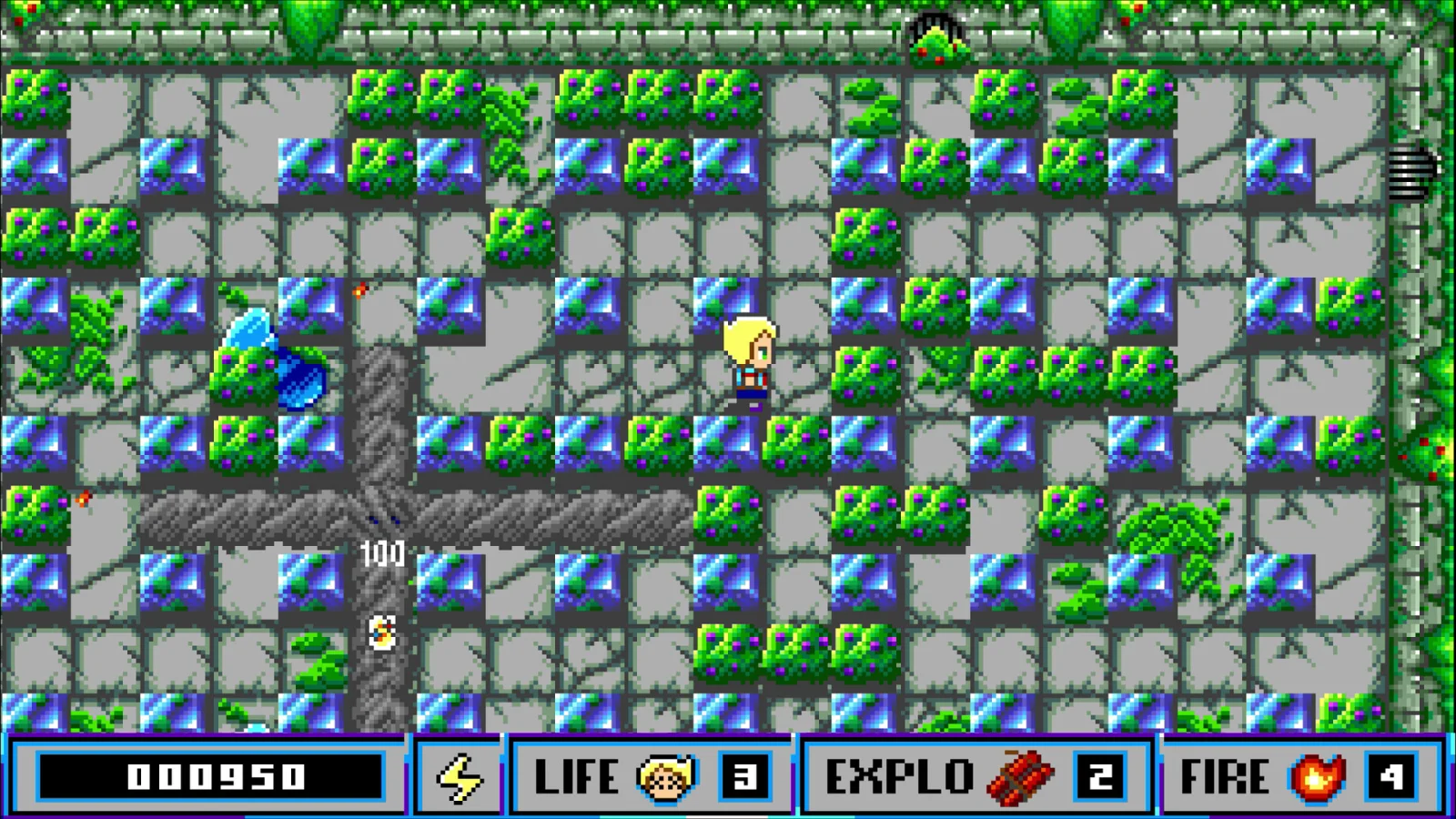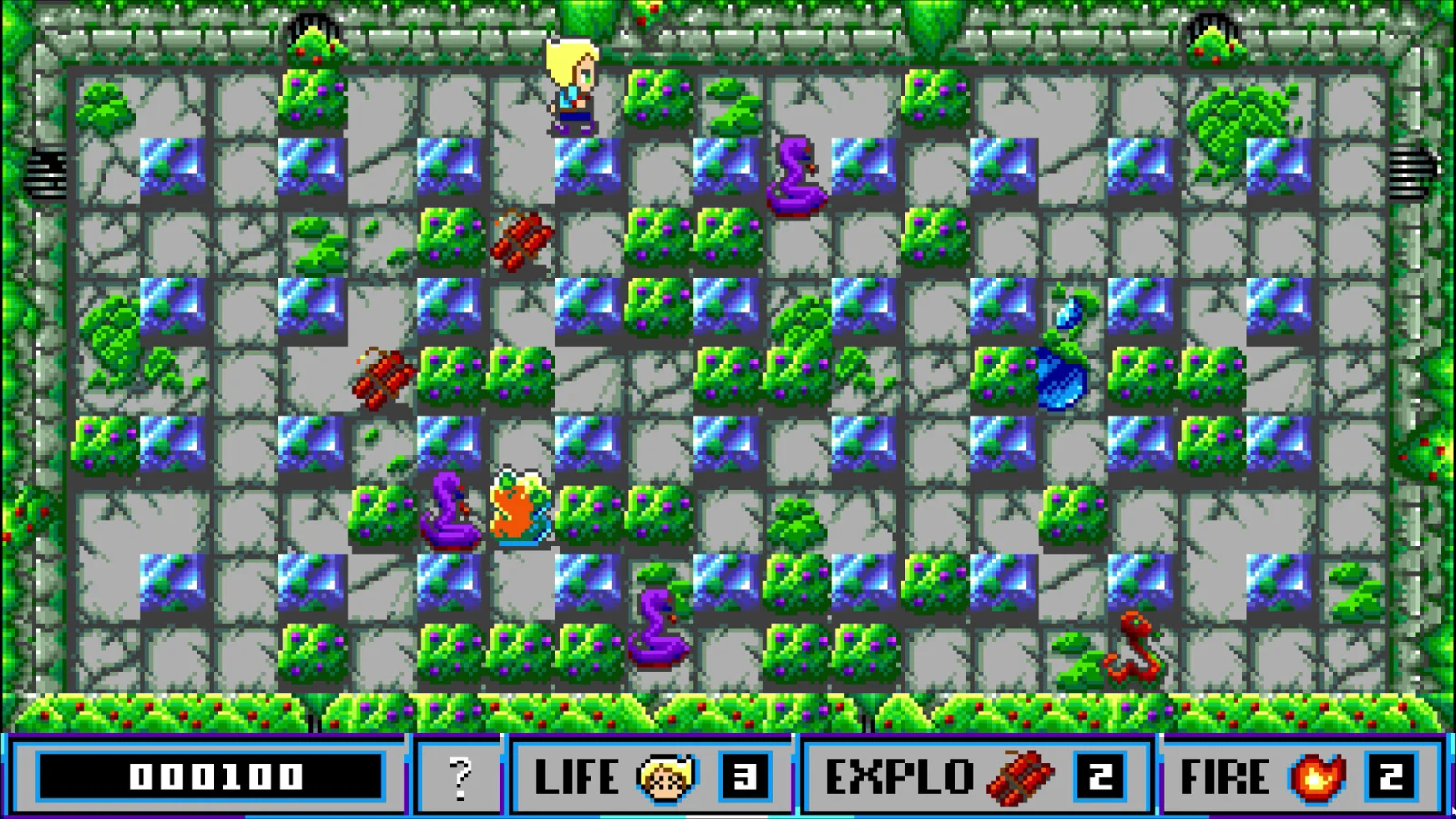
Kaboomania is a PC game developed and published by Fancy Factory, released on August 12, 2026. Verified feature information lists it is a fast-paced retro maze bomber with pixel art, single-player play, shared or split-screen PvP, controller support, Steam achievements, cloud saves, leaderboards, and Remote Play Together. The listing categorizes it as Action, Casual, and Indie.
This is an unscored assessment based on the documented outline and published critical observations, not a hands-on verdict. That distinction matters for a game built around immediate action: the available information can establish its stated features and illuminate its design priorities, but it cannot settle questions of responsiveness, technical consistency, balance, or the personal feel of a given match. What it can support is a useful reading of Kaboomania’s apparent ambition. It seems less interested in remaking the maze-bomber tradition for every current expectation than in presenting a specific, deliberately old-fashioned version of that tradition.
That approach gives Kaboomania a clearer identity than retro pixel art alone could provide. Published criticism points to an Amiga-inspired visual style, a soundtrack associated with Chris Huelsbeck, a one-button foundation, campaign play, local multiplayer for up to four players, large maps, and unusual power-ups. The same criticism raises caution around extended solo repetition, occasional glitches, a deliberately old-fashioned password system, and a reported absence of computer-controlled opponents in battle mode. Taken together, those details suggest a game whose attractions and compromises emerge from the same source: fidelity to a compact arcade design language.
Verified outline and reported context
The verified feature list establishes Kaboomania’s broad lane. It offers single-player content as well as shared or split-screen PvP, and it lists Remote Play Together alongside controller support. Cloud saves, achievements, and leaderboards place some present-day PC conveniences around the core game. Those listings are useful but time-sensitive storefront information rather than permanent guarantees, so players with a specific feature requirement should check the current page before purchasing.
Published observations provide the more textured picture. They characterize the game as colorful and distinctly Amiga-flavored rather than merely generically pixelated. They also describe local competitive play and a campaign, which is important context for interpreting the official single-player and PvP labels. Still, these reports should not be expanded beyond what they establish. The evidence supports that a campaign has been described and that competitive local play has been described; it does not establish the campaign’s structure, the exact rules of every match type, progression details, or how the various systems interact.
One reported limitation deserves precise treatment. Battle mode has been described as lacking computer-controlled opponents. That does not contradict Kaboomania’s official single-player listing, because a campaign and a solo battle practice option are different propositions. Nor does it prove that solo players will find the game thin. It does indicate that anyone hoping to rehearse competitive-style situations against AI should verify the present implementation. This is a narrower concern than a claim about the whole single-player offering, but it is meaningful for a genre in which repeated board-reading can be part of learning.
A simple action can create a dense tactical board
Maze bombers are often easy to explain because their basic verbs are compact. Movement establishes position; placing an explosive turns position into a timed commitment. Yet the compactness of that vocabulary can create considerable tactical density. A bomb is not only an attack. It can be a temporary wall, a threat to a route, a way to open a route, a signal to an opponent, or a clock that changes the value of every nearby square.
That is why the reported one-button foundation is worth considering as a design strength rather than treating it as evidence of shallowness. Mechanical simplicity and decision simplicity are not the same. If blast lines, obstacle layouts, timing windows, escape paths, and player positions are legible, one decisive input can carry several simultaneous questions. Is a route being closed too early? Is there enough room to retreat? Does an opponent have a safer exit than expected? Can one detonation turn a later placement into a chain reaction? The interest lies in having to answer such questions quickly, not in accumulating inputs for their own sake.
Spatial planning is particularly central to this form because a successful move commonly changes the meaning of the board after it has been made. A corridor that looks safe before a placement can become a trap when an explosion reaches across it. A blocked passage can be a shield until it becomes an obstruction during retreat. Chain reactions add another layer because timing ceases to belong only to one bomb. A player may be planning around a delayed danger while another placement converts that delay into an earlier, wider consequence.
These are general analytical possibilities of the format, not claims about any individual Kaboomania map. They help explain what the game’s reported premise can potentially deliver when its layouts support clear choices. The best boards in this genre do not need excessive complexity. They need readable geometry that permits players to form plans, disrupt one another’s plans, and recognize the outcome of a mistake. An arena can be compact yet feel expansive if each choke point, open pocket, and destructible obstruction alters what a player can credibly threaten.
The reports of large maps and unusual power-ups may broaden that tactical vocabulary, although the available evidence does not document the specific effects or map rules. Larger spaces could place more emphasis on navigation, pursuit, and route ownership; they could also make encounters more intermittent. Likewise, a power-up can deepen strategy if it changes how players assess space and timing, but novelty alone does not guarantee that result. The meaningful question is whether additions preserve the readability of the bomb maze or obscure it. In a fast-paced game, players need to perceive danger before an effect is already deciding the match.
Presentation as a functional part of retro design
The published criticism is consistently positive about Kaboomania’s audiovisual identity, particularly its colorful 128-color Amiga-inspired look and soundtrack. That specificity matters. “Pixel art” covers an enormous range of styles; a defined historical visual reference creates a more concrete point of view. A limited palette can be more than a nostalgic badge if it separates walls, hazards, pickups, and players cleanly enough to support rapid spatial judgment.
That final condition is necessarily analytical rather than verified. No assessment without direct testing should claim that Kaboomania remains readable in every busy situation. Still, readability is a useful lens through which to understand why a period-specific aesthetic might serve the underlying game rather than merely decorate it. In a maze bomber, a player is often making decisions at the speed of recognition. If a visual language makes the board’s important relationships easy to parse, it contributes directly to the tactical loop.
The soundtrack serves a different but complementary role. A strong retro score can give short sessions a sense of identity and make repeated returns feel purposeful rather than anonymous. It cannot resolve every possible issue with repetition or feature scope, but it can strengthen the game’s claim to be a cohesive revival rather than a set of familiar mechanics in familiar-looking pixels. Kaboomania’s apparent presentation is most persuasive as part of a larger commitment to a particular era’s sensibility.
Preservation versus modernization
Kaboomania’s most interesting tension is not simply whether retro games are appealing. It is whether a modern release should preserve older friction when that friction helps define the object being revived. The listed cloud saves, achievements, controller support, leaderboards, and Remote Play Together demonstrate that the project is not rejecting modern PC infrastructure outright. Instead, the available evidence suggests a hybrid: contemporary platform support around an intentionally historical gameplay package.
The reported password system sits at the center of this debate. The evidence does not establish what the passwords govern, so it would be incorrect to assume that they necessarily handle saving, progression, access, or every continuity function. If they govern progress or access, however, they may be read in two radically different ways. For players who value historical texture, entering or retaining a password can become a small ritual that reinforces the game’s era-specific identity. For players who expect continuity to be frictionless, the same practice may feel like administration without a corresponding tactical benefit.
Neither response is inherently unserious. Retro authenticity is not automatically valuable merely because it is authentic, and convenience is not automatically superior merely because it is modern. The question is whether a retained limitation contributes something meaningful to the intended experience. A deliberately constrained input model can foreground placement and timing. A stripped-back ruleset can make the board easier to read. A password convention may communicate a conscious archival spirit. But if the friction does not enrich play, it can feel less like preservation and more like an obstacle placed between sessions.
That distinction matters when discussing design without treating every older convention as sacred. Kaboomania appears aimed most clearly at players willing to meet it on historical ground. It may not be attempting the broadest, most streamlined modernization of the maze-bomber idea. That narrower mission can be a virtue: a game with a specific sensibility has a better chance of feeling authored. It also means prospective players should identify which version of retro they want—an updated interpretation, or a more direct encounter with an older design ethos.
For another design-focused discussion of how a central rule can determine an entire game’s appeal, see this assessment of programming as puzzle design.
Solo endurance is a different test from party energy
Published criticism identifies a risk that is familiar to many compact action games: the core loop is immediately satisfying, but may lose force during long solo stretches. This does not mean repetition is a flaw by definition. Repetition is fundamental to arcade-oriented design, where players return to a legible challenge in order to improve perception, execution, or tactical judgment. The more useful question is whether subsequent layouts and situations ask the player to revise their understanding rather than merely repeat a mastered response.
A reported large level count can therefore cut both ways. It may represent welcome density for players who enjoy honing a compact skill set across many variations. It may also make underlying similarities more noticeable if later situations do not substantially change the demands placed on the player. Quantity alone cannot demonstrate depth, but neither is it opposed to depth. What matters is the character of variation: different spatial problems, altered priorities, new reasons to value one escape route over another, or changing relationships between offense and self-preservation.
The evidence cannot establish how consistently Kaboomania achieves those forms of variation. It can, however, clarify why expectations should differ between solitary and social play. In a solo context, level design, campaign pacing, and the player’s appetite for self-directed mastery carry much of the burden. The reported lack of battle AI, if still accurate, could further matter to people whose preferred solo activity is competitive-style practice. In a group context, human behavior can continuously reframe a familiar board. A known choke point becomes less predictable when another player can bluff, panic, hesitate, or recognize a trap.
This makes Kaboomania’s official shared or split-screen PvP support potentially important to its overall appeal. Local competitive games often draw energy from the gap between transparent rules and unstable outcomes. Everyone can understand that a blast line is dangerous; no one can fully know whether another person will turn back, race for an item, create a chain reaction, or accidentally close off their own route. The social result can be lively without requiring complicated controls or dense explanation.
Remote Play Together extends that stated social orientation beyond a single room. Its listing should not be treated as proof of connection quality, latency behavior, setup ease, or any other unverified technical outcome. What can be said is that it fits the game’s documented interest in shared competition. Players with an available group may reasonably see Kaboomania differently from players who expect its campaign to carry the entire package alone.
Who the design appears to suit
Kaboomania appears best suited to players who want a direct maze-bomber loop, a specific Amiga-informed aesthetic, and the possibility of local or remotely shared competition. Its reported accessible control foundation may make it easier to explain than a game with a larger command list, while its spatial implications can leave room for more experienced players to think about timing and board control. That combination is often valuable in a party setting because newcomers can understand the immediate danger even while stronger players discover subtler positioning choices.
It may be a less certain fit for players who require extensive solo novelty, expect every retro convention to be replaced with modern convenience, or specifically want AI opponents for battle-style practice. Published criticism also mentions occasional glitches, but the available evidence does not establish their frequency, severity, or present status. That is a reason for caution rather than grounds for a sweeping technical judgment.
Pros and cons
Pros
- The verified feature list supports single-player play, shared or split-screen PvP, controller support, cloud saves, achievements, leaderboards, and Remote Play Together.
- Published criticism praises the specific Amiga-inspired pixel presentation and soundtrack.
- The maze-bomber premise can make bomb placement, escape routes, and chain reactions tactically meaningful when map readability is strong.
- Reported local multiplayer and an accessible control foundation could make the game well suited to groups with mixed experience levels.
Cons
- Published criticism warns that the central loop may feel repetitive in longer solo sessions.
- One reported old-fashioned password system may read as welcome period texture or as cumbersome friction, depending on the player.
- Occasional glitches have been reported, though the available evidence does not establish their current frequency or severity.
- The reported lack of computer-controlled opponents in battle mode may limit a particular form of solo competitive practice.
Verdict
Kaboomania appears to be a focused retro maze bomber with a coherent historical identity rather than a maximal attempt to modernize the genre. Its documented PC feature set supports both solitary and social use, while published criticism gives it a favorable audiovisual profile and identifies a potentially satisfying foundation of spatial bomb tactics. The apparent appeal is strongest for classic maze-bomber fans, Amiga-minded retro enthusiasts, and groups looking for readable competitive chaos.
The same commitment creates its principal caveats. Long solo sessions may expose repetition more sharply than a party setting does. The reported password system may feel authentic to some players and inconvenient to others. The reported absence of battle AI matters for a specific kind of solo player, and the mention of glitches warrants checking current user information rather than assuming a fixed condition. Kaboomania’s value proposition is therefore not universal modernization. It is a deliberately narrow, colorful revival whose best qualities may emerge when its old-school friction is understood as part of the design question, not ignored as an accidental side effect.