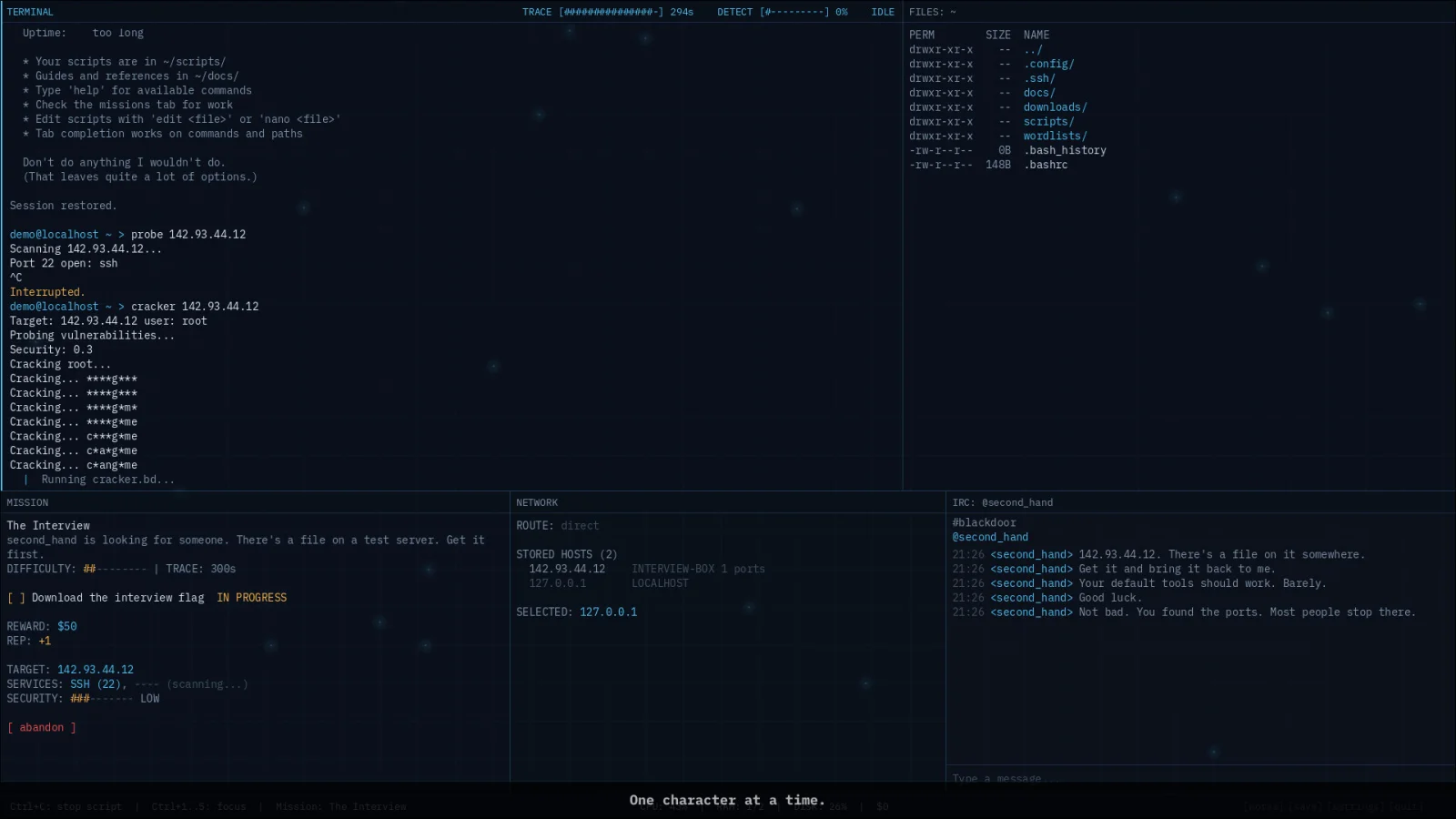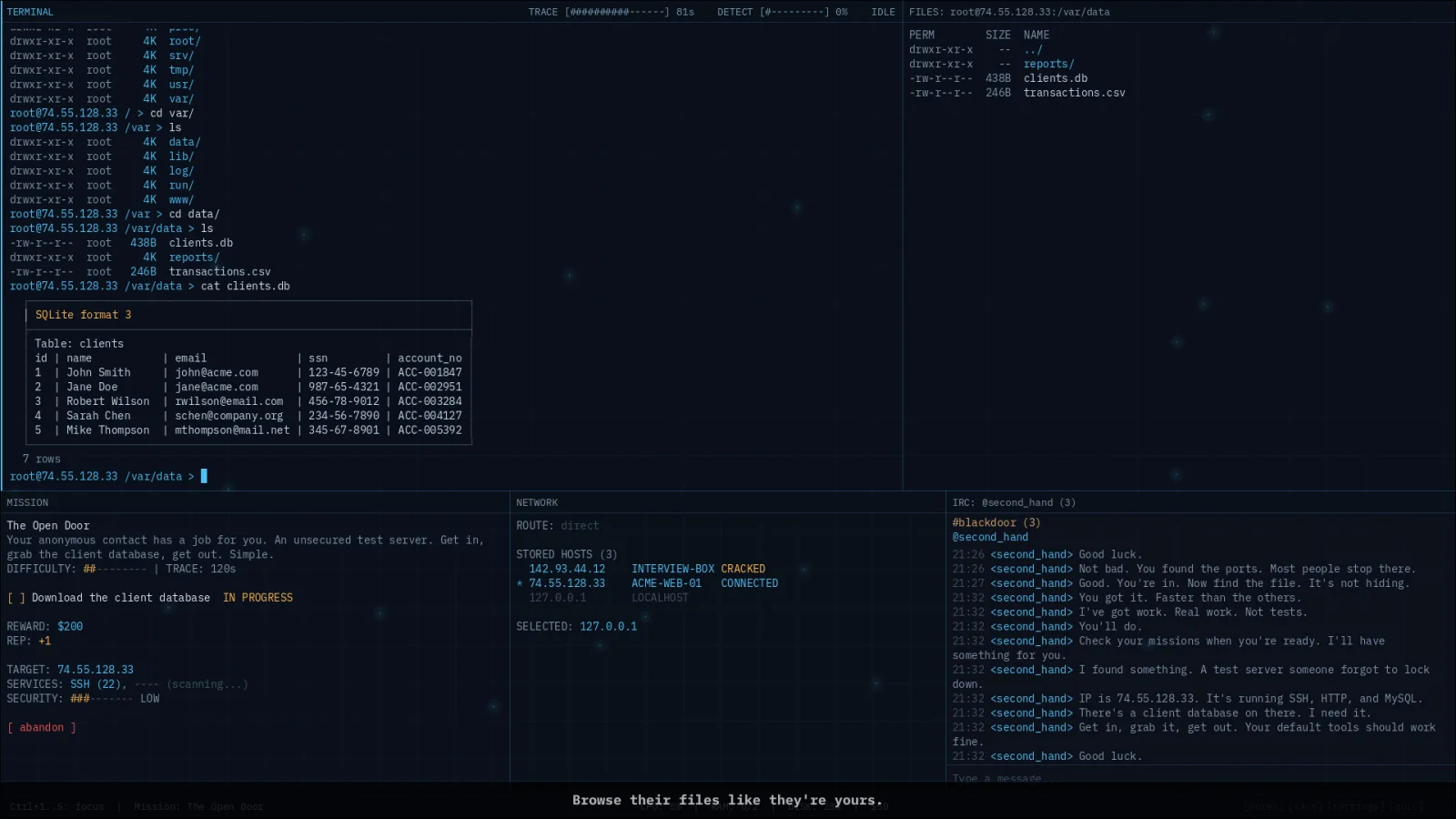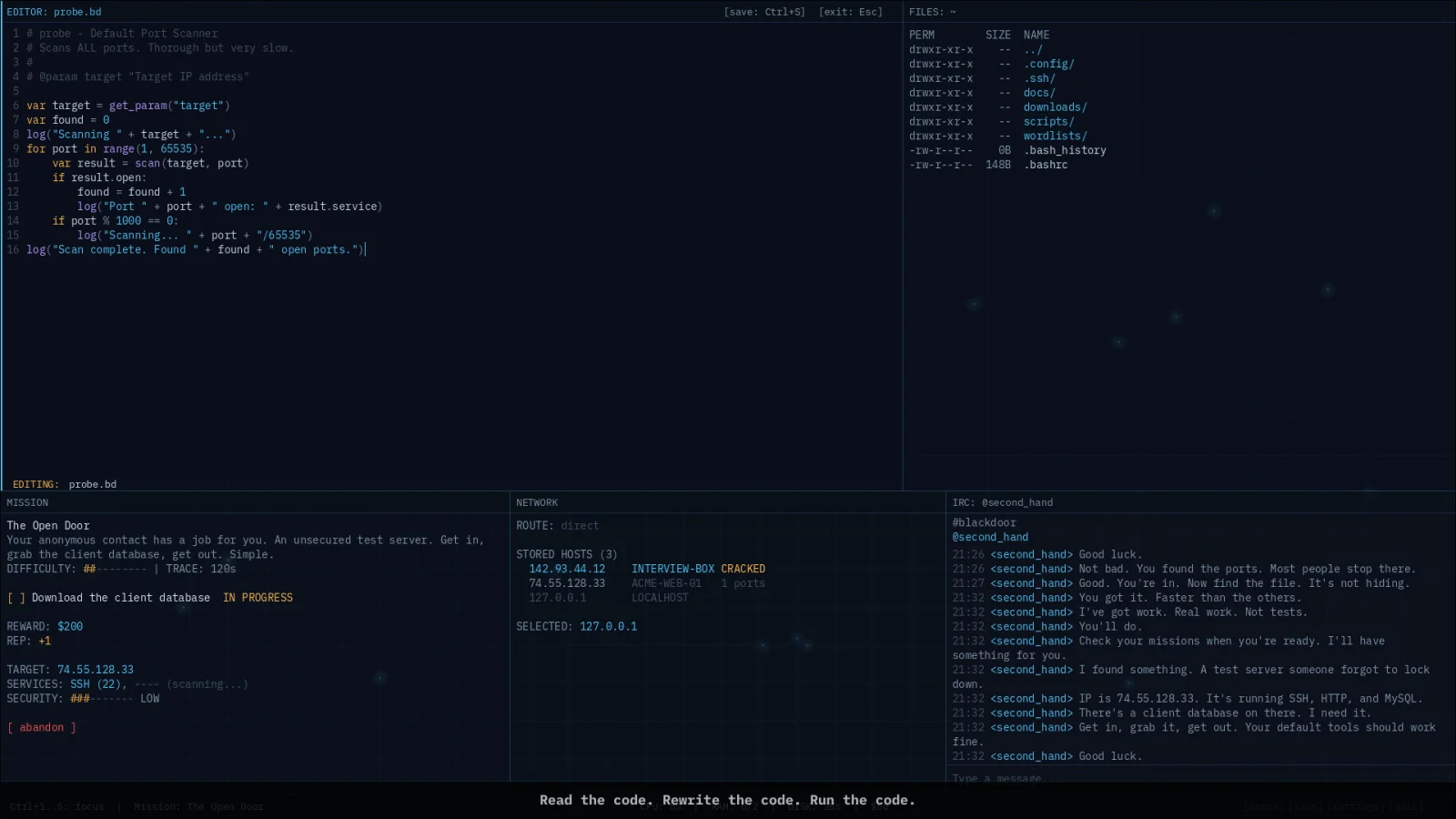
Official information identifies Blackdoor as a single-player PC hacking simulation developed and published by Static Signal, with an August 6, 2026 release date listed on Steam. Its fictional jobs arrive from a contact called second_hand through an IRC-style channel. Players are tasked with probing ports, cracking credentials, exploring fictional filesystems, escalating privileges, stealing data and racing intrusion traces. The premise is deliberately terminal-led: this is not presented as an action-hacking fantasy with command prompts as visual decoration, but as a game in which navigating systems and revising code are intended to be central to the work.
The key stated feature is a custom Python-like scripting language. Players begin with deliberately inefficient scripts and can edit them, with efficiency intended to affect how quickly and quietly jobs are completed. Blackdoor also confirms command history, tab completion and a built-in editor, alongside progression through hardware upgrades, purchased tools or improved code. Later systems include vulnerable web services, mailboxes, multi-user machines, filtered ports and alternate routes.
This is an unscored design assessment, not a claim of direct experience. No owner gameplay notes support saying that Joking Joystick played, tested, completed or benchmarked Blackdoor. The discussion therefore distinguishes confirmed features from conditional analysis of what those features could accomplish. Developer patch notes through September document changes and fixes affecting Workshop support, scripting, the editor, missions and documentation. That establishes ongoing documented work dated through September, not that every concern or issue has been resolved.
Code should be more than terminal wallpaper
Blackdoor’s most compelling proposition is that programming may be the player’s expressive tool rather than a theatrical layer over a fixed sequence of commands. There is a substantial difference between a terminal puzzle that asks players to locate the one accepted verb and a systems puzzle that lets them use understanding to make an operation clearer, faster or quieter. The official connection between script efficiency and both speed and stealth creates room for the latter.
That connection gives inefficient starter code a useful potential role. A starter script can make a problem concrete without demanding that every player author an entire solution from nothing. It gives them something to read, test and revise, while establishing that a working result need not be the best result. If the game clearly communicates the consequences of an inefficient operation, then optimization becomes an intelligible choice: not an abstract score chase, but an attempt to improve a fictional intrusion under pressure.
The terminal conveniences matter in that context. Command history can preserve prior attempts and reduce needless re-entry. Tab completion can reduce rote typing while leaving investigation and interpretation intact. A built-in editor can keep scripting close to the systems being explored rather than treating code as a detached menu exercise. None of those tools removes the intellectual demand of a terminal game. Instead, they can reserve friction for decisions that matter: interpreting outputs, identifying useful files, considering permissions, comparing routes and revising a failing plan.
Trace pressure needs readable cause and effect
Intrusion traces are one of Blackdoor’s confirmed sources of pressure. Combined with the stated importance of faster and quieter scripts, a trace can make execution matter after a player has gathered information. Probing ports and examining a filesystem imply exploratory work; the trace introduces a reason to consider whether the eventual method is efficient enough. This is a potentially strong structure because it can make preparation, coding and route selection parts of the same problem rather than separate activities.
Its success, however, depends on legible cause and effect. A player needs enough information to understand why an attempt was slow, noisy or unsuccessful. When a script fails, useful feedback would help distinguish a syntax problem from an incorrect assumption, inadequate privileges, an unreachable target, a filtered port or an unsuitable route. The game does not need to reveal every solution. It does need to give a failed attempt enough meaning that the next attempt can be based on reasoning rather than blind repetition.
Blackdoor’s alternate routes are especially relevant. Multiple routes could reward experimentation by letting new information alter how players evaluate an objective. A discovered account, a service with a weakness or a constraint created by filtered ports might, conditionally, make one approach preferable to another. Different routes do not need to be equal to be worthwhile; differing costs are part of what can make a route choice meaningful. But alternatives need to be discoverable through the game’s information and logic. An answer that only works because a player happened upon an untelegraphed parser phrase is not the same as an answer earned through system understanding.
The teaching question is bigger than difficulty
A custom Python-like language and terminal-first interface will naturally ask more patience from players than a conventional action game. That is not inherently a problem. Blackdoor can reasonably target people who enjoy reading outputs, investigating fictional machines and learning through repeated experimentation. The crucial accessibility issue is not whether the game is demanding; it is whether its demands teach transferable reasoning.
Transferable reasoning means lessons that remain useful when a new job introduces web services, mailboxes, multi-user systems or filtered ports. Reading inputs and outputs carefully, breaking a larger task into small tests, recognizing repeated work that could be automated, considering access before attempting an action and evaluating the cost of an alternate route are all examples of habits that could carry from one fictional system to another. A teaching structure can support those habits without becoming a conventional classroom tutorial. It can provide bounded early problems, comprehensible results and opportunities to apply a learned idea under new conditions.
The less satisfying possibility is a progression built mainly on hidden parser rules or unclear objective states. In that model, a player may learn what a particular mission accepts without learning why it accepts it. That is a brittle lesson: it teaches compliance with implementation details rather than a way of thinking through related problems. One user account raised concerns about mission parsing and unclear objective recognition. This is one person’s account, not evidence of consensus and not a definitive statement about the current build. It is still directly relevant to Blackdoor’s design stakes, because a terminal puzzle loses much of its educational value when a player cannot tell why an apparently sensible result was not recognized.
The documented fixes and changes dated through September show that missions, scripting, the editor and documentation received attention. They should not be read as proof that all players will find the current game clear. Prospective players who prioritize onboarding and precise objective language may reasonably look at current update information and community discussion before deciding whether Blackdoor’s self-directed approach suits them.
Progression can broaden expression
Blackdoor identifies three progression paths: hardware upgrades, purchased tools and better code. On paper, this is a promising combination because it can offer different forms of improvement. Equipment and tools can expand the options a player has available, while code improvement can change how effectively those options are used. The most interesting version of this design would broaden expression rather than simply replace earlier understanding with stronger gear.
The confirmed Steam Workshop support for scripts and campaigns could extend the same design beyond official content. Script sharing may let players exchange approaches and learn from how others solve a problem. Campaign support could enable new scenarios around the game’s systems. Neither outcome is guaranteed merely by Workshop integration: the practical value will depend on creation tools, discoverability, understandable objectives and reliable behavior in community material. Still, the feature fits a game whose identity is built around systems and player-devised solutions.
For a related design-focused examination of how a game can make interpretation itself central to play, see this BLACKSHARD design spotlight.
Community features and fictional boundaries
Blackdoor also includes a live lounge chat using Steam’s text filter. That may help a solitary technical game support script discussion, but ordinary moderation and reporting questions still apply; no incidents are asserted here.
The game depicts fictional hacking and criminal activity through fictional machines, services and filesystems. This assessment concerns the design of its puzzle systems, scripting and information feedback, not real-world intrusion practice.
Static Signal also discloses the use of generative AI for brainstorming and editing some mission and other written content, followed by human review and editing. This is a materially relevant development disclosure. It does not establish the quality of any individual mission, objective or piece of writing. Players may nevertheless reasonably consider the disclosed practice when deciding whether to support the game, particularly because consistent language and readable mission communication are important to a terminal-based design.
Unscored outlook
Blackdoor has a focused and promising stated identity. Its best idea is not the presence of a terminal by itself, but the prospect that scripts, system knowledge and route choice can produce materially better fictional operations. Trace pressure gives efficiency a reason to matter, while web services, mailboxes, multi-user machines, filtered ports and alternate routes suggest a framework capable of expanding beyond simple credential hunts.
The decisive unknown is clarity in practice. Blackdoor could teach reusable problem-solving habits if errors, objectives and trade-offs provide enough feedback for players to refine a hypothesis. It could frustrate if success depends mainly on opaque recognition rules or undisclosed parser expectations. That difference determines whether programming is genuinely part of the solution space or merely the vocabulary used to request a predetermined answer.
Conditionally recommended for players who enjoy text-heavy programming puzzles, iterative experimentation and patient self-directed learning. Players seeking fast action, a cinematic hacking power fantasy or a conventional tutorial structure should approach with caution. No numerical score is assigned because this assessment has no supported hands-on basis.