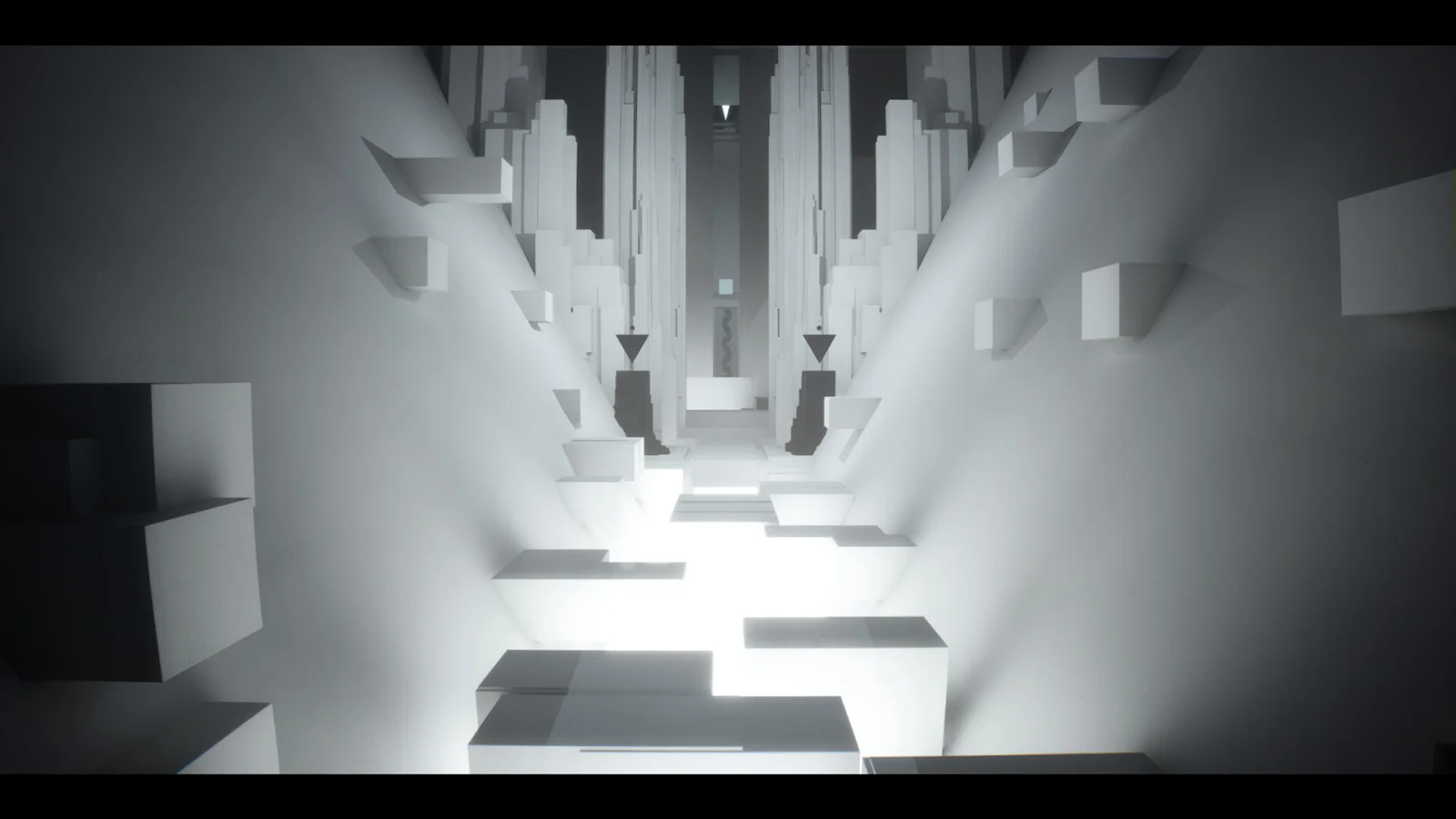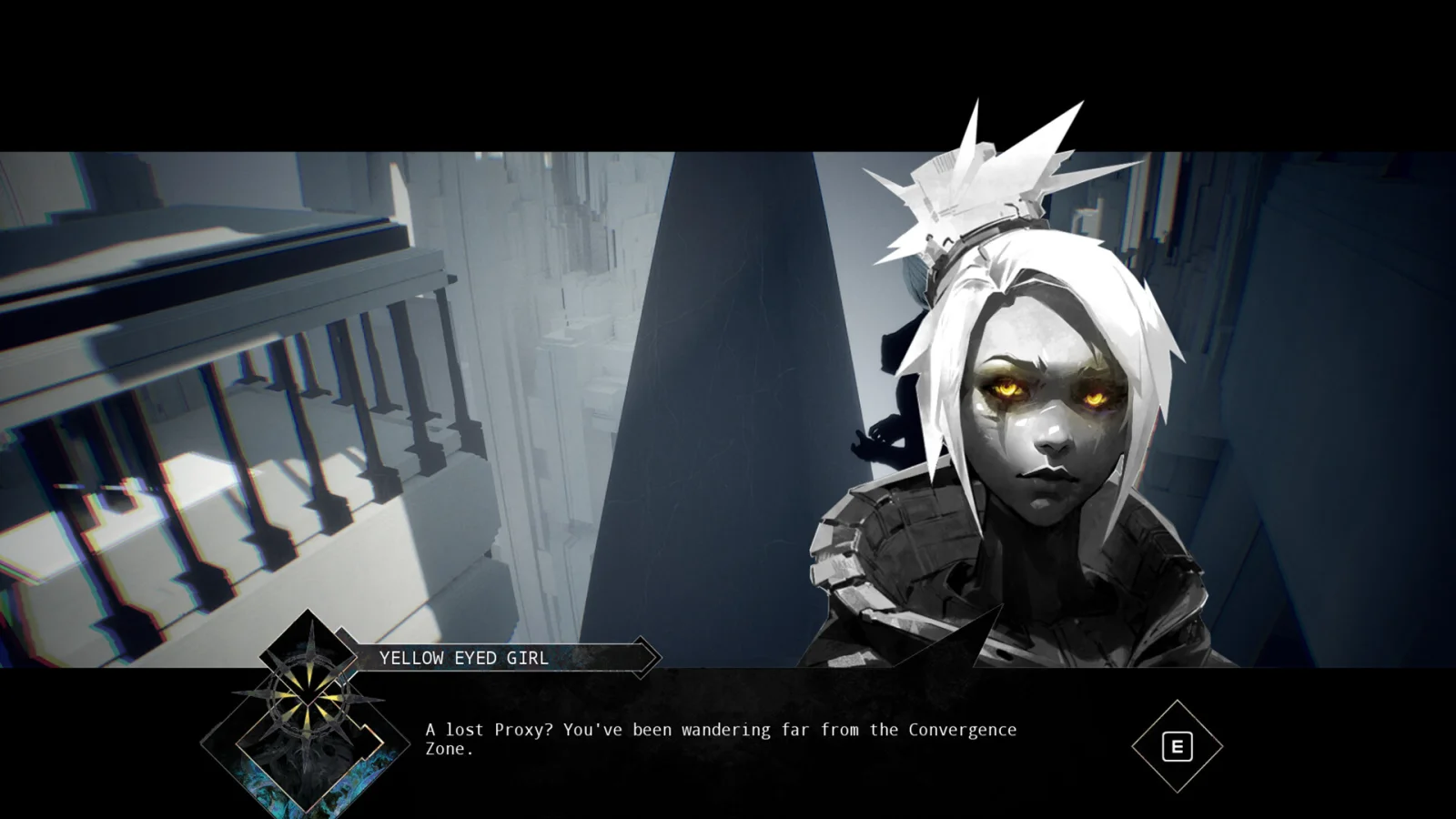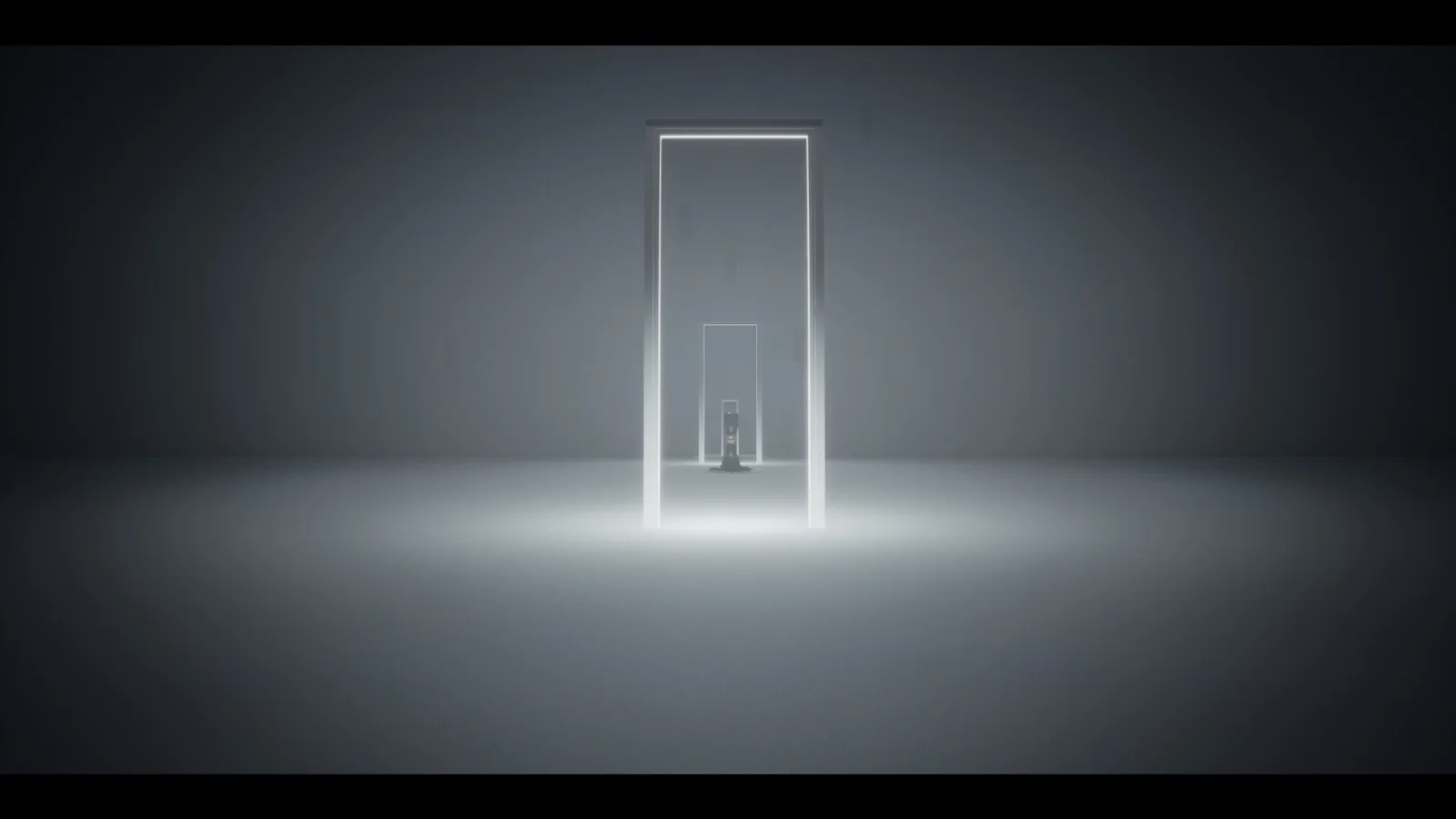
BLACKSHARD is a released first-person exploration game developed and published by Redlock Studio. Its setting is the Labyrinth, a strange megastructure defined in official materials by surreal, brutalist architecture and liminal spaces. The stated premise places the player inside that environment to explore it, encounter memoryshards left by predecessors, and shape the outcome through their behaviour.
This is a design spotlight, not a hands-on review. The discussion below draws on Redlock Studio’s stated features and does not claim personal testing of BLACKSHARD’s navigation, interaction, pacing, audiovisual implementation, or outcomes. That distinction matters especially for an exploration-led game: a premise can identify what a work intends to foreground, but only play can establish how effectively its spaces guide attention, how interaction feels in context, and whether its decisions carry satisfying weight.
Even so, BLACKSHARD has a notably focused identity. It is not presenting its architecture as a scenic stop between battles, or its environmental interaction as an excuse for unrestricted construction. Redlock Studio explicitly states that the game has no fighting, shooting, or building. The Labyrinth is therefore the central object of attention: a place to traverse, observe, interpret, alter, or leave intact.
Established facts: a semi-open first-person exploration game
The official description identifies BLACKSHARD as a first-person exploration game set in a semi-open world. That establishes a useful baseline without settling the many practical questions that term can contain. “Semi-open” does not, by itself, confirm a particular map scale, route structure, guidance system, progression model, or degree of revisiting. It does indicate that exploration of the Labyrinth is being positioned as more than a purely linear passage through a predetermined series of scenes.
First-person perspective is a natural match for an architecture-led premise because it places walls, thresholds, ceilings, empty rooms, and obstructed sightlines directly in the player’s field of view. In conditional design terms, that perspective can make a structure feel less like an image to inspect and more like a physical arrangement to read. The relationship between a passage and a chamber, or between a distant landmark and an immediate barrier, can become part of the experience of finding one’s way.
That possibility is particularly relevant to the official emphasis on brutalist and liminal spaces. Brutalist forms can suggest mass, repetition, utility, and institutional scale; liminal spaces can make ordinary architectural functions feel strangely detached from ordinary life. Neither label guarantees a successful environment, but together they point toward a Labyrinth meant to evoke uncertainty and close observation rather than familiarity or comfort.
The key question for a prospective exploration audience is not simply whether the setting looks unusual. It is whether unusual spaces sound appealing as the primary attraction. BLACKSHARD’s stated design asks players to take the Labyrinth seriously as a destination and subject, rather than treating it as a neutral container for combat encounters or a building loop.
No fighting, shooting, or building
Redlock Studio explicitly says BLACKSHARD contains no fighting, shooting, or building. This is more informative than a short list of exclusions might initially appear. It clarifies that environmental interaction should not be assumed to mean freeform construction, and that progress should not be assumed to depend on defeating enemies with weapons.
Those exclusions do not establish that BLACKSHARD has no tension, challenge, or pressure. They only identify systems the game is not using. Exploration can draw engagement from orientation, curiosity, restraint, interpretation, or the significance of a decision. In BLACKSHARD’s case, the stated ability to transform the Labyrinth or preserve it suggests that the central tension may be tied to a player’s relationship with the environment itself.
For players who want fights, shooting, or construction as a core activity, this is a clear expectation setter. For those more interested in atmosphere and spatial discovery, it makes the pitch easier to understand. BLACKSHARD is presenting attention as an active verb. The player is meant to investigate a place whose condition may matter, not simply move through it on the way to a familiar genre routine.
When navigation becomes interpretation
Navigation can become a form of narrative when spaces carry information. A route does not need to explain itself through direct exposition for a player to draw meaning from it. Repetition can imply routine or control; damage can imply abandonment or change; a sealed entry can make absence meaningful; a recurring architectural feature can help a location develop an identity. In the best cases, movement through a place becomes an accumulating act of interpretation.
BLACKSHARD’s announced ingredients could support that kind of reading. A labyrinthine megastructure is well suited to questions about purpose, history, and use. If the game’s eventual spaces give players clear enough distinctions to notice patterns and contrasts, the surreal presentation could encourage active observation rather than passive sightseeing. A player may begin asking what a room is, what it was for, and why it now feels unsettled.
There is also a genuine design balance to manage. Liminality gains power from incompleteness and dislocation, but an exploration game still benefits when players can develop some meaningful relationship with its geography. If every space is equally indistinct, mystery can turn into disconnection. If there are visual motifs, landmarks, changing conditions, or other readable differences, uncertainty can become productive: the player is not handed total certainty, but has reasons to look closer.
This is conditional analysis rather than a claim about BLACKSHARD’s implementation. The official feature set supports the question, not the answer. A semi-open structure and striking architecture may create memorable exploration, but neither quality follows automatically from a description. The more useful takeaway is that the game appears aimed at players willing to engage with uncertainty as part of the appeal.
Memoryshards and partial knowledge
BLACKSHARD includes memoryshards from predecessors. Official information does not establish what those shards contain, how they are discovered, whether they are optional, or how directly they explain the Labyrinth. It would be unsupported to turn that limited description into a detailed account of the game’s narrative structure.
Still, the concept has a strong thematic fit with the broader premise. A memoryshard suggests a fragment rather than a full archive. Predecessors suggest earlier presences whose traces remain available without necessarily becoming fully knowable. For an exploration game centered on a strange structure, that can make discovery feel less like collecting isolated rewards and more like assembling a provisional understanding of a place.
The effective version of that approach would not need to answer every question. In fact, unresolved elements may be part of what gives a labyrinth setting its pull. What matters is whether each fragment has a meaningful connection to observation, movement, or the player’s evolving understanding. Memory can enrich architecture when it changes how an area is read; architecture can enrich memory when a discovered fragment makes a location feel newly significant.
The opposite possibility is also worth noting as a criterion, not a criticism. If fragments are detached from the places in which they are encountered, they may not create a strong reason to keep investigating. Players drawn to environmental storytelling may therefore want to look for information or footage that clarifies the relationship between memoryshards and exploration before deciding whether BLACKSHARD suits their preferences.
Transforming or preserving the Labyrinth
BLACKSHARD’s most distinctive stated feature is the ability to interact with the environment in ways that can transform the Labyrinth or preserve it. The supplied official description does not detail the specific actions involved, how permanent changes are, how many possible outcomes exist, or what consequences follow from either direction. Those mechanics and narrative stakes should remain open rather than being filled in by assumption.
At the level of design analysis, though, the contrast between transformation and preservation is unusually rich. Games often frame change as simple progress: alter the world, remove the obstacle, and visibly advance. Preservation offers a competing value. It can ask whether intervention is always desirable, whether an existing state deserves protection, or whether restraint can be an intentional act rather than mere inaction.
That contrast could create an ethical question without requiring a conventional good-versus-evil structure. Altering the Labyrinth might be presented as useful, necessary, disruptive, or costly. Preserving it might communicate care, caution, continuity, or refusal. Those are possibilities, not confirmed outcomes. Their importance would depend on whether BLACKSHARD makes the distinction legible enough for players to understand what they are choosing and why it matters.
The most compelling version of this premise would make environmental interaction feel like interpretation. A player would not simply switch scenery between states, but consider what the Labyrinth is, what it has been, and what their intervention means. That is a high ambition, and this source-based spotlight cannot determine whether the released game realizes it. The premise nevertheless gives BLACKSHARD a more reflective center than a generic promise of environmental change.
Architecture, mood, and music
The soundtrack is credited to Alt236 and AL9000. No claim is made here about how the music functions during play, because official credits do not establish its timing, structure, or relationship to exploration. It is reasonable only to say that music is part of the title’s stated creative presentation.
As a matter of design possibility, music can be especially important in an exploration game built around liminal architecture. It may support mood by making a vast chamber feel solemn, uneasy, distant, or inviting. It can also potentially assist orientation if different areas, states, or discoveries receive distinct sonic treatment. Conversely, a score can prioritize continuity and atmosphere over directional clarity. Each approach could suit BLACKSHARD’s described setting, and neither should be treated as confirmed implementation.
The architecture carries a similar responsibility. Surrealism can invite players to reassess familiar forms, while brutalist materials and shapes can make a structure feel imposing or impersonal. The Labyrinth’s visual language may therefore be more than decorative. If its spaces provide meaningful contrasts, they could help turn the act of looking into part of the game’s central activity.
Who BLACKSHARD may suit
Based on its stated design, BLACKSHARD may appeal most to players who enjoy exploration as a process of observation and incomplete understanding. Its explicit lack of fighting, shooting, and building makes it a more specific proposition than a broad all-purpose adventure pitch. The draw is the prospect of encountering an unfamiliar place, finding traces of predecessors, and considering a relationship to that place through transformation or preservation.
Potential players may find a few taste questions useful. Does a surreal, brutalist megastructure sound compelling even without combat as the main source of activity? Does partial information feel intriguing rather than frustrating? Does the idea of environmental choices appeal when the exact stakes are not yet known? And are atmosphere and spatial interpretation enough to make a first-person exploration game worth seeking out?
Readers looking for another unscored piece centered on a game’s stated design can read our Woodo assessment.
Unscored outlook
BLACKSHARD has a coherent released-game premise on paper: first-person exploration inside a semi-open Labyrinth, memoryshards from predecessors, environmental interaction, and a choice between transformation and preservation. Redlock Studio’s explicit rejection of fighting, shooting, and building further clarifies that the game wants its architecture and player relationship to the environment to carry the experience.
Without firsthand play, this coverage cannot judge whether the Labyrinth is readable, whether memoryshards deepen discovery, whether environmental choices feel consequential, or whether the soundtrack and spaces work together in practice. What can be said is that BLACKSHARD’s stated ideas give exploration-minded players a clear set of reasons to investigate it: a strange place, fragmentary traces, and an environmental decision that may ask whether change is always the right answer.